

Short answer: PVC installation in Las Vegas requires adjustments for desert conditions. Solvent cement cures faster in extreme heat, giving you only 5–10 seconds of open time above 100°F. Outdoor PVC must be UV-protected with paint or insulation wrap, as unprotected pipe degrades within 2–3 years in direct southern Nevada sun.
PVC pipe is the backbone of residential drain, waste, and vent systems across the Las Vegas valley. We install thousands of feet of it every year — under slabs, through attics that hit 160°F in July, and along exterior walls taking direct UV for a decade straight. The material is forgiving if you work with it correctly, and ruthless if you cut corners. These are the PVC pipe installation tips we teach every apprentice before they touch a glue can on a Las Vegas job.
Key Takeaways
- PVC, CPVC, and ABS each have a specific job — using the wrong type causes code violations and premature failure in Las Vegas conditions.
- Desert heat accelerates solvent cement cure and shortens open time. You have roughly 5–10 seconds to seat a joint when ambient temperature exceeds 100°F.
- Outdoor PVC must be protected from UV exposure with paint, insulation wrap, or burial — unprotected pipe degrades visibly within 2–3 years in direct southern Nevada sun.
- Expansion and contraction across Las Vegas temperature swings (30°F winter nights to 115°F summer days) require proper support spacing and expansion loops on long runs.
- Most PVC failures we repair trace back to dry-fitting without marking, skipping primer, or not holding the joint long enough during assembly.

Choosing the right pipe: PVC vs CPVC vs ABS
These three plastics look similar on the shelf but serve different purposes with different temperature limits. Mixing them up is one of the most common DIY mistakes we see.
PVC (polyvinyl chloride) — White pipe for drain, waste, and vent (DWV) lines and cold-water pressure applications. Schedule 40 handles continuous temperatures up to 140°F and working pressures of 150–300 PSI depending on diameter. Standard for residential drains, irrigation, and pool plumbing across Clark County. Common DWV sizes: 1-1/2", 2", 3", and 4". Cost: $0.40–$1.50 per linear foot.
CPVC (chlorinated polyvinyl chloride) — Cream or yellow pipe, rated for hot-water distribution up to 200°F at 100 PSI. Used for residential hot and cold supply lines in 1/2" and 3/4" CTS. Requires its own dedicated primer and cement — PVC cement on CPVC creates a weak bond that fails under pressure. CPVC attic supply lines are common in Las Vegas homes built from the early 1990s through the mid-2000s. Cost: $0.50–$2.00 per linear foot.
ABS (acrylonitrile butadiene styrene) — Black pipe, used exclusively for DWV applications. ABS does not require primer — it bonds with ABS solvent cement alone. Some Las Vegas homes built in the 1980s and early 1990s used ABS drain lines. Clark County allows both PVC and ABS for DWV, but you cannot mix them without a listed transition fitting. Green glue on a PVC-to-ABS joint is a code violation.
The decision is straightforward: PVC for drains and vents, CPVC for hot and cold supply lines if you are using plastic, and ABS only when tying into an existing ABS system. For new water supply, PEX has largely replaced CPVC in Las Vegas due to flexibility and faster installation — but CPVC repair remains a daily part of our plumbing calls.
Solvent cementing in desert heat
Solvent cement is not glue — it chemically melts the pipe and fitting surfaces, fusing them into one piece when the solvent evaporates. Desert heat accelerates evaporation dramatically. A joint that gives you 15–20 seconds of open time at 70°F gives you 5–10 seconds at 110°F on a Las Vegas rooftop.
Step 1 — Cut square. Use a ratcheting PVC cutter for pipe up to 2". For 3" and 4", use a miter saw with a fine-tooth blade. An angled cut reduces bonding surface and creates a stress riser.
Step 2 — Deburr and chamfer. Remove all burrs with a deburring tool or utility knife. Chamfer the outside edge at roughly 15 degrees — this prevents the pipe from scraping cement off the fitting socket during insertion.
Step 3 — Dry-fit and mark. Push the pipe into the fitting dry. Mark a reference line across the joint with a Sharpie so you know the pipe is fully seated during real assembly. Skip this and you are guessing on depth.
Step 4 — Prime both surfaces. Apply purple primer to the pipe end and the inside of the fitting socket. Primer softens the PVC surface for a chemical weld. In Las Vegas, primer evaporates fast — apply it and move immediately to cement. On days above 100°F, prime and cement one joint at a time. Do not prime three fittings ahead.
Step 5 — Apply cement and assemble. Cement the pipe first, then the fitting socket. Insert with a quarter-turn twist and hold 15–30 seconds. The twist distributes cement and prevents pushback. In extreme heat, hold longer — zero joint strength for the first 30 seconds.
Cure time in Las Vegas conditions: At 100°F+ ambient, initial set occurs in 1–2 minutes. For 1-1/2" Schedule 40 PVC with humidity below 20%, allow 30 minutes before running water and 2 hours before pressure testing. Larger diameters and CPVC require longer. Check the manufacturer's temperature-adjusted cure chart — Oatey, Weld-On, and Christy's all publish them.
Hot weather tip: Keep cement and primer cans in a cooler (shaded, not on ice) when working outdoors in summer. Cement that has been in a 130°F truck bed thickens and loses solvent content. If it has turned to gel or pulls stringy from the dauber, throw it away.
Expansion and contraction in Las Vegas temperature swings
PVC moves roughly 3.5 inches per 100 feet for every 100°F temperature change. Las Vegas swings 40–50 degrees in a single day during spring and fall — that translates to nearly 2 inches of movement on a 100-foot run.
Inside conditioned spaces, this rarely matters. But exposed PVC in attics, garages, and exterior runs must accommodate movement or fittings crack. We see pulled joints every winter on irrigation lines that were strapped too tightly.
Support spacing. Clark County follows UPC hanger spacing: every 4 feet for horizontal runs of 1-1/2" and larger PVC. For pipe exposed to temperature swings, use supports that let pipe slide — J-hooks or loose straps, not tight two-hole clamps. Anchor at one fitting and let the pipe float through remaining supports.
Expansion loops. On exterior runs exceeding 30 feet, install a U-shaped expansion loop using four 90-degree elbows and a short straight section. This absorbs 1–2 inches of movement. Standard practice on Las Vegas commercial rooftop condensate drains — same principle applies to residential exterior runs.
UV protection for outdoor PVC runs
UV radiation breaks down PVC at the molecular level. In Las Vegas — over 300 days of sunshine, UV index regularly hitting 10–11 from May through September — unprotected pipe becomes chalky and brittle within 2–3 years. Manufacturers do not rate PVC for long-term UV exposure. Any exposed exterior run needs protection.
Option 1 — Latex paint. Two coats of exterior latex (white or light color) blocks UV and costs almost nothing. Reapply every 3–5 years.
Option 2 — UV-rated pipe insulation. Foam insulation with a UV-resistant jacket (Armaflex or similar) protects and insulates. Preferred for CPVC hot water lines and AC condensate drains on exterior walls.
Option 3 — Burial. Bury irrigation lines a minimum of 12 inches deep (18 inches is better in Las Vegas, where desert soil compacts hard and shallow lines get hit by landscape work). Zero UV, minimal temperature swings.
Common PVC installation mistakes
These are the failures we see repeatedly on Las Vegas service calls — both on DIY work and on poorly supervised new construction.
Wrong cement. PVC cement on a CPVC joint holds during testing but fails under thermal cycling. We have cut out entire CPVC attic supply systems assembled with white PVC cement — every joint leaking within 18 months. Always match cement to pipe material.
Skipping primer. Clark County requires purple primer on all PVC and CPVC joints — inspectors check for the staining. Primer softens the surface for a chemical weld. Without it, the joint relies on surface adhesion and fails under thermal cycling.
Not holding the joint. PVC pipe wants to push back out of the fitting socket after insertion. Walk away without holding for 15–30 seconds and the pipe creeps back 1/8" to 1/4" before the cement tacks. That gap is a future leak.
Running water too soon. The joint may feel solid, but the chemical weld is not complete. In Las Vegas heat, wait a minimum of 30 minutes for DWV and 2 hours for pressure applications. Rushing this step turns a permanent repair into a callback.
When to use something other than PVC
PVC is versatile, but it is not always the right call. Here is when to reach for something else.
Hot water supply: use CPVC or PEX. PVC is rated to 140°F. Water heaters can produce 150°F+ at the outlet — PVC on a hot line softens, deforms, and fails. CPVC and PEX both handle 200°F. For new supply work, PEX with expansion fittings is the current Las Vegas standard.
Natural gas lines: black steel, CSST, or PE only. PVC is never acceptable for gas. We have seen homeowners attempt it — serious safety hazard and an immediate code violation.
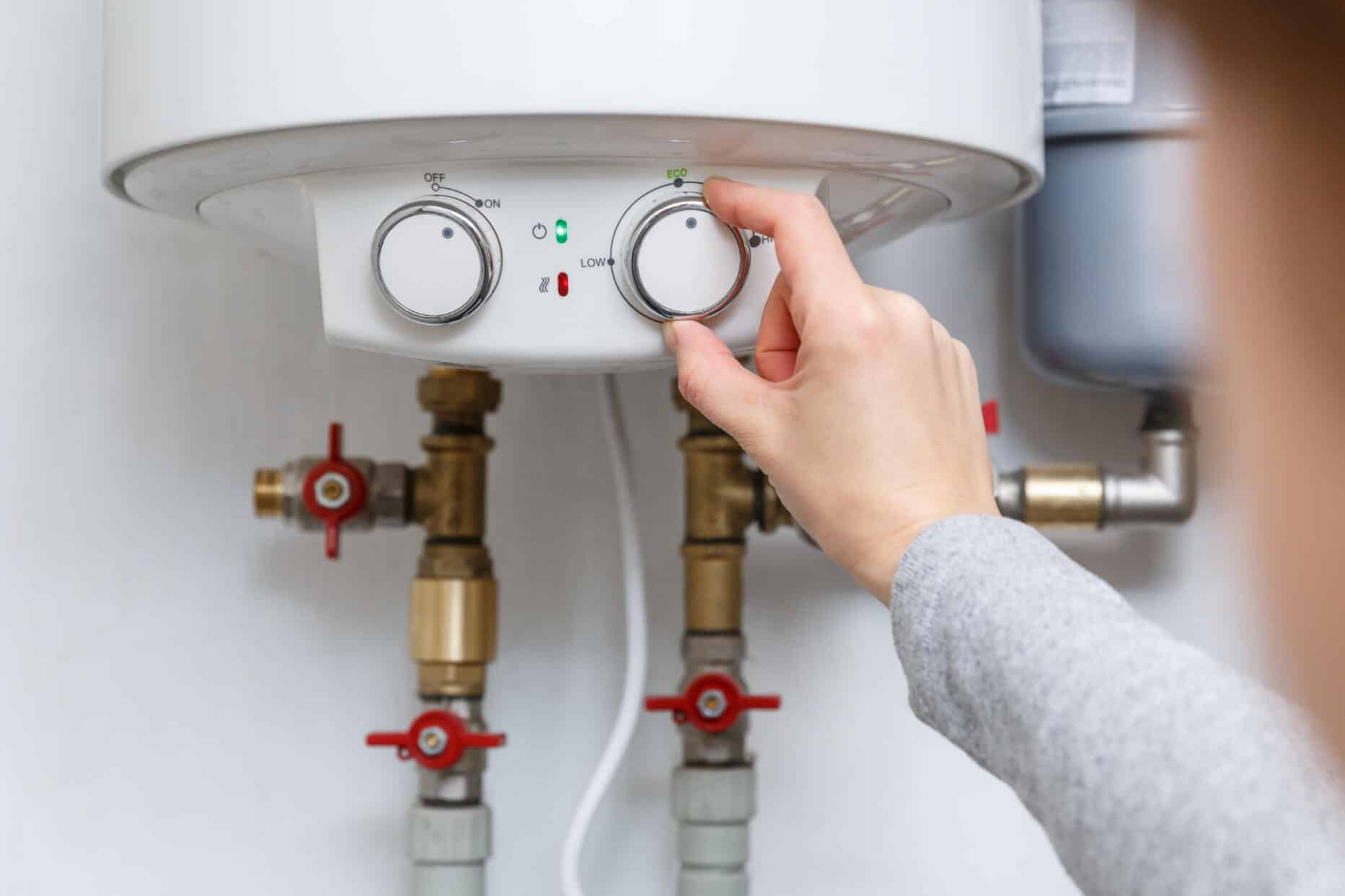
Within 6 inches of a water heater: copper or approved connectors. Code requires metallic connections at the heater. No plastic pipe should connect directly. Use copper stubs, braided stainless connectors, or dielectric unions as the transition.
High-temperature drains: cast iron or CPVC DWV. Commercial kitchen drains, dishwasher discharge lines, and any drain regularly above 140°F should not use PVC. Cast iron is the standard solution.
Frequently Asked Questions
How long does PVC cement need to cure in Las Vegas summer heat?
At temperatures above 100°F with low humidity, initial set happens in 1–2 minutes, but wait at least 30 minutes before running water through DWV joints and 2 hours before pressure testing supply lines. Larger diameters and CPVC require longer. Check the manufacturer's temperature-adjusted cure chart on the can or product data sheet.
Can I use PVC pipe outdoors in Las Vegas without any protection?
Not long-term. UV radiation here is extreme — the index hits 10–11 from May through September. Unprotected PVC becomes chalky and brittle within 2–3 years. Protect it with two coats of exterior latex paint, UV-rated foam insulation, or burial at least 12 inches deep.
What is the difference between PVC and CPVC, and when do I need CPVC?
PVC (white) handles up to 140°F — drains, vents, and cold-water applications. CPVC (cream or yellow) handles 200°F at 100 PSI and is approved for hot and cold supply lines. Any pipe carrying water above 140°F requires CPVC or PEX. The two require different solvent cements — using PVC cement on CPVC creates a weak bond that fails under thermal cycling.
Do I need to use purple primer on PVC joints in Las Vegas?
Yes. Clark County requires primer on all PVC and CPVC joints, and inspectors look for purple staining. Primer softens the pipe surface so cement achieves a true chemical weld. Without it, the joint relies on surface adhesion and is more likely to fail under the thermal cycling Las Vegas attics and exterior runs deliver.
Why is my PVC pipe cracking at the fittings in winter?
PVC moves roughly 3.5 inches per 100 feet for every 100°F temperature change. If supports clamp the pipe too tightly, thermal contraction during cold winter nights (low 30s in Las Vegas) pulls directly on cemented fittings. The fix: anchor at one fitting and use loose supports elsewhere. On runs over 30 feet, install an expansion loop. Cracked fittings must be cut out and replaced.
Need plumbing help in Las Vegas?
The Cooling Company is a licensed plumbing and HVAC contractor serving Las Vegas, Henderson, and North Las Vegas. Failed PVC joint, repipe, or new plumbing run — our technicians handle it. Call (702) 567-0707 to schedule, or visit our plumbing services, water heater repair, or maintenance plans pages. Upfront pricing, no surprises.