


Short answer: In Las Vegas, roughly 30-40% of homeowners replacing their AC should also address ductwork — whether that means sealing, partial repair, or full replacement. Homes with ducts older than 20 years, visible attic damage, or measured energy losses exceeding 20% will see the fastest payback from bundling. AC replacement alone runs $5,200-$13,800. AC plus full ductwork replacement runs $8,700-$22,300. The energy savings from sealed or new ducts — typically a 15-25% reduction in cooling costs — often cover the additional ductwork expense within 3-5 years. A duct blaster test (included in most Cooling Company quotes) tells you exactly where you stand. Call (702) 567-0707 to schedule a no-obligation assessment of both your AC and your ductwork.
Key Takeaways
- 30-40% of Las Vegas AC replacements should include ductwork work — either sealing, partial repair, or full replacement. The remaining 60-70% have ducts in good enough condition that AC-only replacement is the smarter financial move.
- A brand-new 20 SEER2 AC loses 20-30% of its cooling capacity through leaky ducts before conditioned air reaches your rooms. You pay for premium efficiency but receive budget performance. Fixing ducts unlocks the efficiency you already bought.
- AC replacement alone costs $5,200-$13,800 depending on system size, efficiency tier, and installation complexity. Adding full ductwork replacement brings the total to $8,700-$22,300. Duct sealing alone adds $800-$2,500.
- The energy savings payback for new ductwork is 3-5 years in Las Vegas because our AC systems run 2,400-3,000 hours per year — nearly triple the national average. Every percentage point of duct leakage costs more here than anywhere else.
- Las Vegas attics reach 140-160 degrees in summer, which accelerates flex duct degradation, loosens connections, compresses insulation, and creates the conditions for duct failure faster than homes in mild climates.
- A duct blaster test gives you the answer in 30 minutes. If leakage is under 10%, sealing alone is usually sufficient. Between 10-20%, targeted repairs make sense. Over 20%, full replacement typically delivers better long-term value.
- NV Energy PowerShift rebates of $150-$400 for duct sealing are available when performed alongside a qualifying system replacement — stackable with AC or heat pump rebates of $300-$2,000.
- 0% APR financing for up to 120 months makes the bundled approach affordable — the monthly energy savings from new ducts often exceed the incremental monthly payment, making the upgrade cash-flow positive from day one.
Why Ductwork Matters More Than You Think
In most parts of the country, ductwork is a secondary concern. Ducts run through basements and crawl spaces where ambient temperatures are 60-80 degrees year-round. Leaks matter, but they do not transform the economics of a system.
Las Vegas is different. Your ducts almost certainly run through your attic. And your attic, from May through October, is one of the most hostile environments for ductwork on the planet.
During July and August, attic temperatures in Las Vegas routinely hit 140-160 degrees. Your AC is pushing 55-degree air through ducts surrounded by air that is 100 degrees hotter. Every gap, every loose connection, every spot where insulation has compressed or fallen away becomes a thermal hemorrhage. The ductwork is not just leaking air — it is absorbing heat from the attic and delivering warm air to your rooms.
Here is what that looks like in practice. A homeowner installs a brand-new Lennox XC21 — a 21 SEER2 variable-speed system, one of the most efficient residential AC units available. On paper, this system should deliver transformational energy savings compared to the 10-year-old 13 SEER unit it replaced. But the ducts are original from a 2002 build. The flex duct has sagged at three connection points. Insulation has compressed to half its original thickness on the trunk lines. Two boot connections have pulled loose at the supply plenum.
The result: that 21 SEER2 system delivers effective efficiency closer to 14-15 SEER. The homeowner paid a premium for top-tier equipment and received mid-tier performance. The 20-30% of conditioned air lost through duct defects translates to $600-$1,200 per year in wasted energy — every year, for the life of the system.
This is not a theoretical problem. It is the most common installation outcome we see when ductwork is not evaluated as part of an AC replacement project. The Department of Energy estimates that the average home loses 20-30% of conditioned air through duct system defects, and Las Vegas homes with attic ductwork tend to fall at the higher end of that range.

10 Signs Your Ductwork Needs Replacement
Not every ductwork system needs replacing when you get a new AC. Many are in perfectly serviceable condition and simply need minor sealing. The following signs, however, indicate that your ducts are likely past the point where sealing alone will solve the problem. The more signs you identify, the stronger the case for replacement.
1. Uneven room temperatures
The classic symptom: your downstairs is comfortable but your upstairs bedrooms are 5-10 degrees warmer, even with the AC running continuously. In Las Vegas two-story homes, this often indicates duct leakage or insulation failure on the longer attic runs that serve second-floor rooms. The farther air has to travel through a hot attic in compromised ducts, the more heat it absorbs.
2. Visible duct damage in the attic
If you can safely access your attic (early morning only — never enter a Las Vegas attic after 10 AM in summer), look for crushed sections, disconnected joints, sagging flex duct that has pulled away from hangers, or duct runs lying directly on ceiling joists instead of properly suspended. Any visible damage means there is almost certainly hidden damage you cannot see.
3. Excessive dust from supply vents
When ducts leak, they create negative pressure zones that pull attic air — along with insulation particles, dust, and debris — into the duct system. If you notice unusual amounts of dust on furniture near supply vents, or if dust appears shortly after changing your filter, duct leaks are a primary suspect. This is not just an efficiency problem — it is an indoor air quality issue.
4. High energy bills despite new or well-maintained AC
If you have replaced or serviced your AC recently and your NV Energy bills remain stubbornly high during summer months, the ductwork is the next place to investigate. A well-functioning AC paired with compromised ducts will run longer cycles, consume more electricity, and deliver less comfort than an older AC with airtight ducts. Read more about what high-efficiency AC systems actually save.
5. Ductwork older than 20 years
Flex duct — the silver or gray insulated tubing used in most Las Vegas residential construction since the 1980s — has a practical lifespan of 20-25 years under normal conditions. In Las Vegas attic conditions, that lifespan is often closer to 15-20 years. If your home was built before 2006, your ductwork is now at or past its expected service life. The plastic inner liner becomes brittle, the insulation compresses, and joints that were originally sealed with tape or mastic begin to fail.
6. Flex duct with compressed or missing insulation
Duct insulation in Las Vegas needs to be R-6 or higher to prevent heat gain from attic temperatures. Over time, insulation compresses under its own weight, particularly on horizontal runs. When the insulation between the inner liner and the outer jacket compresses from 2 inches to less than an inch, the duct's thermal performance drops dramatically. If you can see the inner liner through the insulation, or if sections feel thin when you squeeze them, the insulation has failed.
7. Mold or musty smells from supply vents
During monsoon season (July-September), Las Vegas sees humidity spikes that can cause condensation on cold duct surfaces — particularly where insulation has failed. This moisture creates conditions for mold growth inside the duct system. If you notice musty odors when your AC cycles on, or if a visual inspection reveals dark spots or discoloration on duct surfaces, remediation is necessary and replacement is often more cost-effective than cleaning and repairing.
8. Whistling or rattling sounds from ducts
Whistling sounds typically indicate air passing through a restriction — a crimped duct, a partially collapsed section, or a gap at a joint. Rattling or popping sounds often mean the duct is expanding and contracting with temperature changes (thermal cycling). Both are signs of structural compromise. Minor sounds may respond to targeted repair, but widespread noise from multiple locations suggests systemic deterioration.
9. Duct blaster test showing greater than 15% leakage
This is the definitive diagnostic. A duct blaster test pressurizes your duct system and measures exactly how much air escapes before reaching your living spaces. Industry standards consider anything under 6% to be tight, 6-10% to be acceptable, 10-15% to be moderate leakage, and anything over 15% to be significant. In Las Vegas, where every percentage point of leakage costs more due to the extreme temperature differential between attic air and conditioned air, we recommend action at 12-15% and replacement consideration above 20%.
10. Rodent or pest damage in attic runs
Las Vegas attics attract roof rats, mice, and occasionally other pests that chew through flex duct outer jackets, nest in insulation, and compromise the entire duct system. If a duct inspection reveals pest damage at any point in the system, a thorough evaluation of the full duct network is essential — visible damage is usually only a fraction of total damage.
AC Only vs. AC + Ductwork: Complete Cost Comparison
The biggest objection to bundling ductwork with an AC replacement is cost. And it is a legitimate concern — adding $3,500-$8,500 in ductwork to an already significant AC investment is not a small decision. But the cost analysis changes completely when you factor in energy savings, system lifespan, and comfort outcomes.
The following table shows the full picture for a typical Las Vegas single-family home (2,000-2,400 sq ft, single-story or two-story, ducts in the attic).
| Scenario | Cost Range | Energy Savings vs. Old System | Payback Period for Duct Work |
|---|---|---|---|
| AC replacement only (existing ducts in good condition) | $5,200-$13,800 | 20-40% vs. old AC | N/A (no duct expense) |
| AC replacement + duct sealing | $6,000-$15,500 | 30-50% vs. old AC + leaky ducts | 2-3 years for sealing cost |
| AC replacement + full duct replacement | $8,700-$22,300 | 40-60% vs. old system | 4-6 years for duct cost |
Here is how the ductwork costs break down independently:
| Ductwork Service | Cost Range | What It Includes |
|---|---|---|
| Duct sealing | $800-$2,500 | Mastic sealant or aerosol sealant at all joints, connections, and penetrations |
| Duct sealing (per linear foot) | $8-$15/ft | Mastic application, joint tape, boot sealing |
| Partial duct repair/replacement | $1,500-$4,500 | Replacing damaged sections, re-insulating exposed runs, reconnecting loose boots |
| Full duct replacement | $3,500-$8,500 | Complete removal and installation of new duct system (flex or rigid) |
| Full duct replacement (per linear foot) | $35-$65/ft | Material, labor, insulation, hangers, sealing, testing |
The critical insight is the payback column. In Las Vegas, the extreme attic temperatures mean that duct defects cost more per year than they would in milder climates. A 20% duct leakage rate that costs a homeowner in Portland $300 per year costs a Las Vegas homeowner $700-$1,000 per year — because our AC runs nearly three times as many hours. That accelerated cost makes the ductwork investment pay back faster here than almost anywhere in the country.
For detailed pricing on AC installation or AC replacement, see our dedicated service pages. For comprehensive pricing breakdowns, read our AC replacement cost guide for 2026.
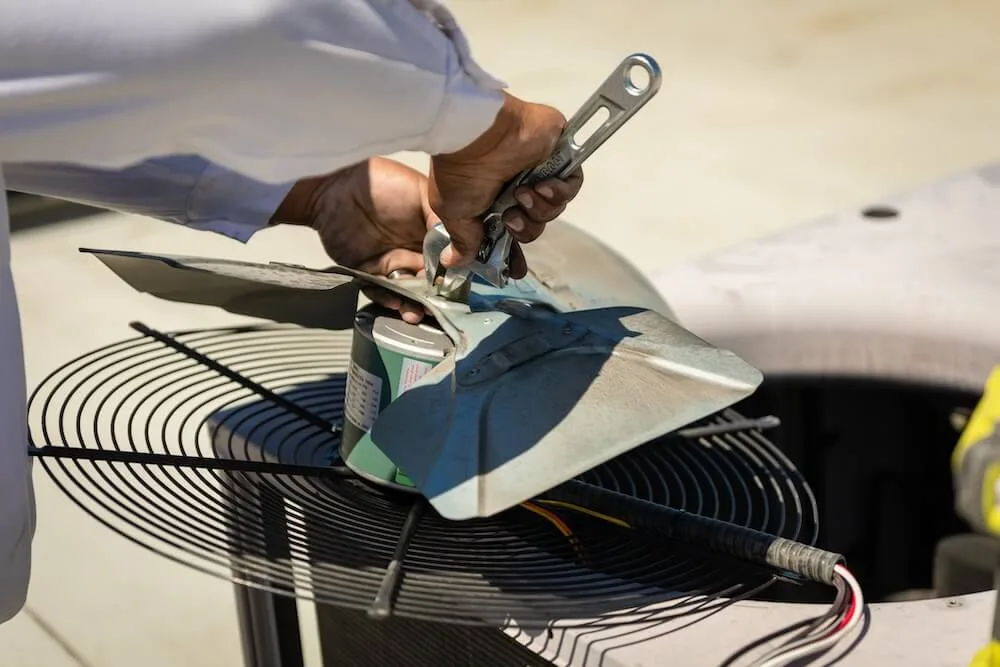
The Las Vegas Attic Problem: Why Desert Heat Destroys Ductwork Faster
If you lived in Minneapolis, your ducts would probably last 30 years or more. Basements stay a comfortable 55-65 degrees year-round, nothing is UV-exposed, and temperature swings are modest. Las Vegas attics are the opposite environment in every measurable way.
Extreme sustained heat
Attic temperatures of 140-160 degrees are not occasional peaks — they are the daily baseline from June through September. This sustained thermal load accelerates the aging of every duct component. Flex duct inner liners (typically polyethylene or metalized polyester) become brittle over time when continuously exposed to temperatures above their rated service range. The adhesives used in factory joints weaken. The wire helix that maintains duct shape fatigues through thermal expansion and contraction cycles.
UV exposure through roof vents and gaps
Las Vegas homes have ridge vents, soffit vents, or gable vents to promote attic air circulation. These vents allow indirect UV radiation into the attic space. While flex duct outer jackets are designed to resist UV degradation, 15-20 years of continuous exposure — combined with the heat — breaks down the outer jacket material. When the outer jacket fails, the insulation inside is exposed to hot attic air and begins to deteriorate rapidly.
Thermal cycling loosens connections
Every day, your attic experiences a 50-70 degree temperature swing — from 90-100 degrees at dawn to 150-160 degrees by midafternoon. This daily expansion and contraction cycle, repeated 200+ times per year, gradually loosens mechanical connections. Duct connections to boots, registers, and the plenum are designed for stable environments. In a Las Vegas attic, they are subjected to forces they were never engineered to handle.
Dust infiltration through gaps
Las Vegas sits in the Mojave Desert. Fine particulate dust is constant, and every gap in your ductwork becomes an entry point. Attic air carries this dust directly into your duct system, where it accumulates on interior surfaces, reduces airflow, and deposits on your evaporator coil. This reduces both system efficiency and indoor air quality, and it accelerates wear on blower motors that have to work harder to push air through increasingly restricted passages.
Monsoon humidity causes condensation
From July through September, monsoon season brings humidity spikes that can push relative humidity above 40-50% — unusual for Las Vegas. When humid attic air contacts cold duct surfaces (particularly on the supply side where 55-degree air flows), condensation forms. On properly insulated ducts, this is minimal. On ducts with compressed or damaged insulation, condensation can be significant enough to cause water damage to ceiling drywall, promote mold growth inside the duct, and accelerate corrosion at metal fittings.
Most Las Vegas homes are past the inflection point
Here is the timeline that matters: the Las Vegas housing boom ran from roughly 1990 through 2008. During this period, the vast majority of homes in Summerlin, Henderson, North Las Vegas, Green Valley, Enterprise, and surrounding communities were built. The flex duct installed in these homes was typically rated for 20-25 years of service life. That means homes built before 2006 are now at or past the expected lifespan of their ductwork — and homes built before 2001 are well past it.
This does not mean every duct system from that era needs replacement. But it does mean that any homeowner replacing an AC in a pre-2006 home should have their ductwork professionally evaluated as part of the project. The cost of the evaluation is trivial compared to the cost of installing a premium AC system on a duct system that cannot deliver the air.
When You Do NOT Need New Ductwork
We are an HVAC company, and we install ductwork. It would be easy — and dishonest — to recommend duct replacement on every AC project. We do not do that, and here is why: recommending unnecessary work erodes trust, and trust is the only competitive advantage that lasts. Our 4.9-star rating across 740+ reviews exists because we tell homeowners the truth, even when the truth means a smaller sale.
Here are the conditions under which you almost certainly do NOT need new ductwork:
Ducts less than 15 years old and in good condition
If your home was built in 2011 or later, and you have not experienced pest damage, water intrusion, or construction work that disturbed the duct runs, your ductwork is likely in perfectly serviceable condition. A visual inspection can confirm this. Save your money for the AC itself and allocate toward a higher-efficiency unit.
Duct blaster test showing less than 10% leakage
Numbers do not lie. If a calibrated duct blaster test shows your system leakage is under 10% of total airflow, your ducts are performing within acceptable parameters. Minor sealing at identified leak points ($200-$600) may be worthwhile, but full replacement would be over-investing.
No visible damage or disconnections
If an attic inspection shows all duct runs are properly suspended, insulation is intact and at full thickness, connections are secure at boots and the plenum, and there are no signs of pest activity, sagging, or crushing — your ducts are doing their job.
Even temperatures throughout the home
The simplest test a homeowner can do is measure room temperatures. If all rooms are within 2-3 degrees of each other when the AC is running, your duct system is distributing air effectively. Significant temperature differentials (5+ degrees between rooms) suggest distribution problems that may originate in the ductwork.
Same system size with no upsizing needed
If your new AC is the same tonnage as the old unit, the existing ductwork was sized appropriately. If the new system requires upsizing (for example, going from 3 tons to 4 tons due to a home addition or correcting a previous undersizing), the existing duct may be undersized for the new airflow requirements. This is the one scenario where even good-condition ducts may need modification.
Duct sealing alone may solve the problem
This is the most important point in this section. Duct sealing — applying mastic sealant or aerosol sealant to joints, connections, and penetrations — costs $800-$2,500 for a whole-house application. Full duct replacement costs $3,500-$8,500. If your duct system is structurally sound but has developed leaks at joints and connections over time, sealing is the right answer and replacement would be wasteful. A good contractor distinguishes between the two based on diagnostic data, not sales targets.
If you are unsure whether your situation calls for repair or replacement, our team can walk you through the diagnostic results and help you make the most cost-effective decision.
The Duct Blaster Test: What It Is and Why You Need One
A duct blaster test is to your ductwork what a blood pressure reading is to your cardiovascular system — it gives you a single, objective number that tells you whether your ducts are healthy or compromised. No guesswork, no subjective assessment, just measured airflow and calculated leakage.
How the test works
A technician seals all supply and return registers in your home with temporary covers. A calibrated fan (the "duct blaster") is connected to one register opening and pressurizes the duct system to a standard test pressure, typically 25 Pascals. The fan measures how much air it has to push into the system to maintain that pressure. The more air it takes, the more leakage your system has.
What the numbers mean
| Leakage Rate | Rating | Recommendation |
|---|---|---|
| Under 6% | Tight | No action needed. Your ducts are performing well. |
| 6-10% | Acceptable | Minor sealing at identified leak points may be worthwhile ($200-$600). |
| 10-15% | Moderate leakage | Professional sealing recommended ($800-$2,500). Cost-effective improvement. |
| 15-20% | Significant leakage | Sealing plus targeted repairs. Evaluate whether full replacement is more cost-effective. |
| Over 20% | Severe leakage | Full duct replacement typically delivers better long-term value than extensive repairs. |
Cost and availability
A standalone duct blaster test typically costs $150-$300 from an HVAC contractor. At The Cooling Company, we include duct blaster testing as part of our AC replacement evaluation at no additional cost. We want you to have the data before you make the decision — because the data almost always leads to the right decision.
The test takes approximately 30 minutes and requires access to all registers and the attic space. Results are available immediately. If you want the test performed independently of an AC replacement project, schedule a duct inspection and request the duct blaster diagnostic.
Real Las Vegas Case Studies
Theory is helpful. Real outcomes are better. Here are three recent projects that illustrate the range of ductwork decisions Las Vegas homeowners face. Names and exact addresses are withheld for privacy, but all details are drawn from actual completed installations.
Case 1: Summerlin home — AC + duct sealing
Home: 2,200 sq ft single-story, built 2004. Original 3.5-ton Carrier system, 13 SEER.
Duct condition: Flex duct, original from 2004 build. Duct blaster test showed 17% leakage — significant but not catastrophic. Most leakage concentrated at supply plenum connections and three boot connections that had pulled loose. Insulation was compressed to approximately 60% of original thickness on main trunk runs but still functional. No pest damage, no mold, no structural collapse.
Decision: AC replacement with comprehensive duct sealing. Replaced all boot connections with new sheet-metal takeoffs, sealed the supply plenum with mastic, and applied aerosol sealant to the entire flex duct system. Did not replace the flex duct itself — it was structurally sound.
Cost: $9,200 total ($7,400 for 3-ton 16 SEER2 Lennox system + $1,800 for comprehensive duct sealing).
Result: Post-sealing duct blaster test showed 7% leakage — within acceptable range. Summer NV Energy bills dropped by approximately $180/month compared to the previous year. At that savings rate, the $1,800 duct sealing investment pays for itself in less than one summer season.
Case 2: Henderson home — AC + full duct replacement
Home: 2,800 sq ft two-story, built 1998. Original 4-ton Trane system, 10 SEER.
Duct condition: Flex duct, original from 1998 build — 28 years old, well past any reasonable service life. Duct blaster test showed 26% leakage. Multiple disconnected joints in the attic. Insulation was compressed to less than half an inch in several locations. Evidence of previous rodent activity (chewing on outer jacket, nesting material in one branch run). Second floor was consistently 6-8 degrees warmer than the first floor despite the system running continuously.
Decision: AC replacement with full duct replacement. Removed all existing flex duct and installed a new R-8 insulated flex duct system with sheet-metal trunk lines, new supply plenum, new boots, and all connections sealed with mastic.
Cost: $16,500 total ($9,800 for 4-ton 17 SEER2 Lennox system + $6,700 for complete duct replacement).
Result: Post-installation duct blaster test showed 4% leakage — tight. The chronic hot-upstairs problem was eliminated — temperature differential between floors dropped from 6-8 degrees to 1-2 degrees. Summer energy bills dropped by approximately $240/month compared to the previous system. The $6,700 duct investment pays for itself in approximately 28 months at that savings rate, and the homeowners gained comfort they had not experienced in years.
Case 3: Paradise home — AC only, no duct work needed
Home: 1,800 sq ft single-story, built 2008. AC system was 14 SEER Lennox, replaced due to compressor failure at age 18.
Duct condition: Flex duct, original from 2008 build — 18 years old. Duct blaster test showed 8% leakage. All connections were secure. Insulation was at approximately 80% of original thickness. No pest damage. No visible deterioration. Temperatures were even throughout the home when the old system was functioning.
Decision: AC replacement only. Sealed two minor leak points identified during the duct blaster test ($0 — included in the installation). Did not recommend any additional ductwork services.
Cost: $7,900 for a 3-ton 16 SEER2 Lennox system. No duct expense.
Result: The homeowner received the full efficiency benefit of the new system without spending an additional $3,500-$6,000 on ductwork that did not need replacing. Smart money saved. We expect the existing ducts to remain serviceable for another 5-7 years, at which point a re-evaluation would be appropriate.
Three homes, three different duct conditions, three different decisions. The diagnostic data — not a sales target — drove every recommendation.

Financing the Bundle: Making the Math Work Monthly
The total cost of an AC + duct replacement bundle ($8,700-$22,300) can feel overwhelming as a single number. But the monthly payment math tells a very different story, especially with 0% APR financing for up to 120 months.
| Project | Total Cost | Monthly Payment (60 months, 0% APR) | Monthly Payment (120 months, 0% APR) | Estimated Monthly Energy Savings |
|---|---|---|---|---|
| AC only (16 SEER2, 3-ton) | $7,400 | $123 | $62 | $80-$130 |
| AC + duct sealing | $9,200 | $153 | $77 | $120-$180 |
| AC + full duct replacement | $14,500 | $242 | $121 | $160-$240 |
Look at the AC + duct sealing row at 120 months: $77 per month in payments against $120-$180 per month in energy savings. The upgrade is cash-flow positive from month one. Even the full duct replacement scenario, at $121 per month against $160-$240 in savings, is often a net positive — meaning you spend less per month after the upgrade than you did before it.
This is the financial case that changes minds: the bundled approach does not just deliver better comfort and better air quality — it can actually reduce your total monthly housing costs when financed at 0% APR. The key is that Las Vegas energy costs are so high during summer months that efficiency improvements translate into savings large enough to offset equipment payments.
To explore financing options tailored to your project, request a free quote and our team will present the monthly payment scenarios alongside the projected energy savings for your specific home.
NV Energy Rebates for Ductwork and AC Bundles
NV Energy's PowerShift program offers rebates that can meaningfully reduce the net cost of an AC + ductwork project. These rebates are available to residential NV Energy customers and apply to qualifying installations performed by licensed contractors.
Available rebates (2026)
| Measure | Rebate Amount | Requirements |
|---|---|---|
| Duct sealing (with qualifying system replacement) | $150-$400 | Must be performed in conjunction with a qualifying AC or heat pump installation. Requires post-sealing duct blaster verification. |
| High-efficiency AC installation | $300-$1,200 | 16+ SEER2 central air conditioner. Higher rebates for higher efficiency tiers. |
| Heat pump installation | $500-$2,000 | Qualifying heat pump systems. Highest rebates for variable-speed cold-climate units. |
The rebates are stackable — meaning you can receive a duct sealing rebate AND a system replacement rebate on the same project. On a combined AC + duct sealing project, total rebates can reach $450-$1,600, effectively covering a significant portion of the sealing cost.
Important note on federal tax credits: The Section 25C federal energy-efficient home improvement tax credit, which previously offered up to $2,000 for qualifying HVAC equipment, was terminated for 2026 installations under the One Big Beautiful Bill Act. NV Energy PowerShift rebates are now the primary financial incentive for efficiency upgrades. These rebates are applied directly to your project cost — no tax filing required.
The Cooling Company handles all NV Energy rebate paperwork on your behalf. We submit the application, provide the required documentation (including duct blaster test results), and apply the rebate as a credit on your invoice. You do not have to navigate the process yourself.
The Right Process: How a Professional AC + Ductwork Evaluation Works
If you are considering an AC replacement and want to know whether ductwork should be part of the project, here is what a thorough evaluation looks like — and what you should expect from any contractor who earns your business.
Step 1: Full-home comfort assessment
A technician measures temperatures in every room, checks airflow at every supply register, and documents any comfort complaints. This establishes a baseline and identifies problem areas.
Step 2: Attic inspection
Visual inspection of all accessible ductwork in the attic, looking for the 10 signs listed above. Photographic documentation of any defects found. This inspection should be thorough — not a 5-minute glance from the attic hatch.
Step 3: Duct blaster test
Quantitative measurement of total system leakage. Results compared against industry standards. This is the single most important data point in the ductwork decision.
Step 4: Load calculation
Manual J load calculation to determine the correct system size for your home. This also determines whether the existing ductwork is appropriately sized for the new system's airflow requirements.
Step 5: Options presentation
Based on the diagnostic data, your contractor should present at least two options: AC only (if the ductwork passes inspection) and AC + ductwork (with the specific scope — sealing, partial repair, or full replacement — justified by the test results). Each option should include total cost, projected energy savings, payback period, and available rebates.
Any contractor who quotes duct replacement without performing a duct blaster test is selling, not diagnosing. And any contractor who never mentions ductwork during an AC replacement quote is not being thorough. The right approach is data-driven: test, diagnose, recommend, and let the numbers guide the decision.
Materials Matter: Flex Duct vs. Rigid Duct in Las Vegas Attics
If you do decide on duct replacement, the material choice has long-term implications for performance and durability in a Las Vegas attic environment.
Flex duct (insulated flexible ductwork)
Flex duct is the most common choice for residential Las Vegas homes. It is lighter, faster to install, and costs less than rigid duct ($5-$20 per linear foot for material vs. $20-$60 for rigid). Modern flex duct with R-8 insulation performs well in Las Vegas attics when properly supported and installed with gentle bends (no kinks or sharp turns that restrict airflow). The tradeoffs: flex duct is more vulnerable to compression, sagging, and physical damage over time, and it has slightly higher friction loss than rigid duct, meaning the blower works marginally harder to push the same volume of air.
Rigid sheet-metal duct
Rigid duct — galvanized sheet metal with external insulation wrap — is more durable, more resistant to physical damage and pest intrusion, and provides better airflow characteristics. It costs more to install ($20-$60 per linear foot) and takes longer, but it typically lasts 30+ years even in Las Vegas attic conditions. For homeowners planning to stay in their home long-term, rigid duct on the main trunk lines with flex duct on branch runs is an excellent compromise that balances cost and durability.
Hybrid approach
Many of our installations use a hybrid approach: rigid sheet-metal trunk lines (the main supply and return runs from the air handler) with R-8 insulated flex duct for individual branch runs to each room. This gives you the durability and airflow advantages of rigid duct where it matters most, combined with the flexibility and cost efficiency of flex duct for the shorter branch runs. This approach typically adds 10-15% to the cost versus all-flex installations but significantly extends the system's overall lifespan. For more detail on ductwork replacement costs and material options, see our dedicated pricing guide.
How Duct Design Affects Your New AC's Performance
Beyond the physical condition of the ducts, the design of the duct system — sizing, layout, number of runs, and return air configuration — directly affects how well your new AC performs. This is an often-overlooked factor that matters especially when upgrading to higher-efficiency equipment.
Duct sizing and airflow
A 4-ton AC system requires approximately 1,600 CFM (cubic feet per minute) of airflow. If your duct system was designed for a 3-ton system (1,200 CFM), the undersized ducts create backpressure that reduces the new system's efficiency and can cause the evaporator coil to freeze. Proper duct repair or modification to match the new system's airflow requirements is not optional — it is essential for the system to function correctly.
Return air adequacy
Older Las Vegas homes (pre-2000) frequently have undersized return air systems — one or two central returns instead of individual returns in each bedroom. Insufficient return air causes pressure imbalances, makes some rooms stuffy when doors are closed, and forces the system to work harder. If you are replacing ductwork, adding return air runs to bedrooms and living areas is one of the highest-value improvements you can make.
Duct layout optimization
A duct replacement is the one opportunity to correct layout problems that have existed since construction. Runs that take unnecessarily long paths through the attic, branch connections with sharp turns that restrict airflow, or trunk lines that are positioned in the hottest part of the attic can all be redesigned during a replacement. This optimization cannot happen during a sealing-only project — it is one of the reasons full replacement, when warranted, delivers disproportionate comfort improvements. Read more about how ductwork affects upstairs vs. downstairs temperatures.
Frequently Asked Questions
How do I know if my ductwork needs replacing or just sealing?
A duct blaster test is the definitive answer. If leakage is under 15% and the duct is structurally sound (no sagging, crushing, disconnections, or pest damage), sealing is almost always sufficient and far more cost-effective. If leakage exceeds 20% or there is widespread structural deterioration, replacement typically delivers better long-term value. The gray zone — 15-20% leakage with some structural concerns — requires professional judgment based on the specific conditions found during inspection.
Can I replace ductwork without replacing my AC?
Yes, but it is usually not the most cost-effective approach. Installing new ductwork on an old, inefficient AC gives you great air distribution — of expensively cooled air from a system that may fail within a few years. If your AC is older than 12-15 years, bundling the replacement saves you a second round of attic work, a second set of labor costs, and a second day of disruption. The combined project also qualifies for NV Energy rebate stacking that separate projects may not.
How long does a combined AC + ductwork replacement take?
AC replacement alone typically takes one day. Adding comprehensive duct sealing adds half a day to one full day. Full duct replacement adds one to two days, depending on the size and complexity of the home. A typical AC + full duct replacement for a 2,000-2,400 sq ft home is completed in two to three days. During the project, your home will be without cooling — we schedule these projects in the cooler months (October through April) whenever possible to minimize discomfort.
What is the lifespan of new ductwork in a Las Vegas attic?
Modern R-8 insulated flex duct, properly installed and supported, has an expected lifespan of 20-25 years in Las Vegas attic conditions. Rigid sheet-metal trunk lines with external insulation wrap last 30-40 years. A hybrid system (rigid trunks with flex branches) splits the difference, with the main structure lasting decades and branch runs potentially needing attention in 20-25 years. Proper installation — adequate support spacing, no kinks, sealed connections, and correct insulation — is the biggest factor in how long any duct system lasts.
Will new ductwork make my home quieter?
Usually, yes. Old ductwork with loose connections, crimped sections, and deteriorated insulation is a significant source of HVAC noise — whistling at restrictions, popping during thermal cycling, and rushing air sounds from oversized gaps. New ductwork with properly sized runs, secure connections, and fresh insulation is noticeably quieter. Variable-speed systems paired with properly designed ductwork can operate at sound levels below normal conversation.
Is it worth upgrading from R-6 to R-8 insulated duct?
In Las Vegas, absolutely. R-8 duct insulation costs approximately 10-15% more than R-6 but reduces heat gain through the duct wall by roughly 25% in a 150-degree attic. On a $5,000 duct installation, the upgrade to R-8 might add $500-$750. The energy savings from reduced heat gain typically recover that cost in 12-18 months. R-8 is the minimum we recommend for any Las Vegas attic installation, and we use it as our standard specification.
Should I get a second opinion before agreeing to duct replacement?
A second opinion is always a reasonable decision for a project of this magnitude. When evaluating contractors, ask specifically for the duct blaster test results (in CFM and as a percentage of total system airflow), photographs of the duct defects identified, and a clear explanation of why sealing alone is insufficient if replacement is recommended. Any contractor who cannot provide quantitative data to support a duct replacement recommendation is not performing a thorough evaluation. We welcome homeowners who bring competitor quotes — our diagnostic process speaks for itself.
Does duct replacement require permits in Las Vegas?
In Clark County, a mechanical permit is required for full duct system replacement. The permit ensures the installation meets current building code requirements for insulation values, sealing standards, and fire safety. Duct sealing alone typically does not require a permit. The Cooling Company handles all permitting as part of our standard installation process — the cost is included in our quoted price, not added as a surprise line item after the work is done.
What happens to my old ductwork during replacement?
All old ductwork is completely removed from the attic and disposed of. We do not install new duct alongside or over old duct. Complete removal ensures a clean installation, eliminates any hidden pest nests or mold colonies in the old material, and allows us to inspect the attic space for any issues (water damage, insufficient insulation, structural concerns) that the old ductwork may have been concealing. Removal and disposal are included in our quoted replacement price.
Can I do duct sealing myself to save money?
You can seal accessible duct connections with mastic sealant or UL-listed foil tape (never standard "duct tape" — despite the name, it fails quickly in attic temperatures). However, DIY sealing has limitations. You cannot reach connections that are buried in insulation or located in tight attic spaces without proper equipment. You cannot verify the effectiveness of your work without a duct blaster test. And you will not qualify for NV Energy rebates unless the work is performed by a licensed contractor. For minor touch-ups on a few visible connections, DIY sealing is reasonable. For comprehensive sealing, the professional approach delivers better results and better value.
How does duct replacement affect my home's resale value?
New ductwork is not typically a line-item feature that increases appraised value the way a kitchen remodel does. However, it contributes to lower energy bills (which buyers increasingly evaluate), even temperatures (which buyers immediately notice during showings), and a documented, well-maintained HVAC system — all of which make your home more competitive in the market. In the Las Vegas real estate market, a home with a documented new AC and duct system from a reputable contractor sells with fewer inspection objections and less buyer hesitation.
What should I look for in a ductwork contractor?
Look for HVAC contractors who perform duct blaster testing (not just visual inspection), provide photographic documentation of duct conditions, offer both sealing and replacement options with clear cost justification, hold current Nevada contractor licenses, and have verifiable reviews from previous duct installation customers. As a Lennox Premier Dealer, The Cooling Company meets all of these criteria and backs every duct installation with our workmanship warranty.
The Bottom Line: Data-Driven Decisions Save Money
The question of whether to replace ductwork when installing a new AC does not have a universal answer. It has a specific answer for your specific home, and that answer comes from diagnostic data — not from sales pressure, not from gut instinct, and not from a contractor who recommends the same thing to every customer.
Here is the decision framework in its simplest form:
- Duct blaster test under 10% leakage + no structural damage = AC only. Save your duct money.
- Duct blaster test 10-20% leakage + structurally sound ducts = AC + duct sealing. Best ROI in most cases.
- Duct blaster test over 20% leakage OR structural compromise = AC + duct replacement. The investment pays back in 3-5 years in Las Vegas.
Every scenario benefits from the test. The test costs nothing when included in an AC replacement evaluation from The Cooling Company. And the data from that test saves you from either of the two expensive mistakes: paying for duct replacement you do not need, or paying for a premium AC system whose performance is crippled by ducts that cannot deliver the air.
Call (702) 567-0707 or request your free quote online to schedule a complete AC and ductwork evaluation. We will run the diagnostics, show you the numbers, and help you make the decision that delivers the most comfort for your budget.
Related Reading
- AC Replacement Cost in Las Vegas: 2026 Price Guide
- Ductwork Replacement Cost: What to Expect
- What a High-Efficiency AC Actually Saves You: Real Numbers from Las Vegas Homes
- Why Is My Upstairs Hotter Than Downstairs?
- New AC System Buying Guide
- AC Installation Services
- AC Replacement Services
- Duct Replacement Services
- Duct Sealing Services
- Duct Repair Services
- Duct Inspection Services
- HVAC Financing Options
- Glossary: Ductwork
- Glossary: SEER2