

Emergency AC Repair in Las Vegas: What Happens When You Call at 2 AM
Short answer: When you call for emergency AC repair in Las Vegas, expect a dispatcher to gather your system details, a technician to arrive within 1-4 hours (longer during peak summer weekends), and a diagnostic process that takes 30-60 minutes. Emergency diagnostic fees typically range from $89-200, with after-hours labor premiums of 1.5x-2x standard rates. Common emergency repairs (capacitor, contactor, fan motor) run $150-800. Major component failures (compressor, coil) cost $2,500-7,000+. The most important thing you can do: stay calm, know your system's age and model number, and have a plan to keep your household safe while waiting.
Need emergency help right now? Call (702) 567-0707 — The Cooling Company offers 24/7 emergency service across the Las Vegas Valley.

The Phone Call: What to Tell the Dispatcher
When you call an HVAC company at 2 AM, you will reach either an answering service, a dispatcher, or a voicemail. Companies that provide true 24/7 emergency service will have a live person or a call-back system that reaches a technician within 15-30 minutes.
The dispatcher will ask you several questions. Having answers ready speeds up the process and helps the technician arrive prepared with the right parts.
Be ready to tell them:
- Your address and the best way to reach the unit (gate code, side yard access, etc.)
- The brand and approximate age of your system — check the metal data plate on the outdoor unit if you can safely do so with a flashlight
- What the system is doing: no cooling at all, weak cooling, strange noises, water leaking, burning smell, tripped breaker
- What the thermostat shows — is it calling for cooling? Is the screen blank? Does it show an error code?
- Whether anyone in the home has a medical condition affected by heat (this often bumps priority)
- Whether you have tried anything already — reset the breaker, changed the thermostat batteries, checked the filter
A good dispatcher will also tell you three things: the estimated arrival window, the diagnostic fee, and whether after-hours rates apply. If they do not volunteer this information, ask for it. A company that cannot tell you what the diagnostic costs before sending someone is a company to be cautious about.
Wait Times: What Is Realistic
Emergency AC wait times in Las Vegas vary dramatically based on when you call.
| Time Period | Typical Wait for Technician | Why |
|---|---|---|
| October - April (off-season), any time | 1-2 hours | Low demand, available technicians, parts on trucks |
| May - June (early summer), weekday | 1-3 hours | Moderate demand, crews ramping up for season |
| May - June (early summer), weekend/night | 2-4 hours | Fewer after-hours crews, moderate volume |
| July - September (peak heat), weekday | 2-4 hours | Extremely high demand, every crew dispatched |
| July - September (peak heat), weekend/night | 3-6+ hours | Skeleton after-hours crew, volume can overwhelm capacity |
| Heat wave (3+ consecutive days above 115F) | 4-8+ hours (sometimes next morning) | Every HVAC company in the valley is at maximum capacity |
During extreme heat waves — the kind where Las Vegas hits 117-120 degrees for three or four consecutive days — emergency wait times can extend to the next morning. This is not because HVAC companies do not care. It is because there are roughly 800,000 residential HVAC systems in the Las Vegas Valley, and during a heat wave, thousands of them fail simultaneously. Every licensed company in the metro area is running flat out. Technicians who started at 6 AM are still on calls at midnight.
This is the strongest argument for preventive maintenance — a spring tune-up catches failing components before they fail during the worst possible week.
What the Technician Does When They Arrive
A competent emergency technician follows a diagnostic sequence. This is not random poking around — it is a systematic process to identify the failure without wasting your time or money.
Step 1: Thermostat and Controls (5 minutes)
The technician checks the thermostat settings, confirms it is calling for cooling, and verifies the control signal is reaching the air handler and outdoor unit. About 8-10% of emergency calls turn out to be thermostat issues — dead batteries, incorrect settings, a tripped high-temperature limit switch that just needs resetting, or a Wi-Fi thermostat that lost its programming after a power flicker.
Step 2: Electrical Panel and Disconnect (5 minutes)
They check the breaker for the AC system (both indoor and outdoor circuits), verify voltage at the disconnect box next to the outdoor unit, and look for signs of electrical damage — burned wires, melted insulation, tripped safety switches. A tripped breaker that trips again immediately after resetting indicates a short circuit and requires further diagnosis before the system can run.
Step 3: Outdoor Unit Inspection (10-15 minutes)
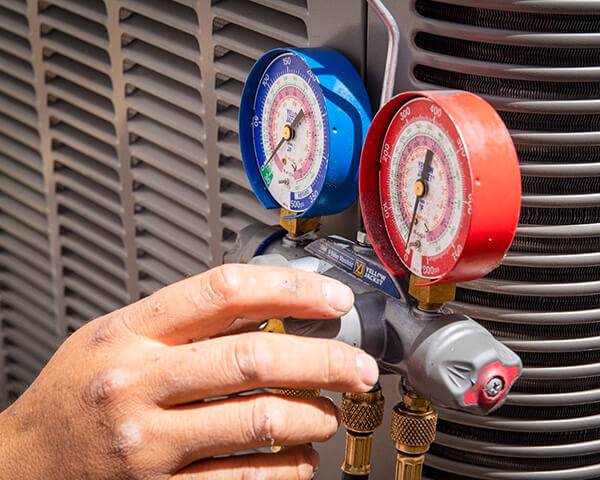
The technician checks the condenser fan motor, compressor operation, capacitor(s), contactor, and refrigerant pressures. This is where most emergency failures live. The five most common findings in Las Vegas emergency calls are:
- Failed capacitor — the cylindrical silver or black component that helps start and run the compressor and fan motor. Desert heat degrades capacitors faster than any other climate. Average Las Vegas capacitor life: 3-5 years, compared to 8-12 years in moderate climates.
- Failed contactor — the relay that sends power to the compressor. Contacts pit and burn over time, especially with the constant on/off cycling during extreme heat.
- Fan motor failure — the motor that spins the fan blade on top of the outdoor unit. When this fails, the compressor overheats and shuts down on its safety switch.
- Low refrigerant — indicating a leak somewhere in the system. Refrigerant does not "wear out" or "get used up." If it is low, it is leaking. The question is where and how fast.
- Compressor failure — the most expensive component. When the compressor fails, the repair-vs-replace conversation begins.
Step 4: Indoor Unit Inspection (10-15 minutes)
The technician checks the evaporator coil (for freezing or dirt buildup), the blower motor, the air filter (a completely clogged filter can cause the system to shut down on safety), and the condensate drain. In Las Vegas, frozen evaporator coils are common during monsoon season when humidity spikes and low refrigerant charge causes the coil temperature to drop below freezing.
Step 5: Diagnosis and Options (5-10 minutes)
After completing the inspection, the technician should explain what they found, what needs to be repaired, what it will cost, and present options. A trustworthy technician will also tell you if the system is not worth repairing — more on that below.
Common Emergency Repairs and Their Costs
Here is what the most common emergency repairs cost in Las Vegas, including both regular-hours and after-hours pricing. These are real ranges based on typical market pricing across the valley.
| Repair | Regular Hours Cost | After-Hours Cost | Time to Complete |
|---|---|---|---|
| Capacitor replacement | $150-300 | $200-450 | 15-30 minutes |
| Contactor replacement | $175-350 | $250-500 | 20-45 minutes |
| Condenser fan motor | $300-600 | $450-850 | 45-90 minutes |
| Hard-start kit installation | $150-275 | $200-400 | 15-30 minutes |
| Refrigerant recharge (R-410A, per lb) | $50-85/lb | $75-125/lb | 30-60 minutes |
| Refrigerant leak repair + recharge | $400-1,200 | $600-1,600 | 1-3 hours |
| Blower motor replacement | $400-800 | $600-1,100 | 1-2 hours |
| Control board replacement | $400-900 | $600-1,200 | 1-2 hours |
| Compressor replacement | $2,000-4,500 | $2,800-5,500 | 3-6 hours (usually scheduled for next day) |
| Evaporator coil replacement | $1,500-3,500 | $2,000-4,500 | 3-5 hours (usually scheduled for next day) |
A note on after-hours pricing: the premium exists because of real costs — overtime wages for technicians, on-call availability pay, stocked truck inventory, and 24/7 dispatch staffing. Reputable companies are transparent about these premiums. If someone tells you after-hours repair costs the same as daytime, ask questions — they may be inflating their regular-hours pricing to hide the difference.
For a more detailed cost breakdown, see our emergency AC repair cost guide.

The Repair-vs-Replace Conversation at 3 AM
This is the hardest conversation in HVAC. It is 3 AM, your house is 92 degrees, and the technician has just told you the compressor is shot. Replacement compressor: $3,200. New system: $7,500-12,000. Your system is 14 years old. What do you do?
Here is the framework we use with homeowners, without pressure, because this decision is too important to make under duress.
The repair usually makes sense when:
- The system is less than 8-10 years old
- The repair cost is less than 30% of a new system
- The system has had no other major repairs in the past 2-3 years
- The system uses current refrigerant (R-410A), not the phased-out R-22
- The overall system is in good condition — clean coils, solid ductwork, no secondary issues
Replacement usually makes more sense when:
- The system is 12+ years old (Las Vegas systems age faster due to year-round use and extreme heat)
- The repair cost exceeds 40-50% of a new system
- The system has had 2 or more major repairs in the past 3 years
- The system uses R-22 refrigerant (no longer manufactured, costs $75-150+ per pound)
- Your energy bills have been climbing despite maintenance
- The system's SEER rating is below 13 (modern systems are 15-22 SEER2)
Here is what a good technician does at 3 AM: They present both options with clear pricing, explain the trade-offs, and never pressure you to decide immediately on a replacement. For a compressor or coil failure, they can often get you through the night with a temporary solution — setting the thermostat to fan-only to circulate air, or confirming there is no safety issue — and schedule the major work for the next business day when you can think clearly, get a second opinion if you want one, and explore financing options.
What a bad technician does at 3 AM: pressures you to sign a $10,000 replacement contract on the spot, refuses to do a repair because "it's not worth it" (your decision, not theirs), or disappears after diagnosing without offering solutions.
Read more about the repair vs. replace decision in our repair vs. replace guide.
What to Do While You Wait: A Las Vegas Summer Night Survival Guide
This section is for the person sitting in a 90-degree house at 2 AM with the technician an hour away. Las Vegas summer nights do not cool down much — overnight lows in July and August average 82-88 degrees F, and on the worst nights, the temperature stays above 95 at midnight. You cannot "open the windows and let it cool down" like you might in Denver or Portland. Opening windows in Las Vegas at 2 AM in July lets in 95-degree air.
Immediate steps:
- Switch the thermostat to FAN ON. Even if the cooling is not working, circulating air provides some relief and distributes the coolest air in the house. If the blower motor is the problem and nothing is moving air, skip this step.
- Close blinds and curtains. If any are open, close them. This matters less at night but becomes critical if you are still waiting at sunrise.
- Move to the lowest level. Heat rises. If you have a two-story home, the downstairs will be 3-8 degrees cooler than upstairs. If you have a ground-floor room with tile flooring, that is your best bet.
- Use box fans or portable fans. Direct airflow over skin increases evaporative cooling from your body. A $20 box fan from Walmart provides meaningful comfort even in a hot room.
- Cold water and cold cloths. Dampen washcloths and drape them on wrists, neck, and forehead. Drink cold water steadily. This is not just comfort — it is heat illness prevention.
- Run cold water in the bathtub. Las Vegas tap water in summer runs at about 85-90 degrees from the cold tap (ground temperature), but it is still cooler than room air and provides some relief for children who are struggling.
- Check on vulnerable household members. Elderly adults, infants, and people taking certain medications (diuretics, beta-blockers, anticholinergics) are at higher risk for heat-related illness. Signs of heat exhaustion: heavy sweating, cold/clammy skin, fast weak pulse, nausea. If symptoms appear, call 911 — do not wait for the HVAC technician.
If you cannot get a technician until morning:
- Consider a hotel. This is not an overreaction if indoor temperatures exceed 95 degrees F with vulnerable people in the home. Many Las Vegas hotels offer last-minute rates of $40-80, and a night in a cool room is worth more than the cost.
- Go to a family member or neighbor's house. A few hours of sleep in a cool space makes a difficult situation manageable.
- If staying home, consolidate into one room and use fans to create airflow. Close doors to unused rooms to reduce the volume of space you are trying to keep bearable.
How to Avoid the 2 AM Call
Emergency AC failures rarely happen without warning. Most systems give signals days or weeks before they quit entirely. Here is what to watch for:
- Gradual cooling loss. If the system used to hold 74 degrees easily and now struggles to reach 78 on a 110-degree day, something is degrading — low refrigerant, dirty coils, a failing compressor. Schedule a diagnostic visit before it fails completely.
- New or unusual noises. Clicking, buzzing, grinding, or screeching from the outdoor unit indicates a component nearing failure. Catching it during a $89 diagnostic is cheaper than a $300 emergency call at midnight.
- Short cycling. The system turns on, runs for 3-5 minutes, shuts off, then repeats. This pattern overworks the compressor and typically signals a refrigerant issue, electrical problem, or oversized/undersized system.
- Rising energy bills. A system working harder than it should consumes more electricity. If your July bill jumped $50-100 compared to last July with similar weather, the system is losing efficiency and likely heading toward failure.
- System age above 12 years. Las Vegas AC systems have a functional lifespan of 12-18 years (shorter than the national average of 15-20 because of year-round operation and extreme heat). If your system is past 12, schedule a maintenance inspection every spring. Proactive replacement on your schedule is always less stressful and less expensive than emergency replacement on the system's schedule.
Why Transparent Pricing Matters in an Emergency
Emergencies create vulnerability. At 2 AM with a house full of heat-stressed family members, you are not in a strong negotiating position. Some companies exploit this by quoting inflated prices, adding unnecessary repairs, or pressuring immediate decisions.
Here is what a fair, transparent emergency repair process looks like:
- Diagnostic fee quoted upfront over the phone before the technician is dispatched
- After-hours premium disclosed before you agree to the visit
- Written estimate presented before any repair work begins
- Clear explanation of what failed, why it failed, and what the repair involves
- Options presented (repair, temporary fix, replacement) without pressure
- Willingness to let you get a second opinion on major repairs ($2,000+)
If a technician tells you a repair costs $3,000+ and pressures you to authorize it immediately without a written estimate, you have the right to decline and call someone else in the morning. The only exception: a genuine safety hazard like an electrical short or gas leak, which any ethical technician will make safe regardless of whether you authorize a full repair.
About Emergency Diagnostic Fees
Most HVAC companies charge a diagnostic fee for emergency calls, typically $89-200 during regular hours and $125-300 for after-hours visits. This fee covers the technician's time, travel, and expertise to identify the problem. It does not include the cost of repair.
Some companies credit the diagnostic fee toward the repair if you authorize the work. Others do not. Ask before the technician is dispatched. Both models are legitimate — the important thing is knowing which one applies before you agree to the visit.
The diagnostic fee is not optional. A technician who drives to your home at 2 AM, spends 30-45 minutes diagnosing your system, and provides a professional assessment has provided a valuable service regardless of whether you authorize the repair. Expecting free diagnostics at 2 AM is like expecting a free doctor visit in the emergency room because you might buy the prescription.
Get Help Now
The Cooling Company provides 24/7 emergency AC repair across the Las Vegas Valley — including Summerlin, Henderson, North Las Vegas, Green Valley, Enterprise, Centennial Hills, and all surrounding communities. Our technicians carry the most common replacement parts (capacitors, contactors, fan motors, hard-start kits) on their trucks, which means most emergency repairs are completed in a single visit.
Call (702) 567-0707 any time, day or night. Or book online for next-available service.
Frequently Asked Questions
How long does it take for an emergency AC technician to arrive in Las Vegas?
During off-season months (October-April), expect 1-2 hours. During peak summer (July-September), arrival times range from 2-6+ hours depending on demand, time of day, and whether a heat wave is in progress. During extreme heat events, waits can extend to the next morning. Companies with larger after-hours crews generally have shorter response times.
How much does an emergency AC repair cost in Las Vegas?
Emergency diagnostic fees range from $89-200 (regular hours) to $125-300 (after-hours). Common repairs like capacitor or contactor replacement cost $150-500 during regular hours and $200-850 after hours. Major repairs such as compressor or coil replacement range from $2,000-5,500, and are typically scheduled for the next business day rather than completed at 2 AM.
Should I try to fix my AC myself before calling a technician?
You can safely check a few things: verify the thermostat is set to cool and the temperature is set below room temp, check that the air filter is not completely clogged, and check the breaker panel for a tripped AC circuit (reset it once — if it trips again, do not reset it again, as this indicates an electrical fault). Do not attempt to open the outdoor unit, handle refrigerant, or work on electrical connections. These tasks require EPA certification and can be dangerous without training.
Is it safe to stay in a house without AC in Las Vegas summer?
For healthy adults, a house without AC is uncomfortable but not immediately dangerous for several hours if you stay hydrated and use fans. For elderly adults, infants, people with chronic health conditions, or anyone taking medications that impair heat regulation, indoor temperatures above 90-95 degrees F can become medically dangerous. If indoor temperatures exceed 95 degrees and you have vulnerable household members, consider going to a hotel, a neighbor's home, or a community cooling center rather than waiting for a repair.
Why does my AC keep running but not cooling the house?
The most common causes are: low refrigerant due to a leak (the system runs but cannot transfer enough heat), a failed compressor (the fan runs but the compressor is not pumping refrigerant), a frozen evaporator coil (ice blocks airflow and heat transfer), or a failed condenser fan motor (the compressor overheats and shuts down while the indoor fan continues running). All of these require professional diagnosis because the symptoms overlap and the causes require different repairs.
Will my homeowner's insurance cover emergency AC repair?
Standard homeowner's insurance policies do not cover HVAC repairs or replacement due to normal wear and tear, which accounts for the vast majority of AC failures. Insurance may cover damage caused by a covered event — for example, if a lightning strike damages the AC system or a fallen tree crushes the outdoor unit. A home warranty (different from homeowner's insurance) may cover AC repairs with a service fee of $75-125 per visit, but coverage limits, exclusions for pre-existing conditions, and contractor quality vary widely by provider.
How can I prevent emergency AC breakdowns in Las Vegas?
Schedule professional maintenance every spring (March-April) before summer heat arrives. Change air filters every 30-45 days during summer. Keep the outdoor unit clear of debris with 24 inches of clearance on all sides. Listen for new or unusual sounds and schedule a diagnostic if anything changes. Address small issues promptly — a $150 capacitor replacement during business hours prevents a $400 emergency call at midnight. Systems over 12 years old should be inspected annually and evaluated for proactive replacement before a failure forces an emergency decision.
What is the difference between an emergency AC call and a regular service call?
An emergency call means the technician responds outside normal business hours (typically evenings, nights, weekends, and holidays) or is dispatched for same-day urgent response during business hours. Emergency calls carry higher diagnostic fees (typically 1.5x-2x regular rates) and higher labor rates. A regular service call is scheduled during business hours, often 1-3 days out, at standard pricing. If your system has reduced cooling but is still functioning, scheduling a regular call saves money. If the system is completely down during extreme heat, an emergency call is appropriate.