

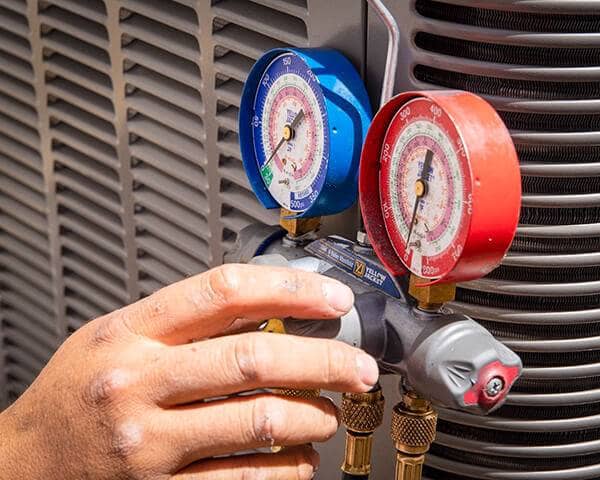
Short answer: In Las Vegas, normal AC runtime depends almost entirely on outdoor temperature. At 95°F, expect 8 to 12 hours of total runtime. At 105°F to 110°F, 14 to 18 hours is completely normal. At 115°F and above, your AC may run nearly continuously for the entire day — and that is not a malfunction. The national advice that "AC should cycle 2 to 3 times per hour" does not apply to desert climates. What matters is whether your system is maintaining your setpoint, not how many hours it runs. If indoor temperature is climbing despite constant operation, that is the warning sign. Call The Cooling Company at (702) 567-0707 for a diagnostic if your AC runs all day and cannot hold temperature.
Key Takeaways
- National runtime guidelines are wrong for Las Vegas. Articles telling you AC should run 15 to 20 minutes per cycle are written for climates where summer highs reach 85°F to 90°F. At 110°F, your system faces a 30+ degree differential that changes everything.
- Runtime scales with outdoor temperature. At 90°F: 6-10 hours. At 100°F: 10-14 hours. At 110°F: 14-18 hours. At 115°F+: 18-24 hours. All normal for a properly sized system.
- The real metric is indoor temperature hold. If your AC runs all day and keeps the house at 76°F to 78°F, your system is working correctly. If it runs all day and the house drifts to 82°F or 85°F, something is wrong.
- Single-stage and variable-speed systems behave differently. Single-stage units cycle on and off. Variable-speed units run continuously at low speed. Both patterns are normal for the equipment type.
- Desert-specific factors drive longer runtime: attic temperatures above 150°F radiating heat downward, west-facing windows with direct solar gain, ductwork in unconditioned spaces losing 20-30% of cooling capacity, and thermal mass from concrete block construction absorbing and re-radiating heat after sunset.
- Seven warning signs separate normal long runtime from a problem: rising indoor temperature, no cycling at all (compressor never shuts off even at 3 AM), supply vent air above 60°F, ice on the refrigerant line, unusual noises, tripping breakers, and electric bills 50%+ higher than the same month last year.
- Dirty filters are the number one fixable cause of excessive runtime. In Las Vegas, filters need replacement every 30 to 60 days during peak summer — not the 90-day national recommendation.
The Short Answer: It Depends on Temperature
AC runtime in Las Vegas is driven by one dominant variable: the gap between outdoor temperature and your thermostat setpoint. The wider that gap, the harder and longer your system must work. Here is what to expect from a properly sized, well-maintained system with the thermostat set to 76°F.| Outdoor Temp | Expected Daily Runtime | Cycling Behavior | Typical Las Vegas Months |
|---|---|---|---|
| 85°F - 90°F | 6 - 10 hours | Normal cycling, 2-3 times/hour | April, October |
| 91°F - 95°F | 8 - 12 hours | Longer run cycles, shorter off periods | May, September |
| 96°F - 100°F | 10 - 14 hours | Extended runs, brief off periods | Late May, early June |
| 101°F - 105°F | 12 - 16 hours | Near-continuous afternoon, cycling overnight | June |
| 106°F - 110°F | 14 - 18 hours | Continuous 11 AM - 9 PM, cycling overnight | July, August |
| 111°F - 115°F | 18 - 22 hours | Continuous most of day, brief cycling 2-5 AM | Peak July |
| 116°F - 118°F+ | 20 - 24 hours | Nearly continuous, may not reach setpoint | Extreme heat events |
Important: At 115°F and above, even a perfectly functioning, brand-new system may not be able to maintain a 76°F setpoint. Most residential AC equipment is designed to maintain a 20-degree differential between indoor and outdoor temperature. When it is 117°F outside, holding 78°F to 80°F is realistic. Expecting 72°F is not — and chasing it will only stress your equipment.
Why Las Vegas AC Runtime Rules Are Different
The fundamental issue is the 20-degree design differential. Residential air conditioning systems are engineered to cool indoor air approximately 20 degrees below outdoor temperature. In a city like Charlotte, North Carolina, where the average summer high is 90°F, a system designed for a 20-degree differential easily maintains 70°F to 72°F with moderate cycling. The system has excess capacity. It runs for 15 minutes, satisfies the thermostat, shuts off, and repeats. In Las Vegas, summer highs routinely exceed 110°F. At 112°F, a system designed for a 20-degree differential is theoretically limited to cooling your home to 92°F. The reason your home actually reaches 76°F is that HVAC contractors in Southern Nevada size systems with extra capacity, your home's insulation and thermal mass provide some buffer, and overnight temperatures in the low 80s to 90s give the system time to pull the house temperature down. But that extra capacity is not infinite. On the hottest days, your system must run nearly continuously to hold a comfortable setpoint. This is why every national article telling you "your AC should cycle 2 to 3 times per hour" is wrong for Las Vegas. That cycling frequency is a sign of a properly sized system in a mild climate. In a desert climate, that same cycling frequency on a 110°F day would actually indicate an oversized system — which creates its own set of problems including humidity issues, temperature swings, and premature compressor failure. The other desert-specific factor is solar heat gain. Las Vegas receives roughly 294 sunny days per year. West-facing windows in communities like Summerlin, Centennial Hills, and The Lakes can add 2,000 to 4,000 BTUs per hour of additional heat load in afternoon hours. South-facing windows in Henderson, Green Valley, and Seven Hills contribute significant gain from late morning onward. Your AC is not just fighting outdoor air temperature — it is fighting direct solar radiation pouring through every window.Normal AC Behavior on a 100+ Degree Day
Here is a realistic timeline of what a healthy, properly sized system does on a typical July day in Las Vegas when the high reaches 108°F. 6:00 AM - 10:00 AM: Outdoor temperature rises from 88°F to 100°F. Your AC cycles normally — running 20 to 30 minutes, shutting off for 10 to 15 minutes. Indoor temperature holds steady at your setpoint. 10:00 AM - 2:00 PM: Outdoor temperature climbs past 100°F toward 105°F. Run cycles get longer. Off periods shrink to 5 to 8 minutes. Indoor temperature holds within 1 degree of setpoint. 2:00 PM - 7:00 PM: Peak heat. Outdoor temperature hits 106°F to 108°F. Your AC runs nearly continuously. The compressor may cycle off for 2 to 3 minutes occasionally, but for practical purposes the system is running nonstop. Indoor temperature may drift 1 to 2 degrees above setpoint during the peak afternoon window (3 PM to 5 PM). This is normal. West-facing rooms may be 2 to 3 degrees warmer than east-facing rooms. 7:00 PM - 11:00 PM: Outdoor temperature drops from 105°F to 95°F. The system gradually catches up. Run cycles shorten. By 10 PM, normal cycling resumes and indoor temperature returns precisely to setpoint. 11:00 PM - 6:00 AM: Outdoor temperature falls to the low 80s. Your AC cycles infrequently — perhaps 15 minutes on, 30 minutes off. This is the period when your system recovers and when any accumulated heat in walls, ceilings, and floors dissipates.The key insight: a 1 to 2 degree afternoon drift above setpoint on a 105°F+ day is not a malfunction. It is your system working at maximum capacity against extreme conditions. If you see 3 degrees or more of drift, or if the temperature never recovers by 10 PM, schedule a diagnostic — the system may need AC repair or it may be undersized.
7 Warning Signs Your AC IS Running Too Much (Even for Las Vegas)
Long runtime alone is not a problem. These seven signs indicate something is actually wrong. 1. Indoor temperature keeps rising despite continuous operation. If your AC has been running nonstop for 4 or more hours and indoor temperature is climbing instead of holding steady, something is failing. The system is running but not effectively removing heat. Common causes include low refrigerant, a failing compressor, or a severely clogged condenser coil. 2. The compressor never cycles off — even at 3 AM. Between midnight and 5 AM, outdoor temperatures in Las Vegas typically drop to the low 80s or high 70s in July. Your AC should cycle down during these hours. If the compressor runs continuously through the coolest part of the night, the system lacks sufficient capacity for the conditions — either due to a mechanical problem, undersizing, or massive duct losses. 3. Supply vent air temperature is above 60°F. Hold a thermometer at a supply register while the system is running. The air coming out should be 15 to 20 degrees cooler than the return air temperature. If the supply air is 60°F or higher (with return air at 78°F), the system is not producing adequate cooling. This points to low refrigerant, a dirty evaporator coil, or compressor issues. 4. Ice is forming on the refrigerant line or indoor coil. Ice on the copper refrigerant line running to your outdoor unit is never normal. It indicates either restricted airflow (dirty filter, blocked return) or low refrigerant charge. Both force the system to run longer without effectively cooling. If you see ice, turn the system to "fan only" for 2 hours to let it thaw before calling for service. For a deeper dive, see our guide on why your AC keeps freezing up. 5. Unusual noises during operation. Grinding, screeching, banging, or hissing sounds during runtime indicate mechanical failure in progress. A system making these noises while running long hours is likely damaging itself further with each hour of operation. Shut the system off and call for emergency AC repair. 6. The circuit breaker trips during long run periods. If your AC trips the breaker after running for several hours on a hot day, the system is drawing excessive amperage. This can be caused by a failing compressor, a locked rotor condition, or electrical issues. Repeated breaker trips are a fire hazard. Do not keep resetting the breaker — call a licensed technician. 7. Your electric bill is 50% or more higher than the same month last year. Compare July to July, August to August. NV Energy rates have increased modestly, but a 50%+ jump with similar outdoor temperatures indicates your system is working significantly harder than it should. This usually means progressive efficiency loss from a slow refrigerant leak, failing components, or severely degraded ductwork. See our breakdown of why your energy bill is high for other contributing factors.Single-Stage vs Variable-Speed: Different Runtime Patterns
The type of equipment you have dramatically affects what "normal" runtime looks like. Understanding this prevents unnecessary service calls.| System Type | How It Operates | Normal Behavior at 108°F |
|---|---|---|
| Single-stage | Full blast on, completely off, repeat | Runs 45-55 min, off 3-8 min, repeat. Near-continuous in afternoon peak. |
| Two-stage | Low speed most of the time, high speed on demand | Runs on low continuously 10 AM - 8 PM, kicks to high stage 2-6 PM. Brief cycling overnight. |
| Variable-speed (inverter) | Adjusts speed from 25% to 100% continuously | Runs 18-22 hours at varying speeds. May literally never shut off on peak days. This is by design. |
Variable-speed systems are designed to run continuously. If you upgraded from a single-stage to a variable-speed unit and noticed it "never turns off," that is the equipment operating exactly as intended. Variable-speed compressors run at the lowest speed needed to maintain your setpoint. They ramp up as heat load increases and ramp down as it decreases, but they rarely cycle fully off. This continuous operation is actually more efficient and provides better humidity control than the on-off cycling of single-stage equipment. Read our full comparison in the single-stage vs two-stage vs variable-speed guide.
The Capacity Problem: Is Your System Too Small?
If your AC runs all day and cannot hold temperature on days above 105°F, the system may be undersized. This is more common than most Las Vegas homeowners realize. A Manual J load calculation is the engineering standard for determining the correct AC size for a specific home. It accounts for square footage, insulation R-values, window area and orientation, air infiltration, duct losses, number of occupants, and — critically — the local design temperature. The problem: many Las Vegas production homes built during the 2004 to 2008 boom had AC systems sized using shortcuts instead of proper Manual J calculations. Builders used rough rules of thumb (400 to 500 square feet per ton) that work in mild climates but fall short in Southern Nevada. A 2,200 square foot home in Henderson that needs 5 tons based on a proper load calculation may have had a 4-ton unit installed to save the builder $800 to $1,200. The result is a system that handles 100°F days fine but cannot keep up on 110°F+ days. It runs 24 hours straight, the house reaches 80°F to 82°F despite the thermostat being set to 76°F, and the homeowner assumes something is broken. In reality, the system is doing everything it can — it simply lacks the capacity. The fix is not a repair. It is a properly sized replacement system. If your home was built before 2010, has the original AC equipment, and consistently struggles on the hottest days, a load calculation should be the first step. The Cooling Company includes Manual J calculations with every system replacement consultation.The Ductwork Factor
Your AC unit could be perfectly sized and well-maintained, but if the ductwork is leaking, your system runtime will be significantly higher than it should be. In Las Vegas, most ductwork runs through the attic. Attic temperatures in Southern Nevada reach 140°F to 160°F during summer afternoons. Every leak in that ductwork does two things: it dumps expensive cooled air into the attic where it does nothing, and it allows superheated attic air to be drawn into the return side of the system. The Department of Energy estimates that duct leaks waste 20 to 30 percent of conditioned air in a typical home, but in Las Vegas attics, the penalty is at the high end or worse because of the extreme temperature differential. Symptoms of duct-related excessive runtime include uneven temperatures between rooms (some rooms comfortable, others warm), visible gaps or disconnected flex duct in the attic, the system running long hours even on moderate 95°F days, and supply vent airflow that feels weak despite the system running at full capacity. Duct sealing and insulation upgrades are among the highest-ROI improvements for Las Vegas homes. A home with 30% duct leakage that seals down to 5% effectively gains the equivalent of an additional ton of cooling capacity without replacing any equipment. For more on diagnosing this, see our guide on how to check air ducts for leaks.Dirty Filters and Coils: The Number One Fixable Cause of Excess Runtime
Before you call anyone, check your air filter. A clogged filter reduces airflow by 25 to 30 percent, which directly reduces cooling capacity by a similar amount. Your AC compensates by running longer — sometimes hours longer per day — to move the same amount of heat. Las Vegas dust makes this worse than national averages. Construction activity, desert winds, and low humidity create fine particulate that clogs filters faster. The national recommendation of changing filters every 90 days is inadequate for most Las Vegas homes. During peak cooling season (May through September), check your filter every 30 days and replace it when it looks visibly dirty. Homes near active construction, homes with pets, and homes in open desert-adjacent areas like Centennial Hills, Skye Canyon, and parts of North Las Vegas may need filter changes every 30 days without exception. The outdoor condenser coil is the second-most-common airflow restriction. Desert dust, cottonwood seeds (prevalent in older Las Vegas neighborhoods), and debris accumulate on the condenser fins and act as insulation — the exact opposite of what the coil needs. A dirty condenser can reduce system efficiency by 15 to 30 percent and increase runtime proportionally. Hosing the condenser coil down monthly during summer is simple maintenance that makes a measurable difference. The indoor evaporator coil is harder to access but equally important. A dirty evaporator coil restricts airflow and reduces heat transfer. Professional cleaning during an annual AC maintenance visit is the only reliable way to address it. A clean system with fresh filters can reduce daily runtime by 2 to 4 hours on a hot day compared to a neglected system with the same equipment.Low Refrigerant: The Silent Runtime Killer
Refrigerant is not consumed during normal operation. If your system is low on refrigerant, it has a leak. And unlike a dirty filter that you can see, a slow refrigerant leak silently degrades performance over months or years. Here is what happens: a system charged with 10 pounds of R-410A slowly loses refrigerant through a pinhole leak at a brazed joint. After one summer, it is down to 9 pounds. Cooling capacity drops roughly 10 percent. Runtime increases, but you barely notice. After two summers, it is down to 7.5 pounds. Capacity is now 25 percent below design. The system runs 4 to 6 extra hours per day to hold temperature. Your electric bill climbs, but you attribute it to rate increases. After three summers, at 6 pounds, the system can barely cool on days above 100°F. The compressor overheats and fails. Now you are facing a $2,500 to $4,500 repair or a full system replacement. This progression is why annual AC maintenance that includes a refrigerant pressure check is not optional in Las Vegas — it is essential. Catching a leak at the one-pound-low stage costs a fraction of catching it after compressor failure. For homes with newer equipment, the transition from R-410A to R-454B (effective January 2025 for new equipment) does not change this dynamic. Both refrigerants lose capacity proportionally when charge is low. The difference is in handling and recovery procedures, which is why only EPA 608-certified technicians should work on refrigerant systems. See our R-410A vs R-454B comparison for details on the transition.What to Check Before Calling a Technician
Run through this DIY checklist before scheduling a service call. These items account for roughly 40 percent of the excessive-runtime calls our technicians respond to.- Air filter: Pull it out and hold it up to light. If you cannot see light through it, replace it immediately. This alone solves many runtime complaints.
- Thermostat setting: Verify the setpoint is where you intend it. Check that the system is set to "cool" (not "fan only" or "heat"). If you have a programmable thermostat, confirm the schedule has not been overridden or reset.
- Return vents: Make sure no furniture, rugs, or curtains are blocking return air grilles. A blocked return starves the system of airflow just like a clogged filter.
- Supply vents: Confirm all supply registers are open. Closing vents in unused rooms is a common misconception that actually increases runtime by raising duct pressure and reducing efficiency.
- Outdoor unit: Check that the condenser is not buried in debris. Clear any leaves, trash, or vegetation within 2 feet of the unit. Hose down the condenser fins gently with a garden hose (spray from inside out if accessible).
- Circuit breakers: Verify both the indoor and outdoor breakers are fully on. A tripped outdoor breaker means the compressor is off while the indoor fan runs — the system will blow air but not cool.
- Ice on the lines: Check the copper refrigerant line running from the outdoor unit to the indoor unit. If you see frost or ice, switch the system to "fan only" mode for 2 hours to thaw. If ice returns when you switch back to cooling, call for service.
- Supply air temperature: Hold a thermometer at a supply register. The air should be 15 to 20 degrees cooler than the room temperature. If the split is less than 14 degrees, the system is underperforming and needs professional diagnosis.
When Continuous Running Costs You Money
Running your AC longer costs real money. Understanding the math helps you decide when longer runtime is acceptable versus when it justifies a repair or upgrade investment. A typical 4-ton AC system in Las Vegas draws approximately 4,000 to 5,000 watts while running. At NV Energy's average residential rate of roughly $0.12 per kWh, that is $0.48 to $0.60 per hour of operation. Here is how runtime translates to monthly cost.| Daily Runtime | Monthly kWh (4-ton unit) | Monthly Cost (approx.) |
|---|---|---|
| 10 hours | 1,350 - 1,500 kWh | $160 - $180 |
| 14 hours | 1,890 - 2,100 kWh | $225 - $250 |
| 18 hours | 2,430 - 2,700 kWh | $290 - $325 |
| 22 hours | 2,970 - 3,300 kWh | $355 - $395 |
The ROI inflection point: if a fixable issue (dirty coils, duct leak, low refrigerant) is adding 4+ hours of runtime per day, that costs $55 to $72 per month — or $275 to $360 across a five-month cooling season. A maintenance visit or repair that costs $150 to $400 pays for itself within one to two seasons. Even a major duct sealing project at $1,500 to $3,000 typically pays back in 2 to 4 years through reduced runtime. For ongoing protection, consider a maintenance plan that includes annual tune-ups, priority scheduling, and diagnostic fee waivers.
If your system is 12 or more years old, running excessively, and requiring increasingly frequent repairs, the calculus shifts toward replacement. Modern variable-speed systems with 17+ SEER2 ratings can reduce runtime and energy consumption by 30 to 50 percent compared to aging single-stage equipment. Learn more about the repair vs replace decision.Frequently Asked Questions
Is it bad for my AC to run 24 hours straight?
On the hottest Las Vegas days (115°F+), running 20 to 24 hours is expected and will not damage a healthy system. Modern compressors are designed for extended operation. The danger is not runtime duration — it is running while something is wrong. If the system runs all day and holds temperature, you are fine. If it runs all day and indoor temperature keeps climbing, something is failing and continued operation risks compressor damage.
Should I give my AC a break by turning it off for a few hours?
No. Turning off your AC on a hot day forces the system to remove accumulated heat when it restarts, which actually uses more energy and stresses the compressor harder than continuous operation. The startup surge when a compressor kicks on draws 3 to 5 times the running amperage. Frequent restarts are harder on the equipment than steady running. Keep the system on and let it manage the load.
Should I turn my AC off when I leave the house?
Do not turn it off entirely. Raise the setpoint by 3 to 5 degrees instead. In Las Vegas summer, turning the AC off while you are at work allows the house to reach 95°F to 100°F+ indoors. When you return and set it back to 76°F, the system must remove all that accumulated heat — a process that takes 3 to 5 hours and puts heavy stress on the compressor. A smart thermostat that raises the setpoint to 80°F while you are away and pre-cools 30 minutes before you return is the most efficient approach.
Does setting my thermostat lower make the AC cool faster?
No. If you set the thermostat to 65°F hoping to cool a 82°F house faster, the system still runs at the same capacity. A single-stage AC has one speed — full blast. Setting it to 65°F just makes it run longer past your actual comfort point, wasting energy. The only exception is variable-speed systems, which may ramp to a slightly higher speed at larger temperature differentials, but the difference is marginal. Set the thermostat to the temperature you actually want.
What temperature should I set my thermostat on a 115 degree day?
Set it to 76°F to 78°F and accept that the system may not hold that number perfectly between 2 PM and 6 PM. Attempting to hold 72°F on a 115°F day forces the system to maintain a 43-degree differential — well beyond residential design specifications. You will stress the equipment, risk a frozen evaporator coil, and spend significantly more on electricity without achieving your target. The Department of Energy recommends 78°F when home for optimal efficiency, and that guidance is particularly sound in extreme desert heat.
Why does my AC run longer at night than my neighbor's?
Several factors create runtime differences between identical-looking homes on the same street: insulation quality and age, window size and orientation, duct condition (sealed vs leaky), equipment age and efficiency, shade from trees or adjacent structures, and even thermostat setpoint differences. A home with west-facing living areas, original 2006 ductwork, and R-19 attic insulation will run 30 to 50 percent longer than a neighbor with east-facing living areas, sealed ducts, and R-38 blown-in insulation — even with identical AC equipment.
How do I know if my AC is short cycling?
Short cycling means the compressor turns on and off rapidly — typically running less than 5 to 8 minutes before shutting down, then restarting after 2 to 3 minutes. In Las Vegas, short cycling is always a problem. Common causes include an oversized system, a failing capacitor, a dirty condenser coil triggering high-pressure cutoff, low refrigerant triggering low-pressure cutoff, or a thermostat malfunction. Short cycling is the opposite of the long-runtime question, but equally harmful — it prevents proper dehumidification, wears the compressor prematurely, and wastes energy. If your outdoor unit sounds like it is starting and stopping every few minutes, call for a diagnostic.
How much does an AC diagnostic cost in Las Vegas?
A standard diagnostic visit from a licensed HVAC contractor typically costs $75 to $150 in the Las Vegas market. The Cooling Company's diagnostic fee covers a comprehensive inspection of refrigerant levels, electrical components, airflow measurements, and system performance. If you proceed with a recommended repair, the diagnostic fee is typically applied toward the repair cost. Maintenance plan members receive diagnostic fee waivers and priority scheduling, which is particularly valuable during July heat waves when service demand peaks. Call (702) 567-0707 or request an appointment online to schedule your diagnostic.