


Short answer: Buying an HVAC system in Las Vegas is not the same as buying one anywhere else in the country. Our summers demand more from equipment than nearly any residential climate in the U.S. Before you sign anything, you need to understand which system type fits your home, why SEER ratings matter more here than most places, how proper sizing is calculated (not guessed), and what questions separate honest contractors from the ones who'll cost you money for years. This guide covers all of it.
Most homeowners buy an HVAC system twice in their lives. The first time, they learn from mistakes. The second time, they know what questions to ask. If you're reading this, you get to skip the expensive first lesson.
Las Vegas is one of the most demanding HVAC environments in the country. Summer temperatures regularly exceed 115°F. Your system runs harder, longer, and under more stress than units in moderate climates. That means system selection, sizing, and installation quality have an outsized impact on your comfort, your electric bill, and how long the equipment lasts.
Here's what you need to know.
System Types: What's Actually Available and What Works in the Desert
Before you talk price with anyone, understand what you're buying. There are four primary system configurations available to Las Vegas homeowners, and each one has a different fit depending on your home's layout, existing infrastructure, and budget.
Central Split Systems
This is the most common setup in Las Vegas homes built after the 1980s. A split system separates the cooling components: the condenser and compressor sit outside in that side-yard cabinet, while the air handler and evaporator coil sit inside — typically in the attic or a utility closet. Refrigerant lines connect them.
Split systems pair with your existing ductwork to distribute conditioned air throughout the house. They handle Las Vegas heat well when properly sized, and they're available with variable-speed compressors that ramp output up or down rather than cycling on and off in blasts. That variable-speed feature matters here — it keeps the home more comfortable at 115°F than a single-stage unit running at full blast.
If your home has existing ductwork in reasonable condition, a central split system is typically the starting point for any replacement conversation. For a full walkthrough of what the installation process involves, see our HVAC installation guide.
Packaged Units
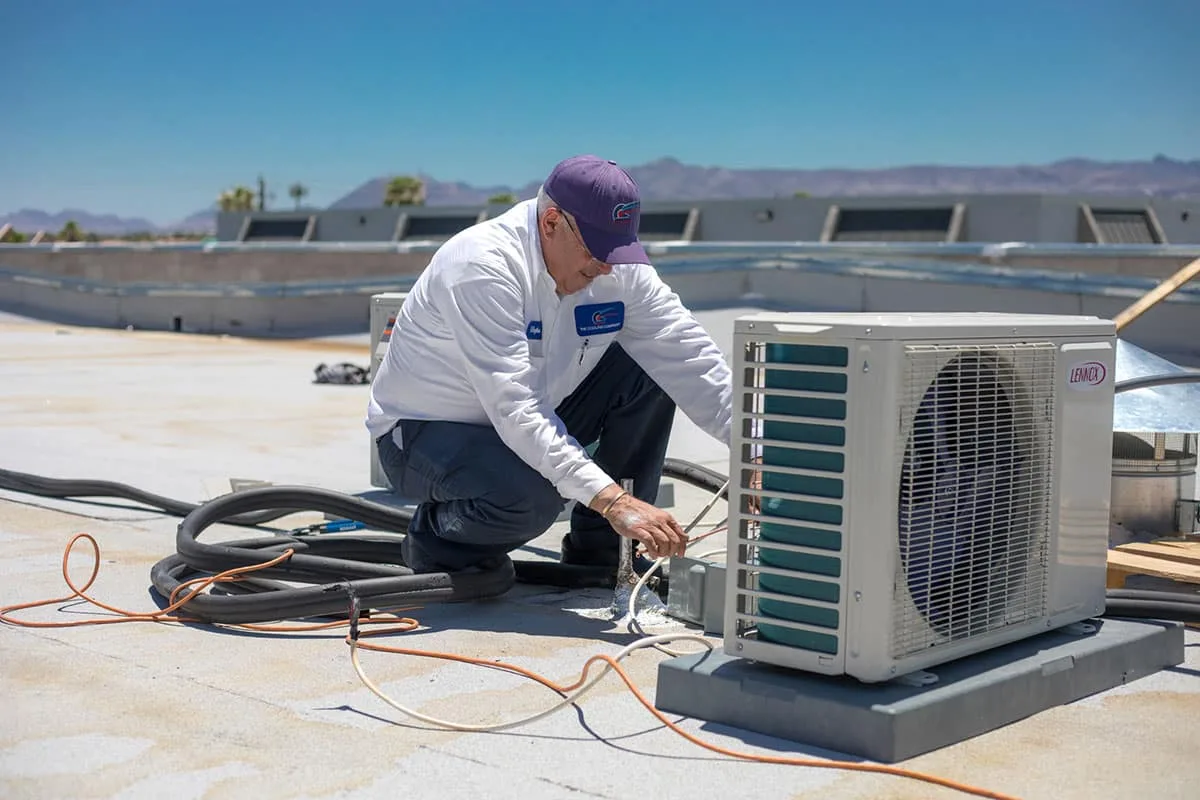
Packaged units put everything — compressor, condenser, evaporator coil, and air handler — into a single cabinet that sits on the roof or on a concrete pad beside the home. All components are in one box, connected to your ductwork through a wall or the roofline.
These are extremely common in Las Vegas, especially in homes from the 1970s and 1980s where attic space is limited. Many single-story ranch-style homes across the valley were built with packaged units in mind. They're easier to service because everything is in one accessible location, and they're often less expensive to install because you're not running refrigerant lines between two separate cabinets.
The tradeoff: rooftop packaged units sit in direct sun and deal with more ambient heat than a shaded side-yard condenser. That thermal stress can shorten equipment life if the unit isn't correctly rated for desert exposure.
Heat Pumps
A heat pump is a split system that runs in reverse during winter: instead of burning fuel to create heat, it extracts heat from outside air and moves it indoors. In summer, it operates as a standard air conditioner.
Las Vegas is actually one of the better climates for heat pumps. Because our winters are mild — we rarely see extended stretches below 35°F — heat pumps operate efficiently year-round without needing a gas backup to handle extreme cold. That's a genuine advantage here compared to northern climates where heat pumps struggle.
Modern heat pumps, especially those with variable-speed compressors, achieve impressive efficiency ratings and can cut heating costs significantly compared to straight electric resistance heat. If you're replacing both your furnace and air conditioner at the same time, a heat pump deserves serious consideration. Read the full breakdown on our heat pump service page.
Ductless Mini-Splits
Mini-splits serve specific rooms or zones without any ductwork. An outdoor compressor connects to one or more wall-mounted indoor air handlers via refrigerant lines. Each indoor unit has its own thermostat, so occupants control temperature independently per room.
Mini-splits solve specific problems extremely well: additions where running ductwork is impractical, garages, casitas, older homes with no existing ductwork, or any situation where one area of the house runs significantly hotter or cooler than the rest. They're also highly efficient because there's no duct loss — and duct loss in a hot attic is a real, significant inefficiency in Las Vegas homes.
Where they struggle: whole-house applications in a large home get expensive quickly when you need four, five, or six indoor units. They also require wall penetrations for every zone, and some homeowners dislike the appearance of wall-mounted cassettes.
SEER Ratings: What They Mean and Why Las Vegas Demands Higher
SEER stands for Seasonal Energy Efficiency Ratio. It measures cooling output divided by energy input over a typical cooling season. Higher SEER means more efficient operation.
As of 2023, federal minimum SEER standards in the Southwest region are 14 SEER for split systems and 14 SEER for packaged units. That's the federal floor — and in Las Vegas, the floor is not where you want to shop.
Here's the practical reality: Las Vegas is not a "seasonal" cooling market. We run our AC from April through October, sometimes longer. Our cooling season is roughly twice as long as the national average used to calculate SEER ratings. A 14 SEER unit that looks barely adequate on paper performs meaningfully worse in the real-world desert environment because it's running under high-heat conditions and for far more hours per year than the SEER test accounts for.
A practical minimum for Las Vegas: 16 SEER. At 16 SEER or above, you start seeing real monthly savings on your NV Energy bill versus the minimum-code options. Many of our customers opt for 18 to 20 SEER systems, and the math on those often pencils out within five to seven years given how much we run our systems.
Two numbers to know beyond base SEER:
- EER (Energy Efficiency Ratio): Unlike SEER, EER is measured at a fixed high-temperature condition (95°F outdoor, 80°F indoor). This is closer to Las Vegas operating conditions than the seasonal average SEER uses. When comparing equipment, ask for the EER number — it tells you more about real desert performance.
- SEER2: The federal government updated the SEER testing methodology in 2023 (SEER2). The new standard uses slightly more realistic test conditions. A SEER2 rating will be numerically lower than the old SEER rating for the same unit. Don't let that confuse you — make sure you're comparing SEER to SEER, or SEER2 to SEER2, not mixing the two.
Sizing: The Calculation That Most Bad Installations Skip
Sizing is where many installations go wrong, and where Las Vegas homeowners get hurt the most.
The old industry rule of thumb — one ton of cooling capacity per 400 to 600 square feet — was always a rough estimate. In Las Vegas, it's dangerously inaccurate. It ignores insulation quality, window orientation, ceiling height, attic conditions, local climate data, and how much radiant heat your home absorbs from the desert sun.
The correct method is a Manual J load calculation. This is a formal engineering calculation that factors in your home's square footage, insulation R-values, window area and orientation, number of occupants, local design temperatures, and infiltration rate. It produces an actual heat gain number for your home in BTUs, which then determines the correct system size.
Oversizing is just as bad as undersizing. An oversized system cools the home quickly then shuts off, cycling on and off repeatedly without running long enough to dehumidify the air or reach full efficiency. You'll have cold, clammy air and a system that wears out faster due to short cycling. Undersizing means the system runs continuously at maximum capacity and never catches up on 115°F days.
For a typical Las Vegas home over 2,000 square feet, expect the contractor to spend time reviewing your home's construction, insulation, and window situation before quoting a tonnage. If they quote you a system size in the first five minutes of a phone call, that's a red flag.
Common sizing benchmarks for Las Vegas (these are starting points only — actual Manual J results vary):
- 1,200–1,600 sq ft: typically 3–3.5 tons
- 1,600–2,200 sq ft: typically 3.5–4 tons
- 2,200–3,000 sq ft: typically 4–5 tons
- 3,000+ sq ft: typically 5 tons or multi-zone systems
How to Evaluate Brands Without Getting Distracted by Brand Names
Every major HVAC manufacturer makes good equipment and mediocre equipment. The brand name matters less than the specific model line, the efficiency tier, the warranty structure, and whether the installing contractor is authorized and trained on that equipment.
What actually matters when evaluating equipment options:
Compressor technology: Single-stage compressors run at 100% or zero — full blast or off. Two-stage compressors have a low and high setting. Variable-speed (or inverter-driven) compressors modulate between approximately 30% and 100% of capacity continuously. In Las Vegas, variable-speed compressors provide the best comfort and efficiency because they can maintain temperature without constant cycling under extreme heat conditions.
Warranty terms: Most manufacturers offer 10-year parts warranties when properly registered within 60 to 90 days of installation. Some offer extended compressor warranties on higher-end lines. Confirm whether the installer's labor warranty is separate from the manufacturer's parts warranty — they usually are. Ask specifically: what happens if the compressor fails in year six?
Contractor authorization: Many manufacturers offer certified dealer programs with additional warranty protection or priority parts access. An authorized dealer has received manufacturer training on that product line, which matters for installation quality and warranty claim support.
Local parts availability: This is a practical Las Vegas consideration. When a component fails in July, you don't want your contractor waiting a week for parts to ship. Ask whether common replacement parts for the recommended equipment are stocked locally in the Las Vegas market.
What to Ask Contractors Before You Sign Anything
The questions you ask reveal the quality of the contractor more than their website or any badge they display. Here's the list that separates thorough installers from the ones cutting corners:
On sizing:
- Will you perform a Manual J load calculation before recommending a size?
- What are the design conditions you're using for Las Vegas (outdoor dry-bulb temperature, indoor target temperature)?
On the quote:
- Does this price include permit pulls and inspections?
- Does it include disposal of the old unit?
- Does it include startup testing and airflow commissioning after installation?
- Is ductwork inspection or sealing included, or is that a separate cost?
On equipment:
- What is the SEER2 rating of this unit? What is the EER?
- What stage compressor is this (single, two-stage, variable)?
- What is the manufacturer's warranty, and what is your labor warranty?
- Are you an authorized dealer for this equipment?
On the company:
- What is your Nevada contractor license number? (Verify it at the Nevada State Contractors Board)
- Do your technicians hold EPA Section 608 certification?
- Do you pull permits on every installation in Clark County?
That last group is not optional. A contractor who installs without permits voids manufacturer warranties and leaves you with potential legal complications if you sell the home.
Red Flags That Should End the Conversation
After doing this work in Las Vegas for years, the warning signs are consistent:
No site visit before quoting a size: Any contractor quoting you a specific tonnage without walking through your home, checking your attic insulation, and measuring your windows is guessing. Guesses cost you money.
The lowest bid with no explanation: A suspiciously low quote usually means something is missing — often permits, ductwork inspection, proper refrigerant handling, or a qualified installation crew. Ask them to match itemized line items with the other quotes. If they can't explain the difference, you have your answer.
Pressure to decide same-day: Quality contractors have booked work. They don't need to pressure you. If someone is pushing hard for an immediate signature with a "today-only" discount, that urgency is manufactured.
Vague or verbal warranties: Get every warranty claim in writing. "We stand behind our work" is not a warranty.
No mention of permits: Clark County requires permits for HVAC replacements. An installer who doesn't mention permits either plans to skip them or is hoping you won't ask.
Recommending an oversized unit as a "just to be safe" approach: More tons is not a safety margin. It's a path to short cycling, comfort complaints, and premature equipment failure.
Financing: How to Pay for It Without Getting Hurt
A quality HVAC system in Las Vegas — appropriately sized, properly installed, 16 SEER or better — typically runs $6,000 to $12,000 for a standard split system replacement. Packaged units, heat pumps, and multi-zone systems have different cost profiles.
That's real money. Financing is a legitimate tool for making a quality system accessible without deferring to a cheaper option you'll regret.
What to evaluate in a financing offer:
Deferred interest vs. true zero interest: "No interest if paid in full in 18 months" sounds great but often comes with deferred interest — meaning if you carry any balance at the end of the promotional period, you owe all the back interest that was accumulating. True zero-interest financing means no interest regardless of payoff timing. Read the terms carefully.
Federal tax credits: Under the Inflation Reduction Act, homeowners replacing older systems with qualifying high-efficiency heat pumps may be eligible for a 30% federal tax credit, up to $2,000. This applies to qualifying heat pump purchases — ask your contractor for the specific equipment certifications and consult a tax professional to confirm eligibility for your situation.
NV Energy rebates: NV Energy periodically offers rebates on qualifying high-efficiency HVAC equipment. Ask your contractor whether the proposed equipment qualifies and whether they'll assist with the rebate paperwork.
For full details on financing options, visit our financing page.
If you're planning an AC installation or AC replacement, financing can bridge the gap between what the job should cost and what feels affordable today.
The Bottom Line for Las Vegas Homeowners
An HVAC purchase done right in Las Vegas means:
- A system type matched to your home's layout and infrastructure
- A size determined by Manual J calculation, not square footage rules of thumb
- A minimum of 16 SEER (ask for EER too)
- A contractor who pulls permits, warranties their labor in writing, and can explain every line on the quote
- Financing structured as true zero interest if you need it, with attention to available rebates and tax credits
The contractors who don't do things this way will cost you more over ten years than the ones who charge appropriately upfront. In a climate where your system runs eight months of the year, the quality of the equipment and the quality of the installation compound every single month.
If you want a straight answer about what system fits your home and what it should cost, call The Cooling Company at (702) 567-0707. We'll tell you what you actually need — not what's easiest to sell.
Frequently Asked Questions
What SEER rating do I need for a Las Vegas home?
The federal minimum for the Southwest region is 14 SEER, but that's not where Las Vegas homeowners should shop. Given our extended cooling season and extreme summer temperatures, 16 SEER is a practical minimum. Many homeowners find 18 to 20 SEER systems pay back the cost premium within five to seven years through reduced NV Energy bills. Also ask for the EER (Energy Efficiency Ratio), which better reflects performance at the high ambient temperatures we actually experience.
How do I know what size HVAC system I need?
The correct method is a Manual J load calculation — a formal engineering process that factors in your home's square footage, insulation, windows, orientation, and local climate data. Any contractor who recommends a specific system size without visiting your home and running this calculation is guessing. Oversized systems short-cycle and underperform; undersized systems run continuously and never catch up on hot days. Require the Manual J before you accept any quote.
Is a heat pump a good choice in Las Vegas?
Yes, Las Vegas is actually one of the better climates for heat pumps. Our winters are mild enough that heat pumps operate efficiently without requiring a gas backup for extreme cold — a real advantage over northern climates where that efficiency drops off. If you're replacing both a furnace and AC at the same time, a heat pump deserves a serious look. Modern variable-speed heat pumps handle desert heat well and can meaningfully reduce total annual energy costs.
What questions should I ask before hiring an HVAC contractor?
Ask whether they'll perform a Manual J load calculation before recommending a size. Ask for their Nevada contractor license number and verify it with the Nevada State Contractors Board. Confirm that permits will be pulled for the installation. Get the manufacturer's warranty terms and the company's labor warranty in writing. Ask for an itemized quote that includes permits, old equipment disposal, and post-installation testing. If any of these questions produce hesitation or vague answers, keep looking.
What are common red flags when getting HVAC quotes?
Watch for contractors who quote a system size without visiting your home, offer the lowest bid without explaining what's different, pressure you to sign same-day with a limited-time discount, provide verbal-only warranty commitments, or don't mention permits. In Clark County, permits are required for HVAC replacements. Any contractor skipping that step is creating problems you'll deal with later — both in warranty coverage and at the time of sale.
Are there financing options for HVAC replacement in Las Vegas?
Yes. Many HVAC companies including The Cooling Company offer financing for new system purchases. When evaluating offers, distinguish between deferred-interest promotions (where you owe back-interest if the balance isn't paid in full) and true zero-interest financing. Also check whether qualifying equipment qualifies for federal tax credits under the Inflation Reduction Act or NV Energy rebates — these can significantly reduce total out-of-pocket cost.
Related service: Ready to move forward? Explore our HVAC installation, AC installation, and AC replacement services for Las Vegas homeowners.
Need HVAC Service in Las Vegas?
The Cooling Company provides expert HVAC service throughout Las Vegas, Henderson, and North Las Vegas. Our licensed technicians deliver honest assessments, upfront pricing, and reliable results.
Call (702) 567-0707 or visit AC repair, maintenance, heat pumps, or financing for details.