

Short answer: Starting October 1, 2026, NV Energy will add a daily demand charge to every residential electric bill in Southern Nevada. The charge is based on your highest 15-minute average power draw each day -- and for most Las Vegas homes, that peak comes from the air conditioning compressor. NV Energy estimates the average impact at roughly $20 per month, but households running AC alongside an EV charger, pool pump, or electric dryer during the same window could see $40 to $60 or more added to summer bills. The single most effective way to reduce this charge is to avoid stacking large electrical loads at the same time. Upgrading to a variable-speed air conditioner eliminates the hard startup spike that single-stage systems create, and a smart thermostat helps you pre-cool your home before peak hours. Call The Cooling Company at (702) 567-0707 for a demand-charge readiness assessment on your current system.
Key Takeaways
- New billing structure: NV Energy's daily demand charge measures your highest 15-minute average kW draw each day and bills you separately for that peak, on top of your normal per-kWh energy charge.
- Effective date: October 1, 2026. Originally scheduled for April 2026, the Public Utilities Commission of Nevada (PUCN) delayed it by six months following the $63 million customer refund order.
- AC is the biggest driver: A single-stage 3-ton air conditioner pulls 3.5 to 4.5 kW at startup. If that coincides with your dryer, EV charger, or pool pump, your 15-minute peak can spike to 10+ kW.
- Variable-speed systems dramatically reduce demand peaks. They ramp up gradually, drawing 0.5 to 1.5 kW at minimum speed versus 3.5+ kW for a single-stage hard start.
- Pre-cooling, load staggering, and smart thermostat scheduling are the three lowest-cost strategies to flatten your demand curve before October.
What Is the NV Energy Daily Demand Charge?
For decades, your NV Energy bill has been straightforward: you pay for the total kilowatt-hours (kWh) of electricity you consume each month. The more electricity you use, the higher the bill. That model is changing. Under the new rate structure, NV Energy will add a daily demand charge based on your single highest 15-minute average power draw during each day. This is measured in kilowatts (kW), not kilowatt-hours. Think of it this way: kWh measures how much total electricity you used, while kW measures how fast you used it at your most intensive moment. Every day, NV Energy's smart meter records your power usage in 15-minute intervals. The interval with the highest average kW becomes your daily demand peak. At the end of the billing cycle, these daily peaks are used to calculate an additional charge on your bill. This means two homes that use the exact same 1,500 kWh per month could receive very different bills. The home that spreads its usage evenly throughout the day will pay less in demand charges than the home that runs its AC, pool pump, dryer, and oven simultaneously for 15 minutes. The demand charge will appear as a separate line item on your NV Energy statement, making it visible but also adding a new variable that homeowners need to understand and manage.Timeline: When Does the Demand Charge Take Effect?
The demand charge has a complicated backstory. Here is the timeline Las Vegas homeowners need to know:- 2022-2023: NV Energy files a general rate case with the Public Utilities Commission of Nevada (PUCN), proposing to restructure residential rates with a demand component. The stated goal is to more accurately reflect the cost of building and maintaining grid infrastructure to meet peak demand.
- December 2023: The PUCN approves a phased rate restructuring that includes a residential demand charge, making Nevada one of the first states in the country to apply demand-based billing to all residential customers.
- Original target: April 1, 2026: NV Energy initially planned to implement the demand charge in spring 2026 to give customers time to adjust before the peak cooling season.
- Early 2026: The PUCN orders NV Energy to issue approximately $63 million in customer refunds related to overearnings and rate adjustments from a prior rate case. As part of the settlement, NV Energy delays the demand charge implementation.
- New effective date: October 1, 2026: The demand charge now takes effect at the start of the fall billing cycle. While this gives homeowners more time to prepare, it also means the charge will already be live heading into the next cooling season.
How Air Conditioning Creates Your Peak Demand
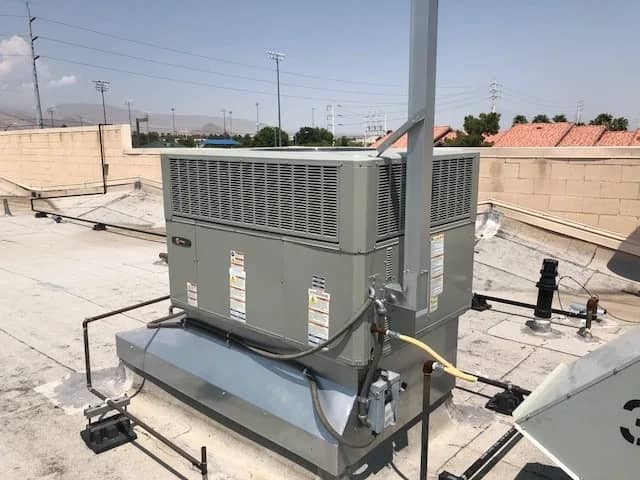
In Southern Nevada, air conditioning is the dominant electrical load in nearly every home. During the cooling season -- which runs roughly from April through October in Las Vegas -- your AC compressor is the single appliance most likely to set your daily demand peak. Here is why. A conventional single-stage air conditioner has one operating mode: full blast. When the thermostat calls for cooling, the compressor kicks on at 100% capacity, drawing a surge of electricity. For a typical 3-ton residential system, that startup draw is approximately 3.5 to 4.5 kW. A 5-ton system can pull 6 kW or more. That compressor then runs at full capacity until the thermostat is satisfied, at which point it shuts off completely. When the house warms up again a few minutes later, the compressor restarts with another full-power surge. This on-off cycling is repeated dozens of times per day during summer, and each restart creates a demand spike that the smart meter records. Now consider what else might be running at the same moment. If your AC compressor starts up while the electric dryer is running (approximately 5 kW), your EV is charging at Level 2 (approximately 7.2 kW), and your pool pump is on (approximately 1.5 to 2.5 kW), your 15-minute demand could easily reach 15 to 20 kW. Under the new rate structure, that simultaneous load is exactly what costs you the most. The fundamental problem with single-stage AC is not that it uses too much energy over the course of a month. It is that it uses energy in sharp, concentrated bursts that create tall demand spikes on the meter.Single-Stage vs Two-Stage vs Variable-Speed: The Demand Charge Difference
The type of AC compressor in your home directly determines how large your demand spikes will be. Here is a comparison for a 3-ton residential system:| Compressor Type | Startup Draw | Normal Running Draw | Minimum Speed Draw | Demand Spike Risk |
|---|---|---|---|---|
| Single-stage | 3.5 - 4.5 kW | 3.5 kW constant | N/A (always full power) | High |
| Two-stage | 2.5 - 3.5 kW | 2.0 - 3.5 kW | ~2.0 kW (low stage) | Medium |
| Variable-speed (inverter) | 0.5 - 1.5 kW (soft start) | 0.5 - 3.5 kW (modulates) | ~0.5 kW | Low |
Why This Matters More in Las Vegas
Las Vegas is at the leading edge of a trend that will eventually reach most of the country. Very few utilities have applied demand charges to residential customers. NV Energy's program makes Southern Nevada one of the first major metro areas where every homeowner will deal with demand-based billing. Several factors make the impact more significant here than it would be in milder climates:- Extended cooling season: Las Vegas homes run air conditioning 8 to 10 months per year. In many months, the AC is the only major energy load, making it the demand peak setter by default.
- Extreme temperatures: With 70+ days above 100 degrees Fahrenheit each summer, AC systems run at or near full capacity for extended periods. This means demand peaks are both frequent and high.
- Older housing stock: Many Las Vegas homes built during the rapid growth of the 2000s were equipped with builder-grade single-stage AC units. Those systems are now 15 to 20 years old and operate at the highest demand-spike profile.
- EV adoption: Southern Nevada has one of the fastest-growing rates of EV ownership in the Southwest. Level 2 home charging at 7.2 kW, combined with AC compressor cycling, can create substantial demand peaks.
- Pool prevalence: An estimated 30% or more of Las Vegas homes have pools. Pool pumps running during the heat of the day add 1.5 to 2.5 kW to whatever else is drawing power.
How Much Will the Demand Charge Actually Cost You?
NV Energy's public communications estimate the average residential impact at approximately $20 per month. That figure is reasonable for a home with moderate loads and no major simultaneous-use issues. But averages can be misleading. Here are three realistic scenarios for Las Vegas households:Scenario 1: Small home, moderate use
A 1,400-square-foot home with a 2.5-ton single-stage AC, no pool, no EV. The homeowner runs the dryer in the evening but generally avoids stacking loads. Typical daily demand peak: 4 to 5 kW. Estimated monthly demand charge: $15 to $25.Scenario 2: Average family home
A 2,200-square-foot home with a 3.5-ton single-stage AC, a pool pump on a timer that overlaps with afternoon AC peaks, and a dryer that runs in the late afternoon. Typical daily demand peak: 8 to 10 kW. Estimated monthly demand charge: $30 to $45.Scenario 3: Large home with EV and pool
A 3,000-square-foot home with a 5-ton single-stage AC, Level 2 EV charger (7.2 kW), pool pump, and a household pattern where the dryer, dishwasher, and AC overlap in the early evening. Typical daily demand peak: 14 to 20 kW. Estimated monthly demand charge: $50 to $75. The key variable is not total usage -- it is simultaneous usage. Scenario 3 does not necessarily consume more total kWh over the month than Scenario 2. But because several high-draw appliances overlap within the same 15-minute windows, the demand peaks are dramatically higher. This is a fundamentally different way to think about your electric bill. Under the old system, the only question was "how much did I use?" Under the new system, you also need to ask "did I use it all at the same time?"5 HVAC Strategies to Flatten Your Demand Curve
Reducing demand charges does not necessarily mean using less electricity. It means using electricity more evenly. Here are five strategies ordered from lowest cost to highest investment:Strategy 1: Stagger your large loads
The simplest and most immediately effective approach requires zero equipment changes. Identify the high-draw appliances in your home -- AC compressor, electric dryer, EV charger, pool pump, electric oven, and dishwasher -- and make sure they are not running simultaneously. Run the dryer early in the morning. Set the pool pump timer for late evening. Schedule EV charging for overnight. This alone can reduce your demand peak by 30 to 50%.Strategy 2: Pre-cool your home
Run your AC harder in the early morning hours (5 a.m. to 10 a.m.) when electricity demand across the grid is lower and your home's thermal mass can absorb the cooling. Then allow the thermostat setpoint to drift upward by 2 to 3 degrees during the afternoon peak hours. Your home acts as a battery, slowly releasing stored coolness rather than demanding a full-blast compressor run when every other appliance is also drawing power. Pre-cooling is especially effective in Las Vegas homes with good insulation and thermal mass (tile floors, stucco walls). A well-insulated home can coast for two to three hours on stored coolness before indoor temperatures rise noticeably.Strategy 3: Smart thermostat scheduling
A smart thermostat with demand-response awareness can automate pre-cooling and setpoint adjustments. Many modern thermostats -- including Ecobee, Google Nest, and Honeywell Home -- support NV Energy's demand response programs and can receive signals to reduce load during grid stress events. Even without utility integration, scheduling your thermostat to pre-cool and coast reduces the number of high-demand compressor starts during peak afternoon hours. See our best thermostats for Las Vegas comparison for specific model recommendations.Strategy 4: Upgrade to a variable-speed AC system
If your air conditioner is more than 10 years old or is a single-stage system, upgrading to a variable-speed (inverter-driven) unit is the most impactful long-term strategy. As shown in the comparison table above, a variable-speed compressor eliminates the 3.5 to 4.5 kW startup spike and replaces it with a gradual 0.5 to 1.5 kW ramp. Over the course of a summer, this reduces both your demand charge and your total energy consumption. The demand charge savings alone can accelerate the payback period of a new system by 1 to 3 years compared to the pre-demand-charge era. When combined with the 25 to 40% reduction in total kWh from higher SEER2 ratings, the financial case for upgrading is stronger than it has ever been. Contact us for a free AC installation estimate that includes demand-charge impact analysis.Strategy 5: Add zoning to your system
A zoned HVAC system divides your home into independent temperature zones. Instead of cooling the entire house to the same temperature, you cool occupied zones while allowing unoccupied zones to drift warmer. This reduces the total cooling load at any given moment, which reduces the compressor speed (on variable-speed systems) or runtime (on staged systems), which reduces your demand peak. Zoning is particularly effective in two-story Las Vegas homes where the upstairs overheats in the afternoon. Rather than running the entire system at maximum to satisfy the upstairs thermostat, a zoned system can focus cooling where it is needed while the cooler downstairs zones require minimal effort.Smart Thermostat Settings That Minimize Demand Charges
Your thermostat is the primary tool for managing when and how hard your AC runs. Here are specific programming strategies for the demand charge era:- Pre-cool schedule: Set your thermostat to 73 to 74 degrees Fahrenheit from 5 a.m. to 10 a.m. This builds a cushion of cooling in your home's thermal mass during lower-demand morning hours.
- Afternoon coast: Allow the setpoint to rise to 77 to 78 degrees from 2 p.m. to 7 p.m. This is when grid demand and your household loads are highest. A warmer setpoint reduces compressor cycling and keeps your demand peak lower.
- Evening recovery: Return to your preferred setpoint (typically 74 to 76 degrees) after 7 p.m. when other large loads like cooking and laundry are finished.
- Fan-only mode: Use the fan-only setting during the coast period to circulate already-cooled air without engaging the compressor. This maintains comfort perception without adding to demand.
- Compressor lockout timer: Some smart thermostats allow you to set a minimum time between compressor cycles (typically 5 to 10 minutes). This prevents rapid on-off cycling that creates repeated demand spikes.
Should You Upgrade Your AC Before October?
The demand charge fundamentally changes the financial math of an AC replacement. Before October 2026, the savings from upgrading were based entirely on reduced kWh consumption (lower SEER2 = lower energy bills). After October, there is a second savings stream: reduced kW demand. Here is a simplified payback comparison for replacing a 15-year-old 3-ton 10-SEER single-stage system with a new variable-speed system:| Cost Factor | Old System (10 SEER, single-stage) | New System (20 SEER2, variable-speed) |
|---|---|---|
| Estimated summer kWh cost (May-Sep) | ~$680/month | ~$380/month |
| Estimated demand charge (May-Sep) | ~$40-55/month | ~$10-18/month |
| Combined summer savings | -- | ~$330-340/month |
| Annual estimated savings | -- | ~$2,400-2,800 |
- Single-stage AC systems older than 10 years
- Systems rated below 14 SEER
- Homes with pools, EVs, or other large electrical loads
- Plans to stay in the home for 5+ more years
Home Battery Storage: Worth It for Demand Charges?
Home battery systems like the Tesla Powerwall, Enphase IQ, and Franklin WH have entered the conversation around demand charges. The idea is straightforward: the battery absorbs solar energy or charges from the grid during off-peak hours, then discharges during your peak demand periods to reduce your grid draw. In theory, a properly sized battery system can flatten your demand curve almost entirely. In practice, the economics are more nuanced:- Cost: A Tesla Powerwall 3 with installation runs approximately $12,000 to $18,000. A system sized to meaningfully offset AC demand typically requires two units.
- Demand charge savings: For a household with $50/month in demand charges, the battery saves $600/year on that line item alone. That is a 20 to 30-year payback on the battery cost from demand savings alone.
- Total value stack: Batteries become more compelling when you combine demand charge savings with solar self-consumption, time-of-use rate optimization, and backup power during outages. NV Energy's net metering changes have also made batteries more attractive for solar homeowners.
- Best case: Homeowners who already have or plan to install solar panels, want backup power, and face high demand charges. The battery serves multiple purposes, improving the overall return.
- Worst case: Buying a battery solely to offset a $20 to $30/month demand charge. The payback period exceeds the battery's warranty life.
NV Energy's Own Tools and Programs
NV Energy offers several programs that help residential customers manage demand and energy costs:- PowerShift demand response: Enroll your smart thermostat and receive bill credits for allowing brief, overridable setpoint adjustments during peak grid stress. Available for Ecobee, Nest, and Honeywell devices.
- Smart thermostat rebates: NV Energy periodically offers rebates on qualifying smart thermostats. Check nvenergy.com for current offers.
- Home energy assessment: NV Energy provides free or subsidized home energy assessments that identify insulation gaps, duct leaks, and equipment inefficiencies contributing to high demand peaks.
- Usage dashboard: Your NV Energy online account shows 15-minute interval usage data. Once the demand charge takes effect, monitoring this data will be essential for identifying which appliances and time windows are setting your daily peak.
- Equal payment plan: While this does not reduce your total bill, it spreads the cost evenly across 12 months, eliminating summer bill shock. Note that the demand charge will still be calculated monthly -- the equal payment plan just smooths the total.
What Renters Can Do
If you rent your home or apartment, you likely cannot replace the AC system or install a home battery. But you are not powerless. Several strategies work regardless of who owns the equipment:- Stagger your loads manually: Do not run the dryer while the AC is cycling heavily. Move laundry to early morning or late evening.
- Use a portable timer or smart plug to schedule high-draw devices (space heaters in winter, portable AC units, dehumidifiers) for off-peak windows.
- Request a smart thermostat: Many landlords will approve a smart thermostat upgrade since it reduces energy costs and increases the property's appeal. Offer to install a Nest or Ecobee and leave it when you move out.
- Reduce the cooling load: Blackout curtains on south- and west-facing windows, door draft seals, and window film can reduce how hard the AC works, which reduces demand peaks.
- Use ceiling fans: Fans create a wind chill effect that lets you raise the thermostat setpoint by 3 to 4 degrees without losing comfort. A ceiling fan draws about 60 watts -- negligible for demand purposes compared to the 3,500+ watts your AC compressor pulls.
- Talk to your landlord about the AC system: If the AC is old, inefficient, and your electric bill is in your name, the demand charge gives you a concrete financial argument for requesting an upgrade. Nevada law requires landlords to maintain functioning AC. An aging single-stage system that creates outsized demand charges could factor into that conversation.
Frequently Asked Questions
What exactly is a demand charge and how is it different from my regular electric rate?
Your regular electric rate charges you per kilowatt-hour (kWh) for total electricity consumed over the billing period. A demand charge adds a separate fee based on your highest instantaneous power draw, measured as the peak 15-minute average kilowatt (kW) reading each day. Two homes can use the same total kWh but pay very different demand charges depending on whether they spread usage evenly or stack heavy loads at the same time.
When does the NV Energy demand charge start?
The demand charge takes effect October 1, 2026. It was originally scheduled for April 2026 but was delayed by six months as part of a settlement that included approximately $63 million in customer refunds. All NV Energy residential customers in Southern Nevada will be subject to the new rate structure automatically -- there is no opt-in or opt-out.
How much will the demand charge add to my monthly bill?
NV Energy estimates the average impact at approximately $20 per month. However, your actual cost depends on your peak demand profile. Homes with single-stage AC running simultaneously with EV chargers, pool pumps, or electric dryers could see $40 to $75 per month in summer demand charges. Homes with variable-speed AC and good load management may see less than $15 per month.
Does a variable-speed air conditioner really help with demand charges?
Yes, significantly. A variable-speed (inverter-driven) compressor starts gradually at 0.5 to 1.5 kW instead of surging to 3.5 to 4.5 kW like a single-stage unit. It also runs continuously at the lowest speed needed rather than cycling on and off at full power. This dramatically reduces the 15-minute demand peaks that the new charge is based on. Variable-speed systems are the single most effective equipment upgrade for minimizing demand charges.
Can a smart thermostat reduce my demand charge?
A smart thermostat helps in two ways. First, it can pre-cool your home during low-demand morning hours and coast during high-demand afternoon hours, reducing compressor cycling when your other appliances are also running. Second, many smart thermostats integrate with NV Energy's PowerShift demand response program, earning credits and receiving grid-aware scheduling signals. It is not a complete solution on its own, but it is a low-cost, high-impact tool.
Will solar panels eliminate my demand charge?
Solar panels reduce your net energy consumption but do not automatically eliminate demand charges. If your AC compressor kicks on during a cloudy interval or in the evening after solar production drops, that demand spike still registers on the meter. Pairing solar with a home battery system is more effective for demand management because the battery can discharge during your peak moments. However, the combined cost of solar plus battery is substantial, and the payback from demand charge savings alone is slow.
Is the demand charge just for summer or year-round?
The demand charge applies to every billing cycle year-round. However, the impact is greatest during the cooling season (roughly May through October) because air conditioning creates the highest demand peaks. During winter months, when cooling loads are minimal, demand charges will be significantly lower for most Las Vegas households -- often under $10 per month.
Should I replace my AC before October 2026 to avoid higher demand charges?
If your current system is a single-stage unit older than 10 years and rated below 14 SEER, the combined savings from lower energy consumption and reduced demand charges make upgrading before October financially compelling. The payback period for a variable-speed system is 1 to 3 years shorter when demand charge savings are factored in. If your system is newer, two-stage or variable-speed, and in good condition, behavioral strategies like load staggering and pre-cooling may be sufficient. Schedule a diagnostic assessment to evaluate your specific situation.
What The Cooling Company Recommends
The demand charge is not a crisis -- it is a shift in how electricity costs are calculated. Homeowners who understand the change and take a few deliberate steps before October will barely notice it on their bills. Those who ignore it risk paying $500 to $900 more per year than they need to. Here is our recommended action plan, ordered by priority:- Log in to your NV Energy account today. Review your 15-minute usage data. Identify your daily peaks and what appliances are running during those windows. Knowledge is the first step.
- Start staggering your large electrical loads immediately. Move dryer cycles to morning. Schedule EV charging for overnight. Adjust pool pump timers to avoid afternoon overlap with AC. This costs nothing and can reduce demand peaks by 30 to 50%.
- Install or upgrade to a smart thermostat. Program pre-cooling schedules and enroll in NV Energy's PowerShift program. Budget: $150 to $300 for the thermostat, or contact us for professional installation that ensures compatibility with your system.
- Schedule an AC assessment. If your system is more than 10 years old, a $79 diagnostic from The Cooling Company will tell you exactly where your equipment stands, what demand spikes it creates, and whether upgrading makes financial sense before October. We hold Nevada contractor licenses #0075849 (C-21 mechanical) and #0078611 (C-1D plumbing), carry a $700,000 bid limit, and maintain a 4.8-star rating across 787+ verified reviews.
- If upgrading, prioritize variable-speed technology. Whether you choose a central AC system, a heat pump, or a ductless mini-split, variable-speed (inverter) compressor technology delivers the greatest demand charge reduction. Ask us about current promotions and manufacturer rebates.
- Maintain your system. A dirty condenser coil, low refrigerant, or clogged filter forces the compressor to work harder and draw more power, increasing your demand peak. Our Comfort Club maintenance plans keep your system operating at peak efficiency year-round.