
The short version: Over the last few years, private-equity firms have been quietly buying up thousands of family-owned HVAC, plumbing, and electrical companies across the country and rolling them into giant national networks. Industry analysts now count more than two dozen private-equity-backed HVAC platforms in the U.S., and private-equity-backed add-on acquisitions of HVAC companies jumped roughly 88% year over year heading into mid-2025. The model is built to maximize returns inside a short ownership window, which often means more upselling, more "replace it" instead of "repair it," and higher prices. The Cooling Company has been offered that path more than once. We said no. We are still family-owned, still independent, and we intend to stay that way, even though doing it right, slowly, without outside capital, is much harder. This is my honest explanation of why. Tiago Santana
Key Takeaways
- HVAC is being consolidated fast. Private equity treats the home trades as a prime "roll-up" target: thousands of small operators, recurring demand, and pricing power. Deal activity hit records in 2024 and kept climbing through 2025.
- The model is built around a clock. PE firms typically aim to buy, grow returns, and sell within a few years. That timeline shapes everything: pricing, sales targets, staffing, and how your service call gets handled.
- It quietly changes your experience. Reporting and former-employee accounts describe a shift toward commission-driven upselling, faster "replace the box" recommendations, and "good enough for now" repairs over real fixes.
- Prices tend to rise where consolidation deepens. When one backer owns several of the brands in a market, competition that used to keep prices honest can fade.
- The local name on the truck doesn't always tell you who owns it. Many roll-ups keep the familiar family brand on the door long after the family is gone.
- The Cooling Company chose the harder road. We turned down outside capital, stayed independent, and accept that building this way is slower and more expensive for us, so it doesn't have to be for you.
- You can tell the difference, and your choice matters. Supporting a genuinely local, independent company keeps real competition, real accountability, and real craftsmanship alive in the valley.
A Letter From Me, Not From a Marketing Department
My name is Tiago Santana. My family started The Cooling Company in Las Vegas in 2011. I want to write to you the way I'd talk to you across my kitchen table, because what I'm about to describe is one of the biggest, quietest changes happening to the home-services industry, and almost nobody is explaining it to the people it affects most. You.
This isn't a how-to article. There are no SEER charts here. This is a manifesto, and a confession. The confession part is this: the path we've chosen for our company is harder than the alternative. We've watched competitors take a shortcut that we've deliberately refused, and on paper, that shortcut looks smart. It brings in money. It funds trucks and ads and growth almost overnight. And every time I've been asked why we don't take it, the honest answer is uncomfortable: because taking it would mean changing who we serve first. It would move you, the homeowner, down the list and put a financial return at the top.
We're not willing to do that. So we build slowly. We grow on our own cash and our own reputation. And it is genuinely hard. I want to tell you exactly what we're refusing, why it matters to your family, and what it actually costs us to keep our word. If you take nothing else from this, take this: the next time your AC dies at 115 degrees and someone shows up at your door, it's worth knowing who really owns the company on that truck and what they're optimizing for.
What Is a Private-Equity "Roll-Up," in Plain English?
Let me define the thing before I have opinions about it.
A private-equity firm is an investment company that raises money from large investors (pension funds, university endowments, wealthy individuals) and uses it to buy ownership of businesses. The goal is simple and not sinister on its face: buy a company, increase its value, and sell it later for a profit. That profit gets split between the firm and its investors. Private equity has been part of the economy for decades, and plenty of it is ordinary.
A roll-up is a specific strategy within that world. Instead of buying one big company, the firm buys one mid-sized company to serve as a "platform," then uses it to acquire many smaller companies in the same industry (called "add-ons"), stitching them together into a single, much larger operation. You buy ten plumbing companies, merge their back offices, their buying power, their call centers, their software, and suddenly you have a regional or national player that's worth far more than the sum of the ten parts you paid for. Then you sell the whole thing, often to an even larger fund.
Here's the part that matters: this model runs on a clock. A private-equity firm doesn't usually intend to own your neighborhood HVAC company forever. The standard playbook is to hold an investment for somewhere around three to seven years, juice its growth and profitability hard during that window, and then exit (sell it) at a much higher valuation. Everything the firm does is in service of making the business look as profitable and fast-growing as possible by the time the "for sale" sign goes up.
That clock is not a detail. It's the whole story. Because the things that make a home-services business look great to a future buyer in three years are not always the same things that make it great for the family whose furnace is broken tonight.
Why the Trades Became Wall Street's Favorite New Target
For most of my life, nobody on Wall Street wanted anything to do with HVAC, plumbing, or electrical work. It was unglamorous. It was your uncle with a van. That changed dramatically, and fast.
If you read what the investment bankers and deal advisors are actually telling each other (and I do, because I need to understand the world my company lives in), the home trades check every box on their wish list:
The industry is enormously fragmented. HVAC is a global market valued north of $350 billion, and yet it's made up of thousands upon thousands of small independent operators. Analysts point out that no single company holds even a couple of percent of the national market. To an investor, fragmentation isn't a problem. It's an opportunity. It means there's a long runway to buy company after company and consolidate a market that has never been consolidated before.
Demand is recurring and recession-resistant. Your air conditioner doesn't care about the stock market. In Las Vegas, it has to run for seven brutal months a year whether the economy is booming or not. People will skip vacations before they'll sit in a 115-degree house. That reliability is exactly what investors crave: predictable, repeating revenue.
There's real pricing power. When your AC fails in July and your kids are home, you are not in a strong negotiating position. You need it fixed now. Investors understand that a customer in distress is a customer who will pay. Advisors openly describe the residential trades as having strong "pricing power with the customer base." Read that sentence again, slowly, as the customer.
Maintenance plans create lock-in. Recurring service agreements (the kind that bring a technician back every season) look beautiful on a spreadsheet because they convert one-time customers into subscription-like revenue.
So the money came. And it came in a wave. Deal advisors reported a record number of HVAC-focused private-equity transactions in 2024, and the pace kept climbing into 2025. By one accounting from Capstone Partners, reported through S&P Global Market Intelligence, private-equity-backed add-on acquisitions of HVAC service companies rose roughly 88% year over year through the first half of 2025 (32 such deals versus 17 in the same period a year earlier), the roll-up machines swallowing smaller shops nearly twice as fast as before. Industry trackers now identify more than two dozen distinct private-equity-backed HVAC platforms operating across the United States.
These aren't small players. Some of these consolidators have rolled dozens of formerly independent brands into single billion-dollar entities. One frequently-cited platform combined more than thirty separate home-services brands into a company valued in the billions. In 2025 alone, separate home-services platforms changed hands in deals valuing them anywhere from around a billion to roughly two and a half billion dollars. This is serious money, moving fast, into the exact industry that fixes your home.
And here's the uncomfortable truth for someone like me: I understand the appeal completely. If you handed me a spreadsheet and asked me to find an underexploited corner of the American economy, the trades would jump off the page. The logic is sound. My objection isn't that the investors are stupid. My objection is about what happens to you when that logic meets your front door.
How the Model Quietly Changes Your Service Call
This is the part I most want you to understand, because it's invisible. The truck still looks the same. The uniform still looks the same. Often the company name is unchanged. Many roll-ups deliberately keep the trusted family name on the door for years after the family has cashed out, precisely because that local reputation is part of what they paid for. So how would you ever know?
You'd know by what starts happening on the service calls. Let me walk through it honestly, drawing on what former employees of acquired companies have described publicly and what's been documented in industry reporting.
Repair becomes "replace"
The single most consistent theme in accounts from technicians at acquired companies is a shift in what they're encouraged, or pressured, to recommend. A repair might cost you a few hundred dollars. A full system replacement costs thousands, sometimes well over ten thousand in this market. Guess which one moves the revenue number that a future buyer cares about?
Former employees of PE-acquired shops have described a cultural shift toward, in their words, "replacing more boxes" and away from caring about whether that's actually what the customer needed. Homeowners served by consolidated companies report a recognizable pattern: a quick diagnosis without a thorough inspection, a "good enough for now" patch instead of a real fix, and a replacement quote pushed when a sensible repair was still on the table. In documented cases, equipment was even oversized and oversold with a promise that the big new unit would "take care of all their problems."
I want to be fair here. Sometimes replacement genuinely is the right call. A fifteen-year-old system limping through its third compressor failure should probably be retired, and we'll tell you so. The problem isn't that replacement is ever recommended. The problem is when the recommendation is being driven by a sales quota instead of by your actual equipment. You deserve to know which one you're getting.
Commissions and quotas enter the picture
To make replacement-heavy selling happen at scale, many consolidated operations lean hard on sales commissions and daily or weekly targets for their technicians. Think about what that does to the person standing in your hallway. A technician who is partly paid on what they sell, and who has a number to hit by Friday, is in a fundamentally different position than one who is simply paid to diagnose your system honestly and fix it.
Some of the most telling comments come from the tradespeople themselves. Several have said that the shift toward selling, rather than repairing, made the work less satisfying. These are people who took pride in fixing things, suddenly being measured on how much they could sell. When the craftsperson is unhappy with what the model asks of them, that tells you something about what the model is doing to the customer on the other side of it.
The squeeze on the people doing the work
Roll-ups create value partly through real efficiencies: shared software, bulk purchasing, centralized scheduling. I won't pretend none of that is legitimate; some of it genuinely is. But a lot of the "value creation" in these deals comes from cost-cutting, and in a service business, the biggest cost is people. There's a documented tension here: while some firms point to pay bumps for technicians after acquisition, critics and former workers describe cost pressure that can mean reduced benefits, increased workload, and turnover among the most experienced people. When experienced tradespeople leave, service quality drops, wait times grow, and the repairs get less consistent. You feel that even if you never see the org chart.
Where it deepens, prices climb
The first promise of consolidation is always efficiency, and efficiency is supposed to mean lower prices. But that's not generally how it plays out for the customer. As one PE-backed firm comes to own several of the brands competing in a single market, the competitive pressure that used to keep everyone's pricing honest weakens. Analysts have noted that consolidation can leave consumers with fewer real choices and higher prices, particularly in areas where a backed firm comes to dominate. Federal producer-price data shows the cost of HVAC equipment has climbed roughly 40% since 2020. Not all of that is consolidation (material and labor costs rose sharply too), but the profit-maximizing posture of the roll-up model is part of the story.
This pattern has gotten large enough that even regulators have started paying attention to roll-up strategies and serial acquisitions across the economy, out of concern that they can quietly reduce competition and harm consumers.
What Actually Gets Lost
I could keep stacking up facts, but I want to step back and say what I really believe is at stake, because the data only points at it. It doesn't capture it.
When a local company is owned by the family that built it and lives in the community it serves, there's an accountability that no spreadsheet can replicate. If I do you wrong, you might see me at the grocery store. My kids might go to school with yours. My actual family name is on the company. That's not a marketing gimmick. That's a structural form of accountability. I cannot exit in three years. I cannot hand your bad experience off to a fund in another state. I have to live with it, here, in front of my neighbors.
What gets lost in consolidation is continuity of judgment. The technician who's been to your house for six years knows your system, knows your home, knows that you mentioned the baby's room never cools right. That institutional memory, the relationship, is exactly the kind of thing that doesn't fit neatly into a centralized national playbook, and it's exactly the kind of thing that erodes when the people doing the work churn through.
What gets lost is the freedom to do right by you when it costs us money. When you answer to outside investors with a return target and a clock, every decision gets filtered through "what does this do to the numbers before we sell?" When you answer to your own conscience and your own neighbors, you can make the call that's right for the customer even when it's worse for this quarter. We get to tell you "honestly, you don't need a new system, let's just replace this part," and absorb the smaller ticket, because the relationship is worth more to us than the sale.
And what gets lost, frankly, is the local economy itself. When a roll-up acquires a Vegas company, the profits increasingly flow out of the valley to investors who've never driven I-15 in August. The decisions about your home comfort get made in a boardroom that has never felt our heat. I'm not romantic about small business for its own sake, but I do believe a community is healthier when the businesses serving it are rooted in it.
Why We Said No
I'll be direct: we've had the conversations. When you build a recognizable, well-reviewed home-services company in a major market, the calls come. The pitch is genuinely seductive, and I'd be lying if I said it wasn't.
Here's what they offer. A check, often a life-changing one. Capital to grow far faster than we could on our own. Trucks, technicians, advertising, new locations, all funded immediately instead of earned slowly over years. They tell you that you can keep running it, keep the name, keep the culture. For a founder who has spent years scrapping for every dollar, it's a powerful thing to be told you can have all of it at once.
We said no. More than once.
We said no because I read the fine print of that promise. Not the legal fine print. The human fine print. The moment you take that capital, the relationship inverts. You no longer answer first to your customers. You answer first to the people who wrote the check and who need their return inside their window. Everyone tells you the culture won't change, and maybe it doesn't on day one. But the incentives change immediately, and incentives win. Over time, the company becomes what its incentives reward. And a company whose incentive is to maximize a sale price in three years will make different choices in your hallway than a company whose only incentive is to still be trusted in this valley in twenty years.
We want to still be here in twenty years. Not sold. Here. Same family, same name, same accountability. That's the entire point.
So we turned down the shortcut. And I want to be honest about what that decision actually costs us, because I think the cost is the most important part of this whole story.
What "Doing It Right" Actually Costs Us
It would be easy to write a self-congratulatory piece about how virtuous we are for staying independent. That's not what this is. Choosing this road is genuinely hard, and I respect you too much to pretend otherwise. Here's the real bill we pay for it.
We grow slowly. Every truck we add, every technician we hire and train, every new bay and tool: it comes out of money we actually earned, not money an investor fronted us. A roll-up can add fifty trucks in a year by writing a check. We add them as we can afford them, the old-fashioned way. That means there are seasons where we're stretched thin, where demand outruns our capacity, where I wish we could move faster. We can't borrow our way past the hard part. We have to grow through it.
We leave money on the table, on purpose. When our technician tells you that you need a repair and not a replacement, we just chose the smaller invoice over the bigger one. Multiply that across thousands of service calls a year and it's a meaningful amount of revenue we deliberately don't capture. A model optimized for the exit wouldn't make that choice. We make it every day, and it costs us, and we'd make it again.
We pay to keep good people. Holding onto experienced, well-trained technicians in a hot labor market is expensive. We could cut benefits, lean on cheaper labor, and let people churn. That's a recognized way to widen margins. We don't, because the person in your home is the entire product. But "we don't cut corners on our people" is another way of saying "our costs are higher than they could be." That's a choice, and we own it.
We refuse the easy upsell. We don't put our technicians on aggressive sales quotas, and we don't reward the person who sold you the biggest system regardless of whether you needed it. That keeps us honest, and it also means we don't get the short-term revenue bump that quota-driven selling produces. We trade that bump for your trust. I think it's the best trade we make.
We can't outspend the giants on marketing. A national consolidator can flood the market with ads in a way a family company simply can't match dollar for dollar. We compete on reputation, on reviews earned one honest job at a time, on referrals from neighbors. It works (we're rated 4.8 stars across hundreds of Google reviews and we've served the valley since 2011), but it's slower and less certain than buying attention.
I won't pretend any of this is easy. The harder road is harder. That's not a slogan; it's a fact of our P&L. But here's the thing I keep coming back to, and it's the closest thing I have to a creed: it is harder to build and do things right without rushing or injecting capital, but we refuse to take shortcuts, and we will always do things the right way. If that costs us growth, it costs us growth. We'd rather be smaller and trusted than bigger and owned.
What This Means for You, the Homeowner
Let me bring this all the way back to your house, because that's where it actually lives.
When you call an independent, family-owned company for your AC, you're getting a few things that are structurally different from the consolidated alternative. Not because we're better people, but because our incentives are pointed at you instead of at an exit.
You get a diagnosis that's trying to find the truth about your system, not a sale. You get a recommendation to repair when repair is right, because nobody in our shop has a quota that makes the bigger ticket more attractive. You get the same technicians over the years, building real knowledge of your home. You get a company that has to live with its reputation in this town, which is the most powerful warranty there is. And when something goes wrong (because in the real world, sometimes it does) you get a path to an owner who actually cares, not a customer-service queue routed to a fund that's about to sell the company anyway.
You also, honestly, are supporting something bigger than your own comfort. Every time you choose a genuinely local, independent company, you're casting a small vote to keep real competition alive in the valley. You're keeping a check on the consolidation that, left unchecked, tends to mean fewer choices and higher prices for everyone. You're keeping dollars circulating in Las Vegas instead of flowing out to investors who've never felt our July. That's not charity. It's enlightened self-interest. A market with healthy, independent competitors is a market that treats you better.
How to Tell the Difference
I'm not going to name competitors and accuse them of anything. That's not how I do business, and a lot of fine independent shops compete with us honestly. But you have every right to know who you're actually hiring. Here's how to find out, without me pointing fingers at anyone.
Ask directly: "Are you family-owned and independent, or are you owned by an investment group or a national parent company?" A genuinely independent company will answer that question plainly and proudly. Watch for vague answers, corporate-speak, or a pivot away from the question.
Look up who owns the brand. A quick search of the company name plus terms like "acquired," "private equity," "platform," or "portfolio company" will often surface a press release announcing the deal. Roll-ups love to announce their acquisitions to investors even when they keep quiet with customers.
Notice the sales posture on the call. Are they diagnosing, or are they selling? Did they actually inspect the system thoroughly, or rush to a replacement quote? Were you handed a tablet with "good, better, best" packages before anyone really understood what was wrong? A push toward the most expensive option, fast, is a tell. So is a hard time-pressure close: "this price is only good today." For more on the specific tactics to watch for, read our guide on how to avoid HVAC scams in Las Vegas and our breakdown of the $49 AC tune-up scam that's designed to get a salesperson in your door.
Check how long the same faces have been there. Ask how long your technician has worked for the company. High turnover often follows consolidation. Continuity is a good sign.
Read the reviews for patterns, not just the star rating. Look for repeated mentions of being pushed toward replacement, of surprise upsells, or of a noticeable change in service quality "after they got bought." Patterns tell the truth.
None of this is about avoiding every large company or assuming every roll-up does wrong by every customer. That wouldn't be fair or accurate. It's about knowing what you're walking into, and choosing with your eyes open.
A Word About Supporting Local
I'll close the argument where I think it really sits: this is, in the end, about what kind of community we want to live in.
There's a version of every American industry where a handful of financial owners control everything, where the local name on the building is just a costume worn by a distant balance sheet, and where the person fixing your home answers to a quota instead of to you. The home trades are being pulled toward that version right now, faster than almost anyone realizes. It's happening to HVAC, to plumbing, to electrical, to veterinary clinics, to dental offices, to so many of the local businesses that used to be the backbone of a place.
The thing standing against it is ordinary. It's you, deciding who to call. It's a homeowner choosing the independent shop over the consolidated one, not out of nostalgia, but because they understand what they're protecting. Every one of those choices keeps a real, rooted, accountable business alive and keeps the whole market honest for everybody else, even the people who never think about any of this.
We chose to stay independent because we believe in that version of the valley. We're betting our entire company on the idea that if we just keep doing right by you, year after year, you'll choose us back. It's a slower bet. It's a harder bet. But it's the only one I can make and still look my neighbors in the eye.
Where We Stand
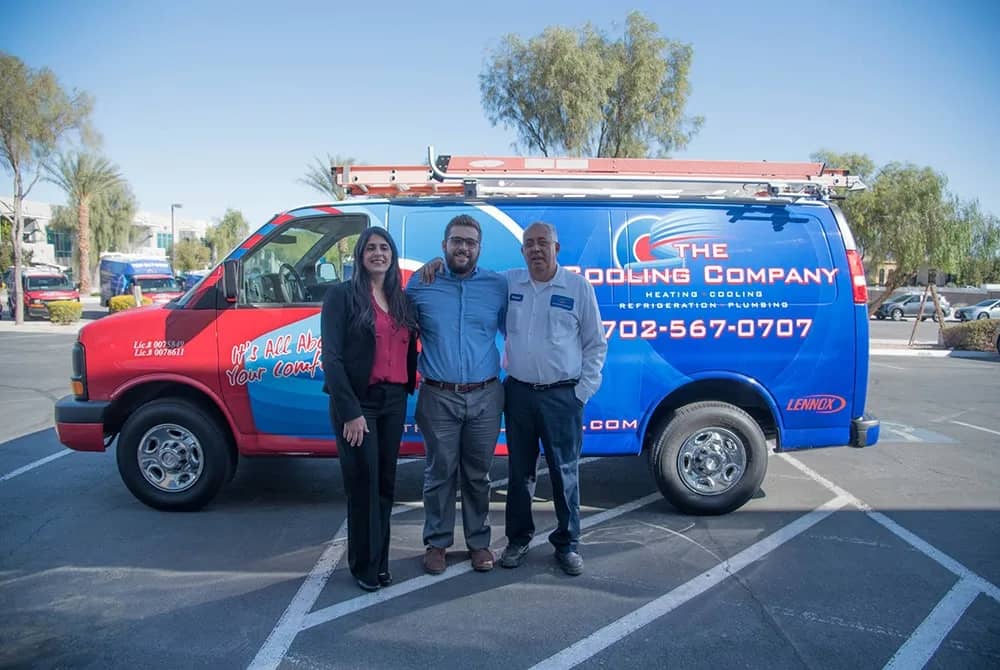
The Cooling Company has served Las Vegas since 2011. We are family-owned, independent, and not for sale. We're licensed in Nevada (#0075849, C-21; and #0078611, C-1D) and rated 4.8 stars across hundreds of Google reviews from real neighbors across the valley: Henderson, Summerlin, North Las Vegas, Green Valley, Enterprise, Centennial Hills, and everywhere in between.
When you call us, you're not feeding a financial return on somebody's three-year clock. You're hiring a family that has to live with the work. We'll diagnose honestly, repair when repair is right, and tell you the truth even when the truth is smaller than the sale. That's the whole company. That's the entire point.
If your system needs attention, I'd be honored to earn your trust the only way we know how: one honest job at a time.
Call (702) 567-0707 to talk to a real, local team. Learn more about who we are and my role in the family business. Whatever you decide, decide it knowing who you're really hiring.
Tiago Santana
[form id="5"]
Frequently Asked Questions
Is The Cooling Company owned by private equity?
No. The Cooling Company is family-owned and independent. We have been since we started in Las Vegas in 2011, and we have declined offers from investment groups to buy or take a major stake in the company. We are not a portfolio company, not part of a national roll-up, and not for sale. The family that built the company still owns and runs it, which means we answer first to our customers and our community, not to outside investors on a timeline to sell.
Why is private equity buying HVAC and plumbing companies?
The home trades check every box investors look for: the industry is highly fragmented (thousands of small operators, no dominant national brand), demand is recurring and recession-resistant (people always need heating and cooling), and there is strong pricing power because customers in distress (like a homeowner with no AC in July) will pay to get fixed fast. Investors buy a "platform" company, then acquire many smaller shops and merge them into a large network they can sell later at a higher value. Industry trackers now count more than two dozen private-equity-backed HVAC platforms in the U.S., and add-on acquisitions rose roughly 88% year over year heading into mid-2025.
Does private equity ownership make HVAC service more expensive?
It often does, especially where consolidation deepens. When a single backer owns several of the competing brands in one market, the competitive pressure that normally keeps prices honest weakens, and analysts have noted this can leave consumers with fewer choices and higher prices. The model also tends to favor higher-revenue recommendations: replacing systems rather than repairing them, and commission-driven upselling. Federal producer-price data shows HVAC equipment costs have risen roughly 40% since 2020. Material and labor inflation is a big part of that, but the profit-maximizing posture of consolidated ownership contributes too.
How can I tell if my local HVAC company is owned by private equity?
Ask directly whether the company is family-owned and independent or owned by an investment group or national parent. An independent company will answer plainly. Search the company name along with terms like "acquired," "private equity," "platform," or "portfolio company," since roll-ups usually announce acquisitions to investors even when they stay quiet with customers. Watch the sales posture on your service call: a fast push toward the most expensive replacement option, high-pressure "today only" pricing, or a quote before anyone thoroughly inspected your system are all signals. Many roll-ups keep the original family name on the truck, so the brand alone won't tell you.
Why does it matter whether my HVAC company is locally owned?
A locally owned, independent company is structurally accountable in a way a distant investor-owned chain is not. The owner lives in your community, has their name on the work, and cannot simply sell the company and walk away from a bad experience. Their incentive is long-term trust, not a short-term sale price. That usually means honest diagnoses, repairs recommended when repair is right, the same technicians over the years, and a real owner to reach if something goes wrong. Choosing local also keeps genuine competition alive in your market, which keeps prices and service quality honest for everyone and keeps dollars circulating in your own community.
Is it always bad when a private-equity firm buys a home-services company?
No, and it would be unfair to claim otherwise. Consolidation can bring real benefits: better software, bulk purchasing power, more consistent training, and in some cases higher technician pay after acquisition. Plenty of good people work at backed companies. The concern is about incentives and the clock: when a business is being optimized to sell within a few years, the pressure toward upselling, replacement over repair, and cost-cutting on the people doing the work tends to grow. The point isn't to avoid every large company. It's to understand what you're hiring and decide with your eyes open.
What is The Cooling Company's approach instead?
We grow on our own earned revenue rather than outside capital, which is slower but keeps us answerable only to our customers. We diagnose honestly and recommend repair when repair is the right call, even though it means a smaller invoice. We don't put our technicians on aggressive sales quotas. We invest in keeping experienced people rather than cutting corners on labor. It's a harder, more expensive way to build a company, but it's the only way we're willing to do it. You can learn more about our services on our AC repair, AC maintenance, and AC installation pages, or about our ongoing maintenance plans.
Related Reading
- How to Avoid HVAC Scams in Las Vegas: the specific tactics to watch for
- The $49 AC Tune-Up Scam Explained: how a cheap tune-up becomes a sales call
- Why Ownership Structure Matters When Choosing an HVAC Company: the family-owned vs PE-backed vs franchise breakdown, point by point
- About The Cooling Company: who we are and why we started
- Tiago Santana: my role in the family business
Services:
- AC Repair: honest diagnosis, repair when repair is right
- AC Maintenance: seasonal tune-ups that protect your system
- AC Installation: straight answers on when replacement actually makes sense
- Maintenance Plans: ongoing care at a fixed annual price
Share This Page