

AC Not Turning On in Las Vegas? 8 Things to Check Before Calling for Repair
Short answer: If your AC won't turn on in Las Vegas, start with the thermostat — confirm it is set to COOL, the temperature is set below room temp, and the display is not blank. Next, check your circuit breaker, the outdoor disconnect switch, and your air filter. About 30% of "AC won't start" calls are resolved by one of these simple checks. If none of them work, or if your indoor temperature is climbing above 95°F with vulnerable people in the home, call The Cooling Company at (702) 567-0707 for 24/7 emergency service. Our $79 diagnostic fee is waived for Comfort Club members.
Key Takeaways
- 30% of "AC won't start" calls are resolved by checking the thermostat, breaker, disconnect, or filter — no technician needed.
- AC failure in Las Vegas heat is a health emergency. If indoor temps exceed 95°F with elderly, children, or pets, call immediately.
- Common repair costs: Capacitor $150–$300, contactor $200–$400, thermostat $150–$500, compressor $1,500–$2,500.
- TCC diagnostic fee: $79 (waived for Comfort Club members). 24/7 emergency service available.
- Prevention: Annual tune-ups catch 90% of the failures that cause AC shutdowns. See our spring checklist.
Your AC just stopped working. In most cities, that is an inconvenience. In Las Vegas — where summer afternoons push past 115°F and attic temperatures can reach 150°F — a dead air conditioner is a health emergency waiting to happen. The Clark County Coroner's Office reports heat-related deaths every summer, and many of those tragedies begin with a home that lost cooling.
Before you panic, there are eight things you can check yourself in the next 15 minutes. Some of them are genuinely simple fixes that do not require a technician at all. Others will help you identify the problem so a technician can arrive prepared with the right parts and get your system running faster.
This guide is written specifically for Las Vegas homeowners. The desert climate, rooftop unit configurations, and extreme heat cycles that define our valley create failure patterns that are different from what you will read in generic troubleshooting articles. We service homes across Las Vegas, Henderson, Summerlin, North Las Vegas, and every community in between — and these are the exact checks our dispatchers walk callers through before we roll a truck.
The 60-Second Triage: What to Check Right Now
Before you work through the full checklist, take 60 seconds and answer these four questions. They will tell you whether this is a quick fix, a standard repair, or a genuine emergency that needs immediate professional help.
1. Is anyone in your home elderly, very young, medically fragile, or a pet that cannot regulate body temperature? If yes, and your indoor temperature is already above 90°F with no cooling, skip every check in this article and call (702) 567-0707 now. Heat exhaustion can set in within 30 minutes at extreme temperatures, and heat stroke can follow quickly. This is not a DIY situation when lives are at risk.
2. Do you smell burning, see smoke, or notice scorch marks on your electrical panel or AC unit? If yes, turn off the breaker for your AC system immediately, leave the area, and call a professional. Electrical fires in HVAC systems happen, and Las Vegas attics — where many air handlers are installed — are already dangerously hot in summer.
3. Is your thermostat screen completely blank? If the screen shows nothing at all, the problem might be as simple as dead batteries or a tripped breaker. That is good news. Proceed to Checks #1 and #2.
4. Was your AC working fine yesterday and just stopped today? Sudden failures in a system that was recently running well often point to electrical issues (breaker, capacitor, contactor) rather than major mechanical failures. These are usually straightforward repairs.
Check #1: Your Thermostat Settings (The Most Common "Fix")
This is the single most common reason for "my AC won't turn on" calls in Las Vegas, and it is resolved without a technician about 15% of the time. Before you do anything else, walk to your thermostat and verify every one of these settings.
Confirm the mode is set to COOL. It sounds obvious, but thermostats get bumped, children press buttons, and smart thermostats sometimes switch modes after software updates. If your thermostat is set to HEAT, OFF, or FAN ONLY, your compressor will not start. On most thermostats, you need to see "COOL" or a snowflake icon actively displayed.
Check the temperature setpoint. Your thermostat needs to be set at least 3-5 degrees below the current room temperature to trigger a cooling cycle. In Las Vegas, we see homeowners set their thermostat to 78°F thinking it should be cooling — but if the indoor temperature is already 77°F, the system has no reason to turn on. During summer, try setting it to 72°F temporarily and wait 3-5 minutes to see if the system responds.
Look for a blank display. If your thermostat screen is completely dark, the unit has lost power. For battery-powered thermostats (most Honeywell, Emerson, and some Ecobee models), replace the batteries — this is usually AA, AAA, or a CR2032 coin cell depending on your model. For hardwired thermostats (Nest, most smart thermostats), a blank screen means the thermostat has lost its 24V power supply, which usually points to a tripped breaker or a blown fuse on the air handler's control board.
Check for schedule overrides and holds. Smart thermostats — Nest, Ecobee, Honeywell Home — can have complex schedules that override your manual settings. Look for "Hold," "Schedule," or "Away" indicators on the screen. Nest thermostats sometimes activate "Auto-Away" if they detect no motion in the house, raising the setpoint far above what you actually want. Temporarily disable any schedules and set a manual hold to your desired temperature.
Check for error codes. Many modern thermostats display error codes or warning messages when something is wrong. If you see a code like "E1," "E2," a blinking snowflake icon, or a "Waiting for equipment" message, write it down. This information will save your technician significant diagnostic time.
Las Vegas-specific note: During peak summer, power surges from heavy grid demand can reset smart thermostats to factory defaults or switch them out of cooling mode. After any power flicker — which are common during July and August when NV Energy's grid is under strain — check your thermostat settings.
Check #2: The Circuit Breaker and Electrical Panel
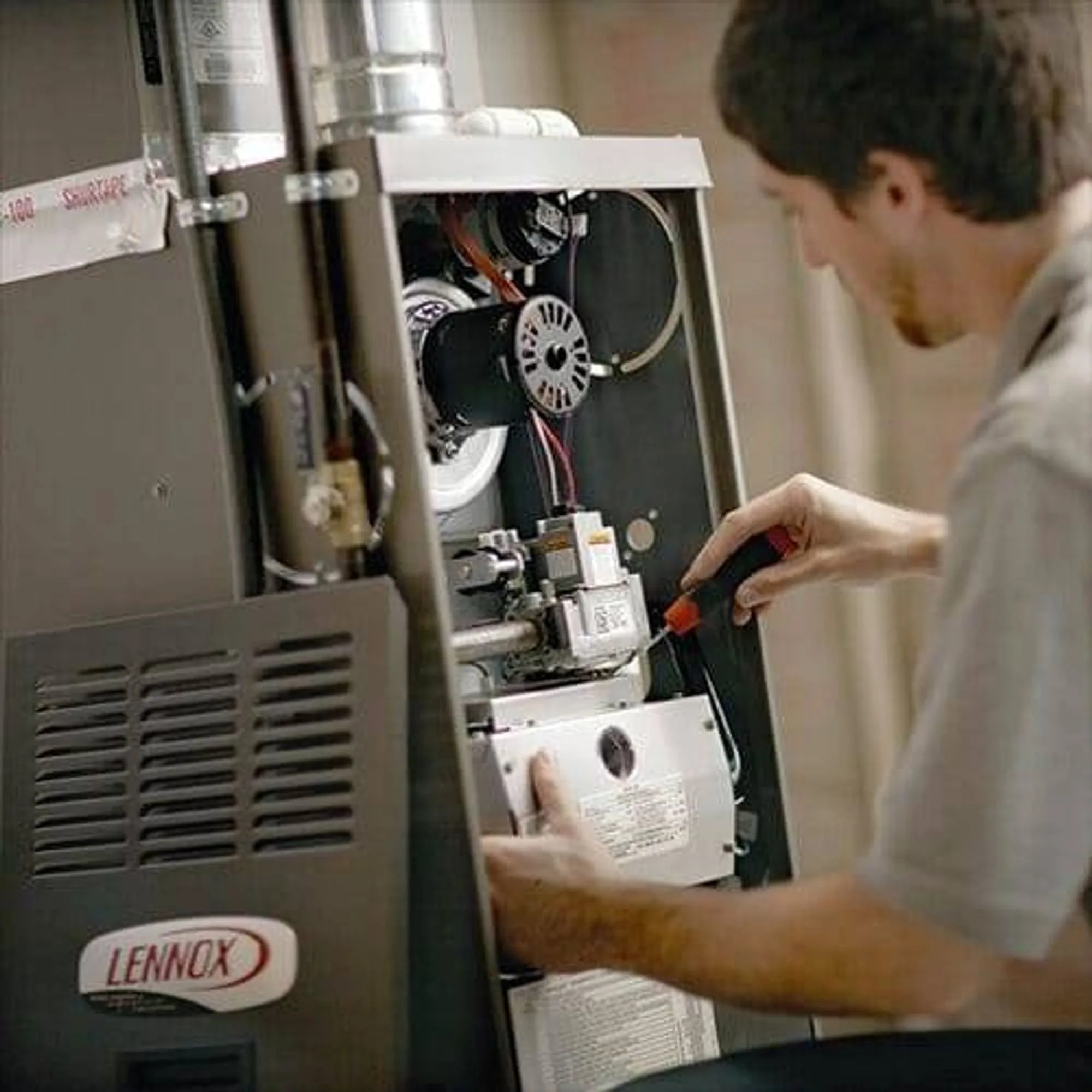
Your air conditioning system uses two separate circuits in most Las Vegas homes — one for the indoor air handler (usually in the attic or a closet) and one for the outdoor condenser unit. Either one can trip independently, and when one trips, your entire system stops working.
Find your electrical panel. In most Las Vegas homes built after 1990, the main electrical panel is in the garage. Older homes may have it on an exterior wall, in a hallway closet, or in a utility room. Look for a gray metal box with a hinged door.
Identify the AC breakers. You are looking for breakers labeled "AC," "A/C," "Air Handler," "Condenser," "HVAC," or "Air Conditioning." Most central AC systems use two breakers — a smaller one (15-20 amp) for the air handler and a larger one (30-60 amp) for the condenser. In some panels, these are double-pole breakers that take up two slots.
Check if any breakers are tripped. A tripped breaker sits in a middle position between ON and OFF — it does not flip all the way to OFF. The handle may also feel loose or springy compared to other breakers. Some breaker brands show a red or orange indicator window when tripped.
How to reset a tripped breaker:
- Flip the breaker fully to the OFF position first
- Wait 30 seconds
- Flip it back to the ON position firmly
- Wait 3-5 minutes for your system to restart (most systems have a built-in time delay to protect the compressor)
Important warning: Reset a breaker only once. If the same breaker trips again within a few hours, you have an electrical problem — a short circuit, a failing compressor drawing too many amps, or damaged wiring. Repeatedly resetting a tripping breaker is a fire hazard. At that point, leave the breaker off and call a licensed technician.
Las Vegas-specific note: Summer brownouts and power surges from extreme grid demand frequently trip AC breakers across the valley. After a neighborhood-wide power flicker — especially common in older areas of Las Vegas, North Las Vegas, and parts of Henderson — your AC breaker may have tripped even though the rest of your house has power. We see a spike in breaker-related calls every time temperatures cross 110°F because the grid is under maximum stress.
Check #3: The AC Disconnect Switch (Outside Your House)
This is the check that most troubleshooting guides written for other parts of the country skip entirely, but it is critical for Las Vegas homes. Every outdoor AC condenser unit has a dedicated disconnect switch mounted on the exterior wall of your house, usually within a few feet of the unit itself.
What it looks like: A small gray or beige metal box, roughly the size of a paperback book, mounted to the wall near your outdoor AC unit. It has a hinged cover and usually contains a pull-out handle or a toggle switch. On rooftop units — which are very common in Las Vegas — the disconnect may be on the roof near the unit, accessible only by ladder.
Why it gets turned off: Disconnect switches get turned off during maintenance visits and sometimes are not turned back on. Pest control technicians, painters, landscapers, and handymen working near the unit sometimes flip the disconnect as a safety precaution and forget to restore it. We also see cases where pool service technicians and yard maintenance crews accidentally bump the disconnect handle while working nearby.
How to check it:
- Open the cover of the disconnect box
- If it has a pull-out handle, make sure the handle is inserted firmly in the "ON" position (the handle must be pushed all the way in)
- If it has a toggle switch, confirm it is in the ON position
- Some disconnects use cartridge fuses — if you see two cylindrical fuses, they should be seated firmly and not visibly damaged (blackened, cracked, or rattling when shaken)
Las Vegas-specific note: Because so many Las Vegas homes have rooftop AC units, the disconnect switches are exposed to extreme sun, monsoon rain, and wind-blown debris year-round. Corrosion on disconnect contacts is common in our climate, especially during monsoon season (July through September) when sudden humidity spikes cause condensation inside the disconnect box. If the disconnect looks corroded, swollen, or melted, do not touch it — call a licensed electrician or HVAC technician.
Check #4: Your Air Filter — A Clogged Filter Can Shut Down Your System
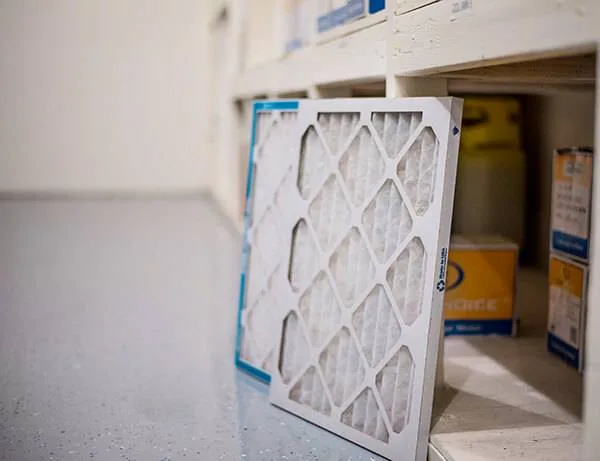
A severely clogged air filter can absolutely cause your AC system to shut down completely, and Las Vegas is one of the worst cities in the country for filter clogging. Desert dust, construction debris, and the fine caliche powder that blows through the valley during windstorms can turn a clean filter into a solid wall of dirt in as little as two to three weeks during summer.
How a dirty filter shuts down your AC: When the filter is clogged, your air handler cannot pull enough air across the evaporator coil. The coil gets too cold because there is not enough warm air passing over it, and ice begins forming on the coil. As ice builds up, airflow drops further. Eventually, the system's safety controls detect the abnormal conditions — low suction pressure, high head pressure, or frozen coil temperatures — and shut the system down to prevent compressor damage.
Where to find your filter:
- Return air grille: Most Las Vegas homes have a large return air grille on a hallway wall or ceiling. The filter slides in behind this grille. Look for a grille that is 20x25 inches, 20x20 inches, or 16x25 inches — larger than your supply vents.
- Air handler cabinet: In some installations, the filter is inside the air handler itself, usually in the attic. You will need to open the service panel on the air handler to access it.
- Multiple returns: Some Las Vegas homes, especially larger ones in Summerlin, Henderson, and the newer master-planned communities, have multiple return air grilles with individual filters.
What to look for: Pull the filter out and hold it up to a light source. If you cannot see any light through the filter material, it is severely clogged and needs replacement immediately. Even if you can see some light, if the filter is visibly gray or brown (and was originally white), it is overdue for a change.
If your filter is clogged:
- Replace it with a new filter of the same size (the size is printed on the filter frame)
- If you do not have a replacement, running the system without a filter temporarily is better than running it with a completely clogged one — but only for a few hours until you can get to a hardware store
- After replacing the filter, wait 30 minutes for any ice on the coil to melt before restarting the system
- If the system still will not start after a filter change, the clogged filter may have caused secondary damage (frozen coil, tripped safety switch) that requires professional attention
Las Vegas filter schedule: Forget the "every 90 days" advice you read elsewhere. In Las Vegas, you need to check your filter every 30 days from April through October and replace it whenever it looks dirty. During dust storms — and we get several major ones every monsoon season — check your filter the day after the storm. Homes near active construction sites (which describes half the valley at any given time) may need filter changes every two to three weeks.
Check #5: The Condensate Drain Line
Your air conditioner removes moisture from the air as it cools your home, and that moisture has to drain somewhere. The condensate drain line carries this water from the indoor evaporator coil to a drain point — usually a PVC pipe that exits your home near the outdoor unit or into a plumbing drain. When this line clogs, many modern AC systems have a safety float switch that shuts down the entire system to prevent water damage.
Why this matters in Las Vegas: You might think that a desert city would not have condensate drain problems, but Las Vegas homes absolutely do — especially during monsoon season. When outdoor humidity spikes from our typical 10-15% up to 40-60% during July and August, your AC system suddenly produces far more condensate than usual. Dust and algae buildup in the drain line that was not causing problems during dry months suddenly becomes a blockage when water volume increases.
Signs of a clogged condensate drain:
- System shuts off and will not restart, but you see no obvious electrical or thermostat issues
- Water dripping from your ceiling, especially near the air handler location in the attic
- A musty or moldy smell coming from your vents
- Water pooled around the indoor air handler unit
- The air handler's drain pan is full of standing water
What you can do:
- Find the drain line exit point: Look for a small PVC pipe (usually 3/4-inch white pipe) exiting your exterior wall near the outdoor unit or dripping near a drain
- Check for flow: When the AC is running, you should see a slow, steady drip of water from this pipe. If there is no drip at all during cooling operation, the line may be clogged
- Try a wet/dry vacuum: Attach a wet/dry vacuum to the end of the drain line and run it for 30-60 seconds. This can dislodge minor clogs
- Pour diluted vinegar: If you can access the drain line cleanout port (usually a capped T-fitting near the air handler), pour a cup of white vinegar or a 50/50 bleach-water mix to help clear biological growth
If the float switch tripped: After clearing the clog, you may need to manually reset the float switch or simply wait 5-10 minutes for it to reset on its own as the water level in the drain pan drops. Some float switches require the system to be power-cycled (turn the breaker off and back on) to reset.
Check #6: Is Your Outdoor Unit Running?
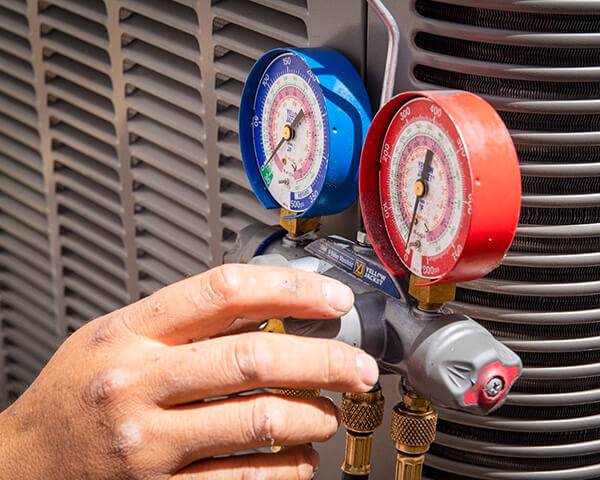
Walk outside (carefully — in Las Vegas summer, the ground and pavement around your outdoor unit can be hot enough to burn bare feet) and check whether your outdoor condenser unit is doing anything at all.
Where to look: In most Las Vegas homes, the outdoor condenser is a large metal box with a fan on top, sitting on a concrete pad on the side or back of the house. If you have a rooftop package unit — common in older Las Vegas neighborhoods and many single-story homes — you will need to go to the roof or at least listen from ground level for fan and compressor noise.
What you should see and hear when the system is calling for cooling:
- The large fan on top of the unit should be spinning
- You should hear a low, steady hum from the compressor
- The unit should be blowing warm air upward (or outward, depending on the design)
Scenario 1 — The fan is running but the compressor is not: You will hear the fan spinning and feel air moving, but there is no deep hum from the compressor. This usually means a bad compressor capacitor, a failed compressor contactor, or a compressor motor failure. A capacitor is a $150-$350 repair. A contactor is $150-$300. A compressor replacement is $2,000-$4,500+ and may justify considering a full system replacement if your unit is more than 12-15 years old.
Scenario 2 — Nothing at all from the outdoor unit: Complete silence means the unit is not receiving power or the contactor is not engaging. Check the disconnect switch (Check #3). If the disconnect is on, this points to a failed contactor, blown fuse in the disconnect box, or a control board issue inside the air handler that is not sending the signal to start the condenser.
Scenario 3 — The fan is running backwards (slowly, in the wrong direction): This rare but serious condition means a capacitor has failed. The fan motor is trying to run but does not have the electrical boost to start correctly. Turn off the system immediately to prevent motor damage and call for repair.
Scenario 4 — The unit is making a loud buzzing or humming but nothing is spinning: This usually indicates a seized fan motor or a failed start capacitor. The motor is receiving power and trying to run but cannot physically turn. Turn the system off to prevent the motor from overheating and call for service. Do not attempt to manually spin the fan blade — even if you have seen this advice online. While it can temporarily work, you risk injury from the blade starting suddenly and you are not fixing the underlying problem.
Las Vegas-specific note: Desert debris — tumbleweeds, palm fronds, landscaping rocks kicked up by monsoon winds — regularly gets lodged in outdoor condenser units across the valley. If your fan is not spinning, look through the top grille for any visible obstructions before assuming the worst. We remove debris from condensers multiple times per week during monsoon season, especially in neighborhoods near open desert like Centennial Hills, Aliante, and Mountain's Edge.
Check #7: Listen for Clicking, Humming, or Buzzing
The sounds your AC system makes — or does not make — when it tries to turn on are some of the most useful diagnostic clues a technician can have. Before you call for repair, spend two minutes listening carefully at both the indoor unit and the outdoor unit.
Set your thermostat to call for cooling (set it 5 degrees below current room temperature), then go to each unit and listen.
At the indoor air handler (usually in the attic or a closet):
| Sound | Likely Cause | Severity |
|---|---|---|
| Complete silence | No power to the air handler (breaker, blown fuse on control board) | Moderate |
| Single click then silence | Control board sending signal but blower motor not starting (bad capacitor or motor) | Moderate |
| Repeated clicking (click-click-click) | Control board relay or contactor cycling — could be a failing control board | Moderate to High |
| Humming but no airflow | Blower motor is stuck or capacitor has failed | Moderate |
| Rattling or banging | Loose component, broken blower wheel, or debris in the housing | High — turn off system |
| High-pitched squealing | Belt-driven blower with a worn belt (older systems) or bearing failure | Moderate to High |
At the outdoor condenser:
| Sound | Likely Cause | Severity |
|---|---|---|
| Complete silence | No power (disconnect, breaker) or contactor not engaging | Low to Moderate |
| Single click then silence | Contactor engaging but compressor not starting (bad capacitor, locked rotor) | Moderate to High |
| Loud buzzing or humming, no spinning | Seized compressor or fan motor, failed capacitor | High — turn off system |
| Chattering or rapid clicking | Low voltage, failing contactor, or low refrigerant triggering pressure switch | Moderate |
| Screaming or high-pitched hissing | Refrigerant leak under high pressure or internal compressor relief valve | High — turn off immediately |
| Banging or clanking | Loose or broken internal compressor component | High — turn off system |
Write down exactly what you hear. When you call for service, telling the technician "the outdoor unit clicks once and then buzzes for about five seconds before going silent" is far more helpful than "it's making a weird noise." Accurate sound descriptions can save 15-30 minutes of diagnostic time, which means your AC gets fixed faster.
Check #8: Check for Ice on the Refrigerant Lines
Ice on an air conditioning system is never normal, regardless of how hot it is outside. If you see ice or frost forming anywhere on your AC system, it is a clear sign that something is wrong — and the system needs to be shut off to prevent compressor damage.
Where to look for ice:
- The refrigerant lines: These are the two copper (or copper-colored) pipes that run between your indoor and outdoor units. One is thin (the liquid line) and one is thicker and insulated with black foam (the suction line). Ice typically forms on the insulated suction line first.
- The outdoor unit: Look through the top grille or side panels for frost or ice on the copper tubing inside the condenser.
- The indoor evaporator coil: If you can access your air handler, check for ice on the coil itself. In attic installations common in Las Vegas, you may need to open a service panel on the air handler.
Why ice forms on AC systems:
- Restricted airflow: A clogged filter (Check #4), blocked return vents, or a failing blower motor reduces the warm air flowing over the evaporator coil. Without enough warm air, the coil drops below freezing and moisture in the air turns to ice.
- Low refrigerant: A refrigerant leak causes the pressure in the evaporator coil to drop below normal. Lower pressure means lower temperature, and the coil freezes. Low refrigerant is the most common cause of icing in Las Vegas systems because the extreme heat puts enormous stress on refrigerant line connections, and vibration from continuous summer operation causes leaks at fittings and joints over time.
- Failed metering device: The thermostatic expansion valve (TXV) or fixed orifice that controls refrigerant flow into the evaporator can fail, sending too much or too little refrigerant into the coil.
- Dirty evaporator coil: Even with regular filter changes, dust can accumulate on the evaporator coil over years, insulating it from airflow and causing the same freezing problem as a dirty filter.
What to do if you find ice:
- Turn the system to OFF at the thermostat
- Set the fan to ON (not AUTO) to blow room-temperature air across the coil and speed up melting
- Wait 2-4 hours for all ice to melt completely — do not try to chip ice off the coil or pour hot water on it, as you can damage the delicate aluminum fins
- Check and replace the air filter while you wait
- After the ice has melted, try restarting the system
- If ice forms again within a few hours, you likely have a refrigerant leak or another mechanical problem that requires professional diagnosis
Las Vegas-specific note: It may seem counterintuitive to find ice on an AC system when it is 115°F outside, but it is actually one of the most common issues we see in the Las Vegas valley during peak summer. The extreme heat forces compressors to work harder, which accelerates refrigerant leaks and stresses components. Combined with the rapid filter clogging from desert dust, frozen evaporator coils are a year-round occurrence here — not just a shoulder-season problem like in other climates.
When to Call a Professional Immediately
You have worked through the eight checks above. Some situations clearly require professional help, and in Las Vegas, waiting too long can create genuine danger. Call a licensed HVAC technician immediately if any of the following apply:
Safety emergencies — do not wait:
- You smell electrical burning or see scorch marks near your AC equipment
- A circuit breaker trips repeatedly after being reset (this is a fire hazard)
- You hear a screaming or hissing sound from the outdoor unit (possible refrigerant leak under pressure)
- Indoor temperature is above 95°F and rising, with elderly residents, young children, or pets in the home
- Water is actively leaking from your attic or ceiling near the air handler
Situations that need same-day professional service:
- The outdoor unit hums or buzzes but nothing spins (seized motor or compressor — running it will cause further damage)
- Ice has formed on your system and returns after melting and restarting
- No checks in this guide resolved the problem and the system still will not start
- The system starts but blows warm air only (possible refrigerant leak, compressor failure, or reversing valve issue)
- You hear banging or clanking from either the indoor or outdoor unit
The health stakes in Las Vegas: The Centers for Disease Control and Prevention classifies indoor temperatures above 95°F as dangerous, and above 104°F as life-threatening — especially for adults over 65, children under 4, people taking certain medications (diuretics, beta-blockers, antidepressants), and pets. In a Las Vegas home without air conditioning during July or August, indoor temperatures can climb above 100°F within 2-3 hours and reach 110°F or higher by afternoon. According to the Southern Nevada Health District, heat-related illness is a leading cause of preventable death in Clark County every summer.
While you wait for a technician:
- Close all blinds and curtains, especially on south- and west-facing windows
- Use portable fans to circulate air
- Drink cold water frequently — do not wait until you feel thirsty
- Apply cool, wet towels to the neck and wrists
- If you have a second-floor home and the AC is out, stay on the ground floor — heat rises
- Consider relocating vulnerable household members to a neighbor's home, a public cooling center (Clark County opens several during heat waves), or a hotel until the repair is complete
- Check our guide on how to stay cool while waiting for AC repair
"When it is 110 degrees outside and climbing, every hour without AC matters. I have seen indoor temperatures hit 120 in attics and 105 in living rooms by mid-afternoon. If you have gone through these checks and the system still is not running, do not wait until tomorrow — call us tonight. We have technicians on the road 24 hours a day because Las Vegas heat does not take breaks, and neither do we."
— Frank Santana, General Manager, The Cooling Company
What to Expect When You Call The Cooling Company
When you call The Cooling Company at (702) 567-0707, here is exactly what happens — no surprises, no pressure.
Step 1: Talk to a real person. Our dispatchers are available 24 hours a day, 7 days a week, 365 days a year. You will not get a voicemail during an emergency. We handle 24/7 air conditioning repair across all of Southern Nevada.
Step 2: Phone triage. Our dispatcher will ask you a few quick questions — what you have already checked (this article will make that conversation much faster), what sounds or symptoms you noticed, and whether anyone in the home is at medical risk from the heat. If your situation is a safety emergency, we prioritize your call.
Step 3: A licensed technician arrives. Our technicians arrive in fully stocked trucks with the most common parts for Las Vegas AC systems — capacitors, contactors, fan motors, control boards, and refrigerant. For standard service calls, the diagnostic fee is $79. For Comfort Club members, the diagnostic fee is waived entirely.
Step 4: Honest diagnosis and upfront pricing. Before any work begins, your technician will explain exactly what is wrong, show you the failed component when possible, and give you a written price for the repair. You approve the price before we start. No work is done without your authorization.
Step 5: Repair and verification. After the repair, we verify the system is running correctly — checking temperatures, airflow, and electrical readings. We do not leave until your home is cooling.
Common repair costs in Las Vegas (2026):
| Repair | Typical Cost Range | Time to Complete |
|---|---|---|
| Capacitor replacement | $150 - $350 | 30 - 60 minutes |
| Contactor replacement | $150 - $300 | 30 - 60 minutes |
| Condensate drain cleaning | $100 - $250 | 30 - 45 minutes |
| Blower motor replacement | $400 - $900 | 1 - 2 hours |
| Condenser fan motor | $350 - $700 | 1 - 2 hours |
| Refrigerant recharge (with leak repair) | $400 - $1,200 | 1 - 3 hours |
| Control board replacement | $500 - $1,200 | 1 - 2 hours |
| Compressor replacement | $2,000 - $4,500 | 3 - 5 hours |
"Our techs are trained to give you the honest picture — not the most expensive one. If a $200 capacitor gets you through the summer safely, we will tell you that. If the compressor is failing on a 14-year-old unit and a repair just delays the inevitable, we will tell you that too. The diagnostic is about finding the truth, not making a sale."
— The Cooling Company service team
For a deeper look at repair pricing, see our emergency AC repair cost guide for Las Vegas. If your system is older and facing a major repair, our technicians will also provide an honest assessment of whether repair or replacement makes more financial sense — with no pressure either way.
How to Prevent AC Emergencies in Las Vegas
The best AC emergency is one that never happens. Las Vegas puts more stress on air conditioning systems than almost any other city in the country — our cooling season is 8 to 10 months long, peak temperatures are among the highest in North America, and desert dust accelerates wear on every component. A spring tune-up catches 90% of the issues that cause midsummer shutdowns. Here is how to dramatically reduce your risk of a system failure.
Schedule professional maintenance twice a year. Every HVAC manufacturer and the U.S. Department of Energy recommends at least annual maintenance. In Las Vegas, twice a year is the standard — once in early spring before the cooling season begins, and once in early fall after the extreme heat has passed. Professional HVAC maintenance includes coil cleaning, refrigerant level checks, electrical connection tightening, capacitor testing, and drain line clearing. Our Comfort Club maintenance plans include two annual tune-ups, priority scheduling, waived diagnostic fees, and discounts on repairs.
Change your filter every 30 days during cooling season. This is the single most impactful thing you can do as a homeowner. Buy a 12-pack of filters at the start of summer and set a monthly calendar reminder. Use MERV 8-11 rated filters — they capture most dust without overly restricting airflow. MERV 13+ filters can restrict airflow in older systems not designed for high-efficiency filtration.
Keep the area around your outdoor unit clear. Maintain at least 2 feet of clearance on all sides of the condenser. Trim back landscaping, remove any stored items, and keep the area free of debris. In Las Vegas, desert landscaping with rock and gravel near the unit can reflect additional heat onto the condenser — consider a shade structure if your unit receives direct afternoon sun, but ensure it does not restrict airflow.
Rinse your outdoor condenser coils quarterly. Use a garden hose (not a pressure washer) to gently rinse dust and debris off the condenser fins from the outside. Do this in the early morning or evening when the unit is not running and the metal is not scorching hot. In Las Vegas, the combination of dust, pollen from desert plants, and general construction debris coats condenser coils much faster than in other climates.
Address small problems immediately. That strange noise, that slightly warm air, that slight increase in your NV Energy bill — these are early warning signs of a developing failure. A capacitor that is weakening costs $150-$350 to replace proactively. If it fails during a July heat wave, you are looking at the same repair cost plus an emergency call, potential secondary damage, and hours or days without cooling. Small problems in Las Vegas become big problems fast because the system never gets a break.
Know the age of your system. Central AC systems in Las Vegas have a shorter lifespan than in milder climates — typically 12-18 years compared to 15-25 years nationally. The extreme heat, long runtime hours, and desert conditions accelerate wear on every component. If your system is approaching 12-15 years old, start planning for replacement proactively rather than waiting for a catastrophic failure in the middle of August. Visit our AC installation page to learn about your options and current rebates, including NV Energy PowerShift rebates of up to $3,200 for qualifying high-efficiency systems.
Consider a surge protector for your AC system. Power surges from summer grid fluctuations are a leading cause of control board and compressor failures in Las Vegas. A whole-home or dedicated HVAC surge protector costs $150-$300 installed and can prevent thousands of dollars in damage from a single power surge event.
Related Guides
- AC Blowing Warm Air? — 7 causes, repair costs, and when to replace
- When to Replace Your AC in Las Vegas — the 2026 replacement timeline and decision framework
- Spring AC Tune-Up Checklist — prevent breakdowns with this pre-summer checklist
Frequently Asked Questions
Why won't my AC turn on even though the thermostat is set correctly?
If your thermostat is set to COOL and below room temperature but the system is not responding, the most common causes are a tripped circuit breaker, a disconnected power switch at the outdoor unit, a blown fuse on the air handler control board, or a failed contactor in the condenser. Start by checking both AC breakers in your electrical panel and the outdoor disconnect switch. If those are fine, the problem is likely an internal component failure — a capacitor, contactor, or control board — that requires a technician with proper testing equipment to diagnose. In Las Vegas, power surges during peak summer demand are a frequent cause of these component failures.
How long can I safely go without AC in Las Vegas during summer?
This depends entirely on who is in your home and the current outdoor temperature. Healthy adults can generally tolerate indoor temperatures up to about 90°F for several hours with adequate hydration and airflow from fans. However, for elderly adults (especially those over 75), infants, young children, people with heart conditions or respiratory issues, people taking certain medications, and pets, indoor temperatures above 85°F can become dangerous within 1-2 hours. When outdoor temperatures exceed 110°F, a home without AC can reach 100°F within 2-3 hours and 110°F or higher by mid-afternoon. If you cannot get a same-day repair and have vulnerable household members, relocate to a cooled environment — a neighbor's home, public cooling center, library, or hotel.
Can I fix my AC myself, or do I need a licensed technician?
Homeowners can safely handle several checks and minor fixes: replacing thermostat batteries, resetting breakers, replacing air filters, clearing condensate drain lines, and removing debris from outdoor units. However, anything involving electrical components (capacitors, contactors, wiring), refrigerant, or the compressor requires a licensed HVAC technician. In Nevada, working with refrigerant requires EPA Section 608 certification, and performing electrical work without a license violates state contractor regulations. Attempting these repairs yourself can void your equipment warranty, create safety hazards, and potentially cause more expensive damage. The Cooling Company's technicians hold NATE certification, EPA 608 Universal certification, and are licensed through the Nevada State Contractors Board (License #0075849).
How much does it cost to diagnose why my AC won't turn on?
The Cooling Company charges a $79 diagnostic fee for standard service calls, which covers the technician's visit, full system inspection, and a written diagnosis with repair options and pricing. For Comfort Club members, the diagnostic fee is waived entirely. The diagnostic fee is applied as a credit toward the repair if you choose to have us complete the work. Some Las Vegas HVAC companies charge $100-$200 for diagnostics, and some charge no diagnostic fee but build the cost into higher repair prices. Always ask for the total out-the-door price for both the diagnosis and the repair before authorizing any work.
Why does my AC keep tripping the breaker in Las Vegas?
Repeated breaker trips during Las Vegas summers are typically caused by one of five issues: (1) a failing compressor drawing excessive amperage as it overheats — extremely common when outdoor temperatures exceed 110°F and the compressor is working near its maximum capacity; (2) a shorted condenser fan motor; (3) a weak or failing capacitor that causes the compressor to draw high starting amps; (4) damaged or deteriorated wiring — Las Vegas attic temperatures of 140°F+ accelerate wire insulation breakdown over time; or (5) the breaker itself is worn out and tripping at lower-than-rated amperage. A breaker that trips repeatedly is a fire hazard and should be diagnosed by a licensed technician promptly. Do not keep resetting it.
Is it normal for my AC to struggle when it's over 110°F in Las Vegas?
Air conditioning systems are designed to maintain roughly a 20-degree temperature differential between outdoor and indoor temperatures. When it is 115°F outside, even a perfectly functioning system may only be able to maintain 93-95°F indoors if your home has poor insulation or significant air leaks. However, a well-maintained system in a well-insulated Las Vegas home should be able to maintain 75-78°F even on the hottest days. If your system cannot keep up on extreme heat days, common culprits include low refrigerant, dirty condenser coils (which reduce the unit's ability to reject heat), an undersized system for your home's square footage, or ductwork in the attic that is leaking cooled air into the 150°F attic space. A professional evaluation can identify which factor is limiting your system's performance.
Should I replace my AC if it keeps breaking down in Las Vegas?
Consider replacement over repair if any of these conditions apply: your system is more than 12-15 years old (the average Las Vegas AC lifespan), the repair costs more than 50% of the cost of a new system, you have needed more than two major repairs in the past 24 months, or your system uses R-22 refrigerant (which was phased out in 2020 and is now extremely expensive). New high-efficiency systems — especially those qualifying for NV Energy PowerShift rebates of up to $3,200 — can reduce your monthly cooling bills by 30-50% while providing more reliable performance. The Cooling Company provides honest replacement assessments and will never pressure you into a new system if a repair makes more financial sense. Visit our AC installation page or call (702) 567-0707 for a free replacement estimate.
What should I tell the HVAC technician when I call?
The more information you can provide, the faster and more accurate the repair will be. Tell the technician: (1) what the system is doing or not doing (no power, fan runs but no cooling, making noise, etc.); (2) any sounds you hear — clicking, buzzing, humming, hissing — and where they are coming from; (3) what checks you have already performed from this list; (4) the approximate age of your system if you know it; (5) whether this has happened before; (6) the brand and model of your system if you can see the label on the outdoor unit; and (7) whether you have a maintenance plan or warranty. This information helps the technician arrive with the right parts and diagnose the issue faster, which saves you both time and money.
AC not turning on? The Cooling Company is here 24/7.
If you have worked through these checks and your system still is not running — or if you are in an emergency situation and need help now — call us at (702) 567-0707 any time, day or night. Our licensed technicians serve every community in the Las Vegas valley with honest diagnostics, upfront pricing, and same-day service.
Book online now or learn about our 24/7 emergency AC repair service.