


Short answer: A full AC refrigerant recharge in Las Vegas costs $200 to $600 for R-410A and $500 to $1,500 for R-22, including labor and refrigerant. Leak detection runs $150 to $350. Leak repair costs range from $100 for a Schrader valve to $3,500 for an evaporator coil replacement. If your system needs refrigerant, it almost always means you have a leak -- and adding refrigerant without repairing the leak is throwing money away. Las Vegas systems are especially prone to refrigerant leaks because extreme thermal cycling, long run times, and hard water accelerate copper joint fatigue and coil corrosion. Call The Cooling Company at (702) 567-0707 for honest leak detection and repair pricing.
Key Takeaways
- Refrigerant cost per pound: R-22 runs $75-$150/lb (phased out, dwindling supply), R-410A costs $10-$25/lb, and the newer R-454B (A2L) refrigerants cost $15-$30/lb.
- Total recharge cost including labor: R-22 systems cost $500-$1,500 to recharge, R-410A systems cost $200-$600. Most residential systems hold 6-16 pounds of refrigerant.
- Leak detection costs $150-$350. Methods include electronic leak detection, nitrogen pressure testing, and UV dye testing. A proper leak search is not optional -- it is the only way to know if recharging is worthwhile.
- Leak repair cost depends on location: Schrader valve ($100-$200), service valve ($150-$350), brazed joint ($200-$500), condenser coil ($800-$2,000), evaporator coil ($1,500-$3,500).
- Las Vegas conditions cause more refrigerant leaks. Daily thermal swings of 30+ degrees stress copper joints, 2,500-3,500 annual runtime hours create vibration fatigue, UV degrades insulation, and hard water corrodes indoor coils.
- Repeated recharges without repair is the most expensive mistake. If you have recharged refrigerant more than once, you have a leak that is getting worse. Each recharge costs $200-$1,500, and the leak never fixes itself.
- R-22 systems: stop recharging, start planning. With R-22 prices climbing every year and supply shrinking, investing in a recharge for an R-22 system is rarely the best use of money. A modern system replacement eliminates the problem permanently.
AC Refrigerant Cost by Type
The type of refrigerant your system uses is the single biggest factor in what you will pay for a recharge. Three refrigerant types are in active use across the Las Vegas Valley, and they differ dramatically in cost and availability.| Refrigerant | Cost Per Pound | Total Recharge Cost (Parts + Labor) | Status |
|---|---|---|---|
| R-22 (Freon) | $75-$150/lb | $500-$1,500 | Phased out since 2020; reclaimed supply only |
| R-410A (Puron) | $10-$25/lb | $200-$600 | Current standard; production declining under AIM Act |
| R-454B / A2L blends | $15-$30/lb | $250-$700 | New standard for 2025+ equipment; mildly flammable |
R-22 (Freon): The Expensive Phase-Out
R-22 was the standard residential refrigerant for decades, but the EPA banned production and import of new R-22 as of January 1, 2020. The only supply available now is reclaimed R-22 recovered from decommissioned systems. That finite supply gets smaller every year while demand from aging systems persists, which is why per-pound costs have climbed from $20-$30 ten years ago to $75-$150 today -- and will keep rising.
If your system uses R-22, every recharge you pay for is more expensive than the last. A 10-pound recharge at $100/lb is $1,000 in refrigerant alone, plus $200-$400 in labor. And if you have a leak (you almost certainly do), you will be paying that again within 6 to 18 months.
R-410A: The Current Standard
R-410A replaced R-22 and has been the standard refrigerant in residential systems manufactured since 2010. It is significantly cheaper per pound ($10-$25) and widely available. A typical residential recharge of 4-8 pounds runs $200-$600 including labor and refrigerant.
R-410A is now being phased down (not out) under the EPA's AIM Act, which is reducing HFC production by 85% by 2036. This means prices will likely increase over the next decade, but R-410A will remain available for service and repair for many years. If your system uses R-410A, recharging is still a reasonable investment when paired with proper leak repair.
R-454B and A2L Refrigerants: The Future
Starting in 2025, new residential AC equipment must use lower-GWP (global warming potential) refrigerants. R-454B is the leading replacement, classified as an A2L -- mildly flammable but significantly better for the environment than R-410A. Per-pound costs are currently $15-$30, slightly higher than R-410A but expected to normalize as production scales.
If you are buying a new system today, it will likely use R-454B or a similar A2L refrigerant. Recharging costs will be comparable to R-410A systems.
Leak Detection Costs
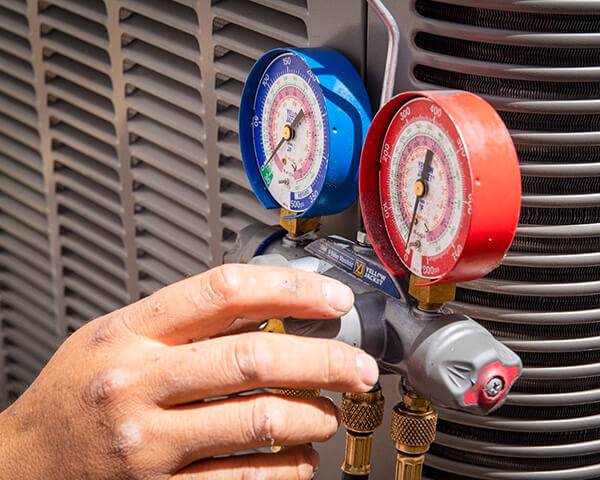
Before any refrigerant recharge, a proper leak search should be performed. Refrigerant does not evaporate, wear out, or get consumed -- if your system is low, it leaked out somewhere. Skipping leak detection means you are paying to recharge a system that will just lose the refrigerant again.Leak detection in Las Vegas typically costs $150 to $350 depending on the method used and the complexity of the system. Most contractors offer three detection approaches, often used in combination:
| Detection Method | Cost Range | How It Works | Best For |
|---|---|---|---|
| Electronic leak detection | $150-$250 | Handheld sensor detects refrigerant gas concentration at joints and connections | Larger leaks, accessible joints, fast screening |
| Nitrogen pressure test | $200-$350 | System is pressurized with dry nitrogen and monitored for pressure drop over time | Confirming leak existence, isolating which circuit is leaking |
| UV dye test | $150-$300 | Fluorescent dye is injected into the system and a UV lamp reveals the exact leak point | Pinhole leaks, slow leaks that electronic detectors miss |
A thorough leak search may combine two or more of these methods. Electronic detection is the fastest first pass, nitrogen testing confirms the leak rate, and UV dye pinpoints the exact location of small or slow leaks. Any contractor who offers to "just add refrigerant" without performing leak detection is either cutting corners or counting on your repeat business.
Leak Repair Cost by Location
Where the leak occurs determines the repair cost. Some leaks are quick fixes. Others require major component replacement.| Leak Location | Repair Cost | Repair Method | Typical Time |
|---|---|---|---|
| Schrader valve (service port) | $100-$200 | Valve core replacement or cap tightening | 15-30 minutes |
| Service valve | $150-$350 | Valve stem repair or replacement | 30-60 minutes |
| Brazed joint (solder connection) | $200-$500 | Re-braze the joint with silver alloy | 1-2 hours |
| Condenser coil | $800-$2,000 | Coil replacement (repair rarely viable) | 3-5 hours |
| Evaporator coil | $1,500-$3,500 | Coil replacement including refrigerant recovery and recharge | 4-8 hours |
Schrader valve and service valve leaks are the best-case scenario -- cheap, fast, and common. Brazed joint leaks are moderate and usually repairable in place. Condenser and evaporator coil leaks are the expensive ones, and they are unfortunately common in Las Vegas due to the conditions described below.
Important: these costs are for the leak repair only. Add the leak detection fee ($150-$350) and the refrigerant recharge cost ($200-$600 for R-410A, $500-$1,500 for R-22) to get the total out-of-pocket number.
Why Las Vegas Systems Leak More Than Anywhere Else
Las Vegas is one of the hardest environments in the country for AC refrigerant systems. Four specific conditions create a perfect storm for copper fatigue, joint failure, and coil corrosion that causes more leaks, more often.Thermal Cycling Stress
Las Vegas summer days routinely hit 110-115 degrees while nights drop to 80-85. That 30+ degree daily temperature swing causes copper refrigerant lines and coil tubing to expand and contract repeatedly. Over thousands of cycles, this thermal fatigue weakens brazed joints and creates micro-cracks in copper tubing. The same principle that causes a paperclip to break when you bend it back and forth applies to your refrigerant lines -- just much more slowly.
Vibration From Extended Run Times
A Las Vegas residential AC runs 2,500 to 3,500 hours per year -- roughly double the runtime of a system in the Midwest or Pacific Northwest. Every hour of compressor operation creates vibration that travels through the refrigerant lines, fittings, and coils. Over years, this constant vibration loosens brazed joints and fatigues copper at stress points. The vibration effect is amplified in rooftop installations, which are common throughout the valley, because the unit's weight and operation vibrate the mounting structure.
UV Degradation of Line Insulation
The refrigerant lines running between your indoor air handler and outdoor condenser are wrapped in foam insulation. In Las Vegas, with 310+ days of direct sunlight and intense UV exposure, that insulation degrades and crumbles within 5-8 years if not protected. Once exposed, the copper lines experience accelerated temperature extremes that increase thermal cycling stress. Exposed lines also suffer surface oxidation that can progress to pitting over time. Replacing deteriorated insulation during routine maintenance is one of the cheapest preventive measures available.
Hard Water Corrosion on Indoor Coils
Las Vegas municipal water ranks among the hardest in the nation at 16+ grains per gallon. While water does not directly contact evaporator coils in a split system, the high mineral content in the air -- from construction dust, hard water evaporation, and desert soil -- deposits on the coil surface. Combined with the condensation that naturally forms on the evaporator coil during operation, these deposits create a corrosive environment that slowly pits the copper tubing. This formicary corrosion (also called "ant nest corrosion") produces tiny, branching tunnels in the copper that are nearly invisible to the naked eye but allow refrigerant to escape.
The "Just Add Refrigerant" Trap
This is the single most expensive mistake homeowners make with refrigerant issues, and it happens constantly in Las Vegas.Here is the scenario: your AC is blowing warm air. A technician comes out, checks the refrigerant charge, finds it low, and offers to "top it off" for $200-$500. The system works great for a few months. Then it starts blowing warm again. Another recharge. A few months later, same thing. By the time you have recharged three or four times, you have spent $800-$2,000 on refrigerant that leaked right back out -- money that could have been applied toward actually finding and fixing the leak.
Refrigerant is a closed-loop system. It does not get "used up" during normal operation. If your system is low on refrigerant, it leaked out somewhere, and that leak will not fix itself. It will only get worse as thermal cycling and vibration continue to widen the breach.
Any contractor who repeatedly recharges your system without performing leak detection is either incompetent or counting on you as a recurring revenue source. A proper approach is: detect the leak, quote the repair, and then make an informed decision about whether the repair cost justifies recharging or whether system replacement is the smarter long-term move.
How to Know If Your AC Needs Refrigerant
Refrigerant leaks produce a consistent set of symptoms. If you notice any combination of the following, schedule a diagnostic before the problem worsens:- Warm air from the vents. The most obvious sign. If your system is running but the air is not cold, low refrigerant charge is one of the top causes.
- Ice forming on the refrigerant lines or evaporator coil. Low refrigerant causes the evaporator coil temperature to drop below freezing, and moisture in the air condenses and freezes on the coil surface. Paradoxically, your system freezes up because it does not have enough refrigerant to absorb heat properly.
- A hissing or bubbling sound near the indoor unit or refrigerant lines. This is the sound of gaseous refrigerant escaping through a crack or hole. Hissing indicates a gas-phase leak; bubbling suggests the leak is in a section where refrigerant is in liquid form.
- Electric bills climbing with no change in usage. A low-charge system runs longer and harder to achieve the same cooling, consuming more electricity in the process. If your summer bills jump 20-30% without explanation, a refrigerant leak is a prime suspect.
- System running constantly without reaching the set temperature. A healthy, properly charged system cycles on and off. A system that runs continuously but never reaches thermostat setpoint is almost certainly low on charge.
- Humidity feels higher than normal indoors. Refrigerant charge affects the evaporator coil's ability to dehumidify. Low charge means reduced dehumidification, leaving your home feeling muggy even when the AC is running.
If you spot any of these signs, turn the system off if you see ice buildup (running with a frozen coil can damage the compressor) and call for a diagnostic. Catching a leak early, before the compressor is damaged by running low on charge, can save you from a $2,000-$4,500 compressor replacement.
EPA Regulations and Certification Requirements
Refrigerant handling is federally regulated, and homeowners should understand what that means for cost, contractor selection, and legality.EPA Section 608 requires that any technician who purchases, handles, or disposes of refrigerant must hold an EPA Section 608 certification. There are four certification types (Type I for small appliances, Type II for high-pressure systems, Type III for low-pressure systems, and Universal for all types). Residential AC work requires at least Type II certification.
It is illegal to intentionally vent refrigerant into the atmosphere. The EPA can impose fines up to $44,539 per day per violation. This matters to you as a homeowner because any contractor who vents refrigerant rather than recovering it before a repair is both breaking the law and harming the environment. Recovered refrigerant must be reclaimed or destroyed according to EPA guidelines.
Practically, this means you cannot legally buy refrigerant and recharge your own system unless you hold Section 608 certification. The certification requirement exists for good reason -- improper refrigerant handling is dangerous (liquid refrigerant causes frostbite on contact), environmentally harmful, and can damage your equipment.
Refrigerant Charge and Your Warranty
Improper refrigerant charge -- too much or too little -- can void your manufacturer warranty. This matters both for new systems and for existing systems under extended warranty.Every AC system has a specific design charge (the exact amount of refrigerant, measured in ounces or pounds, that the manufacturer specifies for that model). Overcharging floods the compressor with liquid refrigerant and can cause slugging damage. Undercharging starves the compressor of cooling and lubrication. Either condition can lead to compressor failure, and if the manufacturer determines that the failure was caused by improper charge, the warranty claim will be denied.
This is one of the strongest reasons to use a licensed, experienced HVAC contractor for any refrigerant work. A qualified technician measures superheat and subcooling to verify that the charge is within manufacturer specifications -- not just "close enough." If your system was recently recharged by someone who did not verify superheat and subcooling readings, and the compressor later fails, you may be facing an uncovered $2,000-$4,500 repair.
A maintenance plan that includes annual refrigerant charge verification protects both your system's performance and your warranty coverage.
When Leak Repair Is Not Worth It
Not every refrigerant leak is worth repairing. The decision depends on three factors: the age of your system, the location of the leak, and the type of refrigerant.System Age + Leak Location Decision Matrix
| Leak Location | System Under 7 Years | System 7-10 Years | System Over 10 Years |
|---|---|---|---|
| Schrader/service valve ($100-$350) | Repair | Repair | Repair |
| Brazed joint ($200-$500) | Repair | Repair | Evaluate carefully |
| Condenser coil ($800-$2,000) | Repair | Evaluate carefully | Lean toward replacement |
| Evaporator coil ($1,500-$3,500) | Repair | Lean toward replacement | Replace system |
If your system uses R-22, shift everything one column to the right. The escalating cost of R-22 refrigerant makes every recharge more expensive, so even a minor leak on a 7-year-old R-22 system warrants a serious conversation about replacement.
The general principle: if the total cost of leak repair plus recharge exceeds 30-40% of the cost of a new system, and the system is past mid-life, replacement is usually the smarter financial move. A new system comes with a full warranty, uses affordable modern refrigerant, and delivers 30-50% better energy efficiency than a unit built 10-15 years ago. Our repair vs. replace guide covers the complete decision framework.
The R-22 Phase-Out: What Las Vegas Homeowners Need to Know
If your AC system was manufactured before 2010, there is a strong chance it uses R-22 refrigerant (commonly known as Freon). The EPA banned production and import of new R-22 as of January 1, 2020. The only R-22 available today is reclaimed from decommissioned systems, and that supply shrinks every year as more R-22 systems are retired.What this means in practice:
- R-22 prices have roughly doubled in the past 5 years and will continue climbing. A pound that cost $30-$50 in 2018 now costs $75-$150. In another 5 years, it could be $150-$250+.
- Finding a contractor with R-22 in stock is becoming harder, especially during peak season when every HVAC company in the valley is handling emergency calls.
- You cannot convert an R-22 system to R-410A by simply swapping the refrigerant. R-410A operates at significantly higher pressures, and R-22 components (compressor, coils, expansion valve, line set) are not rated for those pressures. A "drop-in" replacement refrigerant like R-407C or R-422D exists, but performance and efficiency are compromised, and not all manufacturers support its use.
- Each R-22 recharge is money you will never recover. That $800-$1,500 recharge buys you 6-18 months of cooling before the leak loses enough refrigerant to cause problems again. After two or three recharges, you have spent enough on refrigerant alone to make a meaningful down payment on a new system that uses $10-$25/lb R-410A.
If you are currently recharging an R-22 system, the best advice is to start planning your replacement now rather than waiting for the compressor to fail on a 115-degree July afternoon. Scheduled replacement during shoulder season (October through March) gives you lower prices, better contractor availability, and time to compare options. If you are a homebuyer, an R-22 system is a significant red flag -- see our HVAC red flags for Las Vegas homebuyers guide.

Frequently Asked Questions
How often should AC refrigerant be recharged?
Never, under normal circumstances. Refrigerant is a closed-loop system -- it circulates continuously and is not consumed during operation. A properly installed and maintained AC system should never need a recharge during its entire lifespan. If your system needs refrigerant added, it has a leak that requires diagnosis and repair. The common misconception that AC systems "use up" refrigerant leads homeowners to accept repeated recharges without addressing the underlying problem.
How long does refrigerant last after a recharge?
If the leak was found and properly repaired before recharging, the refrigerant should last the remaining life of the system -- 10 to 15 years or more. If the recharge was done without finding or fixing the leak (which unfortunately happens often), expect the charge to drop low enough to cause problems again within 6 to 18 months depending on the leak rate. A slow pinhole leak might take a year to become noticeable. A larger leak at a brazed joint might lose enough charge to affect cooling within a few weeks.
Can I recharge my AC refrigerant myself?
Legally, no -- unless you hold EPA Section 608 certification. Purchasing refrigerant requires certification, and handling it without proper training and equipment is dangerous. Liquid refrigerant causes instant frostbite on skin contact, and inhaling refrigerant vapor in a confined space can displace oxygen and cause asphyxiation. Beyond the safety and legal issues, improperly charging a system (too much or too little) damages the compressor and can void your warranty. This is genuinely not a DIY job.
Why is R-22 so much more expensive than R-410A?
Supply and demand. No new R-22 has been manufactured or imported since January 2020. The only supply comes from reclaimed R-22 recovered from decommissioned systems, and that supply decreases every year as more R-22 units are retired. Meanwhile, millions of R-22 systems are still in operation across the country, all potentially needing service. R-410A, by contrast, is actively manufactured at scale. The price gap will only widen as R-22 supply continues to shrink.
Is it worth fixing a refrigerant leak on a 15-year-old system?
In most cases, no. A 15-year-old system in Las Vegas has already exceeded the typical useful life for this climate. Even if the leak repair itself is cheap (say, a $200 brazed joint repair), you will spend another $200-$600 on the recharge, and other components -- compressor, fan motors, capacitors -- are all at the end of their lifespan. Investing $400-$1,000 or more in a system that may need a $3,000 compressor replacement next year is a poor bet. That money is better applied toward a new system installation with a full warranty and modern, affordable refrigerant.
What is the difference between a refrigerant leak and a refrigerant recharge?
A recharge (or "top-off") is the act of adding refrigerant to bring the system back to its design charge level. A leak is the reason the charge was low in the first place. They are cause and effect: the leak caused the low charge, and the recharge addresses the symptom but not the cause. A complete service addresses both -- find the leak, repair it, verify the repair holds pressure, and then recharge the system to manufacturer specifications. Any contractor who recharges without investigating the cause is providing incomplete service.
Does a refrigerant leak damage the compressor?
Yes, and this is why prompt leak repair matters so much. The compressor relies on returning refrigerant to cool its internal motor and lubricate its bearings. When refrigerant charge drops, the compressor runs hotter, works harder, and loses lubrication. Sustained low-charge operation causes overheating of the compressor windings, which eventually leads to an electrical short and complete failure. A $300 leak repair today can prevent a $2,000-$4,500 compressor replacement tomorrow. This is one of the strongest arguments against the "just add refrigerant" approach -- every day the system runs with a leak, the compressor is taking damage.
Complete Cost Summary: What to Budget
Here is a consolidated view of all refrigerant-related costs for Las Vegas homeowners:| Service | R-410A System | R-22 System |
|---|---|---|
| Leak detection | $150-$350 | $150-$350 |
| Schrader/service valve repair | $100-$350 | $100-$350 |
| Brazed joint repair | $200-$500 | $200-$500 |
| Condenser coil replacement | $800-$2,000 | $800-$2,000 |
| Evaporator coil replacement | $1,500-$3,500 | $1,500-$3,500 |
| Refrigerant recharge (full) | $200-$600 | $500-$1,500 |
| Total: minor leak + recharge | $450-$1,300 | $750-$2,200 |
| Total: coil leak + recharge | $1,850-$4,450 | $2,150-$5,350 |
These ranges include all three components: detection, repair, and recharge. For R-22 coil leak repairs that approach $3,000-$5,000, the repair cost is entering the range where a new system becomes the financially rational choice. Get both quotes -- the repair cost and the replacement cost -- before committing.
Protect Your Investment With Preventive Maintenance
The cheapest refrigerant leak is the one you prevent. Annual AC maintenance includes a refrigerant pressure check that catches slow leaks before they drain the system and damage the compressor. A technician checking your system in March, before the summer heat arrives, can identify a leak that costs $200-$500 to fix -- the same leak that would cost $200-$500 plus a $2,000 compressor replacement if it goes undetected through the summer.
A Cooling Company maintenance plan includes two tune-ups per year, refrigerant charge verification, electrical component inspection, and priority scheduling during peak season. It is the most cost-effective insurance against both refrigerant leaks and the compressor damage they cause.
Get Honest Refrigerant Leak Diagnosis
If your AC is blowing warm air, has ice on the lines, or has been recharged before without a leak repair, here is what to do next:
Call (702) 567-0707 or book online. Our technicians perform thorough leak detection -- not a quick pressure check and a recharge -- and give you an honest recommendation on whether repair or system replacement is the smarter investment for your specific situation.
The Cooling Company is licensed (NV #0075849, C-21 and #0078611, C-1D), rated 4.8 stars across 787 Google reviews, and family-owned. We serve every community in the Las Vegas Valley -- Henderson, Summerlin, North Las Vegas, Green Valley, Enterprise, Centennial Hills, and everywhere in between.