

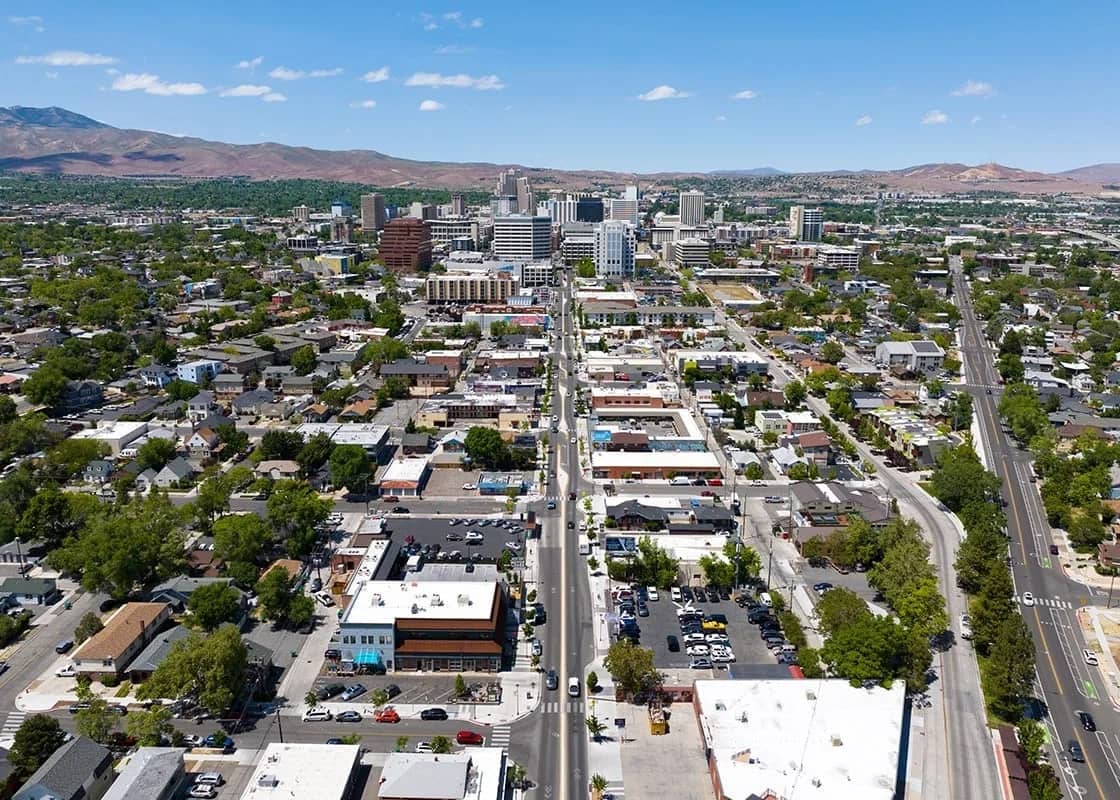
Short answer: AC replacement cost depends not just on the system but on your specific home and neighborhood. A 1998-built Henderson ranch home with attic-mounted equipment costs differently than a 2015 Summerlin two-story with a ground-level condenser. Across the Las Vegas Valley, total installed replacement costs range from $6,500 to $15,000+, with the biggest cost drivers being home age, equipment access, ductwork condition, and electrical panel capacity — all of which vary dramatically by neighborhood. Here is what to expect in yours.
Call (702) 567-0707 for a free in-home assessment tailored to your neighborhood and home, or request a quote online.
Every AC replacement quote starts with the same question: how much? But in the Las Vegas Valley, the better question is: how much in my neighborhood? A homeowner in Inspirada replacing a four-year-old system in a modern home faces a fundamentally different project than a homeowner in Paradise replacing a 30-year-old R-22 unit with attic ductwork that has been baking since the Clinton administration.
The system itself — brand, tonnage, efficiency rating — matters. Our 2026 AC replacement cost guide covers those numbers in detail. But the house the system goes into matters just as much. And the house is a product of when it was built, where it was built, and what standards applied at the time.
This guide breaks down replacement costs and common challenges for every major neighborhood in the Las Vegas Valley. We install systems across all of these communities every week, and the patterns are consistent enough to document. If your neighborhood is not listed individually, the general cost factors section at the end will help you identify which profile your home most closely matches.
Key Takeaways
- Home age is the strongest predictor of replacement cost — not home size. A 1995-built 1,800 sq ft home in Paradise frequently costs more to replace than a 2015-built 2,400 sq ft home in Inspirada because of ductwork condition, electrical panel upgrades, and equipment access complications.
- Pre-2000 homes across the valley often need $1,500-$3,500 in additional work beyond the basic system swap — electrical panel upgrades, ductwork replacement, refrigerant line modifications, or platform/stand modifications for new equipment dimensions.
- R-22 systems must be fully replaced — no exceptions. R-22 refrigerant was phased out in 2020 and now costs $100-$200 per pound for recovered stock. If your system runs on R-22, every repair is a temporary fix with escalating costs. Full replacement is the only economically rational path.
- HOA restrictions in Summerlin, Seven Hills, Southern Highlands, and other master-planned communities can affect condenser placement, sound ratings, and equipment visibility requirements — sometimes adding $300-$800 to the project for compliant installation.
- Permit jurisdictions matter. Clark County, the City of Henderson, and the City of North Las Vegas each have different permit processes, fees ($150-$350), and inspection timelines. Your contractor should pull the correct permit for your jurisdiction — not skip it.
- NV Energy PowerShift rebates ($300-$2,000) are the primary incentive for 2026 installations. The federal Section 25C tax credit was terminated for 2026 installations under the One Big Beautiful Bill Act. NV Energy rebates are utility-funded and remain fully available. See our complete 2026 rebates guide for details.
- Newer neighborhoods (Inspirada, Cadence, Aliante, Providence) benefit from modern construction standards — better insulation, sealed ductwork, properly sized electrical panels, and ground-level condenser pads — making replacements simpler and less expensive.
- Dual-system homes in Seven Hills, Red Rock Country Club, and larger custom homes should budget $14,000-$28,000+ for full replacement of both systems, but staggering the replacements over 1-2 years is often the smarter financial move.
Why Your Neighborhood Matters for AC Replacement Cost
National AC replacement guides quote averages. Averages are useless when your house has specific characteristics that push the cost up or down by thousands of dollars. Here are the neighborhood-dependent variables that create those cost swings:
Home age and construction era. Homes built in the 1970s-1980s followed different building codes than homes built in the 2010s. Older homes have less insulation, smaller electrical panels, and ductwork designed for less powerful systems. A replacement in a 1985 home is rarely a simple swap — it is a modernization project.
Equipment access. Where is the air handler? Attic-mounted equipment in a single-story ranch home requires different labor than a closet-mounted unit in a two-story. Rooftop units — common in certain Las Vegas neighborhoods — add crane or hoist costs. The condenser pad location, distance from the air handler, and whether the refrigerant lines need to be rerouted all factor in.
Ductwork condition. Flex duct in Las Vegas attics degrades. The combination of 150°F+ attic temperatures, UV exposure at connection points, and the natural settling of insulation means that ductwork in a 1990s home has likely lost 20-40% of its original efficiency. If your ducts need replacement or significant repair, that is $2,000-$5,000 on top of the system cost. Some newer neighborhoods have ductwork in better condition simply because it has had fewer years of thermal abuse.
Electrical panel capacity. Older homes — particularly those built before 2000 — may have 100-amp or 150-amp electrical panels that are already near capacity. A modern high-efficiency AC system with a variable-speed compressor may require a dedicated 240V circuit that the existing panel cannot support without an upgrade. Panel upgrades run $1,500-$2,500 and must be completed before the HVAC installation.
HOA requirements. Many Las Vegas master-planned communities have specific rules about exterior equipment: noise limits, setback requirements, screening requirements, even approved equipment colors. These rules can limit which condensers you can install and where, sometimes requiring additional labor for compliant placement.
Permit jurisdiction. The Las Vegas Valley spans multiple permit-issuing jurisdictions — Clark County (unincorporated areas including Paradise, Spring Valley, Enterprise, Sunrise Manor), City of Las Vegas, City of Henderson, City of North Las Vegas, and City of Boulder City. Permit fees, processing times, and inspection requirements vary. Your contractor needs to pull the correct permit for your specific address.

Henderson: The Valley's Largest and Most Diverse Market
Henderson spans over 100 square miles and includes neighborhoods built from the early 1990s through today. This makes it the most variable city in the valley for AC replacement costs. A single zip code in Henderson can contain 1993 tract homes and 2020 custom builds. The neighborhood within Henderson matters more than the city name.
Green Valley and Whitney Ranch (1990s-2000s)
Green Valley was the first major master-planned community in Henderson, with most homes built between 1990 and 2005. Whitney Ranch followed a similar timeline. These are predominantly single-story and two-story homes ranging from 1,800 to 3,200 square feet, typically requiring 3-4 ton systems.
Common challenges: Aging flex duct in attics is the primary cost driver. Twenty-five to thirty years of Las Vegas attic conditions have degraded the original ductwork in many of these homes. R-22 systems are still present in homes built before 2006 — these must be fully replaced, not recharged. Many homes have 150-amp electrical panels that are adequate for modern systems but leave little headroom for future additions like EV chargers.
Typical replacement cost: $7,500-$11,000 for a standard 3-4 ton system. Add $2,000-$4,000 if the ductwork needs significant repair or full replacement.
Inspirada and Cadence (2010s-Present)
These newer Henderson communities benefit from modern building codes, R-38+ ceiling insulation, sealed ductwork, and properly sized electrical infrastructure. Homes range from 1,600 to 3,500 square feet. Most original systems are still within their warranty period or early in their lifecycle, so replacements here are less common but do occur — particularly for homeowners who purchased homes with builder-grade systems and want to upgrade to premium efficiency.
Common challenges: Fewer complications overall. The main cost variable is size and efficiency tier chosen. Some Inspirada homes have compact mechanical closets that limit equipment options. HOA architectural review is required for any exterior equipment changes.
Typical replacement cost: $6,500-$9,500 for a standard changeout. These are the cleanest, most straightforward replacements in the Henderson market.
Seven Hills (Custom and Semi-Custom)
Seven Hills sits at a higher elevation than the valley floor and features larger homes — many in the 3,000-5,500 square foot range with 4-5 ton systems. Approximately 40% of homes in Seven Hills have dual HVAC systems (one for each floor). Custom homes may have non-standard ductwork configurations, zoned systems, or equipment placed in unusual locations.
Common challenges: Dual systems mean dual replacement costs. Larger tonnage increases equipment cost significantly — a 5-ton system costs $2,500-$4,000 more than a 3-ton system at the same efficiency tier. Some custom homes have rooftop equipment that requires crane access for replacement. HOA restrictions apply to condenser placement and noise levels.
Typical replacement cost: $9,000-$15,000+ per system. For dual-system homes needing both replaced, budget $18,000-$28,000+. Many homeowners stagger replacements — doing the system that serves the most-used floor first and the second system the following year.
For more on HVAC services in the Henderson area, see our Henderson HVAC service page or our detailed guides for AC replacement in Henderson and AC replacement in Seven Hills.
Summerlin: Premium Community, Premium Considerations
Summerlin stretches from the older sections near Charleston Boulevard to the newer developments at the base of Red Rock Canyon. The community has been building since the early 1990s, creating a wide range of home ages and replacement scenarios within a single master plan.
South Summerlin and The Paseos (2005-Present)
The newer sections of Summerlin — The Paseos, Stonebridge, Mesa, and areas surrounding Downtown Summerlin — feature homes built to modern energy codes with good insulation and sealed ductwork. Homes range from 1,800 to 4,000+ square feet. Many feature two-story designs with ground-level condenser pads and interior mechanical closets.
Common challenges: The Summerlin HOA (managed by The Howard Hughes Corporation) maintains strict architectural standards. Condenser units must meet specific setback and screening requirements. Some neighborhoods require sound-rated equipment — if your current system was a quieter model, the replacement may need to meet the same or lower decibel rating. Premium finishes inside homes mean installers must take extra care with interior work, which adds modestly to labor time.
Typical replacement cost: $7,500-$12,000. The premium reflects HOA compliance costs and the tendency of Summerlin homeowners to select mid-tier or premium efficiency systems (16-20+ SEER2) rather than entry-level equipment.
Older Summerlin (1990s-Early 2000s)
The original Summerlin neighborhoods — The Trails, The Willows, The Hills — were built in the 1990s. These homes typically range from 1,600 to 2,800 square feet with 3-4 ton systems. Construction quality was high for the era, but building codes have improved significantly since then.
Common challenges: R-22 systems are still present in pre-2006 homes and must be replaced — there is no economical way to continue operating them. Original ductwork is 25-30+ years old and showing its age. Some older Summerlin homes have attic-mounted air handlers with limited access through small ceiling openings, making equipment removal and installation more labor-intensive. Electrical panels are typically 200-amp (Summerlin required this earlier than some areas) so panel upgrades are less common here than in other neighborhoods of similar age.
Typical replacement cost: $7,000-$11,000. The ductwork question is the swing factor — if the ducts are still serviceable, costs stay toward the lower end.
Downtown Summerlin Area
The neighborhoods surrounding Downtown Summerlin include a mix of single-family homes, attached homes, and condominium-style residences. Condos and townhomes present unique replacement challenges.
Common challenges: Condominium replacements often require HOA board approval, which can add 2-4 weeks to the timeline. Rooftop units are common in multi-story attached homes — these require crane or hoist access for equipment changeout. Interior access in condos may be limited, requiring smaller or split equipment configurations. Some condo associations require licensed and insured contractors on an approved vendor list.
Typical replacement cost: $6,500-$10,000 for single-family homes. Condos with rooftop units or restricted access may run $8,000-$12,000 due to additional labor and equipment logistics.
Learn more about our services in the area on our Summerlin HVAC page and Summerlin AC replacement page.
North Las Vegas: The Fastest-Growing Market
North Las Vegas has experienced explosive growth over the past two decades. The city contains both the oldest housing stock in the valley — some homes dating to the 1960s — and some of the newest master-planned communities. The cost range is correspondingly wide.
Aliante, Elkhorn, and North Valley (2005-Present)
Aliante and the surrounding developments north of the 215 beltway represent modern Las Vegas construction at its most standardized. Homes range from 1,400 to 3,000 square feet with 3-4 ton systems. Builders like Pulte, KB Home, Lennar, and DR Horton used efficient, repeatable floor plans with standardized HVAC installations.
Common challenges: These are generally straightforward changeouts. The most common issue is builder-grade equipment reaching end of life — many homes built in 2005-2010 are now seeing their original systems fail after 15-20 years of Las Vegas service. The standardized layouts mean replacement is predictable and efficient. Some neighborhoods have active construction nearby, which creates dust issues — homeowners replacing their system should consider enhanced filtration (MERV 13+) to protect the new investment.
Typical replacement cost: $6,500-$9,500. These are among the most cost-effective replacements in the valley due to modern construction, easy access, and adequate electrical infrastructure.
Older North Las Vegas (Pre-2000)
The older sections of North Las Vegas — south of Craig Road, east of Losee Road — contain homes built from the 1960s through the 1990s. Many of these are smaller ranch-style homes (1,000-1,800 square feet) on compact lots. Some are original construction with minimal updates.
Common challenges: Aging electrical panels are the biggest cost adder in this area. Many pre-1990 homes have 100-amp panels that cannot support modern HVAC equipment without an upgrade ($1,500-$2,500). R-22 systems are very common — some homeowners have been paying $100-$200 per pound for R-22 recharges and should have replaced years ago. Ductwork in older NLV homes is often hard-pipe (sheet metal) rather than flex duct, which is more durable but may be undersized for modern equipment. Condenser pads on small lots sometimes lack the minimum clearance required by current code, requiring relocation.
Typical replacement cost: $7,000-$11,000. The upper range accounts for electrical panel upgrades and ductwork modifications that are frequently needed. A straightforward system swap in a home with adequate electrical and decent ductwork will be toward the lower end.
See our North Las Vegas HVAC services page and North Las Vegas AC replacement page for more details.
Paradise and East Las Vegas: The Diversity Zone
Paradise — the large unincorporated area east of the Strip — is one of the most varied housing markets in the valley. It includes everything from 1970s apartment conversions to 1990s suburban developments to newer infill construction. East Las Vegas extends this diversity further, with some of the oldest residential construction in the valley.
Home ages: 1960s-2000s, with the heaviest concentration in the 1970s-1990s era. Homes range from 1,000 to 2,500 square feet, typically requiring 2.5-4 ton systems.
Common challenges: This area has the highest concentration of R-22 systems still in operation anywhere in the valley. Many homeowners have been patching aging systems rather than replacing them — understandable given the cost, but increasingly uneconomical as R-22 prices climb. We regularly see R-22 recharge costs of $400-$800 for a single service call, on systems that need recharging every 6-12 months due to chronic leaks.
Older construction means smaller lots with limited condenser clearance. Some homes require rooftop package units because there is no viable ground-level location for a split system condenser. Rooftop installations add $800-$1,500 for crane/hoist access and the additional labor of working at height. Electrical panels in 1970s-1980s homes are frequently undersized. Ductwork ranges from original hard-pipe (still functional in many cases) to deteriorating flex duct installed during previous HVAC replacements.
Typical replacement cost: $7,000-$10,500 for a ground-level split system. Rooftop package unit replacements run $8,500-$12,500. Add $1,500-$2,500 for an electrical panel upgrade if needed.
Our Paradise HVAC services page covers the full range of services we provide in the area.
Enterprise and Southern Highlands: Newer, Larger, More Predictable
Enterprise — the unincorporated area south of the 215 beltway — includes the master-planned community of Southern Highlands along with several other newer developments. Most homes were built between 2000 and 2015, with continued building in surrounding areas.
Home ages: Predominantly 2000s-2010s. Homes range from 1,800 to 3,500 square feet, typically requiring 3.5-5 ton systems.
Common challenges: Enterprise homes are generally well-suited for straightforward AC replacement. Modern construction standards mean adequate electrical panels, reasonable ductwork condition, and proper condenser pad placement. The primary complication is Southern Highlands' HOA, which has strict rules about exterior equipment visibility, noise levels, and even the direction condensers face relative to neighboring properties. Compliance may require specific equipment models or additional screening.
Larger homes in Southern Highlands — 3,000+ square feet — frequently have dual systems. The same cost multiplier applies here as in Seven Hills: budget for two systems if you have two systems.
Typical replacement cost: $7,000-$10,500 for a standard single system. Southern Highlands homes with dual systems or HOA-driven equipment requirements may run $9,000-$13,000 per system.
Visit our Enterprise HVAC services page for more information.
Centennial Hills and Providence: Northwest Valley
The northwest corner of the valley — Centennial Hills, Providence, and Skye Canyon — represents some of the newest construction in the Las Vegas market. Most homes were built between 2005 and the present, with significant new building still underway.
Home ages: Predominantly 2005-present. Homes range from 1,600 to 3,500 square feet, with a heavy concentration in the 2,000-2,800 square foot range requiring 3.5-4.5 ton systems.
Common challenges: These are among the easiest replacements in the valley from a technical standpoint — modern construction, good electrical infrastructure, relatively new ductwork. The unique factor here is dust. Active construction sites throughout the northwest valley generate significant airborne particulate that accelerates wear on HVAC systems. Homeowners replacing their system should strongly consider upgrading to a higher-efficiency filtration setup — MERV 13 or better — and consider a whole-home air purification system to protect the new investment.
Some Providence and Skye Canyon homes are built at slightly higher elevations, which provides marginally cooler ambient temperatures but also exposes equipment to higher wind loads. This is a minor factor but can influence condenser placement decisions.
Typical replacement cost: $6,500-$10,000. The range is primarily driven by home size and efficiency tier chosen rather than by installation complications.
Boulder City: Unique Challenges, Higher Costs
Boulder City sits about 30 miles southeast of Las Vegas and operates under its own city government with distinct building codes and inspection requirements. The housing stock is diverse — from 1940s-era homes near the historic district to newer developments on the south and east sides of town.
Home ages: Extremely varied — 1940s through present. Older homes near downtown Boulder City are among the oldest residential structures in the region.
Common challenges: Distance is a real cost factor. Most HVAC contractors are based in the central Las Vegas Valley, and the 30+ mile drive to Boulder City adds travel time that contractors build into their pricing. For emergency replacement, this distance can add a day to the timeline. Older Boulder City homes — particularly those near the historic core — may have extremely outdated electrical systems (60-amp panels, knob-and-tube wiring remnants) that require significant upgrades before modern HVAC equipment can be installed. Some homes are on well water or have non-standard utility configurations. The City of Boulder City issues its own building permits, which can have different fee structures and inspection timelines than Clark County.
Typical replacement cost: $7,500-$11,500. The premium over comparable homes in the central valley ($500-$1,500) reflects travel costs and the higher likelihood of electrical or infrastructure work.
The Lakes and Spring Valley: Central Valley Workhorses
The Lakes — the master-planned community centered on the man-made lake near Sahara and Durango — and the broader Spring Valley area represent the heart of 1990s Las Vegas suburban development. These are predominantly single-story and two-story homes built between 1988 and 2002.
Home ages: 1988-2002. Homes range from 1,400 to 2,800 square feet, typically requiring 3-4 ton systems.
Common challenges: The Lakes community has specific HOA rules about exterior equipment, including noise and visual screening requirements. Spring Valley, being unincorporated Clark County, has fewer restrictions but more variability in construction quality. Ductwork age is the primary cost variable — 25-35 year old flex duct in attics has had a hard life. Many homes in this area had their original systems replaced once already (in the 2008-2015 timeframe) with mid-grade equipment that is now reaching end of life. These "second replacement" scenarios are usually simpler because the ductwork and electrical were already addressed during the first replacement.
Typical replacement cost: $6,500-$10,000. Homes that have already had one replacement (with ductwork and electrical addressed at that time) are toward the lower end. Homes still running original or near-original systems with untouched ductwork are toward the upper end.
Silverado Ranch and Green Valley Ranch: Southeast Valley
These communities south of Henderson and east of the 15 freeway were built primarily in the 2000s. Silverado Ranch and Green Valley Ranch feature mid-size homes (1,600-3,000 square feet) with relatively modern construction standards.
Home ages: 2000-2012. Homes typically require 3-4.5 ton systems.
Common challenges: These are generally moderate-complexity replacements. The original builder-grade systems from the 2000s-era are reaching the 15-20 year mark and failing at increasing rates. Construction quality in this era was decent but not up to current code standards — insulation levels, duct sealing, and weatherization are all below current minimums. Some homeowners opt to upgrade insulation and duct sealing at the same time as the AC replacement, which adds cost but dramatically improves the performance of the new system.
Typical replacement cost: $6,800-$10,500. Straightforward changeouts on the lower end; add-on duct sealing or insulation upgrades push toward the upper range.

Anthem and MacDonald Ranch: South Henderson Premium
Anthem and MacDonald Ranch sit in the southern foothills of Henderson, featuring larger homes with premium finishes. Many homes have mountain or Strip views with corresponding lot premiums — and corresponding HVAC complexity.
Home ages: 1998-2010. Homes range from 2,200 to 5,000+ square feet, typically requiring 4-5 ton systems. Dual-system homes are common in the 3,500+ square foot range.
Common challenges: Similar to Seven Hills — larger homes mean larger systems and frequently dual systems. Anthem's elevation (higher than the valley floor) provides slightly cooler ambient temperatures, which modestly reduces cooling load. MacDonald Ranch features custom homes with non-standard mechanical configurations. Both communities have active HOAs with exterior equipment requirements.
Typical replacement cost: $8,500-$14,000 per system. Dual-system homes should budget $16,000-$26,000+ for full replacement.
AC Replacement Cost Summary by Neighborhood
| Neighborhood | Typical Home Age | Common System Size | Typical Replacement Cost | Key Cost Factors |
|---|---|---|---|---|
| Green Valley / Whitney Ranch | 1990-2005 | 3-4 ton | $7,500-$11,000 | Aging ductwork, R-22 systems |
| Inspirada / Cadence | 2010-present | 3-4 ton | $6,500-$9,500 | Simple changeouts, modern construction |
| Seven Hills | 1998-2010 | 4-5 ton | $9,000-$15,000+ | Dual systems, custom layouts, crane access |
| South Summerlin / The Paseos | 2005-present | 3-4.5 ton | $7,500-$12,000 | HOA requirements, premium efficiency preference |
| Older Summerlin | 1990-2002 | 3-4 ton | $7,000-$11,000 | R-22 systems, aging ductwork |
| Downtown Summerlin area | 2000-present | 2.5-4 ton | $6,500-$10,000 | Condo HOA approvals, rooftop units |
| Aliante / Elkhorn / North Valley | 2005-present | 3-4 ton | $6,500-$9,500 | Standardized layouts, dust concerns |
| Older North Las Vegas | 1960-2000 | 2.5-3.5 ton | $7,000-$11,000 | Electrical panel upgrades, R-22 systems |
| Paradise / East Las Vegas | 1960-2000 | 2.5-4 ton | $7,000-$10,500 | R-22, small lots, rooftop units, panel upgrades |
| Enterprise | 2000-2015 | 3.5-5 ton | $7,000-$10,500 | Generally straightforward replacements |
| Southern Highlands | 2000-2015 | 3.5-5 ton | $9,000-$13,000 | Strict HOA, dual systems in larger homes |
| Centennial Hills / Providence | 2005-present | 3.5-4.5 ton | $6,500-$10,000 | Construction dust, easy access, modern builds |
| Boulder City | 1940s-present | 2.5-4 ton | $7,500-$11,500 | Travel distance, older electrical, separate permits |
| The Lakes / Spring Valley | 1988-2002 | 3-4 ton | $6,500-$10,000 | Ductwork age, HOA (The Lakes), second replacements |
| Silverado Ranch / GV Ranch | 2000-2012 | 3-4.5 ton | $6,800-$10,500 | Builder-grade failures, insulation upgrades |
| Anthem / MacDonald Ranch | 1998-2010 | 4-5 ton | $8,500-$14,000 | Dual systems, premium homes, HOA rules |
Important: These ranges reflect total installed cost for a single system including equipment, labor, permits, and standard accessories (thermostat, disconnect, line set). They do not include ductwork replacement ($2,000-$5,000), electrical panel upgrades ($1,500-$2,500), or other structural modifications unless noted. Every home is different — the only way to get an accurate price for your specific home is a professional in-home assessment. Call (702) 567-0707 or request a quote to schedule one.
What Drives Cost Differences Between Neighborhoods
Looking at the summary table, the cost range across the valley is roughly $6,500 to $15,000+ for a single system. That $8,500 spread is not random. It is driven by specific, identifiable factors. Here is how each one contributes:
Home Age and the $2,000-$4,000 "Old House Premium"
Pre-2000 homes across every neighborhood carry a cost premium over newer construction. This is not because older homes are worse — many are beautifully built. It is because the systems, codes, and materials of the 1990s and earlier were different. Replacing AC in a 1995 home typically means:
- Refrigerant transition: R-22 to R-410A (or the newer R-454B) requires new line sets, sometimes new fittings, and system flushing. This adds $300-$800 to the replacement.
- Electrical upgrades: 100-150 amp panels may need upgrading to support modern equipment. Add $1,500-$2,500.
- Equipment dimension changes: Modern air handlers and condensers are often different dimensions than their 1990s equivalents. Stands, platforms, and pads may need modification. Add $200-$500.
- Code compliance: Current code requires elements that the original installation did not — safety disconnects at specific locations, condensate overflow protection, seismic strapping in some configurations. Bringing the installation up to current code adds $200-$600.
None of these are optional if you want a proper, permitted installation. Contractors who quote a suspiciously low price on an older home may be planning to skip some of these items — which will create problems at inspection or down the road. Our guide to avoiding HVAC scams in Las Vegas covers the warning signs in detail.
Equipment Access: Attic vs. Closet vs. Rooftop
Where the equipment lives affects how long the installation takes and how many crew members are needed:
- Interior mechanical closet (ground floor): Easiest access. Standard 2-person crew, 4-6 hours. No access premium.
- Attic-mounted air handler: More difficult. Equipment must be carried up through a ceiling access point, and the crew works in extreme heat (140-160°F in summer). If replacing during summer months, attic work may be limited to early morning hours. Add $300-$700 for the additional labor and difficulty.
- Rooftop package unit: Most expensive to access. Requires crane, boom lift, or roof hoist to move the old unit down and the new unit up. Crane rental alone runs $500-$1,200 depending on the height and weight involved. Total access premium: $800-$1,500.
Ductwork: The Hidden Cost Multiplier
You can install the most efficient air conditioner on the market and lose 30-40% of its capacity to leaking ductwork. In Las Vegas attics, the combination of extreme heat, thermal cycling, and UV degradation through any exposed sections means ductwork degrades faster here than almost anywhere in the country.
A proper AC replacement should include a ductwork inspection. If the ducts are losing more than 15% of airflow (measurable with a duct blaster test), sealing or replacement is strongly recommended — otherwise you are paying for a 16 SEER2 system that performs like a 12 SEER2 system because the air never reaches the rooms.
- Duct sealing (mastic and tape at connections): $500-$1,200. Appropriate when the duct material is still sound but connections have loosened or degraded.
- Partial duct replacement (specific runs): $1,200-$3,000. Common when some sections have degraded while others are still serviceable.
- Full duct replacement: $3,000-$5,000+. Necessary when the existing ductwork is original 1990s flex duct that has compressed, torn, or separated from registers.
Our efficiency savings analysis quantifies exactly how much leaking ductwork costs you per year in wasted energy. For many older homes, addressing the ducts during AC replacement pays for itself within 2-3 years through reduced energy bills.
Permit Jurisdictions and Fees
The Las Vegas Valley spans multiple jurisdictions, each issuing their own building permits for HVAC work:
| Jurisdiction | Neighborhoods Covered | Typical HVAC Permit Fee | Notes |
|---|---|---|---|
| Clark County | Paradise, Spring Valley, Enterprise, Sunrise Manor, Whitney, Silverado Ranch | $175-$275 | Largest jurisdiction; covers most unincorporated areas |
| City of Henderson | Green Valley, Inspirada, Cadence, Seven Hills, Anthem, MacDonald Ranch | $175-$300 | Separate permit system from Clark County |
| City of Las Vegas | Summerlin, Centennial Hills, Downtown Las Vegas, portions of central Las Vegas | $200-$350 | Includes Summerlin despite being west of the city center |
| City of North Las Vegas | Aliante, Elkhorn, all areas within NLV city limits | $150-$275 | Growing city with active building department |
| City of Boulder City | All Boulder City addresses | $150-$250 | Separate city with own building codes |
Any contractor who tells you a permit is not needed for an AC replacement is either uninformed or planning to skip a legal requirement. HVAC replacement requires a permit in every jurisdiction in the Las Vegas Valley. The permit ensures the installation is inspected, the equipment is properly sized, the electrical connections are safe, and the work meets current building codes. An unpermitted installation can create problems when you sell your home, void manufacturer warranties, and leave you liable if something goes wrong. Our guide to questions to ask before buying a new HVAC system covers this and other critical topics.
HOA Requirements and Compliance Costs
Master-planned communities with active HOAs — Summerlin, Southern Highlands, Seven Hills, Anthem, The Lakes, Inspirada — may have requirements that affect your replacement options and costs:
- Noise limits: Some HOAs require outdoor condensers to operate below a specific decibel level (typically 72-76 dB). Premium quiet-operation condensers cost $200-$500 more than standard models. Lennox's quiet-operation condensers are a strong choice for noise-restricted communities.
- Visual screening: Equipment must be hidden from street view. If your current condenser location is grandfathered but the HOA no longer approves that location for new equipment, relocation and screening can add $300-$800.
- Architectural approval: Some HOAs require architectural committee approval before any exterior equipment change. Processing times vary from 1 week to 6 weeks. In summer emergencies, some HOAs offer expedited review — ask your contractor to help coordinate.
- Approved contractor lists: Primarily a condo/townhome HOA requirement. The Cooling Company is on the approved vendor list for most major Las Vegas Valley HOAs — call us to confirm for your specific community.
NV Energy Rebates: Your Primary 2026 Incentive
Regardless of which neighborhood you live in, NV Energy's PowerShift rebates are available to every residential customer in the Las Vegas service territory. For 2026, the rebate structure for AC replacement is:
- Central AC (SEER2 15.0+): $300-$500
- Central AC (SEER2 17.0+): $500-$800
- Central AC (SEER2 19.0+): $800-$1,200
- Heat pump (SEER2 15.2+): $500-$750
- Heat pump (SEER2 18.0+): $750-$1,500
- Heat pump (SEER2 20.0+): $1,500-$2,000
- Smart thermostat (ENERGY STAR): $75-$125
- Professional duct sealing: $100-$300
Critical note for 2026: The federal Section 25C Energy Efficient Home Improvement Credit was terminated for installations after December 31, 2025, under the One Big Beautiful Bill Act (signed July 4, 2025). If a contractor quotes you a federal tax credit as part of your 2026 savings, that contractor is either misinformed or misleading you. NV Energy PowerShift rebates are utility-funded and independent of federal tax policy — they remain fully available. Our complete 2026 rebates and incentives guide has the full details.
PowerShift rebates are first-come, first-served each year. The program has run out of funding mid-year in the past (August 2024). If you are planning a replacement in the second half of the year, verify current funding availability at NV Energy's PowerShift portal before making purchasing decisions.
How to Get an Accurate Quote for Your Specific Home
The neighborhood-level cost ranges in this guide are useful for budgeting, but every home has specific characteristics that push the actual price above or below the range. The only way to get an accurate number is a professional in-home assessment. Here is what a thorough assessment should include:
- Manual J load calculation: The contractor should calculate your home's actual cooling load — not estimate based on square footage. In Las Vegas, the outdoor design temperature (115°F), your home's insulation levels, window orientation, and ceiling height all affect the correct system size. An oversized system costs more to buy and more to operate. An undersized system will never keep up on the hottest days.
- Ductwork evaluation: A visual inspection of accessible ductwork plus a measurement of static pressure and airflow. If the contractor does not look at your ducts, they are not doing a thorough assessment.
- Electrical panel inspection: Verification that your panel has adequate capacity for the proposed system. If a panel upgrade is needed, that should be quoted separately and clearly.
- Equipment access evaluation: Where the old equipment is, where the new equipment will go, and what it takes to get it there. Attic access, condenser pad condition, line set routing — all of these affect the labor quote.
- Itemized written quote: Equipment, labor, permits, accessories, and any additional work (ductwork, electrical, structural) should each be itemized separately. A single lump-sum number makes it impossible to compare quotes meaningfully.
We provide free in-home assessments with detailed, itemized quotes for every neighborhood in the Las Vegas Valley. Call (702) 567-0707 or request a quote online. Our AC buying guide walks you through the entire process from first call to final inspection.
Should You Repair or Replace? The Neighborhood-Adjusted Answer
The standard repair-or-replace calculation applies everywhere: if the repair cost exceeds 50% of the replacement cost, or if the system is over 15 years old and needs a repair exceeding $2,000, replacement is usually the better financial decision.
But neighborhood context changes the math in important ways:
If you are in an R-22 neighborhood (Paradise, older NLV, older Green Valley, older Summerlin) and your system needs any refrigerant-related repair — leak fix, recharge, compressor replacement — the answer is almost always replace. R-22 refrigerant costs $100-$200 per pound, and every repair is temporary because you are maintaining a system that cannot receive new components designed for modern refrigerants. Every dollar spent on R-22 system repairs is a dollar that could have gone toward a new system with a 15-20 year lifespan.
If you are in a newer neighborhood (Inspirada, Aliante, Providence) with a system that is 8-12 years old and experiencing its first significant failure, repair often makes sense. The ductwork is still good, the electrical is fine, and the system has meaningful life remaining. A $1,200 compressor capacitor or fan motor replacement on a 10-year-old system in a 2012-built home is a reasonable investment.
If you are planning to sell within 2 years, the neighborhood matters for a different reason: buyer expectations. Buyers in Summerlin, Seven Hills, and Anthem expect functional, modern HVAC systems. A 20-year-old system — even if it is currently working — can reduce your negotiating position and final sale price by more than the cost of replacement. In more price-sensitive neighborhoods, buyers may be more willing to accept an older but functional system. Our full cost guide covers the repair-vs-replace math in more detail.
Why We Know These Neighborhoods
The Cooling Company has been installing and servicing HVAC systems across every neighborhood in this guide since our founding. We are a Lennox Premier Dealer with a 4.9-star rating across 740+ reviews. We know which Henderson subdivisions have the deteriorating flex duct. We know which Summerlin neighborhoods require HOA architectural review. We know that Boulder City's older homes need electrical work before the AC goes in.
This is not generic advice assembled from national data. This is what we see every day, in every community, across the Las Vegas Valley.
When you call us for a replacement quote, we already know the likely challenges for your neighborhood before we arrive. That does not mean every home is the same — it means we come prepared with the right tools, the right equipment options, and realistic cost expectations from the first visit.
Frequently Asked Questions
Why does the same AC system cost different amounts in different Las Vegas neighborhoods?
The equipment itself costs the same regardless of location. The cost difference comes from the installation — specifically, the condition of the home the system goes into. Older homes need more prep work (electrical upgrades, ductwork repair, equipment access modifications), and HOA-regulated communities sometimes require specific equipment models or placement accommodations. A 3-ton Lennox system costs the same whether it is going into a home in Inspirada or Paradise, but the total installed cost differs because the installation labor and additional work vary.
Is AC replacement cheaper in newer neighborhoods like Aliante or Inspirada?
Generally, yes. Newer construction (2005 and later) typically requires less additional work during replacement — the electrical panels are adequate, the ductwork is in better condition, equipment access is designed into the home, and there are fewer surprises during installation. The typical savings compared to a pre-2000 home is $1,000-$3,000 on the total project, primarily from avoided ancillary work rather than equipment cost differences.
I live in Summerlin and my HOA has strict rules about exterior equipment. Will this affect my replacement cost?
It can. Summerlin's architectural standards may require specific condenser placement, noise ratings, or visual screening. If your current condenser location is approved but the HOA requires a different location for new equipment, the relocation adds $300-$800. If the HOA requires a sound-rated unit, that may limit your brand and model options or require a premium model. We work with Summerlin HOAs regularly and can advise you on compliance requirements before quoting.
My home in Paradise still has an R-22 system. How much more will replacement cost compared to a home with a newer refrigerant system?
An R-22 to modern refrigerant conversion adds approximately $300-$800 to the replacement cost for new line sets and system flushing. However, the more important consideration is that continuing to operate the R-22 system is increasingly expensive — R-22 recharges now cost $100-$200 per pound, and any refrigerant-related repair is a diminishing investment. The incremental cost of replacing an R-22 system versus a system that already uses R-410A or R-454B is small compared to the ongoing cost of maintaining the R-22 system.
Do I need an electrical panel upgrade for AC replacement in an older North Las Vegas home?
Possibly. Many pre-1990 North Las Vegas homes have 100-amp electrical panels. A modern central air conditioning system typically requires a dedicated 30-50 amp 240V circuit. If your panel is already at or near capacity, an upgrade to a 200-amp panel ($1,500-$2,500) is necessary before the new AC can be installed. Your contractor should evaluate this during the in-home assessment and include it in the quote if needed. It is not optional — an overloaded panel is a fire hazard.
Are NV Energy rebates available in all Las Vegas Valley neighborhoods?
Yes. NV Energy PowerShift rebates are available to all residential NV Energy customers in the Las Vegas service territory, regardless of neighborhood, city, or zip code. Henderson, Summerlin, North Las Vegas, Boulder City, and all unincorporated Clark County areas are eligible. The rebate amounts ($300-$2,000 depending on equipment efficiency) are the same across all neighborhoods. See our 2026 rebates guide for current details and how to apply.
Is the federal tax credit still available for AC replacement in 2026?
No. The federal Section 25C Energy Efficient Home Improvement Credit was terminated for equipment installed after December 31, 2025, under the One Big Beautiful Bill Act signed in July 2025. If a contractor includes a federal tax credit in your 2026 savings estimate, that is incorrect. NV Energy PowerShift rebates remain your primary incentive for 2026 installations. Homeowners who installed qualifying equipment in 2025 can still claim the credit on their 2025 tax return.
Should I replace my ductwork at the same time as my AC in an older Henderson home?
If your ductwork is original 1990s flex duct that has been sitting in a 150°F+ attic for 25-30 years, you should at minimum have it tested. A duct blaster test measures actual leakage. If leakage exceeds 15-20%, duct sealing or replacement is strongly recommended — otherwise you are paying for efficiency you will never receive. Replacing ductwork at the same time as the AC saves on labor (the crew is already there, the system is already disconnected) compared to doing it as a separate project later. For a typical Henderson ranch home, expect $2,500-$4,500 for full duct replacement when done concurrently with AC replacement.
Why is Boulder City more expensive than other Las Vegas neighborhoods for AC replacement?
Three factors. First, distance — most HVAC contractors are based in the central valley, and the 30+ mile drive to Boulder City adds travel time that is reflected in labor costs. Second, many Boulder City homes — particularly those near the historic core — have older electrical systems that require upgrading before modern HVAC equipment can be installed. Third, Boulder City issues its own building permits with a separate fee schedule and inspection timeline. The total premium over a comparable home in the central valley is typically $500-$1,500.
I have a dual-system home in Seven Hills. Do I need to replace both systems at the same time?
Not necessarily. If one system has failed and the other is still performing well, replacing just the failed system is reasonable. However, if both systems are the same age and one has failed, the other is statistically likely to follow within 1-3 years. Many homeowners in Seven Hills, Anthem, and Southern Highlands choose to stagger replacements — doing the system that serves the primary living areas first and the second system 6-12 months later. This spreads the financial impact while ensuring the most critical system is addressed first. If both systems need replacement simultaneously, ask about package pricing — replacing both at once typically saves $1,000-$2,000 compared to two separate projects.
What is the best time of year to replace my AC in Las Vegas, regardless of neighborhood?
Spring (March through May) and fall (late September through October) offer the best combination of scheduling flexibility, contractor availability, and price. During peak summer (June through August), HVAC contractors in Las Vegas are running at maximum capacity — emergency calls take priority, scheduling windows are narrower, and some contractors increase pricing to reflect demand. If your system is showing signs of decline (reduced cooling, unusual noises, increasing repair frequency), scheduling a spring replacement before the summer rush gives you time to get multiple quotes, choose the right system, and ensure a quality installation without the pressure of a 115-degree emergency.
Does the Cooling Company service all of the neighborhoods listed in this guide?
Yes. We install and service HVAC systems across the entire Las Vegas Valley — Henderson, Summerlin, North Las Vegas, Paradise, Enterprise, Southern Highlands, Centennial Hills, Boulder City, The Lakes, Spring Valley, Silverado Ranch, Green Valley, Seven Hills, Anthem, and every community in between. Our service area covers all of Clark County. Call (702) 567-0707 or visit our quote request page to get started.