> By: The Cooling Company
Key Takeaways
- Match system type to building size, hours, and control needs.
- Prioritize low-GWP refrigerants and strong commissioning.
- Use lifecycle cost estimates, not just first cost.
- Require contractor training and rapid leak response.
Choose a commercial HVAC system by matching type to building size, hours, and long-term goals. Start with a measured load and occupancy profile. Prioritize controls, commissioning, and lower-GWP refrigerants to cut energy use and reduce future regulatory risk and operating cost. (DOE Better Buildings HVAC)
Which commercial HVAC type fits my building?
Measure peak sensible and latent loads and the building’s typical operating hours before choosing a system. A simple hourly spreadsheet or short simulation shows when the building runs near peak and where part-load operation dominates. This data narrows choices among centralized chilled-water plants, rooftop units (RTUs), variable refrigerant flow (VRF) systems, and packaged heat pumps.
Site constraints often decide the system family. Roof-mounted equipment frees indoor space but requires crane access and adequate roof structure. A central plant needs room for chillers, boilers, pumps, and piping. Understand routing, shaft capacity, and plant-room ventilation early. Accessibility for service and spare parts storage also affects lifecycle cost and downtime risk.
What are the pros of central chillers?
Central chillers work well for large buildings and campuses with predictable loads. They offer high efficiency at full load and often better part-load performance when paired with modern controls and variable-speed drives. Central plants can serve many air handlers and zones, which reduces per-ton installation cost in larger projects and simplifies centralized monitoring and control.
Designers commonly combine central chillers with thermal storage to reduce peak demand charges and shift loads to off-peak energy. Central plants also centralize maintenance and spare parts, lowering per-ton service costs if staffed correctly. The trade-offs are higher upfront cost, greater space needs for pumps and piping, and the need for trained technicians to maintain complex equipment and controls.
When are rooftop units the best choice?
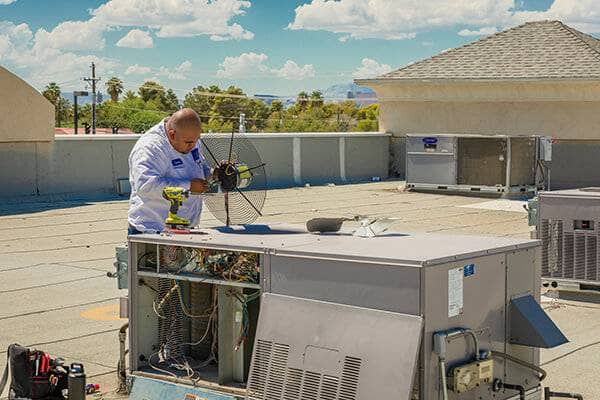
Rooftop units suit smaller buildings, single-floor retail, or tenants needing a fast replacement option. RTUs install quickly and avoid complex indoor piping or large plant rooms. Owners value RTUs for modular repairs and straightforward mechanical layouts that simplify service and minimize interior disruption.
However, rooftop equipment faces weather, debris, and higher exposure risk. Choose RTUs with good part-load performance, economizers, and variable fans when possible. Ensure regular rooftop inspection schedules and protective measures; otherwise, RTUs may show higher lifecycle maintenance and replacement costs than anticipated.
How do VRF heat pump systems work?
VRF systems transfer refrigerant between outdoor condensing units and many indoor units. Each indoor unit modulates refrigerant flow to match zone loads. This zoning yields precise control and avoids over-conditioning, which helps comfort and energy use in buildings with varied occupancy or extended operating hours.
Modern VRF equipment uses inverter compressors and variable pumps or fans to reduce cycling losses and improve part-load efficiency. Design must account for refrigerant charge limits, service access, and code constraints around refrigerant type and volume. Also budget for technician training and diagnostic tools, because VRF service differs from traditional chilled-water or direct-expansion systems.
How do performance and efficiency compare?
Compare rated efficiency metrics and expected behavior at part-load conditions. Ratings such as SEER, EER, HSPF, and COP give a baseline but do not capture how units perform across real operating profiles. Buildings rarely operate at peak conditions, so choose equipment with good part-load and staged performance.
Controls and sequencing strongly influence real-world efficiency. Variable-speed compressors, fans, and pumps reduce cycling losses and keep systems operating near optimal efficiency during partial loads. Commissioning and seasonal tuning are essential to ensure the installed controls deliver the modeled savings and maintain occupant comfort across conditions.
How do SEER and EER differ?
SEER (Seasonal Energy Efficiency Ratio) averages cooling performance across a range of conditions to reflect seasonal use. EER (Energy Efficiency Ratio) measures efficiency at a single outdoor temperature and helps estimate peak demand performance. Both metrics matter where peak and seasonal loads influence cost, but neither replaces part-load performance curves.
In hot climates, look for strong SEER and EER values to keep both seasonal and peak costs down. For heating, review HSPF or COP values to understand winter performance. Always obtain manufacturer part-load tables or performance maps to feed into lifecycle models rather than relying solely on nameplate SEER or EER.
What are typical COP ranges?
Heat pump COPs vary by outdoor temperature and equipment design. Many modern electric heat pumps achieve COPs of 3 to 5 at moderate outdoor temperatures, meaning they deliver three to five units of heat per unit of electrical energy. Cold-climate models maintain higher COPs at lower temperatures compared with older systems.
Large chillers often show COPs between about 4 and 7 at rated conditions. Expect COP to decline at part-load or extreme conditions; therefore, ask manufacturers for both full-load and part-load performance data. Use these values in lifecycle energy models and sensitivity analyses for utility price scenarios.
How do variable-speed compressors save energy?
Variable-speed compressors match output to the instantaneous load instead of cycling on and off. This reduces startup energy and keeps the system operating near its peak efficiency point during partial-load periods. Reduced cycling also improves occupant comfort by minimizing temperature swings.
Systems using variable drives lower mechanical stress on components, which can reduce repairs and extend equipment life. Proper control coordination among compressors, pumps, and fans is essential to prevent hunting and inefficiency. Commissioning should include tuning of variable-speed control loops to ensure stable performance.
What are upfront and lifecycle costs?
Upfront costs cover equipment purchase, installation labor, controls, and any structural work for supports or penetrations. Rooftop units usually have lower installed cost and shorter lead times. Central chilled-water plants and thermal storage require significant sitework, pumps, piping, and redundancy, which raises initial spend and project schedule.
Lifecycle cost adds energy bills, maintenance, parts replacement, refrigerant replenishment, and eventual disposal. Use 15–25 year horizons for commercial projects and include scenarios for utility price changes and carbon pricing if relevant. Higher initial investment in efficiency and controls can pay back when energy or service costs are high, but always quantify savings conservatively.
What is order of magnitude installed cost?
Provide early budget ranges to avoid surprises during approvals. Small rooftop systems might budget roughly $10–$25 per square foot installed. VRF systems typically fall between $20–$40 per square foot depending on zoning complexity and labor. Central chilled water plants usually start above $40 per square foot and climb with redundancy, pumping complexity, and thermal storage.
These numbers vary by local labor rates, crane or rigging needs, and distribution piping complexity. Request local budget numbers early and include allowance ranges for site-specific conditions. A detailed scope helps contractors produce comparable bids.
How do maintenance costs vary by type?
Rooftop units sit in the weather and need frequent inspections for debris, seals, and exposure damage. Their hourly maintenance rate can be lower, but rooftop exposure often causes faster replacement of certain components. Central plants need skilled technicians and structured preventive maintenance programs that can be cost-effective at scale.
VRF systems require refrigerant leak monitoring and technicians trained in refrigerant-side diagnostics. Budget for specialized tools, annual control tuning, and parts procurement lead times. A well-defined maintenance strategy lowers unplanned downtime and preserves expected lifecycle savings.
How to estimate payback periods?
Estimate payback by dividing the incremental installed cost by expected annual energy and maintenance savings. Use conservative utility rates and assume some efficiency degradation over time. For larger projects, compute net present value (NPV) or internal rate of return (IRR) using realistic discount rates and scenario analysis.
Include non-energy benefits such as improved occupant comfort, tenant retention, or lower carbon exposure. These soft benefits can tip decisions toward higher-efficiency options even when simple payback appears long. Document assumptions transparently so stakeholders can adjust scenarios.
How important are controls and commissioning?
Controls and commissioning often determine whether installed systems meet promised savings. Poor sequencing, incorrect setpoints, or missing sensors can erase most theoretical efficiency improvements. Budget for a full commissioning process that begins during design and continues into the first year of operation.
Continuous monitoring and fault detection help catch drift, sensor faults, and control logic problems early. Include operator training so staff can understand alerts and act on them promptly. A strong controls strategy reduces energy waste and helps avoid costly performance shortfalls during the warranty period.
What is HVAC commissioning?
HVAC commissioning verifies that the installed system performs to design intent. It includes design review, startup inspections, functional performance testing, and documentation of corrective actions. Commissioning reduces energy waste, improves reliability, and documents baselines for future tuning.
Start commissioning activities during design and maintain oversight through at least the first year of operation. Require operator training and a post-occupancy tuning window to capture real-use adjustments and occupant feedback. Deliverables should include test reports, sensor calibrations, and an actionable tuning plan.
How do BAS and BMS differ?
Building Automation Systems (BAS) and Building Management Systems (BMS) are often used interchangeably but can imply scale or feature differences. Both provide control, scheduling, trending, and alarms for HVAC and other building systems. When selecting, prefer open protocols like BACnet or Modbus to ensure future integration.
Good BAS/BMS choices include clear data-logging frequency, secure remote access, and support for analytics tools. Document expected data retention and export formats. A flexible automation platform simplifies continuous commissioning and allows third-party analytics to run fault detection and performance benchmarking.
Which refrigerant and emissions risks matter?
Refrigerant choice affects greenhouse-gas emissions and regulatory risk. High-GWP refrigerants face phase-downs and can become costly or restricted to service. Plan refrigerant strategy early and include leak detection, repair timelines, and end-of-life recovery procedures in procurement documents.
Recordkeeping simplifies audits and trend analysis. Estimate typical annual leak rates for equipment types on site and require vendor commitments to keep leak rates below contract thresholds. Rapid repair reduces both emissions and operational expense from lost charge.
What are low GWP refrigerant choices?
Low-GWP options include HFO blends like R-1234yf, HFC/HFO blends such as R-454B, and natural refrigerants like CO2 in selected applications. Each refrigerant has trade-offs: pressure levels, efficiency impacts, toxicity, or flammability concerns, and code limitations.
Match refrigerant selection to the application, local code, and service landscape. For CO2 systems, use crews trained on high-pressure machining and components. For mildly flammable refrigerants, adhere strictly to charge limits, ventilation, and safety standards. Include refrigerant training requirements in contractor scopes.
How to assess leak rate liabilities?
Estimate leak liability by multiplying installed refrigerant charge by an expected annual leak rate from historical data or typical industry values. Small rooftop DX units often leak more than sealed central plants, so plan budgets accordingly. Regulations may require reporting, repairs, and record submission when thresholds are exceeded.
Put leak-rate caps and response-time clauses in contracts. These reduce long-term liability and encourage contractors to maintain tight systems. Lower leak rates preserve equipment efficiency and reduce the need for future retrofits as regulations tighten.
What monitoring reduces refrigerant loss?
Continuous electronic leak detectors and charge-monitoring tools catch slow losses before they escalate. Combine sensors with trending of pressures and temperatures to spot anomalies. Remote alerts speed repair responses and reduce downtime.
Complement continuous monitoring with scheduled infrared or ultrasonic inspections. Manual checks validate system tightness and sensor performance. Integrated monitoring combined with marked response protocols lowers both emissions and replacement costs.
How to include refrigerant clauses in RFPs?
Specify allowed refrigerants, annual leak targets, repair response times, and recovery procedures in RFPs. Ask vendors for lifecycle refrigerant plans, training records, and servicing pathways. Make compliance documentation a contract deliverable to reduce ambiguity.
Include holdbacks or penalties for missed leak thresholds and require reclaim receipts on disposal. Clear contractual language reduces future disputes and keeps operating risk visible during procurement.
Ready to choose your system?
Confirm building data, set clear performance goals, and prepare a shortlist of system types before issuing formal bids. Request detailed proposals that include lifecycle cost models, refrigerant plans, commissioning schedules, and training deliverables. This approach de-risks procurement and clarifies expectations for bidders.
Run a risk review with operations, finance, and sustainability stakeholders. Score proposals on energy, emissions, maintenance, warranty terms, and service responsiveness. Include parts availability and documented technician training in final scoring to reduce operational surprises after award.
How to contact a qualified engineer?
Las Vegas area owners can call The Cooling Company at 17029308411 to schedule a site visit and load study. The Cooling Company serves Las Vegas, Henderson, and North Las Vegas and provides lifecycle cost analysis, commissioning, and service plans tailored to each building. If you are outside the service area, ask for NATE-certified technicians and an engineer with commercial HVAC experience.
Request past project references, commissioning reports, and a clear refrigerant strategy during vendor interviews. Documentation of prior work helps verify that firms can meet your performance and maintenance expectations.
What checklist should you bring to vendor meetings?
Bring recent energy bills, occupancy schedules, as-built drawings, and any prior mechanical reports to vendor meetings. Note code requirements, refrigerant preferences, and budget constraints. These materials help bidders scope work accurately and reduce change orders after award.
Ask vendors to show lifecycle cost data, warranty terms, and commissioning plans. Request details on refrigerant leak management, hvac technician training, and BMS integration. Confirm proposed timelines for installation, commissioning, and post-occupancy tuning before signing contracts.
What service terms should you require?
Require a minimum of one-year parts and labor coverage and seek extended compressor warranties when feasible. Ask for guaranteed response times for critical failures and a documented spare-part list. Transferable warranties add value if ownership changes during the asset life.
Include training requirements and quarterly performance reports in service contracts. Make monitoring data available to your operations team to support continuous commissioning and fault detection. Ready to move forward? Las Vegas building owners can call The Cooling Company at 17029308411 for a free initial consultation and site survey. The Cooling Company serves Las Vegas, Henderson, and North Las Vegas and can provide NATE-certified technicians and full commissioning. Outside our area, ask vendors for NATE-certified techs and commissioning proof before hiring.
About The Cooling Company
The Cooling Company has been serving the Las Vegas valley with professional HVAC services for over a decade. Our team of licensed, NATE-certified technicians specializes in air conditioning repair, heating system maintenance, and complete HVAC installations. We're committed to providing honest, reliable service with upfront pricing and a 100% satisfaction guarantee on all work performed.
- Phone: (702) 930-8411
- Reviews: 4.9/5 stars (500 reviews) - See reviews
Service Areas
We proudly serve homeowners and businesses throughout the Las Vegas metropolitan area, including Las Vegas, Henderson, and North Las Vegas. Our service technicians are available for same-day appointments in most areas, with emergency service available 24/7 for urgent HVAC issues.