

Short answer: The most critical HVAC red flags when buying a Las Vegas home are: an R-22 refrigerant system (production banned in 2020 — recharge is extremely expensive and replacement is mandatory within 1-3 years), a system older than 10 years in the Las Vegas desert (lifespan is 8-12 years here vs. 15-20 nationally), an undersized unit for the home's square footage (epidemic in 1990s-2000s Las Vegas tract homes), unpermitted HVAC work (check Clark County permit records before closing), and ductwork running through an uninsulated attic where temperatures reach 150-160°F in summer. A standard home inspection covers HVAC at a surface level — it does not include a load calculation, refrigerant analysis, duct leakage test, or electrical verification. A dedicated pre-purchase HVAC inspection by a licensed contractor will catch problems that cost $5,000-$27,000 to fix after you own the home.
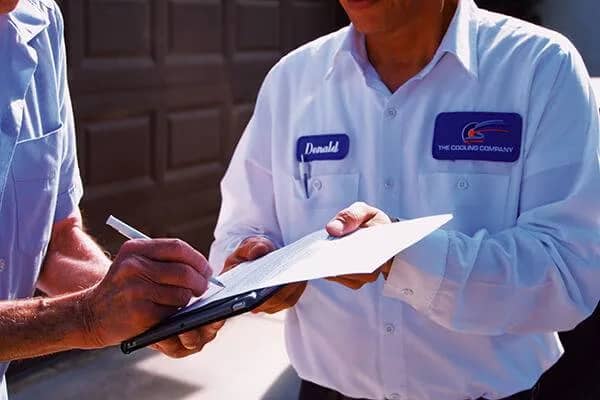
The Cooling Company offers pre-purchase HVAC inspections for homebuyers. Call (702) 567-0707 before you close.
Key Takeaways
- Desert heat destroys HVAC systems faster. The national average AC lifespan is 15-20 years. In Las Vegas, where systems run 4,000+ hours per year in extreme heat, realistic lifespan is 8-12 years. A "10-year-old system" in Las Vegas is equivalent to a 15-year-old system in a moderate climate.
- R-22 systems are a ticking financial time bomb. If the system uses R-22 (Freon), production was banned in 2020. Remaining stockpiles cost $75-$150 per pound, and a typical recharge runs $500-$1,500. The system will need full replacement within 1-3 years regardless — negotiate accordingly.
- Undersized systems never catch up. Many Las Vegas homes built in the 1990s-2000s had HVAC systems installed based on national rules of thumb, not desert load calculations. A system that is 1 ton undersized will run continuously on 110°F+ days without reaching setpoint — and burn out years ahead of schedule.
- Always check permit records before closing. Unpermitted HVAC work is your liability once you own the home. Clark County permit records are searchable online.
- Attic ductwork is the hidden money pit. In Las Vegas, attic temperatures reach 150-160°F in summer. Uninsulated or poorly sealed ducts in the attic lose 25-40% of conditioned air before it reaches your rooms — and no amount of new equipment fixes that.
- A $79 pre-purchase HVAC inspection can save $10,000+. A licensed contractor catches what a general home inspector does not: refrigerant type, actual capacity vs. required capacity, duct leakage, electrical code compliance, and remaining useful life.
Why Las Vegas HVAC Is Different From Everywhere Else
Most homebuyer guides treat HVAC as a generic checklist item. Las Vegas is not a generic market. The desert climate creates specific failure patterns, accelerated aging, and installation challenges that do not exist in moderate climates. Understanding these differences is the difference between buying a home with a healthy system and inheriting a $15,000-$27,000 problem on day one.
The Desert Lifespan Reality
National HVAC industry data from ASHRAE and the Department of Energy cite average AC system lifespans of 15-20 years. That number is meaningless in Las Vegas. Our systems operate under conditions that no national average captures:
- 4,000+ cooling hours per year — compared to 1,500-2,500 in moderate climates
- 100+ days above 100°F — sustained high-temperature operation stresses compressors, capacitors, and contactors far beyond normal duty cycles
- Extreme temperature differentials — outdoor condensers operate in 115°F+ ambient temperatures while trying to reject heat, dramatically reducing efficiency and increasing mechanical stress
- UV degradation — desert sun deteriorates refrigerant line insulation, wiring insulation, and plastic components on outdoor equipment faster than any other U.S. climate
- Dust and particulate loading — desert dust clogs condenser coils faster, reducing heat transfer and forcing the system to work harder
The realistic lifespan of an AC system in Las Vegas is 8-12 years with proper maintenance, 6-8 years without it. When evaluating a home purchase, age the HVAC system accordingly. A 10-year-old system in Las Vegas has roughly 0-2 years of remaining useful life — not the 5-10 years a national calculator might suggest.
Red Flag #1: R-22 Refrigerant Systems
This is the single most expensive HVAC red flag in the Las Vegas resale market, and many buyers miss it entirely.
What R-22 means: R-22 (brand name Freon) was the standard air conditioning refrigerant for decades. The EPA phased out R-22 production under the Montreal Protocol due to ozone depletion. Production and import were banned entirely on January 1, 2020. The only R-22 available today comes from dwindling stockpiles and reclaimed supplies.
Why it matters for your purchase:
- Recharge costs have skyrocketed — R-22 currently costs $75-$150 per pound. A typical residential recharge (3-8 pounds) runs $500-$1,500. Five years ago the same service cost $150-$300.
- Replacement parts are disappearing — Compressors, coils, and expansion valves designed for R-22 systems are no longer manufactured by most brands. Replacement parts come from shrinking aftermarket inventories at premium prices.
- You cannot "convert" to R-410A — R-22 and R-410A systems use different compressors, different coils, and operate at different pressures. Converting an R-22 system to R-410A means replacing the condenser, evaporator coil, and refrigerant lines — which is effectively a full system replacement.
- Replacement is mandatory within 1-3 years — If the system develops a significant leak, repair becomes economically irrational. You will need a full AC replacement regardless.
How to identify R-22 systems: Check the data plate on the outdoor condenser unit. It will list the refrigerant type. Any unit manufactured before 2010 almost certainly uses R-22. Units manufactured 2010-2015 may use either R-22 or R-410A — always verify from the data plate, not the age alone.
What to negotiate: If the home has an R-22 system, you are buying a system with a defined, limited remaining life. Factor $11,000-$27,000 for a full system replacement into your purchase negotiation. This is not optional future maintenance — it is a known, imminent capital expense.
Red Flag #2: Undersized Equipment
This is the most common HVAC problem in Las Vegas homes built between 1990 and 2010, and it is invisible during a winter home showing.
The problem: During the Las Vegas building boom, many builders installed HVAC systems using generic national sizing rules (roughly 1 ton per 500-600 square feet) rather than performing a proper Manual J load calculation that accounts for Las Vegas-specific factors: extreme outdoor temperatures, solar heat gain through west-facing windows, attic heat loads, and insulation levels common in that era's construction.
The result: Thousands of Las Vegas homes have AC systems that are 0.5 to 1.5 tons undersized for their actual cooling load. These systems:
- Run continuously on days above 105°F without reaching thermostat setpoint
- Cannot maintain comfortable temperatures in west-facing rooms during afternoon hours
- Produce higher electricity bills because the system never cycles off
- Wear out 30-50% faster due to constant operation without rest cycles
- Cannot dehumidify effectively (in monsoon season, this creates comfort and air quality problems)
How to identify it: Ask the seller what the system tonnage is (it is on the data plate or in the model number). Then compare to the home's conditioned square footage, construction era, window exposure, and insulation. A rough Las Vegas guideline is 1 ton per 400 square feet for standard construction — but the only accurate method is a Manual J calculation that accounts for the specific home.
Warning signs during showing: If you visit the home on a hot day and notice temperature differences between rooms greater than 3-4°F, if certain rooms feel warm while others are comfortable, or if you hear the system running continuously, undersizing may be the cause.
What to negotiate: An undersized system is not a repair — it is a design deficiency that requires a full system replacement with proper sizing. If the home has a 3-ton system where a Manual J calculation shows a 4.5-ton requirement, the entire system (condenser, coil, possibly furnace and ductwork) needs to be replaced. Budget $11,000-$27,000 for properly sized replacement.
Red Flag #3: Unpermitted HVAC Work
Unpermitted HVAC installations are disturbingly common in Las Vegas, particularly in homes that have changed hands multiple times or have had work done by unlicensed contractors.
Why it matters: Once you close on the home, unpermitted work becomes your problem. You cannot pursue the previous owner's contractor. You are responsible for bringing the system into code compliance, which may cost more than the original installation. Read our detailed guide on HVAC permits in Las Vegas & Clark County for the full permit process.
How to check before closing:
- Search the property address on Clark County's permit portal
- Look for mechanical permits corresponding to any HVAC equipment visible at the property
- Verify permits show "Final" status (meaning inspection was completed and passed)
- If the system appears newer than the most recent mechanical permit, the replacement may be unpermitted
- Ask the seller directly: "When was the HVAC system last replaced, and who performed the work?"
What to negotiate: If you find unpermitted HVAC work, request the seller obtain a retroactive permit and pass inspection before closing. If the installation fails inspection, the seller is responsible for bringing it to code — not you. Alternatively, negotiate a credit of $3,000-$8,000 to cover the cost of compliance, or $11,000-$27,000 if the system needs full replacement to meet current code.
Red Flag #4: Attic Ductwork Problems
In Las Vegas, most residential ductwork runs through the attic. This is the worst possible location for ducts in a desert climate, and the quality of the duct installation has an outsized impact on system performance and energy costs.
Attic Temperature Reality
Las Vegas attics reach 150-160°F in summer. Supply air leaving your air handler at 55°F travels through ducts in this extreme environment before reaching your rooms. Even with proper insulation, some heat gain is inevitable. With poor insulation or leaky connections, the losses are catastrophic.
What to Look For
- Duct insulation level — Las Vegas code requires R-8 insulation on attic ducts. Many older homes have R-4.2 or R-6 insulation, or insulation that has degraded, compressed, or fallen off over the years. Inadequate insulation can add 20-30% to cooling costs.
- Disconnected or collapsed ducts — Flexible duct connections can separate at takeoffs, especially if not properly secured. A disconnected duct dumps conditioned air directly into the attic — you pay to cool the attic while the room it serves gets no air.
- Duct leakage at connections — Even without complete disconnection, leaky connections at registers, takeoffs, and transitions lose significant air volume. A duct system with 25% leakage (common in pre-2005 Las Vegas homes) wastes 25 cents of every cooling dollar.
- Crushed or kinked flex duct — Flexible duct that is kinked, excessively long, or crushed by stored items restricts airflow dramatically. A single kink can reduce airflow to that register by 50% or more.
- Missing duct sealing — Mastic sealant or approved tape should seal every joint. Cloth-backed "duct tape" is NOT a code-approved duct sealant — it degrades in attic heat within 1-2 years.
What to negotiate: Duct problems range from $500-$800 for targeted repairs to $3,000-$8,000 for full duct replacement. Professional duct cleaning ($85 per vent) should be performed at minimum after purchasing any home, but cleaning does not fix insulation or leakage problems.
Red Flag #5: Electrical Issues at the HVAC Equipment
General home inspectors check that the HVAC system turns on and produces conditioned air. They typically do not verify the electrical installation details that determine safety and code compliance.
What a Licensed HVAC Contractor Checks
- Wire gauge matches equipment requirements — An AC system with a 30-amp minimum circuit breaker requirement needs 10-gauge wire. If the previous installer used 12-gauge wire (rated for 20 amps) to save money, the wire can overheat under full load — a fire hazard.
- Disconnect switch is present and properly rated — NEC code requires a visible, lockable disconnect within sight of the outdoor condenser unit. Missing disconnects or undersized disconnects are common in DIY or unlicensed installations.
- Breaker is properly sized — An oversized breaker will not trip when it should, allowing wiring to overheat. An undersized breaker will trip during normal operation, shutting down your AC on the hottest days.
- Shared circuits — The AC condenser should have a dedicated circuit, not a shared circuit with other equipment. Shared circuits cause voltage drops that damage compressor motors.
- Whip and conduit condition — The electrical conduit or whip connecting the disconnect to the condenser degrades in desert sun. Cracked, brittle, or exposed wiring is both a code violation and a safety hazard.
What to negotiate: Electrical corrections range from $200-$500 for a disconnect replacement to $1,500-$3,000 for rewiring a circuit with the correct gauge wire and breaker. These are safety issues — do not accept them as-is.
Red Flag #6: System Age Approaching or Beyond Expected Life
The data plate on any HVAC unit includes the manufacture date (or a serial number that encodes the manufacture date). Here is how to assess remaining value based on age in the Las Vegas market:
| System Age | Remaining Life (Las Vegas) | Negotiation Position |
|---|---|---|
| 0-3 years | 5-9 years | Full value — verify warranty transfer and permit records |
| 4-6 years | 2-6 years | Some remaining value — verify maintenance history and condition |
| 7-9 years | 0-3 years | Limited value — budget for near-term replacement |
| 10-12 years | 0-1 years | Minimal value — replacement is imminent, negotiate accordingly |
| 13+ years | Borrowed time | System is past expected Las Vegas life — full replacement credit warranted |
Important: These are averages for systems with regular professional maintenance. Systems without documented annual maintenance degrade faster and sit at the lower end of each range.
Red Flag #7: Evidence of Refrigerant Leaks
Refrigerant leaks are common in aging Las Vegas systems. Desert temperature cycling — 115°F days followed by 85°F nights — causes thermal expansion and contraction that stresses brazed copper joints. Look for:
- Oil stains around refrigerant line connections at the condenser or air handler — refrigerant oil leaks with the refrigerant
- Green copper corrosion at brazed joints on exposed copper lines
- Ice formation on refrigerant lines or the evaporator coil during operation — low refrigerant causes the evaporator to drop below freezing
- System running but warm air from vents — insufficient refrigerant means insufficient cooling
A slow leak may only require $200-$500 to locate and repair. But if the leak is in the evaporator coil (inside the air handler), replacement is $1,500-$3,500 for the coil alone — and at that cost on an aging system, full system replacement often makes more financial sense.
What a Pre-Purchase HVAC Inspection Includes
A standard home inspection is NOT a substitute for a dedicated HVAC inspection. Here is what a licensed HVAC contractor evaluates that a general inspector typically does not:
| Assessment | General Inspector | HVAC Contractor |
|---|---|---|
| System turns on and produces air | Yes | Yes |
| Thermostat setpoint vs. actual temperature | Yes | Yes |
| Refrigerant type and charge level | No | Yes |
| Temperature split (supply vs. return) | Sometimes | Yes — with exact readings |
| Manual J load calculation | No | Yes |
| Duct leakage testing | No | Yes |
| Electrical code compliance | Visual only | Amperage, wire gauge, disconnect verification |
| Compressor amp draw | No | Yes — compared to nameplate rating |
| Capacitor testing | No | Yes — microfarad readings vs. rated |
| Remaining useful life estimate | Generic | Las Vegas-specific, condition-based |
| Permit history review | Sometimes | Yes — matched against visible equipment |
How to Use HVAC Findings in Purchase Negotiation
HVAC findings are one of the most effective negotiation tools in a Las Vegas home purchase because the costs are large, verifiable, and non-discretionary. Here is a framework for calculating your negotiation position:
Replacement Credit Formula
If the system needs replacement within 0-3 years, calculate a prorated credit based on remaining useful life:
- System at end of life (10+ years in Las Vegas): Request full replacement credit ($11,000-$27,000 depending on home size and system type)
- System with 1-3 years remaining: Request 60-80% of replacement cost as credit
- System with 3-5 years remaining but has identified issues: Request repair cost credit plus a home warranty with HVAC coverage
Repair vs. Replace Decision
If repair costs exceed 40-50% of replacement cost, replacement is the better financial decision. In Las Vegas HVAC terms:
- Repair bill over $4,000 on a system 8+ years old → replace
- R-22 system needing any repair over $500 → replace (the system is on borrowed time regardless)
- Undersized system → replace (no repair fixes a design deficiency)
- Unpermitted system that fails retroactive inspection → replace (bringing a bad installation to code often costs more than starting fresh)
Frequently Asked Questions
How long does an AC system last in Las Vegas?
The realistic lifespan of a properly maintained air conditioning system in Las Vegas is 8-12 years. Systems without regular maintenance may last only 6-8 years. This is significantly shorter than the national average of 15-20 years because Las Vegas systems run 4,000+ hours annually in extreme heat, which accelerates wear on compressors, capacitors, contactors, and fan motors.
How can I tell if an HVAC system uses R-22 refrigerant?
Check the data plate on the outdoor condenser unit — it will list the refrigerant type. Any system manufactured before 2010 almost certainly uses R-22. Systems manufactured between 2010-2015 may use either R-22 or R-410A, so always verify from the data plate. If the data plate is unreadable, a licensed HVAC contractor can identify the refrigerant type during an inspection.
Should I get an HVAC inspection before buying a Las Vegas home?
Yes. A dedicated HVAC inspection by a licensed contractor costs $79 and provides detailed information that a general home inspection does not cover: refrigerant type and charge, actual vs. required system capacity, duct leakage, electrical compliance, and a Las Vegas-specific remaining life estimate. Given that HVAC replacement costs $11,000-$27,000, a $79 inspection is the highest-ROI investment you can make during the buying process.
What does an undersized AC system look like in Las Vegas?
An undersized system will run continuously on hot days (105°F+) without reaching thermostat setpoint. You may notice 4-6°F temperature differences between rooms, west-facing rooms that stay warm in the afternoon regardless of thermostat settings, and electricity bills 20-40% higher than neighbors with similar homes but properly sized systems. The only way to confirm undersizing is a Manual J load calculation compared against the installed system capacity.
Can I negotiate HVAC replacement into the home purchase price?
Absolutely, and you should. HVAC condition is one of the most legitimate negotiation points in a home purchase because the costs are large ($11,000-$27,000 for replacement), verifiable (a licensed contractor can document the condition), and non-discretionary (a failing system must be replaced regardless of who owns the home). Your options include requesting a purchase price reduction, a seller credit at closing for HVAC replacement, or requiring the seller to replace the system before closing with permitted, inspected work by a licensed contractor.
What is the biggest HVAC cost surprise for Las Vegas homebuyers?
The biggest surprise is discovering that a system that "works fine" during a winter or spring showing is actually undersized, uses banned refrigerant, or has 2 years of remaining life in the Las Vegas climate. Many buyers from cooler climates apply a 15-20 year lifespan assumption and are shocked when a "7-year-old system" needs replacement within their first 2-3 years of ownership. The second biggest surprise is duct losses — a home with a brand new AC system but poorly insulated, leaky attic ducts will still have high energy bills and uneven comfort.
How much does HVAC replacement cost in Las Vegas?
A full HVAC system replacement in Las Vegas — including condenser, evaporator coil, and furnace or air handler — costs $11,000-$27,000 depending on home size, system capacity, equipment brand and efficiency tier, and ductwork condition. A straight AC condenser and coil replacement without furnace replacement costs $7,000-$18,000. These ranges include installation labor, permits, and standard accessories. See our pricing page for detailed breakdowns.
Buying a Las Vegas home? Get a dedicated HVAC inspection before you close. The Cooling Company's licensed technicians provide pre-purchase HVAC assessments that document everything you need for negotiation. Call (702) 567-0707. Nevada C-21 License #0075849 | C-1D License #0078611 | 4.8 stars, 787 Google reviews.