

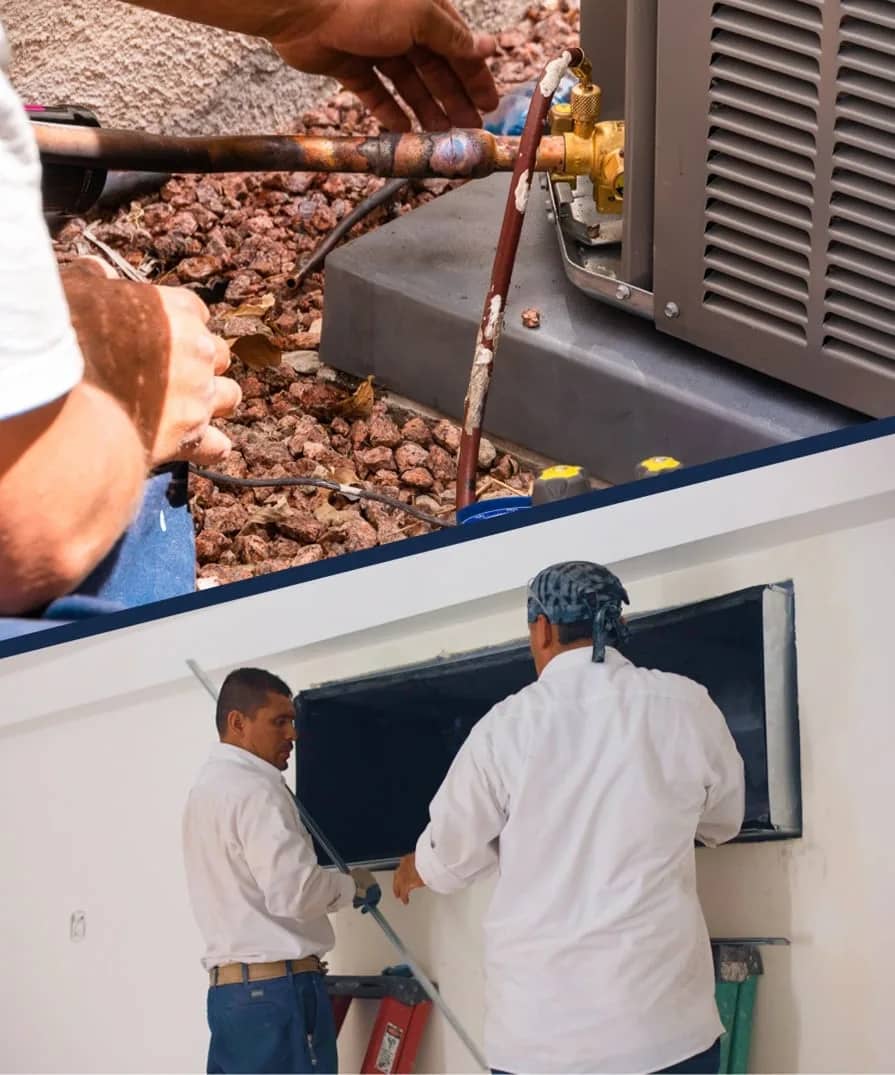
Short answer: Commercial HVAC maintenance cost estimating requires a full asset audit, percent-of-replacement benchmarks (1–3% for PM-only, 3–8% for full O&M), and a 1–4% contingency based on equipment age and criticality. In Las Vegas, factor in extended summer runtime, desert dust requiring frequent coil cleaning, monsoon season impacts on condensate systems, and peak demand charges that make preventive maintenance essential for controlling energy bills.
For more information, see our guide on commercial HVAC maintenance best practices.
For more information, see our guide on commercial HVAC maintenance costs.
For more information, see our guide on commercial HVAC systems guide.
What can change maintenance cost estimates
- Equipment count, age, and replacement value
- Service tier (basic PM vs. enhanced vs. full-service contracts)
- Building criticality and downtime cost tolerance
- Local climate factors (Las Vegas heat load, dust, monsoon season)
- Peak demand charges and energy cost structure
- Access constraints and site complexity
Key Takeaways
Start with a clear summary of the actions that stop common budget mistakes. Capture all assets, track ages and warranties, and use percent-of-replacement or per-square-foot benchmarks to set defensible budgets. Add 1–4% contingency based on average age and criticality, and match service tiers to building risk to reduce downtime.
- Use PM-only at 1–3% of replacement value and complete O&M at 3–8%.
- Inventory major assets, track ages, and add a 1–4% emergency contingency.
- Match service tier to building risk; critical sites need full-service contracts and guaranteed KPIs.
- Request line-item pricing, parts-markup caps, and SLA terms for clear comparison.
Summarize how to use these takeaways against real data. Use a short spot audit to validate percent-of-replacement benchmarks for your site. Adjust budgets each year after reconciling actual spend and logged failures. Doing this keeps your plan honest and reduces surprise change orders.
Why do budget errors happen in commercial HVAC?
Missing data and wrong assumptions cause most budget misses. Facility teams may not know exact counts, ages, or replacement costs for rooftop units, chillers, or controls. Contractors can also bid narrow scopes or assume lower commercial labor than reality, creating gaps that surface as change orders and emergency spend.
Contractor pricing often differs by labor class, travel time, and parts markup. Low initial bids may exclude refrigerant work, controls troubleshooting, or economizer calibration. When those exclusions appear in the field, owners face sudden costs and tenant complaints. Accurate estimates prevent that disruption.
Budgets that ignore criticality and downtime costs are incomplete. Some buildings absorb short outages, while others lose revenue when systems fail. Quantify potential downtime costs and include them in the risk profile to choose the right service tier and contingency level.
What common traps cause underestimates?
Many estimates use residential assumptions on commercial jobs. That error lowers labor and parts allowances. Another trap is defining PM scope too narrowly and excluding consumables or small parts. Those omissions reduce upfront price but raise emergency and overtime spend later. (Building America Solution Center HVAC Guides)
How do inventory gaps affect costs?
Incomplete inventories hide replacement and spare-part needs. If rooftop units or VAV boxes are missing, line items for parts and labor vanish. Asset age matters too. Systems near end of life need larger repair budgets and faster replacement planning. A good inventory lowers surprises.
Which hidden parts drive surprise repairs?
Controls, dampers, sensors, and economizers often fail unpredictably. Small parts like belts, starters, and bearings cause repeated truck rolls and added labor. Coil fouling and sensor drift can slowly raise energy use and push repairs into emergency mode. Budget these items separately.
How do emergency callouts inflate budgets?
Emergency work triggers premium labor rates, overtime, and rush parts. Repeat truck rolls increase total labor and reduce first-time fix rates. Emergency service also hurts tenants and can raise landlord liabilities. A solid PM plan cuts those calls and stabilizes annual spend.
When does age trigger replacement needs?
Age rules vary by equipment type and runtime patterns. Rooftop units often reach planning replacement at 15–20 years. Chillers and boilers may need action between 15–25 years depending on hours and service history. Use age thresholds to schedule capital funds and avoid reactive replacements.
How often do warranties alter estimates?
Active warranties reduce budgeted parts costs when they are tracked. Untracked or expired warranties shift costs back to the owner. Checking warranty status during audit can surprise you with covered parts. Record warranty dates to make the estimate defensible.
Are vendor markups and bidding practices accounted for?
Contractor markups and subcontractor use change the final cost. Low bids can hide markup practices and exclusions. Ask for line-item parts pricing, parts-markup limits, and blended labor rates to compare offers fairly. Clear terms prevent post-award cost growth.
See why homeowners trust us — view our industry awards and certifications.
How to inventory HVAC for accurate estimates?
Start inventory with a physical audit and a simple, repeatable template. Capture make, model, serial, age, tonnage or kW, and last service date for each major asset. Note control panels, economizer types, and critical spare parts. Clean data makes vendor proposals comparable.
Use the audit to verify warranty status and installed options. Look for recent repairs and BAS alarms. Track refrigerant types and charges. Those details affect replacement cost and compliance budgets, and they make the estimate defensible when you compare vendor bids.
Our pricing guide breaks down the costs you can expect.
Document runtime hours and operating patterns when possible. High-run assets need higher PM frequency and spare-part stocks. BAS logs or runtime counters help prioritize which units get quarterly checks and which can be maintained semi-annually.
What equipment should be listed first for commercial sites?
Begin with chillers, boilers, packaged rooftop units, and large AHUs. These items carry the highest replacement cost and the largest energy impact. Next, list terminal equipment like VAV boxes, fan coils, and pumps. Recording capacities helps set replacement-value classes. (Building America Solution Center HVAC Guides)
How to estimate unit replacement value?
Use current installed prices for like-for-like replacements and add 20–40% for labor and controls. Regional costs matter, so adjust for your market. For quick checks, use rule-of-thumb ranges: RTUs $15k–$35k, chillers $200k–$500k, boilers $10k–$150k depending on size and complexity.
Which assets need serial tracking?
Track any asset with warranty, refrigerant charge, or large replacement cost. Chillers, packaged DX units, boilers, and major AHUs fit this rule. Serial numbers help claim warranty parts and monitor recall or refrigerant-transition requirements. Include serials in the audit template.
How do zone counts affect labor hours?
Each additional VAV box or thermostat adds inspection and balancing time. High-zone counts raise commissioning and calibration hours during PMs. Estimate labor per zone for planned visits and startups to avoid under-resourcing labor. That step reduces missed work and follow-up trips.
Can remote sensors simplify inventory?
Remote sensors and BAS data can speed inventory validation and show runtime and alarms. They reduce manual checks and help prioritize units with high runtime or frequent faults. Budget a small fee for data services when building the estimate, and use those feeds to refine PM frequency.
Which service level matches building criticality?
Match service tiers to occupant risk, downtime cost, and regulatory needs. Basic tiers suit low-risk retail. Enhanced tiers fit multi-tenant offices. Full-service contracts work best for sites needing uptime, redundancy, and verified KPIs like hospitals and data centers.
Build your service level around response time, parts coverage, and reporting. Full-service options include parts allowances, priority response, and performance metrics. Decide how much uptime and documentation you need, then compare offers on those exact terms.
Include SLA penalties or credits where downtime is costly. Those terms align contractor incentives with building needs. Request guaranteed first-time fix rates and clear response windows. Price the contract accordingly so it reflects the building’s true risk.
What defines basic vs enhanced service?
Basic service covers routine PM tasks, filter swaps, and visual checks. It limits included parts and often excludes labor for repairs. Enhanced service adds periodic testing, small repairs, and parts within a cap. Enhanced packages usually include seasonal startups and some troubleshooting.
How much does full service cost more?
Full-service contracts typically run 20–50% higher than enhanced tiers. Prices vary with parts allowances, guaranteed response times, and included KPIs. The premium pays for fewer emergencies and faster fixes. Compare total cost of ownership, not just annual fee, to see value.
When should you choose full service?
Choose full service for sites where failure risks cost revenue or safety. Hospitals, data centers, and critical manufacturing need guaranteed uptime. Single-failure risks and strict regulatory needs also justify full coverage. Use downtime cost estimates to test the math. (Building America Solution Center HVAC Guides)
How do emergency repairs skew annual budgets?
Emergency repairs use premium labor and rush parts, both of which inflate year-to-year costs. Multiple truck rolls and overtime worsen the impact. Facilities without spare parts or with thin PM schedules tend to see higher emergency percentages of total spend.
Track emergency spend as a percent of replacement value or of planned O&M. That metric helps you set contingency and justify PM investments. A predictable emergency reserve also smooths year-end accounting and reduces surprise capital calls.
Use historical service logs to refine your contingency. If unplanned repairs cluster or rise each year, increase PM frequency or schedule phased replacements. Those steps move spend from premium emergency rates into planned, lower-cost work.
What is typical emergency repair spend?
Emergency spend depends on age and complexity. Low-risk sites often spend 0.5–2% of replacement value annually. Older or critical assets can need 2–5% or more. Tracking your own history gives the best guidance for setting reserves and contingency levels.
How to set contingency reserves?
Set a contingency of 1–4% of replacement value based on average equipment age and criticality. Young fleets can sit near 1%, while older assets need higher reserves. Update the percentage each year after reconciling actual emergency spend and documented failures.
When to escalate to capital replacement?
Move to replacement when repair frequency and cost approach half the replacement value over a short span. Also replace when efficiency losses hike utility bills or when refrigerant phase-down forces an expensive retrofit. A clear threshold helps avoid repeated emergency expenses.
Try our energy savings calculator to see how much you could save.
What benchmarks and rules of thumb apply?
Use percent-of-replacement and per-square-foot rules as baseline controls. Layer age factors, service tier multipliers, and contingency on top. Then validate the baseline with a spot audit to ensure local labor, parts, and climate are reflected correctly.
Adjust per-ft2 rates for climate and building type. Cooling-dominated climates like Las Vegas need larger budgets for condenser cleaning and refrigerant checks due to extended summer runtime and desert dust accumulation. Las Vegas commercial buildings face extreme heat loads (110°F+ summer days), frequent dust storms that foul coils, monsoon season humidity spikes that stress condensate systems, and high peak demand charges that make preventive maintenance critical for controlling energy bills. High-rise or complex HVAC systems require more labor per ft2 than simple low-rise offices. Tailor the numbers to your portfolio.
Update models annually to reflect actual spend and replacement activity. Escalate labor and parts by 3–6% per year, and add planned replacements from lifecycle schedules. Doing this creates a practical multi-year capital and O&M projection.
What ft2 benchmarks apply to commercial offices?
Office buildings often budget $0.25–$1.00/ft2/yr for whole-building HVAC O&M depending on complexity. Low-rise basic offices sit at the low end. Mixed-use or high-end offices with many zones and controls approach the higher end. Adjust for local labor and climate. (DOE Better Buildings HVAC)
How to estimate per-unit service costs?
Estimate parts, travel, and labor per visit by unit type. For RTUs, budget $500–$1,500 per annual PM depending on access and size. Use billed labor rates of $75–$150 per hour as a guide, and include truck-stock and small parts in per-visit fees.
Which age thresholds trigger replacement?
Use roughly 15 years for RTUs and chillers as a planning threshold. Boilers and specialty equipment may vary with use and service history. Heavy runtime systems often need earlier replacement. Fleet-level plans smooth capital needs and prevent emergency spikes.
Are predictive tools worth the cost?
Predictive monitoring pays when it reduces emergency truck rolls and catches failures early. For larger portfolios, these tools often lower total O&M and energy costs. Run a quick ROI model using your failure history to decide if predictive monitoring fits your portfolio.
How to budget for refrigerant compliance?
Add line items for leak detection, tracking, and replacement where needed. Phase-down rules can force retrofits or early replacements for certain units. Budget for certified technicians and refrigerant purchase or recovery work to avoid compliance fines and surprises.
Which contractors provide best value?
Value comes from commercial experience, transparent pricing, and verifiable KPIs. Ask for NATE-certified techs, line-item pricing, and parts-markup caps. Favor contractors who show lower emergency rates and good reporting, not just the lowest bid. References and audit examples help verify claims.
What audit checks ensure completeness?
Verify serial numbers, warranty dates, recent repairs, and control schematics during the audit. Cross-check runtime hours and BAS alarm logs. Confirm refrigerant type and charge amounts. These checks prevent missing costly items in the estimate and strengthen contract defensibility.
How to model multi-year cost escalation?
Apply labor and parts escalation of 3–6% yearly, and add planned replacements from your lifecycle schedule. Include energy-price forecasts if you model savings from efficiency work. Run scenarios with conservative and optimistic escalation to test funding needs.
Ready to get a defensible estimate?
If you need a local site audit, pick a contractor that gives line-item pricing and a clear percent-of-replacement baseline. Request a simple chart showing PM-only, enhanced, and full-service costs side by side for the same asset list. That deliverable makes comparisons easy and defensible.
Maintenance estimating checklist
- Complete asset inventory with make, model, serial, age, and tonnage
- Verify warranty status and expiration dates
- Document runtime hours and operating patterns
- Calculate replacement value for each major asset
- Assess building criticality and downtime cost tolerance
- Review historical maintenance and emergency repair spend
- Factor in Las Vegas-specific challenges: extended summer runtime, dust loading, monsoon season impacts
- Request line-item pricing with parts-markup caps
- Compare service tiers (basic PM, enhanced, full-service) side by side
- Set contingency reserves (1–4% of replacement value) based on age and criticality
Need commercial HVAC maintenance estimating help in Las Vegas?
Las Vegas building owners trust The Cooling Company for professional commercial HVAC maintenance cost estimating and service agreements. Our licensed, NATE-certified technicians conduct comprehensive site audits, inventory all assets, verify warranties, and present defensible percent-of-replacement budgets with clear SLA options. We understand Las Vegas-specific challenges: extreme commercial heat loads, desert dust requiring frequent coil cleaning, monsoon season impacts on condensate systems, and peak demand charges that make preventive maintenance essential.
Our commercial HVAC services include:
- Site audits and asset inventory for accurate cost estimating
- Commercial HVAC maintenance agreements tailored to your building
- Line-item pricing with parts-markup caps and guaranteed KPIs
- Energy audits and peak demand reduction strategies
- Emergency commercial HVAC repair with fast response times
Call (702) 567-0707 or visit our commercial HVAC services page to schedule a site audit and receive a detailed, defensible maintenance cost estimate. We serve Las Vegas, Henderson, North Las Vegas, and surrounding commercial areas.
Outside our service area, ask potential contractors for NATE-certified technicians, clear line-item pricing, PM frequency by asset, and percent-of-replacement budgeting. If you want local help in Las Vegas, Henderson, or North Las Vegas, contact The Cooling Company at (702) 567-0707 and request a commercial HVAC budgeting audit and proposal.
About The Cooling Company
The Cooling Company has been serving the Las Vegas valley with professional HVAC services for over a decade. Our team of licensed, NATE-certified technicians specializes in air conditioning repair, heating system maintenance, and complete HVAC installations. We're committed to providing honest, reliable service with upfront pricing and a 100% satisfaction guarantee on all work performed.
- Phone: (702) 567-0707
- Reviews: 4.8/5 stars (780+ reviews) - See reviews
Service Areas
We proudly serve homeowners and businesses throughout the Las Vegas metropolitan area, including Las Vegas, Henderson, and North Las Vegas. Our service technicians are available for same-day appointments in most areas, with emergency service available 24/7 for urgent HVAC issues.
Local essentials and challenges
Estimating in Las Vegas means accounting for extended cooling season hours, rooftop heat island effects, and higher dust loading than most markets. Summer demand peaks put pressure on labor availability and parts lead times, and monsoon storms can add unplanned drain and electrical work. Build those variables into your contingency so estimates stay realistic.
Cost drivers to include in estimates
- Number of RTUs, chillers, and AHUs with verified tonnage
- Filter change cadence and coil-cleaning frequency
- Access complexity (roof hatches, escorts, lift rentals)
- Controls/BAS support and reporting requirements
- Refrigerant type, leak history, and compliance tracking
- After-hours coverage and critical zone SLAs
Decision guidance for budgeting
- Use a PM-only baseline for low-risk sites, then add targeted enhancements.
- Weight budgets by criticality, not just square footage.
- Ask for line-item pricing so you can compare apples to apples.
- Update assumptions after each peak season using actual spend.
Prevention that stabilizes costs
- Schedule pre-season inspections by late spring.
- Clean coils after dust storms to restore airflow quickly.
- Track runtime hours to identify overworked units.
- Keep an approved spare-parts list for long-lead items.
Neighborhoods we serve around Las Vegas
We estimate and service commercial sites in Summerlin, Henderson, North Las Vegas, Paradise, Green Valley, Spring Valley, Centennial Hills, and Enterprise. Mixed-use corridors and older strip centers often need more frequent filter and controls work, which we reflect in the estimate.
Trust and guarantees
- Serving Las Vegas since 2011 with 55+ years of combined experience
- Licensed, EPA-certified, and NATE-trained technicians
- BBB A+ rated and Lennox Premier Dealer
- Clear scopes, upfront pricing, and a 100% satisfaction guarantee
Visit our Las Vegas location
Share This Page
References
- U.S. Department of Energy (Energy.gov) (accessed 2026-01-03)
- U.S. Environmental Protection Agency (EPA) (accessed 2026-01-03)
- ASHRAE (Standards and guidance) (accessed 2026-01-03)
- ENERGY STAR (Heating & cooling) (accessed 2026-01-03)
Need HVAC Service in Las Vegas?
The Cooling Company provides expert HVAC service throughout Las Vegas, Henderson, and North Las Vegas. Our licensed technicians deliver honest assessments, upfront pricing, and reliable results.
Call (702) 567-0707 or visit commercial HVAC, AC repair, maintenance, or installation for details.