

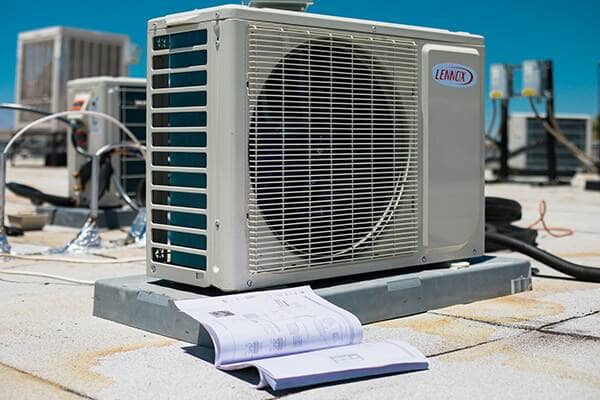
Short answer: Light commercial service (rooftop packaged units, larger splits, businesses that cannot close while you diagnose) is the single capability that most reliably moves a residential service technician to the top of the $24 to $44 per hour range. It requires different diagnostic habits, different customer handling, and comfort working on a roof in Las Vegas summer. We hold C-21 #0075849 and C-1D #0078611 with a $700,000 bid limit, so this work is a real part of the schedule.
There is a ceiling in residential service work, and most technicians reach it around year six or seven without quite noticing.
You get fast. You know the common failures on the common equipment in the common neighborhoods. A call that would have taken you two hours in year two takes forty minutes. That is genuine skill and it is worth real money.
But it stops compounding. The tenth year of residential-only work does not make you meaningfully more valuable than the seventh, because you are doing a task you already mastered more efficiently. Pay ranges reflect that, which is why so many experienced technicians feel stuck at a number they cannot argue past.
Light commercial is the usual way through.
Key Takeaways
- Commercial capability is the most reliable route to the top of the pay range for a service technician.
- The equipment is not harder, it is less familiar: rooftop packaged units, economizers, larger splits, controls you did not install.
- The pressure is different. A restaurant cannot close while you think.
- Maintenance history is usually terrible, because the equipment was serviced by whoever was cheapest for a decade.
- Roof work in Las Vegas summer is the real physical cost and deserves an honest look before you commit.
- It makes you hard to replace, which is the actual leverage.
What Is Actually Different
The equipment is unfamiliar rather than complicated
Rooftop packaged units combine everything into one cabinet on a roof. Economizers bring in outside air and fail in ways that have no residential equivalent. Larger splits, multiple stages, and controls that somebody configured years ago and did not document.
None of it is beyond a competent residential technician. It is a body of unfamiliarity that takes a season or two to burn off, and the technicians who never make the jump usually stopped because of the first few uncomfortable calls rather than because they lacked the ability.
You cannot take your time
A homeowner with no cooling is uncomfortable. A restaurant with no cooling at 11am on a Friday is losing a service and deciding right now whether to send staff home.
That changes how you work. You communicate earlier and more often, you give an honest read before you have a complete diagnosis, and you get comfortable saying "here is what I know at this moment, here is what I still need to check, here is when I will have an answer." Technicians who cannot narrate their progress struggle in commercial regardless of how good the diagnosis eventually is.
The history is bad
Commercial equipment in this valley has usually been maintained by a rotating cast of whoever quoted lowest. You will find previous repairs that were wrong, controls jumpered out, missing panels, filters that have not been changed since a different tenant occupied the building.
That is frustrating and it is also where the work gets interesting, because you are reasoning about a system rather than swapping a known failed part.
The roof
Worth saying plainly. Las Vegas rooftop work in July is the hardest physical condition in this trade, harder than attics because there is no end to it and no shade. Early starts, hydration discipline, and knowing when to come down are not soft policies, they are how people avoid heat injury.
If you want the unvarnished version of the environmental reality here, we have written it: 115 degrees, attics, and rooftops.
Why It Pays
Straightforward supply and demand. A technician who can be dispatched to a rooftop unit at a restaurant on a Friday afternoon and resolve it is scarce, and the consequences of not having one are expensive for both the customer and the company.
Our published service technician range is $24 to $44 per hour based on experience and certifications. Senior and lead technicians sit at the upper end, with published on-target annual earnings of $140,000 to $200,000 at Senior and $220,000 and up at Lead. Commercial capability is one of the clearest ways to get there, alongside advanced diagnostics and mentoring. We have written about how to reach the top of that range more broadly.
How the Transition Usually Goes
Ride along first. A few commercial calls with someone experienced, mostly to get familiar with roof access, safety, and the rhythm of a business customer.
Maintenance before service. Scheduled commercial maintenance is the low-pressure way to build familiarity with the equipment before you have to diagnose it with a manager watching.
Mixed schedule. Most technicians here run both, which keeps residential speed sharp while commercial capability builds.
Certifications. EPA 608 Universal is the baseline. Beyond that, specific manufacturer and controls training compounds quickly in commercial. Our guide to which certifications actually raise your pay in Nevada covers the ones worth the time.
Frequently Asked Questions
Do I need commercial experience to be hired?
No. We hire experienced residential service technicians and build commercial capability on the job. Willingness matters more than prior exposure, and the honest requirement is comfort with heights and heat.
What licenses does the company hold for commercial work?
Nevada C-21 #0075849 and C-1D #0078611, with a $700,000 bid limit. That is what makes light commercial a real and recurring part of the schedule rather than an occasional job.
Is commercial work on-call heavy?
Commercial customers do have urgent failures, and on-call rotates rather than defaulting to whoever objects least. Peak-season overtime is real and paid.
Will I stop doing residential work?
Most technicians run a mix. Full commercial specialization is possible over time but is not required to benefit from the capability.
Is this different from commercial install work?
Yes. Install and service are separate tracks with different rhythms. If the install side is what interests you, we have compared residential and commercial install work separately.
If You Have Hit the Ceiling
If you are a strong residential service technician who has stopped learning much, this is the direction that fixes it, and it is available here on a real schedule rather than as a promise about next year.
Apply here, or call (702) 567-0707.
Share This Page