

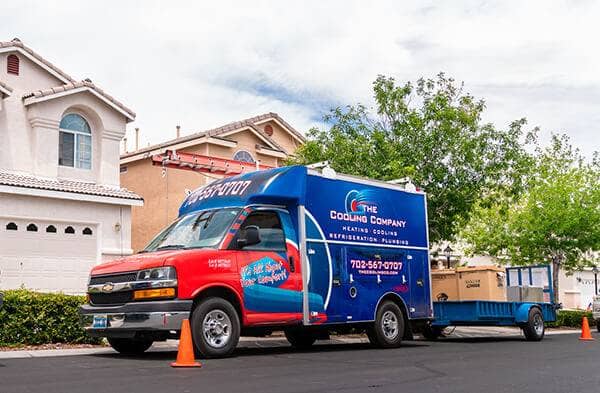
Short answer: An HVAC career starts paying immediately, requires no tuition debt, and cannot be performed remotely or automated away, because somebody has to physically be in the attic. At The Cooling Company that path starts at $18 to $24 per hour as a helper with no experience and moves to $24 to $44 for service technicians or $28 to $38 for install. The honest tradeoff is that the work is physically demanding in a 115 degree climate and takes a real toll on your body over decades. College is the better answer for careers that genuinely require a degree. It is a poor answer if the plan is "a degree in something, probably."
I am the managing director of a family HVAC business, so treat this as an interested opinion. I will try to make it a fair one, including the parts that argue against us.
Key Takeaways
- The trade pays from day one. No tuition, no four-year income gap, no debt service afterward.
- The work cannot be offshored or done remotely. Somebody has to be physically present.
- Advancement is capability based, which suits people who perform better than they credential.
- The physical cost is real and cumulative over a career. This is the honest counterargument.
- College is right for careers that actually require it. It is a poor default when the plan is vague.
- The trade also leads to business ownership through Nevada contractor licensing.
The Timeline Difference
Consider two people who both finish high school in Las Vegas.
Person A enrolls in a four-year program. For four years, they pay tuition and earn little or nothing. They graduate with a degree and, in many cases, debt that will require years of payments.
Person B starts as an HVAC helper at $18 to $24 per hour with health insurance and paid time off. They earn EPA 608 certification in their first year with employer support. Helpers who develop quickly reach technician pay within their first year, and technician ranges here are $24 to $44 per hour for service and $28 to $38 for install. By year four they may be a senior technician with light commercial capability and manufacturer certifications.
Person B has four years of income instead of four years of expense, no debt, and a portable credential set. That gap is the entire argument for the trades, and it is a serious one.
I am deliberately not publishing lifetime earnings projections for either path, because those numbers are enormously sensitive to which degree, which trade, and which decisions come after. Anyone showing you a confident lifetime comparison is selling something.
The Security Argument
Three structural things about HVAC work:
It cannot be done remotely. Someone has to physically be at the equipment. No amount of connectivity changes that.
It cannot be offshored. The failed compressor is in a house in Henderson.
Demand here is not tied to the construction cycle. A large share of the work is service and replacement on equipment that already exists. In Las Vegas, where systems run at extreme load for four months a year and dust shortens equipment life, that replacement cycle is constant.
Air conditioning in a 115 degree city is a safety system, not a luxury. That is a durable foundation for a career.
The Honest Case Against the Trade
If I only made the positive case, you should not trust the rest of this.
The physical cost is real and cumulative. Knees, back, shoulders, and heat exposure add up across decades. A 25 year old handles attic work easily. A 55 year old who spent thirty years in attics feels it. Some technicians move into supervision, dispatch, sales, or business ownership partly for that reason.
The heat is genuinely hard. Las Vegas summers exceed 115 degrees, attics are worse, and peak season runs June through September. Some people simply cannot do this, and there is no shame in finding that out.
Some paths do require a degree. Medicine, law, engineering, research, teaching, and many corporate tracks are gated by credentials. If that is what you want, the trade is not a substitute and you should go get the degree.
The trade rewards a specific temperament. Comfort with dirt, heat, physical work, problem solving, and talking to strangers in their homes. If several of those are wrong for you, the money will not carry you.
Where the Trade Path Leads
Worth spelling out, because people underestimate the ceiling.
Helper, then technician, then senior technician, then lead technician, then field supervisor or operations leadership. Beyond that, Nevada contractor licensing under the C-21 classification allows you to hold your own licensed business. The Cooling Company itself is a family business built by people who did the work first: we hold C-21 license #0075849 and C-1D license #0078611.
The people who own HVAC companies in this valley are, overwhelmingly, people who used to be technicians. That path is available and the qualifying experience for it starts with your first day as a helper.
What If You Are Not Sure?
The asymmetry favors trying the trade first, and it is not close.
Work as a helper for a year. You are paid $18 to $24 per hour to find out whether this suits you. If it does, you are a year into a career with no debt. If it does not, you are a year older with savings, real work history, and clarity, and college is still available.
Do it in the other order and a year of college costs you a year of tuition to reach the same conclusion.
Questions Young Applicants Ask
How much do HVAC techs make in Las Vegas without a degree?
At The Cooling Company, service technicians earn $24 to $44 per hour and install technicians $28 to $38 per hour, with no degree required. Entry-level helpers start at $18 to $24 per hour with no experience required.
Do I need a degree to work in HVAC?
No. What you need for field positions is a valid Nevada driver's license, the ability to pass a background check, physical fitness for the work, and eventually EPA 608 certification, which we support helpers in earning.
Is HVAC a good long-term career?
In this market, structurally yes: demand is constant, the work cannot be automated or offshored, and there is a defined path from entry level through senior technical roles and into business ownership. The honest caveat is the physical toll over decades, which is worth planning for.
What if my parents want me to go to college?
That is a real conversation and worth having with actual numbers. Bring the comparison: starting pay, no tuition, no debt, employer-supported certification, and a defined ladder. Many parents object less to the trades than to the idea of no plan. A specific plan changes the conversation.
Can I do both?
Yes. People work in the trade and take coursework, particularly business coursework aimed at eventually owning a company. Field positions are full-time, so it requires planning, and we would rather you tell us than hide it.
What is the youngest you hire?
Field positions require a valid Nevada driver's license and the ability to work full-time in field conditions. Ask about your specific situation when you apply.
Try It Before You Commit to Anything
A year in the trade costs you nothing but time, and it pays while you find out.
Start your application, see all roles on our careers page.
Share This Page