

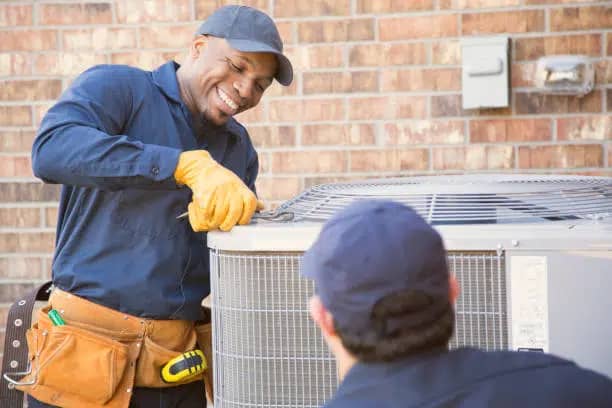
Short answer: A service technician day at The Cooling Company starts with dispatch assigning your calls, usually a mix of diagnostics and scheduled maintenance across the Las Vegas Valley. On each call you verify the complaint, take readings, identify root cause, document with photos, present written options, and complete the work if the part is on your van. Dispatch stays reachable all day. You close out your calls, return the company vehicle, and go home. Peak season is intense; the rest of the year is steady.
Install work and service work are different jobs that happen to share a trade. Install is production: you know what the day holds, you execute it well, and you finish something. Service is investigation: you find out what the day holds one call at a time, and the interesting part is the problem you did not expect.
Here is a service day, concretely.
Key Takeaways
- Morning dispatch assigns your calls. Diagnostics, maintenance visits, and repairs, mixed.
- Van stock decides your day. A well-stocked truck is the difference between completing a call and scheduling a return.
- Every call gets documented with photos and written options for the customer.
- Dispatch is reachable when a call turns into something bigger than the ticket described.
- You drive an air-conditioned company vehicle between calls, which matters more than it sounds in July.
- Peak season is June through September, with overtime available for those who want it.
Morning: Dispatch and Van Check
The day begins with your assigned calls coming through our dispatch platform. A typical board is a mix: two or three diagnostic calls where something is wrong, a couple of scheduled maintenance visits, and whatever repair work carried over from a diagnosis earlier in the week where a part had to be ordered.
Before you roll, check your van stock against the day. Our inventory operation manages van restocking against what the schedule actually needs, with each van carrying a defined parts list. That system exists because the single most frustrating experience in service work is diagnosing a problem correctly and then not being able to fix it because the part is thirty miles away.
First Call: A Standard Diagnostic
No cooling, single-family home in the east valley, 1990s equipment.
You verify the complaint with the homeowner and get the history, which is often more useful than any single reading. Has it been gradual or sudden? Any noises? When was it last serviced? Then you work the system: thermostat, filter, indoor blower and coil, disconnect and outdoor unit, electrical components, and pressures.
Say it is a failed run capacitor with a contactor showing significant pitting. You photograph both, replace the capacitor from van stock, and present written options: the capacitor replacement now, and the contactor as work the system genuinely needs before it strands them in August. The customer decides. You do not create pressure and you do not need to, because a pitted contactor speaks for itself in a photograph.
Call complete, documented, closed out. On to the next.
Second Call: Maintenance, Which Is Not Filler
Scheduled maintenance visits are where the trade's actual value is, especially here.
Las Vegas conditions are unusually hard on equipment: extreme runtime for four months, heavy dust loading on coils and filters, hard water scale, and rooftop units baking through the entire summer. A maintenance visit that catches a coil that is 40 percent blocked, a capacitor drifting out of tolerance, or a condensate drain about to back up into a ceiling is the visit that prevents an emergency call in July.
You clean, inspect, take readings, and document conditions. If you find something, you report it honestly with a photo. If you find nothing, you say that too. A technician who invents findings on maintenance visits is doing the thing this company specifically does not do.
Third Call: The One That Goes Sideways
This is the call that makes service work interesting and makes it hard.
An intermittent fault. The system runs fine while you are there. The homeowner says it quits every afternoon around three. Nothing is obviously wrong on inspection.
Now you are doing real diagnostic work: thinking about what changes at three in the afternoon (ambient temperature, load, voltage under grid stress), checking for a component that fails when hot, looking at electrical connections that might be marginal under thermal expansion, examining whether the equipment is simply undersized for the load on the hottest part of the day.
This is where experience compounds, and where a good employer matters. If you need to spend an extra 45 minutes to find a root cause instead of throwing a part at it, that is the right decision and it is supported. And if you genuinely cannot resolve it today, you can call a senior technician or leadership and talk it through. Dispatch and leadership are reachable during the workday. We are fewer than 50 people, so there is no queue between you and someone who can help.
Afternoon: Heat Management Is Part of the Job
By early afternoon in July, outdoor temperatures are past 110 and attic work has become genuinely hazardous. Attic-heavy work gets scheduled early where possible for exactly this reason.
Between calls you are in an air-conditioned company vehicle, which is a small thing that turns out to matter enormously across a summer. Fuel card, so nothing comes out of your pocket. Hydration is treated as an operational requirement, not a suggestion, and a technician who takes fifteen minutes to cool down is doing the job correctly.
Close-Out
Calls closed out with documentation complete, any parts needed for follow-up work ordered so they are staged for the return visit, and the vehicle returned. Then you go home. Your personal truck sat in your driveway all day.
During peak season there may be more calls than the standard day holds, and overtime is available for technicians who want the hours. It is available, not mandatory.
What Makes a Good Day Versus a Bad One
Good day: every call diagnosed correctly, most completed on the first visit, one genuinely hard problem solved, and a customer who understood what you told them.
Bad day: a callback on work from last week, a part that was not on the van, and a customer who was already angry at a different contractor before you arrived. These happen. What determines whether they are survivable is whether you are supported through them or blamed for them.
Questions About the Service Day
How many calls does a service tech run in a day?
It varies with the mix. Maintenance visits are shorter than diagnostics; a difficult intermittent fault can consume a large part of a day. We do not set a call-count target that would push technicians to rush a diagnosis, because rushed diagnostics produce callbacks.
Do technicians work alone?
Service technicians generally run calls solo, unlike install crews which run 2 to 3 people. You are not unsupported, though: dispatch and leadership are reachable throughout the workday, and senior technicians are available to talk through a hard call.
What happens when I cannot fix something?
You document what you found, explain it to the customer honestly, order what is needed, and schedule the return. Nobody is expected to bluff. Escalating a call you cannot resolve is a sign of judgment, not weakness.
Is the van stocked properly?
Van stock is managed against the actual schedule, with each van carrying a defined parts list and restocking driven by our inventory system rather than by memory. It will not be perfect on every call, but it is a managed process rather than an afterthought.
How much driving is involved?
A real amount. Calls are spread across the Las Vegas Valley, from the northwest through Henderson and the southeast. You drive a company vehicle with a fuel card, and the drive time between calls is part of the workday.
What are the hours?
Full-time, year round. Peak season June through September runs long with overtime available. Outside peak, the schedule is steadier. On-call rotation depends on current staffing, so ask about specifics during your interview.
If That Sounds Like Your Kind of Work
Service technicians at The Cooling Company earn $24 to $44 per hour, with EPA 608 Universal and 2 or more years of field experience required, and a company vehicle, fuel card, tools, uniforms, and PPE provided.
Start your application, see all roles on our careers page.
Share This Page