

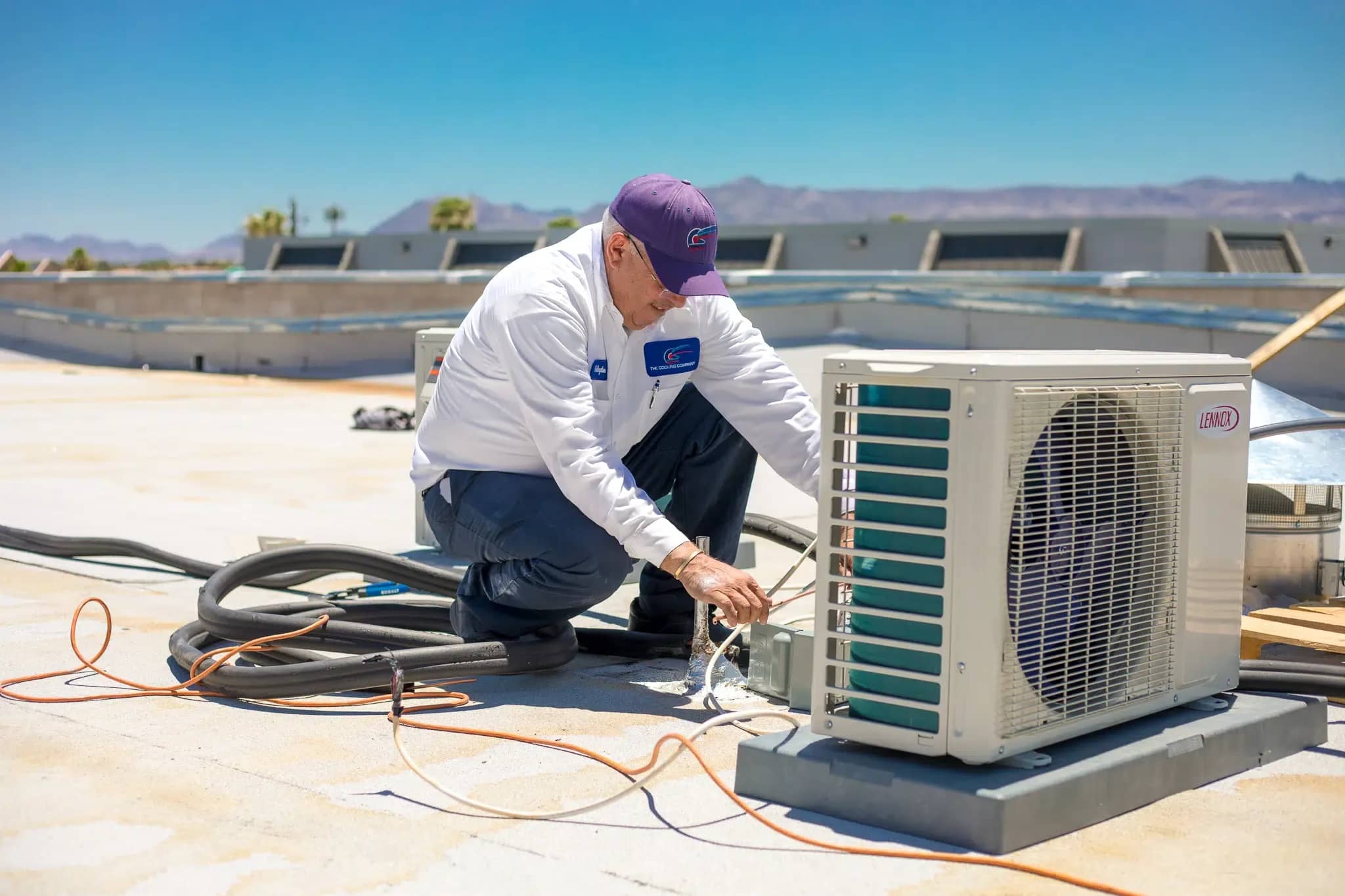
Short answer: Las Vegas hospitality workers bring three things HVAC employers struggle to hire for: physical stamina across a full shift, composure with stressed and unhappy people, and proven reliability in an industry that does not tolerate no-shows. What you need to add is the technical trade itself, which you learn on the job. Helper and apprentice roles at The Cooling Company start at $18 to $24 per hour with no experience required, with a path to $24 to $44 as a service technician or $28 to $38 on install.
This valley runs on hospitality, and a lot of very capable people are looking at the trades right now for reasons that have nothing to do with disliking their current work: schedule volatility, wanting daytime hours, wanting a skill that transfers anywhere, or simply wanting a path with clearer steps on it.
If that is you, here is an honest assessment of the switch.
Key Takeaways
- Stamina transfers directly. Ten hours on your feet is ten hours on your feet.
- Customer composure is a technical skill here. You will be in stressed people's homes, and that is a large part of the job.
- Reliability from a no-show-intolerant industry is exactly what we screen for.
- Bilingual ability is genuinely valuable across the whole operation.
- The schedule flips to daytime, with peak season June through September as the demanding stretch.
- Realistic entry: $18 to $24 per hour with no HVAC experience required.
What Transfers, Specifically
Physical stamina
People underestimate this. A cook, a server, a housekeeper, or a banquet worker who does a full shift on their feet already has the endurance base that new HVAC helpers most often lack. The environment is different, but the underlying capacity to work hard for a full day without fading is already built.
Composure with upset people
This is the one that surprises people, and it is genuinely valuable.
A large part of HVAC service work is walking into a house where the air conditioning failed in July, the family is uncomfortable and worried about money, and they have already gotten a scary number from somebody else. Managing that conversation calmly, explaining clearly, and not taking the stress personally is a skill.
Hospitality workers have that skill already, usually at a level most people do not. A technician who can defuse a tense situation is more valuable than one who cannot, and it is one of the factors that moves you up a pay range.
Reliability
Hospitality does not tolerate no-shows. If you have held a position through several years of shifts, you have demonstrated the single strongest predictor of success in an entry-level HVAC role. Put the tenure on your application prominently.
Bilingual ability
English and Spanish is a real asset across our operation, in the field and in customer-facing roles.
Speed and prioritization
Anyone who has worked a busy service or kitchen shift knows how to sequence work under pressure. That translates directly to a service day with multiple calls and to install work where the order of operations matters.
What You Have to Learn
Being straight about the gap:
- The trade itself. Refrigeration, electrical, airflow, and diagnostics. Expect real confusion for the first four to six weeks. That is normal and it is on schedule.
- EPA 608 certification. Federally required for refrigerant handling. We support helpers in earning it, and it is the clearest step toward technician pay. See our EPA 608 guide.
- Heat tolerance in a different form. A hot kitchen is hard. A Las Vegas attic in July is harder, and it is worth knowing that before you start.
- Working more independently. Service technicians run calls solo. There is support on the phone, but nobody is standing next to you telling you what to do next.
How the Schedule Compares
This is often the actual reason people make the switch, so here is a fair comparison.
What you gain: daytime hours, a predictable week for eight months of the year, and full-time year-round work rather than shifts that expand and contract with occupancy. Field positions here are full-time and permanent.
What you trade: peak season, June through September, is genuinely demanding, with long days and overtime available for those who want it. And the work is outdoors in extreme heat rather than in a climate-controlled building.
For many people leaving hospitality, the tradeoff is clearly favorable. For some it is not. Both are legitimate conclusions.
The Money Comparison
Be careful and honest with yourself here, because hospitality compensation varies enormously.
Our ranges: helpers and apprentices $18 to $24 per hour, install technicians $28 to $38, service technicians $24 to $44, and customer service and dispatch $19 to $26. Add health insurance for full-time employees, paid time off, uniforms, tools, and PPE provided, and a company vehicle with a fuel card for field staff.
If you are currently in a strong tipped position, the entry-level HVAC rate may be a short-term step down. What you are buying is a ladder with defined steps and a skill that is portable to any city in the country. Helpers who develop quickly reach technician pay within their first year, and advancement here is tied to demonstrated skill and certifications rather than time served.
Run that math honestly against your current earnings rather than assuming the trade automatically pays more on day one.
There Are Also Non-Field Roles
If field work in extreme heat is not right for you, hospitality experience maps directly onto other positions:
- Customer service and dispatch at $19 to $26 per hour. Phone communication, scheduling, coordinating field technicians, and staying calm during peak-season volume. This is close to hospitality work in kind, with daytime hours. Bilingual candidates are at the top of that range.
- Warehouse and inventory control. Parts staging, receiving, restocking vans, and inventory accuracy. Physical but not in an attic.
Career Change Questions
Can I switch from casino or restaurant work to HVAC?
Yes. Helper and apprentice roles at The Cooling Company require no HVAC experience and pay $18 to $24 per hour. What we require is a valid Nevada driver's license, the ability to pass a background check, physical fitness for outdoor fieldwork, and a genuine willingness to learn.
Will I have to take a pay cut?
Possibly at first, depending on what you earn now. Compare our full package including health insurance, paid time off, provided tools and vehicle, and the certification support, then weigh it against the ladder. Helpers who develop quickly reach technician pay within their first year.
Am I too old to start a trade?
No. Career changers in their thirties and forties often outperform younger hires because the work discipline is already there. Say why you are making the change and what you bring.
What if I have never used tools?
That is fine for a helper role. Tools are provided and the fundamentals are taught on the job. Mechanical hobbies help, but they are not a prerequisite.
Do you hire bilingual staff?
Yes, and English and Spanish ability is valuable across the operation, particularly in customer service and dispatch where bilingual candidates sit at the top of the $19 to $26 range.
How fast can I start?
Application, phone screen within a few business days, interview, background check, then offer. For urgent needs the process can close in under two weeks. Give proper notice to your current employer; this is a small city and how you leave matters.
Make the Switch
Bring the stamina, the composure, and the attendance record. We will teach the trade.
Start your application, see every open role on our careers page.
Share This Page