

Short answer: Discover HVAC maintenance tips to cut warehouse AC costs with 7 fast-payback ways like insulation, door seals, controls, and right-sizing to start saving.
This guide explains practical ways to lower the cost to air condition a warehouse. It focuses on steps that reduce cooling load, cut runtime, and squeeze more value from installed equipment. The goal is to help facility managers and owners make informed choices that lower both capital and operating expenses.
Key Takeaways
- Start with envelope fixes and door management to cut loads.
- Right-size systems and add controls like VFDs and economizers.
- Retrofit RTUs first when roof work is costly; choose chillers for large sites.
The recommendations that follow start with low-cost envelope fixes. They then move to controls and equipment changes that pay back quickly. Finally, the guide covers how to size systems and estimate costs so bids and rebates match real needs. Use this as a checklist before you request detailed contractor proposals or apply for incentives.

What drives total warehouse AC cost?
Total cost to air condition a warehouse has three main buckets: capital, operational, and lifecycle. Capital includes equipment purchase and installation. Operational includes electricity, demand charges, and maintenance. Lifecycle covers replacement and major repairs over years.
Site factors change these buckets a lot. Roof condition, door activity, internal heat sources, and local labor rates all affect the final price. Plan early for permit fees, crane lifts, and potential roof repairs to avoid surprise change orders.
How do capital and operational costs compare?
Capital costs are one-time. Equipment, ducting, controls, and installation are included there. Operational costs repeat annually. Electricity, routine maintenance, and service agreements live in the operational bucket.
Over a 10- to 15-year life, energy costs often exceed initial equipment cost. So choosing higher-efficiency equipment makes sense if the system runs many hours per year. Use lifecycle cost models to compare options rather than upfront price alone.
Use our energy savings guide to estimate your potential savings.
What is the typical cost per square foot?
Costs vary by climate and how tightly the space must be conditioned. For basic light storage, an installed cost near $0.50 to $1.50 per ft² can be a rough starting range. Areas that need humidity control, clean rooms, or constant temperature will cost more.
Use per-square-foot numbers only for early budgets. A site-specific load calculation is required for final sizing and accurate bids. The envelope, dock activity, and ceiling height change the estimate dramatically.
How do system type and size change pricing?
Smaller and mid-sized warehouses often get the best value from packaged rooftop units (RTUs). They are cheaper per ton for modest loads and are easier to install. At larger tonnages, chilled-water systems can be more efficient but need higher capital and piping work.
Always match system choice to the building size, runtime, and serviceability needs. A system that looks cheap at purchase can cost more over its life if it runs poorly at part load or requires frequent service.
Which AC systems are common in warehouses?
Warehouses commonly use packaged rooftop units (RTUs), split systems, and chilled-water plants. Each system type has clear trade-offs in capital cost, controls complexity, and maintenance burden. Select the type that fits both short-term budget and long-term energy goals.
Many warehouses prefer RTUs because they are modular and simple to replace. Chilled-water plants are appropriate for very large or multi-building campuses where central control and part-load efficiency matter most. Split systems fit when roof options are limited or when a lower-profile solution is needed.
What is an RTU and how much does it cost?
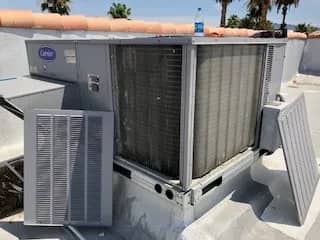
An RTU is a packaged rooftop unit that contains compressors, coils, fans, and controls in one cabinet. It sits on a roof curb and serves the space below through supply and return ductwork.
Installed costs for standard RTUs commonly range from $1,300 to $4,000 per ton. High-efficiency RTUs with economizers, advanced controls, and better coils sit at the upper part of that range. Roof repairs and crane lifts can add thousands to the installed price.
You may qualify for federal tax credits that reduce your upfront cost.
For a detailed cost breakdown, see our HVAC pricing guide.
How do packaged rooftop units compare?
RTUs are fast to install and useful for staged capacity. For retrofit projects they avoid long interior duct runs and reduce onsite work. When many units operate in a single building, control complexity increases because staging and networked controls are needed.
Ensure proper sequencing logic and networked control strategies when selecting multiple RTUs. Poor staging can cause many units to run at once and raise demand charges.
What are chilled water system costs?
Chilled-water plants include chillers, pumps, distribution piping, and air handlers. Installed cost often ranges roughly $3,000 to $8,000 per ton depending on chiller type, site work, and campus complexity.
Chilled-water systems can deliver good part-load performance. They are best for large tonnages or multiple buildings that share cooling. Budget also for piping, valve work, and pump maintenance when weighing lifecycle costs.
Do split systems suit large warehouses?
Split systems separate an outdoor condensing unit from indoor air handlers. They can work where roof load limits prevent large RTUs or where curb space is tight. These systems require refrigerant lines and more field labor.
Split systems can be cost effective for mid-size spaces. For very large warehouses they become complex and may require many units. Evaluate labor and long-term maintenance when choosing splits.
When are DOAS or dedicated fans needed?
A Dedicated Outdoor Air System (DOAS) handles ventilation independently from space cooling. DOAS is useful when ventilation rates and humidity control are critical for stored goods, workers, or processes.
DOAS reduces latent load on the main cooling system and improves indoor air quality. Use DOAS when code or product requirements demand strict ventilation or when humidity could damage inventory.
How to estimate first cost ranges?
Start with simple rules of thumb for rough budgets. Then add site-specific variables. First-cost estimates must include equipment, roof curbs, crane lifts, ductwork, controls, commissioning, and any roof repairs or structural work.
A site visit is essential. Inspect roof condition, curb sizes, and crane access. Small repairs found onsite can add thousands to cost and should be in the early budget, not as a mid-job surprise.
What is a simple sizing rule of thumb?
A commonly used rule is 1.5 to 3.0 tons per 1,000 ft². Use the lower end for well-insulated, rarely opened spaces. Use the higher end for tall, open bays with frequent dock use.
This rule is a starting point only. Always run a certified load calculation before final equipment selection to avoid oversizing and poor humidity control.
How to estimate tons from floor area?
Multiply building area by the chosen tons per 1,000 ft² and divide by 1,000. Then adjust for ceiling height, internal heat loads, and dock operations. Bays with heavy forklift traffic or lighting loads need more cooling.
To translate tons to electrical demand, multiply tons by 3.517 to get the cooling kW at EER baseline assumptions. This helps plan service size and utility charges.
Which EER or COP targets reduce expenses?
For RTUs, aim for EER of 11 or higher when the budget allows. Higher EER lowers power draw per unit of cooling. For chillers, choose models with strong COP at expected part-load points.
Efficiency matters most when equipment runs many hours per year. If runtime is limited, higher-efficiency gear may not pay back as quickly. Model savings for expected hours to make the right choice.
Can installation costs vary by contractor?
Yes. Contractor experience, scheduling, and local labor rates affect final bids. Retrofit complexity, crane needs, and curb repairs increase prices. Line-item bids help you compare contractors clearly.
Ask for references from similar commercial projects. Confirm that crews are experienced with rooftop work, rigging, and commercial controls before signing contracts.
What are utility incentive opportunities?
Many utilities offer rebates for high-efficiency RTUs, advanced controls, and efficient chillers. Rebates can lower first cost by thousands. They often require pre-approval or a specific application window.
Contact your utility early in the project to check eligibility and timelines. Some incentives need measurement and verification after installation.
How do structural upgrades change capital needs?
Roof reinforcement, curb replacement, and crane lifts add significant cost. Old roofs may require patching or full replacement before new units mount securely. These costs can shift a project from a simple swap to a large capital job.
Budget for structural work after a roof and curb inspection. Doing so early avoids mid-job change orders and schedule slippage.
How to estimate operating energy costs?
Estimate annual energy by combining cooling tons, equipment efficiency (EER/COP), runtime hours, and local electricity rates. Include demand charges and part-load inefficiencies for a realistic yearly cost.
Controls and part-load performance change annual energy a lot. VFDs, proper staging, and economizers lower kWh and demand peaks. Factor these savings into lifecycle models when comparing options.
How to compute annual kWh from tons?
A simple rule: each ton at EER 10 draws about 1.2 kW. Multiply that kW by annual runtime hours to get kWh. Then multiply by your $/kWh rate and add any demand charges to get an annual dollar figure.
Adjust for part-load performance and controls for a closer estimate. Field metering of a few representative units can validate model assumptions.
What runtime and schedules matter most?
Daily operating hours and peak-season runtime drive energy costs. Frequent dock openings and internal heat sources raise runtime needs and energy use. Night and weekend setbacks can cut hours significantly.
Where possible, use setback schedules and controlled ventilation to avoid cooling unoccupied spaces. Even small daily reductions add up to big annual savings.
Can controls cut energy spend?
Yes. Staging, VFDs, demand ventilation, and intelligent scheduling reduce simultaneous operation and lower runtime. Cloud monitoring detects faults and prevents wasted run time.
Invest in controls when runtime is high. Controls often provide faster payback than replacing the entire unit. Make sure control logic avoids conflicting setpoints that cause short cycling.
Which efficiency upgrades yield biggest savings?
The largest immediate wins usually come from lowering the load first. Insulation, reflective roofing, dock seals, and door management shrink cooling needs. After load reduction, add controls, VFDs, and high-efficiency equipment.
Combine measures for best lifecycle results. For instance, improve insulation then add VFDs and high-EER RTUs. Incentives often reward bundled upgrades and can shorten payback time.
What savings do high EER units deliver?
A higher EER reduces power per unit of cooling. Moving from EER 9 to EER 12 can cut energy usage significantly, particularly when units run long hours. The exact savings depend on annual runtime and part-load behavior.
Model expected hours and local energy rates to predict payback. Higher EER is more compelling in high-runtime scenarios.
How effective are VFDs on warehouse fans?
VFDs adjust fan speed to match demand and save energy under variable loads. Because fan power follows a cubic or square relationship with speed, small reductions in speed give big power savings.
VFDs also reduce mechanical stress and extend fan life. They are especially useful on roof or AHU fans that run many hours per year.
Do economizers save cooling energy?
Economizers use cool outdoor air to reduce mechanical cooling when conditions allow. They perform best in dry or moderate climates and during shoulder seasons. Proper dampers and controls are needed to avoid unwanted humidity or over-ventilation.
If your climate offers many hours of cool outdoor air, economizers can cut mechanical cooling substantially. Verify controls and dampers work reliably before relying on economizer savings.
When is chilled water a better choice?
Chilled-water systems are advantageous for very large tonnages or campuses with multiple air handlers. Centralized chillers can be optimized for part-load operation and often deliver better life-cycle efficiency.
Pick chilled water when lifecycle models show energy and maintenance savings over RTUs. Also consider service expertise and spare-part logistics for chillers and pumps.
Can RTU retrofit kits be cost effective?
RTU retrofit kits often include coils, controls, and VFDs. They can cost much less than full unit replacement and avoid roof work. Retrofit kits are a practical option when crane access or curb replacement is costly.
Confirm compatibility with the existing unit and check how retrofits affect warranty. A detailed contractor review prevents unexpected failures or short warranty periods.
How do insulation and air sealing help?
Improving roof and wall insulation reduces heat gain. Sealing gaps at doors, docks, and penetrations stops outside air infiltration. These measures lower required cooling capacity and reduce runtime.
Envelope work is usually low-cost and offers fast payback. Start here before spending on major equipment to get the most impact per dollar.
What controls reduce simultaneous heating and cooling?
Use integrated control systems with clear sequencing logic and mode lockouts. Staging prevents many units from operating at full capacity at the same time. Trend alarms and analytics help spot bad setpoints or sensor faults.
Well-configured controls also ensure setback schedules and economizer logic do not conflict. This reduces wasted operation and avoids scenarios where systems fight each other.
Are demand response programs available?
Many utilities run demand response programs for large commercial customers. Programs pay participants to reduce load during grid peaks. Payment and curtailment rules vary by utility and program.
Consider demand response as a revenue or cost-avoidance stream. Confirm enrollment rules, notice windows, and penalty terms before committing to a program.
Next steps and call to action
Get a formal, certified load calculation before you buy equipment or apply for rebates. A proper load study prevents oversizing and ensures humidity control where required. Use the calculated loads to request lifecycle bids rather than relying on rules of thumb.
Collect at least three detailed bids and ask for line-item costs. Include expected runtime assumptions and part-load performance in each proposal. Confirm utility incentive eligibility before final selection.
When should you get a formal load calculation?
Order a certified load calculation early in design and before bidding. Early calculations avoid scope changes and ensure the equipment matches actual cooling needs. Insist on a report that states assumptions and part-load performance so lifecycle models are accurate.
A certified calculation also helps with rebate applications. Many incentive programs require documented load work to qualify.
How to contact a commercial HVAC contractor?
If you are in Las Vegas, Henderson, or North Las Vegas, call The Cooling Company at (702) 567-0707 for warehouse estimates, load calculations, and rebate help. They can provide tailored quotes and help navigate local utility programs.
For readers outside our area, ask contractors for NATE-certified technicians, sealed drawings when needed, and lifecycle cost proposals. Compare at least three bids and verify references for similar commercial work.
About The Cooling Company
The Cooling Company has been serving the Las Vegas valley with professional HVAC services for over a decade. Our team of licensed, NATE-certified technicians specializes in air conditioning repair, heating system maintenance, and complete HVAC installations. We're committed to providing honest, reliable service with upfront pricing and a 100% satisfaction guarantee on all work performed.
- Phone: (702) 567-0707
- Reviews: 4.8/5 stars (780+ reviews) - See reviews
Service Areas
We proudly serve homeowners and businesses throughout the Las Vegas metropolitan area, including Las Vegas, Henderson, and North Las Vegas. Our service technicians are available for same-day appointments in most areas, with emergency service available 24/7 for urgent HVAC issues.
Sources
Primary technical guidance for load calculations, controls, and best practices is available from ASHRAE. See the ASHRAE Technical Resources for standards and application guidance to support detailed design and commissioning.
- U.S. Department of Energy (Energy.gov) (accessed 2026-01-03)
- U.S. Environmental Protection Agency (EPA) (accessed 2026-01-03)
- ASHRAE (Standards and guidance) (accessed 2026-01-03)
- ENERGY STAR (Heating & cooling) (accessed 2026-01-03)
For incentive details, consult your local utility early in the project. Utility rebate programs and demand response offerings change frequently, so confirm eligibility and timelines before you finalize equipment purchases.
(ASHRAE Technical Resources)
Related reading: what to explore next?
Expand your knowledge with these related guides from our experts. Each article provides in-depth information to help you make informed decisions about your HVAC system and home comfort needs.
- General Commercial HVAC Guide: Key Decisions Managers Need Now
- HVAC Applications Per Industry
- New HVAC Cost: Full Breakdown for Las Vegas Homeowners
Need HVAC Service in Las Vegas?
The Cooling Company provides expert HVAC service throughout Las Vegas, Henderson, and North Las Vegas. Our licensed technicians deliver honest assessments, upfront pricing, and reliable results.
Call (702) 567-0707 or visit AC repair, maintenance, heating, or installation for details.