

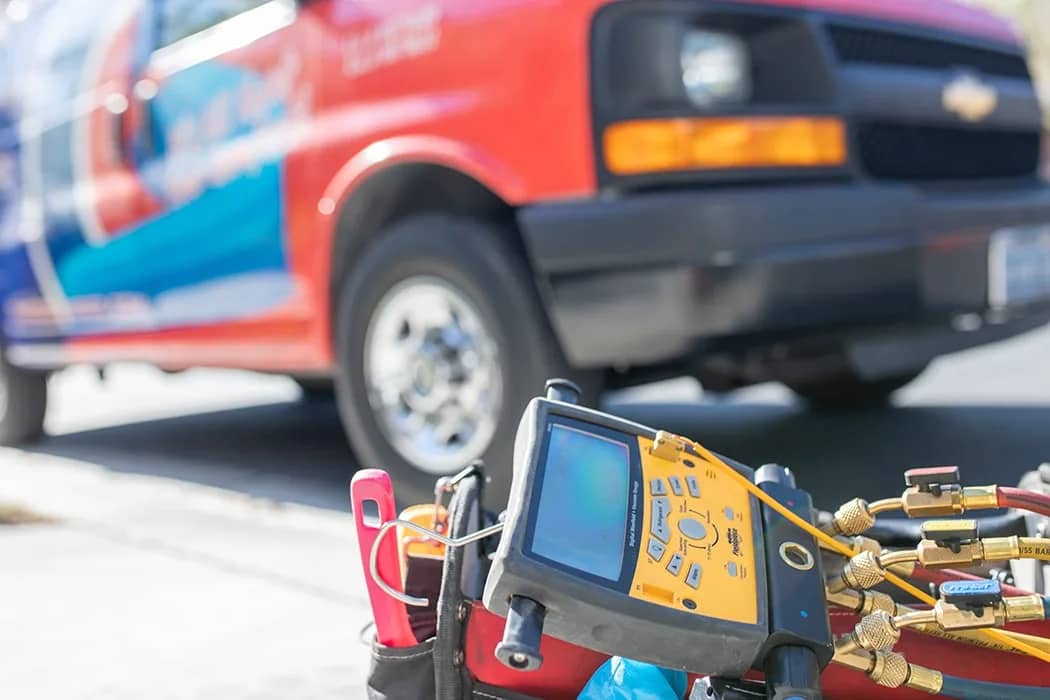
Short answer: Las Vegas has over 800 licensed HVAC contractors and an unknown number of unlicensed ones. The vast majority are honest professionals. But every summer, we get calls from homeowners who paid $3,500 for an AC that should have cost $7,000 — and now understand why it was so cheap. This guide teaches you exactly what to look for, what to avoid, and how to protect yourself. If you want a quote from a contractor who will answer every question on this page, call The Cooling Company at (702) 567-0707 or request a quote online.
Key Takeaways
- Las Vegas is uniquely vulnerable to HVAC fraud because extreme heat turns AC breakdowns into medical emergencies — desperation makes homeowners accept the first contractor who answers the phone, without vetting them.
- The eight most common scams are lowball quotes, bait-and-switch pricing, unnecessary repairs, permit skipping, refrigerant fraud, the "free" diagnostic trap, predatory financing, and phantom warranties. This guide exposes every one of them with real examples.
- A $2,999 "new AC system" is not a bargain — it is a warning sign. Legitimate installations with permits, load calculations, proper equipment, and warranty registration cost $7,000 to $15,000 depending on system size and efficiency. Anyone promising dramatically less is cutting corners you cannot see until years later.
- Clark County requires mechanical permits for all HVAC installations. Any contractor who says "we do not need a permit" is breaking Nevada law and putting your home, your warranty, and your future home sale at risk.
- Verify every contractor through the Nevada State Contractors Board before signing anything. You need a current C-21 license, general liability insurance, and workers' compensation coverage. This takes five minutes and costs nothing.
- A legitimate quote is itemized, written, and includes everything: equipment make and model, labor, materials, permits, warranty details, timeline, financing terms, and what is not included. If you cannot compare it line by line against another quote, it is not a real quote.
- NV Energy PowerShift rebates ($300 to $2,000) are available for qualifying high-efficiency systems. The federal Section 25C tax credit was terminated for 2026 installations under the One Big Beautiful Bill Act — any contractor still advertising it is either uninformed or dishonest.
- If you have already been scammed, you have options: file a complaint with the Nevada State Contractors Board, contact the BBB, report to the Nevada Attorney General's consumer protection division, and pursue small claims court for amounts under $10,000.
Why I Am Writing This
I am going to tell you things that some contractors will not like me saying. That is fine. You deserve to know.
My name is Wellington Santana. I am the CEO and co-owner of The Cooling Company. We have been serving the Las Vegas valley since 2011. Nevada C-21 license #0075849. Lennox Premier Dealer. 4.9 stars from over 740 Google reviews. I am not telling you this to sell you anything — I am telling you because you need to know who is behind these words and why they have standing to write them.
Over the past 15 years, I have watched good homeowners lose thousands of dollars to contractors who had no business being on their property. I have stood in garages looking at 3-ton systems crammed into homes that need 5 tons. I have opened electrical panels and found work that would make a building inspector's blood run cold. I have met families who paid full price for a "new system" only to discover the outdoor unit was a refurbished compressor pulled from a demolished house in North Las Vegas.
Every summer, the pattern repeats. Temperatures hit 110. AC units fail. Homeowners panic. And a certain type of contractor — not licensed, not insured, not planning to be in business next year — shows up at the door with a price that sounds too good to be true.
It always is.
This guide is everything I know about how HVAC scams work in this valley, distilled into a single document. Use it before you sign anything. Share it with your neighbors. Print it out and hand it to whoever knocks on your door offering to replace your AC for half the price everyone else quoted.
I would rather you read this and hire a different reputable company than skip this and get scammed. The goal is protecting Las Vegas homeowners, not winning every job.
Why Las Vegas Is a Hotbed for HVAC Fraud
Las Vegas has a combination of factors that create a near-perfect environment for HVAC fraud. Understanding why helps you understand what to watch for.
Extreme heat creates desperation. When your AC fails on a 115-degree day, you are not browsing Yelp reviews over coffee. You are sweating through your shirt at 2 a.m. with a crying toddler and an 85-degree house. The National Weather Service issues excessive heat warnings for Las Vegas nearly every summer — heat that can kill vulnerable people in hours if they lose cooling. That desperation makes homeowners accept the first person who says they can come today, regardless of credentials.
The market is enormous. Clark County has over 600,000 single-family homes, nearly all with central AC systems that need service, repair, or replacement. That is a massive target for both legitimate businesses and predatory operators. During peak summer months, the demand for HVAC service exceeds the supply of qualified technicians, creating gaps that unlicensed operators rush to fill.
Transient population, less institutional knowledge. Las Vegas attracts tens of thousands of new residents every year from states where AC is a convenience, not a survival tool. These homeowners often do not know what a system should cost in this climate, which contractors are established, or that Clark County requires permits for HVAC work. They are learning the hard way — sometimes at $5,000 a lesson.
Construction booms bring fly-by-night operators. Southern Nevada's residential construction cycles attract contractors from all over the country. When the building slows, some of those operators shift to residential service work — without the local knowledge, licensing, or intention to stick around long enough to honor a warranty.
Peak demand removes leverage. When every reputable contractor in the valley is booked three to five days out in July, the person who says "I can be there in two hours" gains an outsized advantage. That speed is sometimes legitimate (a well-staffed company with capacity). Other times, it is someone with no other customers for a reason.
None of this means every affordable contractor is a scammer or every fast-responding technician is unqualified. It means the conditions in this valley reward fraud more than almost any other market in the country, and homeowners need to be proportionally vigilant.
The 8 Most Common HVAC Scams in Las Vegas
I am going to walk through each one: how it works, how to spot it, and what a legitimate contractor does instead. These are not theoretical scenarios. Every one of them has played out in homes across Henderson, Summerlin, North Las Vegas, Enterprise, and every neighborhood we serve.
Scam #1: The Lowball Quote
How it works: You see an ad — Facebook, Craigslist, a flyer on your doorstep — offering a "complete new AC system" for $2,999 or $3,499. The price seems incredible compared to the $8,000 to $12,000 quotes you have gotten from other companies. You call. They show up fast. They give you a price in writing. You sign.
Here is what you actually get for $2,999:
- Builder-grade equipment — the lowest-tier unit available, often a brand you have never heard of, with the minimum efficiency rating allowed by federal law. Not the brand they showed in the ad.
- No Manual J load calculation — they matched your old system's tonnage or guessed based on square footage. If your home needs a 4-ton and they install a 3-ton because it is cheaper, you will not know until August when the house cannot get below 82 degrees.
- No permit — permits cost money and require an inspection. Skipping them saves the contractor $200 to $400 and eliminates any chance an inspector will see their work.
- No warranty registration — most manufacturers require the installing contractor to register the equipment within 60 days to activate the full warranty. Unregistered equipment gets a 5-year parts warranty instead of a 10-year. The contractor does not tell you this. You find out when the compressor fails in year 7 and you are told it is not covered.
- Undersized or mismatched components — the indoor and outdoor units may not be from the same manufacturer or product line, which means they are not rated to work together. The published SEER2 rating only applies to matched systems. Mismatched systems lose 10 to 30 percent of their rated efficiency.
The real cost: That $2,999 system typically costs the homeowner $5,000 to $8,000 in excess energy bills, premature repairs, and early replacement over the following five to seven years. The "savings" evaporate within two summers.
What a legitimate quote looks like: A properly installed 3-ton 16 SEER2 system in Las Vegas, including permits, load calculation, matched components, warranty registration, and a labor warranty, costs $7,500 to $10,000. A 4-ton or 5-ton system costs more. A high-efficiency or variable-speed system costs more still. If someone is quoting $4,000 less than every other licensed contractor, they are not better at their job — they are skipping parts of it.
Scam #2: Bait-and-Switch Pricing
How it works: The contractor gives you a reasonable-sounding quote — say, $7,500 for a new AC system. You agree. They schedule the installation. They show up, remove your old equipment, and then the phone rings.
"Hey, we got your old unit out and there is a problem. Your ductwork is completely deteriorated — we cannot connect the new system to it. We need to replace the duct trunk line. That is going to be an additional $3,000."
Or: "Your electrical panel does not have the capacity for this new unit. We need an electrician to upgrade the panel first. That is $2,000 extra."
Or: "The refrigerant lines from your old system are incompatible with the new equipment. We need to run new lines. Another $1,500."
Now your old system is in pieces in your driveway. You have no cooling. It is 108 degrees. And someone is asking you for $3,000 more than you agreed to — with the implicit understanding that if you refuse, you are sitting in a house with no AC and a hole where your system used to be.
How to spot it: Legitimate contractors identify these issues BEFORE removing anything. A competent pre-installation inspection includes:
- Measuring your existing ductwork to confirm compatibility
- Checking your electrical panel capacity and breaker sizes
- Inspecting refrigerant line condition and sizing
- Noting any code issues that need correction
- Including all of this in the written quote, or clearly noting "if we discover X during installation, the cost will be $Y"
If a contractor cannot tell you what the total price will be before they start, they either lack experience or they are planning to add costs after you have lost your leverage.
What we do differently: At The Cooling Company, our pre-installation inspection takes 60 to 90 minutes. We check every component that the new system will connect to. If there is a potential issue — ductwork, electrical, refrigerant lines, drain lines, structural support — it goes in the quote. Our customers know the total before we touch a single wire. If we discover something genuinely unexpected during installation (it happens, though rarely), we stop work, explain the situation, and get approval before proceeding — with photographs and a written change order.
Scam #3: The Unnecessary Repair
How it works: Your AC stops cooling. A technician arrives, spends 20 minutes with the outdoor unit, and delivers the verdict: "Your compressor is shot. That is $2,500 for the part plus labor. Honestly, at this point, you should just replace the whole system."
What actually happened: your compressor is fine. The problem is a failed run capacitor — a $15 part that takes 15 minutes to replace. Total legitimate repair cost: $150 to $250. But a new system sells for $8,000 to $12,000, and commission on that sale is a lot more attractive than a $200 service call.
I am not saying every compressor diagnosis is wrong. Compressors do fail. But in my 35 years in this industry, I have seen enough misdiagnoses — some honest mistakes, some deliberate — to know that homeowners need a defense against them.
How to protect yourself:
- Ask to see the failed part. A dead capacitor has a visible bulge on top. A failed contactor has burned or pitted contacts. A legitimate technician will show you what they found.
- Ask for the diagnostic reasoning. "How did you determine the compressor has failed?" The answer should involve specific measurements: amp draw, voltage, resistance readings, or a locked rotor condition.
- Get a second opinion before approving any repair over $500. Tell the first technician: "I appreciate the diagnosis. I want to get a second opinion before spending that much." A legitimate company respects this. A scam operator pressures you with "it could cause more damage if you wait."
- Check if the part is under warranty. If your system is under 10 years old and was properly registered, the compressor may be covered under the manufacturer parts warranty. You pay labor only. A dishonest technician will not mention this.
Our policy: We photograph every failed component. We explain what we tested, what we found, and why we reached our conclusion. If the repair is over $500, we actively encourage homeowners to get a second opinion. We would rather earn your trust than your money.
Scam #4: Permit Skipping
How it works: "Listen, we can save you about $300 by not pulling a permit. It is just a formality anyway — we do this every day. The inspector is just going to come look at it for five minutes and sign off."
This pitch sounds reasonable. Who does not want to save $300? But here is what you are actually agreeing to:
No inspection. Clark County building inspectors verify that electrical connections are safe, refrigerant lines are properly sized and insulated, the condensate drain terminates correctly, the equipment is structurally supported, and the installation meets current mechanical code. Without that inspection, no one except the installer has verified any of this. If the installer is cutting corners everywhere else, the inspection is the one safeguard that catches it.
Voided manufacturer warranty. Most major manufacturers — Lennox, Carrier, Trane, Rheem, Goodman — include language in their warranty terms requiring installation in accordance with local building codes. An unpermitted installation, by definition, has not been verified for code compliance. When you file a warranty claim in year 4, the manufacturer's warranty department can deny it.
Problems when selling your home. When you sell your house, the buyer's home inspector will check permit records. An unpermitted HVAC installation is a red flag that can cost you $3,000 to $8,000 in remediation — or kill the deal entirely. I have seen this happen in Green Valley, Summerlin South, and Henderson multiple times. The seller ends up paying for a permitted reinstallation just to close escrow.
Legal liability. In Nevada, HVAC work requires a mechanical permit. Performing permitted work without pulling the permit is a violation enforceable by the Nevada State Contractors Board. If something goes wrong — a fire, a refrigerant leak, a carbon monoxide exposure from a connected furnace — and the work was unpermitted, the liability picture changes dramatically.
What it actually costs: A mechanical permit in Clark County typically runs $150 to $350 depending on the scope of work. The inspection itself adds no cost — it is included in the permit fee. On an $8,000 installation, that is 2 to 4 percent of the total. Any contractor willing to risk your safety and their license to save 3 percent of the job cost is telling you everything about how they run their business.
Scam #5: Refrigerant Fraud
How it works in three versions:
Version 1: The phantom charge. A technician tells you your system is low on refrigerant and needs 5 pounds of R-410A at $75 per pound — $375 total. They connect their gauges, add some refrigerant, and hand you a bill. But they only added 2 or 3 pounds. You cannot verify the amount without your own gauges. The technician pockets the difference.
Version 2: The fake conversion. Your older system uses R-22 (Freon), which is no longer manufactured. A technician tells you that R-22 is "illegal" and you must convert your system to R-410A immediately — a $2,000 to $4,000 job. This is false. Owning or using existing R-22 is completely legal. Only the manufacturing and import of new R-22 has been phased out. You can continue using your R-22 system until it reaches end of life. When it does need refrigerant, reclaimed R-22 is available — it costs more than it used to, but a "conversion" of the entire system is not required.
Version 3: The unnecessary recharge. A properly installed, leak-free AC system should never need refrigerant added. Refrigerant is not consumed like fuel — it circulates in a sealed loop. If your system is low, there is a leak. Adding refrigerant without finding and fixing the leak is like putting air in a tire with a nail in it. A legitimate technician finds the leak, repairs it, pressure-tests the repair, then recharges to the manufacturer's specifications. A dishonest one adds refrigerant, charges you $300, and comes back in six months to charge you $300 again.
How to protect yourself: Ask the technician to show you the gauge readings before and after. Ask where the leak is. Ask what they are doing to fix it. If the answer is "we just need to top it off," that is a red flag — there is no such thing as "topping off" a sealed system.
Scam #6: The "Free" Diagnostic
How it works: A company advertises "Free AC Diagnostic" or "Free Service Call." You call. A technician arrives, looks at your system for ten minutes, and then presents you with one of two outcomes:
Outcome A: The surprise fee. "The diagnostic is free, but the analysis and testing is $89." Or $129, or $149. The "free" part was walking through your door. Actually figuring out the problem costs extra. This is technically disclosed in fine print on their website, but no one mentioned it on the phone when you booked.
Outcome B: The death sentence. The free diagnostic always concludes that your system is beyond repair and needs full replacement. Always. Regardless of what is actually wrong. Because the free diagnostic is not a diagnostic — it is a sales appointment. The "technician" is a commission salesperson whose job is to sell you a new system, not fix your old one. A $200 repair earns them nothing. A $10,000 sale earns them $500 to $1,000.
How to spot it: Ask these questions when you call to book:
- "What exactly does the free diagnostic include?"
- "Is there any additional charge for testing, analysis, or diagnosis beyond the free portion?"
- "If I need a repair, will the technician be able to do it today, or will I need to schedule a separate appointment?"
- "Is the person coming to my house a technician who can do repairs, or a comfort advisor/sales consultant?"
A legitimate service company sends a licensed technician who can diagnose AND repair. A sales operation sends someone who can only sell.
Our approach: We charge a diagnostic fee. It is not free, and we do not pretend it is. That fee covers a real diagnosis by a real technician who carries parts on the truck and can fix most problems the same day. If you approve a repair, the diagnostic fee is applied to the repair cost. If you need a replacement, the diagnostic fee is applied to the installation price. You never pay for nothing.
Scam #7: Predatory Financing
How it works: The contractor offers "0% APR for 12 months" or "no payments for 6 months." This sounds like a great deal — and it can be, if you read every word of the financing agreement. Many homeowners do not.
Here is what the fine print often contains:
Deferred interest, not waived interest. The 0% APR is a promotional period. If you pay the balance in full within 12 months, you pay zero interest. If you have a single dollar remaining on day 366, the financing company charges you interest on the ENTIRE original balance — not just the remaining balance — retroactively from day one. At 26.99% APR, a $10,000 system generates $2,699 in retroactive interest charges. You now owe $12,699.
Origination fees. Some financing agreements include a 5 to 8 percent origination fee rolled into the loan. On a $10,000 system, that is $500 to $800 added to your balance before you make a single payment. The contractor does not mention this because it does not come out of their pocket — it comes out of yours.
Payment shock. "Low monthly payments of just $89!" What they do not emphasize is that $89 per month for 12 months is only $1,068 on a $10,000 balance. After the promotional period, the remaining $8,932 (plus retroactive interest) now has payments of $250 to $400 per month at full APR.
How to protect yourself:
- Read the financing agreement. Every word. Before signing.
- Ask: "Is this deferred interest or waived interest?" Deferred interest means it accumulates and you owe it if you do not pay in full. Waived interest means it is genuinely 0%.
- Ask: "Is there an origination fee?"
- Ask: "What is the APR after the promotional period?"
- Calculate whether you can realistically pay the full balance before the promotional period ends. If not, traditional financing with a fixed rate of 8 to 12 percent often costs less total than deferred-interest promotional plans.
What responsible financing looks like: At The Cooling Company, we offer multiple financing options through established lending partners. Our team explains every term — APR, payment schedule, total cost of financing, and what happens if you cannot pay it off early. We want you to understand what you are signing because a customer who feels tricked by financing does not refer their neighbors, and referrals are how we have grown for 15 years. For a full breakdown of HVAC financing options, read our 2026 HVAC financing guide.
Scam #8: The Phantom Warranty
How it works: The contractor promises a "10-year warranty" on your new system. You feel protected. You are not.
What they did not tell you:
Warranty registration is required. Most major manufacturers — Lennox, Carrier, Trane, Rheem, Goodman, and others — require the installing contractor to register the equipment within 60 to 90 days of installation to activate the extended warranty. If the contractor does not register it, you get the base warranty — typically 5 years on parts instead of 10, and 1 year on the compressor instead of 10. You do not find out until you need warranty service.
"Warranty" can mean very different things. A manufacturer parts warranty covers the cost of replacement parts but NOT the labor to install them. A compressor replacement under parts-only warranty still costs $800 to $1,500 in labor. A labor warranty from the installer covers the work itself — but some installers offer only 1 year of labor warranty. If the condenser coil fails in year 3, the part is covered but you pay $600 in labor.
The company may not exist. A labor warranty is only as good as the company behind it. A fly-by-night operation that closes its doors in 18 months takes your labor warranty with it. The manufacturer's parts warranty survives — but you lose the labor coverage.
How to protect yourself:
- Ask the contractor: "Will you register this equipment with the manufacturer?" Get this commitment in writing.
- Ask: "How many years does your labor warranty cover?"
- Get the equipment model numbers and serial numbers from the contractor after installation. Call the manufacturer directly (the number is on the unit) and verify that the registration was completed.
- Research how long the contractor has been in business. A 2-year-old company offering a 10-year labor warranty requires an act of faith.
What we do: The Cooling Company registers every piece of equipment with the manufacturer within 48 hours of installation. We provide homeowners with the registration confirmation. Our labor warranty is backed by a company that has been in continuous operation in this valley since 2011 — not a year-old LLC that might not exist when you need us.
How to Verify a Las Vegas HVAC Contractor
Before you sign a contract or hand over a deposit, take 15 minutes to verify the basics. This is not being paranoid — it is being responsible with a $5,000 to $15,000 purchase. Here is how, step by step.
Step 1: Check the Nevada State Contractors Board (NSCB). Go to nscb.nv.gov and search by company name or license number. You are looking for an active C-21 (Refrigeration and Air Conditioning) license. This is the license classification required for residential and commercial HVAC work in Nevada. The search results show the license status, issue date, expiration date, any disciplinary actions, and open complaints. If the company is not listed, or the license is expired, suspended, or revoked — walk away immediately.
For reference: The Cooling Company's license number is C-21 #0075849. It is active. You can verify it right now. Any legitimate contractor will give you their license number without hesitation.
Step 2: Verify insurance. Ask for a certificate of insurance showing general liability coverage and workers' compensation. General liability protects you if the contractor damages your property during the installation. Workers' compensation protects you if one of their employees is injured on your property. If the contractor does not carry workers' comp and a worker falls off your roof — you could be liable.
Do not take their word for it. Call the insurance company listed on the certificate and confirm the policy is active.
Step 3: Check the Better Business Bureau. Search bbb.org for the company name and location. Look at their rating, accreditation status, complaint history, and how they respond to complaints. A few complaints over many years is normal for any active company — what matters is the pattern and the response.
Step 4: Read Google reviews — but read them intelligently. Stars are less important than patterns. Look for:
- Consistent mentions of specific behaviors (on-time arrival, clean work, clear explanations) — these are hard to fake at scale.
- Specific neighborhood references ("they installed our AC in our Summerlin home" or "we are in Green Valley Ranch") — real customers mention real places.
- Negative reviews and how the company responded — a thoughtful, professional response to criticism tells you more about a company than 100 five-star reviews.
- Suspiciously generic five-star reviews posted in clusters — "Great service! Highly recommend!" posted 15 times in one week is a red flag for purchased reviews.
Step 5: Ask for three recent references. Not testimonials on their website. Actual phone numbers of homeowners who had work done in the past three months, in your area. Call them. Ask: Was the work done on time? Was the final price the same as the quote? Did they pull a permit? Would you hire them again?
Step 6: Verify a physical business address. Not a PO box. Not a UPS Store mailbox. A real location where the company operates, stores equipment, and can be found if something goes wrong. Drive by if you can. A company with 20 trucks and a warehouse operates differently than someone working out of a pickup truck.
What a Legitimate HVAC Quote Looks Like
If you are comparing quotes — and you should always get at least three — you need to know what a professional quote includes. If any of these elements are missing, you do not have a complete quote, and you cannot make an informed comparison.
Here is what a legitimate HVAC installation quote contains, line by line:
| Category | What Should Be Listed | Example |
|---|---|---|
| Equipment — Outdoor Unit | Manufacturer, model number, SEER2 rating, tonnage, type (single-stage, two-stage, or variable-speed) | Lennox XC16S, 16 SEER2, 4-ton, single-stage |
| Equipment — Indoor Unit | Manufacturer, model number, type (air handler, gas furnace, or coil only) | Lennox CBA38MV, cased coil, matched to outdoor unit |
| Thermostat | Brand and model, smart or programmable, compatibility | Lennox S40 Smart Thermostat, WiFi-enabled |
| Labor | Estimated hours, crew size, what the labor covers | 6-8 hours, 2-person crew, includes startup and commissioning |
| Materials | Refrigerant type and amount, line set, disconnect, condenser pad, drain line, electrical whip | R-410A charged to manufacturer specs, new 30-foot line set, new disconnect and whip |
| Permits | Permit type, fee, and who is responsible for scheduling the inspection | Clark County mechanical permit, included in price, we schedule the inspection |
| Warranty — Manufacturer | Parts warranty duration, compressor warranty duration, registration confirmation | 10-year parts, 10-year compressor (registered within 48 hours) |
| Warranty — Contractor Labor | Labor warranty duration, what it covers, what it excludes | 2-year labor warranty on all installation work |
| Financing | Available options with APR, term, monthly payment, total cost of financing | 60-month fixed rate at 8.99% APR, or 12-month same-as-cash (deferred interest — see terms) |
| Timeline | Installation start date, estimated completion, what happens if delayed | March 22, 8:00 AM start, completed same day by 4:00 PM |
| Exclusions | What is NOT included — ductwork modifications, electrical panel upgrades, attic insulation, etc. | Does not include duct modifications, electrical panel upgrades, or wall/ceiling repairs |
The comparison test: If you have three quotes and they all list this level of detail, you can compare them meaningfully. If one quote says "New 4-ton AC system — $7,500" with no further detail, that is not a quote — it is a placeholder designed to get your signature. You have no idea what you are buying.
Read our 17 questions to ask before buying a new HVAC system for a complete interrogation framework you can use alongside these quotes.
The True Cost of Cheap HVAC Installation
The most expensive HVAC system you will ever own is the cheap one. Here is what actually happens when you save $3,000 on installation by hiring a contractor who cuts corners.
Undersized system. A 3-ton unit in a home that needs a 4-ton runs 18 to 20 hours per day during Las Vegas summers instead of the 14 to 16 hours a properly sized system would run. That extra runtime adds $120 to $180 per month to your NV Energy bill — $720 to $1,080 per cooling season. Over 8 years (the shortened lifespan of an overworked system versus 15 for a properly sized one), the excess energy cost alone is $5,760 to $8,640. You did not save $3,000 — you paid an extra $3,000 to $6,000.
No Manual J load calculation. Without a Manual J load calculation, the system size is a guess. An oversized system short-cycles — turning on and off every 5 to 8 minutes instead of running in longer, more efficient cycles. Short cycling creates uneven temperatures (hot rooms, cold rooms), increases humidity because the system never runs long enough to dehumidify, and wears out the compressor through excessive start-stop cycles. Homeowners often compensate by lowering the thermostat 3 to 4 degrees, which increases energy consumption by 9 to 16 percent.
Improper refrigerant charge. A system that is 10 percent overcharged or undercharged on refrigerant loses 10 to 20 percent of its rated efficiency. On a 16 SEER2 system, that means it performs like a 13 SEER2 — you paid for premium equipment and got mid-range performance. Worse, an incorrect charge stresses the compressor. Compressors designed to last 15 years under correct conditions fail in 5 to 8 years under chronic over- or undercharging. Compressor replacement: $2,500 to $4,500.
No permit, no inspection. The permit and inspection cost $150 to $350. Skipping them saves the contractor money, not you. When you sell your home, the buyer's inspector checks permit records. An unpermitted HVAC installation in Clark County triggers a remediation requirement that costs $3,000 to $8,000 — because someone has to pull a permit retroactively, bring the work up to current code (which may have changed since installation), and pass a delayed inspection. In some cases, the entire system has to be reinstalled.
Wrong ductwork connections. Improperly sealed duct connections leak conditioned air into your attic — an uninsulated space that reaches 150 degrees in Las Vegas summers. Duct leakage of 20 to 30 percent (common in bad installations) means that for every 3 dollars of cooling you pay for, 1 dollar goes directly into your attic. Additionally, improperly sloped or connected condensate drain lines cause moisture accumulation, creating conditions for mold growth inside ductwork — a health hazard and a remediation cost of $2,000 to $10,000.
Add it up. The homeowner who "saved" $3,000 on a cheap installation ends up spending $12,000 to $20,000 more over the system's shortened life in excess energy, premature repairs, remediation costs, and early replacement. The bargain was never a bargain.
For the full cost picture, read our 2026 AC replacement cost and price guide and our analysis of the real cost of running an old AC in Las Vegas.
Red Flags That Should Make You Walk Away
Print this list. Tape it to your refrigerator. If you encounter any of these during the quoting or hiring process, stop and find another contractor.
- They will not provide a written quote. Verbal quotes are meaningless and unenforceable.
- They demand full payment upfront. Standard payment terms are 50 percent at contract signing and 50 percent at completion, or payment upon completion. Requiring 100 percent before starting is a red flag for abandonment.
- They pressure you to "decide today" or the price goes up. Legitimate pricing does not expire in 24 hours. This is a high-pressure sales tactic designed to prevent you from getting competing quotes.
- They cannot provide a license number. If they hesitate, dodge, or say "it is in the truck," walk away.
- They arrived in an unmarked vehicle. Legitimate HVAC companies have branded trucks with the company name, phone number, and license number. An unmarked white van is either an unlicensed operator or a company ashamed of its reputation.
- They showed up without being called. Door-to-door HVAC sales immediately after a heat wave is a predator's tactic. Legitimate companies are too busy serving their existing customers to canvass neighborhoods.
- They say permits are not needed. Clark County requires them. Period.
- They cannot name the specific equipment they will install. "We will put in a good 4-ton unit" is not a specification. It is a blank check.
- They offer a price dramatically lower than every other quote. Three quotes at $8,000, $8,500, and $9,000 — and one at $3,500? The outlier is not a better deal. It is a different product entirely.
- They claim the federal tax credit still applies in 2026. The Section 25C tax credit was terminated for 2026 installations under the One Big Beautiful Bill Act. A contractor still advertising "up to $2,000 in federal tax credits" is either ignorant of current law or deliberately misleading you.
- They refuse to provide references. "Our reviews speak for themselves" is not a substitute for talking to actual customers.
- They want to start work the same day you sign. Cooling-off periods exist for a reason. Nevada law gives you three business days to cancel a home improvement contract. A contractor who rushes to start before that window closes does not want you to reconsider.
- They have no physical business location. A PO box is not a business address. You need to know where to find them when something goes wrong in month 13.
- They ask you to pay in cash. Cash payments leave no paper trail for warranty disputes, complaints, or legal action.
- They badmouth every other contractor in the valley. A confident company talks about its own work. An insecure one attacks competitors.
- Their Google listing shows a different name than their truck or contract. Multiple business names often indicate a company that has rebranded to escape bad reviews.
How TCC Does It Differently
I am not going to give you a sales pitch. I am going to give you a list of specific, verifiable practices that you can confirm for yourself. If we do not live up to any of them, hold us accountable — our license number, our phone number, and our address are on everything we put our name on.
Manual J load calculation on every installation. We do not guess tonnage. We measure and calculate for your specific home. Every time. This takes time. It is worth it. A system sized by Manual J runs fewer hours, lasts longer, dehumidifies better, and costs less to operate than a system sized by rule of thumb.
Permits pulled on every job. One hundred percent of the time. We file the permit application with Clark County, we schedule the inspection, and we do not consider the job complete until it passes. You get a copy of the passed inspection.
Warranty registration within 48 hours. Every piece of equipment we install is registered with the manufacturer within two business days. You receive confirmation. Full 10-year parts and compressor warranties — activated, documented, and traceable.
4.9 stars from 740+ Google reviews. Not a few dozen reviews from a year of business — hundreds of reviews accumulated over more than a decade of serving this community. Read them. Look for patterns. Look for how we respond to the rare negative review. Our reputation is verifiable, not claimed.
Lennox Premier Dealer. This is not a title you buy. It is earned through installation quality, customer satisfaction scores, and technician training standards verified by Lennox annually. Fewer than 5 percent of Lennox dealers nationwide achieve Premier status. Compare brands and what dealer status means.
Licensed, bonded, and insured since 2011. NV C-21 #0075849. General liability. Workers' compensation. Verify all of it through the Nevada State Contractors Board. We have been at this for 15 years, in this valley, serving these neighborhoods. We are not going anywhere.
Transparent pricing with itemized quotes. Every quote we provide follows the format described in this article — equipment specs, labor, materials, permits, warranty, financing, timeline, and exclusions. You will never see a single line item that says "new system — $8,000." You will see exactly what you are getting and what you are paying for each component. See our pricing page for current ranges.
NV Energy PowerShift rebate assistance. We help you identify and apply for NV Energy's PowerShift rebates, which range from $300 to $2,000 for qualifying high-efficiency equipment. We do not inflate prices to absorb the rebate — the rebate reduces your out-of-pocket cost. We are transparent about what qualifies and what does not. Read our complete buying guide for details on rebates and incentives.
What to Do If You Have Been Scammed
If you have already been victimized by a dishonest HVAC contractor, you have recourse. Do not accept it and move on — take action. You protect yourself and every homeowner who would have been next.
File a complaint with the Nevada State Contractors Board. Call (702) 486-1100 or visit nscb.nv.gov. The NSCB investigates complaints against licensed contractors and can take action against unlicensed operators. They can order remediation, restitution, or license revocation. If the contractor is unlicensed, the NSCB still investigates — and unlicensed contracting is a criminal offense in Nevada.
Contact the Better Business Bureau. File a complaint at bbb.org. The BBB facilitates dispute resolution and creates a public record of complaints that other consumers can see. Companies with unresolved BBB complaints face consequences in their accreditation status.
Report to the Nevada Attorney General. The Consumer Protection Bureau of the Nevada Attorney General's office handles complaints about deceptive trade practices. Call (702) 486-3132 or file online at ag.nv.gov. This is particularly important if the contractor engaged in deceptive advertising, misrepresentation, or unfair business practices.
Leave honest reviews. Post detailed, factual reviews on Google, Yelp, and the BBB. Describe what happened, what you paid, what you expected, and what you received. Stick to facts — not emotions. Include dates, amounts, and the company name. These reviews warn other homeowners and create a searchable record.
Small claims court. For amounts under $10,000, Nevada small claims court lets you file a claim without an attorney. The filing fee is minimal ($55 to $90 depending on the amount). You will need documentation: the contract, receipts, photographs of the work, communications with the contractor, and any reports from other contractors who assessed the work. If the original contractor was unlicensed, this fact alone strengthens your case significantly.
Get the work assessed by a licensed contractor. Before pursuing any legal or administrative remedy, have a licensed HVAC contractor inspect the work and provide a written assessment. This documentation becomes evidence. Ask them to note code violations, equipment issues, and the estimated cost to correct the problems.
Document everything. Photograph the installation from every angle. Save every text message, email, receipt, and contract. Record phone calls (Nevada is a one-party consent state — you may record your own conversations). Build a paper trail. It matters.
Frequently Asked Questions
How do I check if an HVAC contractor is licensed in Nevada?
Visit the Nevada State Contractors Board website at nscb.nv.gov and use the license search tool. Search by company name or license number. You are looking for an active C-21 (Refrigeration and Air Conditioning) license. The results will show the license status, issue and expiration dates, any disciplinary actions, and pending complaints. This search is free and takes less than five minutes. If a contractor cannot or will not give you their license number, do not hire them.
What should a new AC system cost in Las Vegas in 2026?
A properly installed central air conditioning system in Las Vegas costs $7,000 to $15,000 depending on the system size (tonnage), efficiency rating (SEER2), equipment tier (single-stage, two-stage, or variable-speed), and any additional work required (ductwork modifications, electrical upgrades, etc.). This range includes permits, load calculations, matched equipment, warranty registration, and a labor warranty. A quote significantly below $7,000 for a complete system with installation should prompt serious questions about what is being left out. Read our 2026 AC replacement cost guide for detailed pricing by system type and size.
Are HVAC permits required in Clark County, Nevada?
Yes. Clark County requires a mechanical permit for HVAC installations, including replacement of existing equipment. The permit process includes submission of installation plans, payment of a permit fee ($150 to $350), and a post-installation inspection by a county building inspector. The inspection verifies that the work meets current mechanical, electrical, and safety codes. Performing HVAC work without a permit is a violation enforceable by both Clark County and the Nevada State Contractors Board. Any contractor who tells you a permit is optional is either misinformed or breaking the law.
Is the federal tax credit still available for HVAC systems in 2026?
No. The Section 25C federal tax credit for energy-efficient home improvements was terminated for 2026 installations under the One Big Beautiful Bill Act. Homeowners who installed qualifying equipment in 2025 or earlier may still claim the credit on their tax returns for those years, but new installations in 2026 and beyond no longer qualify. The primary financial incentive available to Las Vegas homeowners is NV Energy's PowerShift rebate program, which offers $300 to $2,000 for qualifying high-efficiency equipment. Any contractor still advertising federal tax credits for 2026 installations is providing inaccurate information.
How can I tell if an HVAC repair diagnosis is legitimate?
Ask the technician three questions: (1) What specific tests did you perform to reach this diagnosis? The answer should reference measurable data — amp readings, voltage measurements, pressure readings, or temperature differentials. (2) Can you show me the failed component? A dead capacitor has a visible bulge. A burned contactor has pitted contacts. A leaking coil shows oil residue. (3) Is this repair covered under my system's warranty? If the system is less than 10 years old and was properly registered, many parts are covered. For any repair quoted over $500, getting a second opinion from another licensed contractor is reasonable and any honest company will support that decision.
What is the difference between a manufacturer warranty and a contractor labor warranty?
A manufacturer warranty covers the cost of replacement parts — the compressor, coil, heat exchanger, and other components — if they fail due to manufacturing defects. It does NOT cover the labor to remove the failed part and install the replacement. A typical manufacturer warranty is 10 years on parts and compressor when the equipment is properly registered within 60 to 90 days of installation. A contractor labor warranty covers the cost of the technician's time to perform repairs related to installation defects. Labor warranties vary widely — some contractors offer 1 year, others offer 2, 5, or even 10 years. The labor warranty is only valid as long as the contractor remains in business. This is why hiring an established, long-operating company matters.
Should I get multiple quotes before replacing my AC?
Yes — get at least three quotes from licensed, insured contractors. But do not compare on price alone. Compare on scope: are they all quoting the same size system? The same efficiency tier? Are permits included in all three? What does each warranty cover? A quote that is $2,000 cheaper but does not include a permit, uses mismatched equipment, and offers only a 1-year labor warranty is not cheaper — it is incomplete. Use the quote comparison table in this article to evaluate each proposal on equal terms. Our 17 questions to ask before buying article provides a complete evaluation framework.
What is a Manual J load calculation and why does it matter?
A Manual J load calculation is an engineering analysis that determines the exact heating and cooling capacity your home requires. It accounts for square footage, ceiling height, insulation type and condition, window size and orientation, air infiltration, duct layout, number of occupants, and local climate data specific to Las Vegas. The result tells the contractor precisely how many tons (BTUs per hour) your system should be. Without it, the contractor is guessing — and in a climate where the penalty for getting it wrong is either an overworked system that dies early or an oversized system that short-cycles and creates humidity problems, guessing is unacceptable. Any contractor who sizes your system without a Manual J is not doing their job.
Can I use my R-22 air conditioner until it dies?
Yes. Owning and operating an R-22 (Freon) air conditioning system is completely legal. The EPA phased out the manufacturing and importing of new R-22, but existing systems can continue to operate, and reclaimed R-22 is available for recharging systems that develop leaks. The cost of reclaimed R-22 has increased significantly — expect to pay $75 to $150 per pound compared to $25 to $40 per pound a decade ago — but it is available. Any contractor who tells you that R-22 is "illegal to use" or that you "must convert immediately" is either uninformed or trying to sell you a replacement you may not need yet. When your R-22 system does reach end of life, replacement with a modern R-410A system is the practical path forward, but that timing should be based on the system's condition, not a manufactured urgency.
What should I do if a contractor starts work and then demands more money?
First, do not pay the additional amount under pressure. Ask the contractor to explain the unexpected issue in detail and provide it in writing as a change order. Take photographs of whatever they claim requires additional work. If you feel the situation is a bait-and-switch — if the "discovery" is something that should have been identified during the pre-installation inspection — tell the contractor you want a second opinion before approving additional costs. If they refuse to stop work or threaten to leave the job incomplete, document everything (photographs, recordings, written communications) and file an immediate complaint with the Nevada State Contractors Board. Nevada law requires contractors to honor their written contracts — unilateral price increases after work has begun may constitute a deceptive trade practice.
How long should a properly installed AC last in Las Vegas?
A properly installed, correctly sized central air conditioning system in Las Vegas should last 15 to 20 years with regular maintenance. This assumes annual professional tune-ups, clean filters, and a matched system installed per manufacturer specifications with proper refrigerant charge and sealed ductwork. Systems that are undersized, improperly charged, installed without permits, or never maintained typically last 8 to 12 years — sometimes less. The Las Vegas climate is among the harshest for HVAC equipment in the country. Extreme heat, temperature swings, dust, and UV exposure all accelerate wear. Proper installation is the single biggest factor in longevity — the best equipment in the world, installed poorly, will not last.
Is it worth paying more for a higher SEER rating in Las Vegas?
In Las Vegas, yes — more so than almost anywhere else in the country. Your AC runs 2,400 to 3,000 hours per year, compared to 1,000 to 1,200 hours in a moderate climate. Every SEER point saves more dollars per year when the system runs more hours. A 16 SEER2 system costs $900 to $1,200 per year less to operate than a 14 SEER2 system in Las Vegas. Over 15 years, that is $13,500 to $18,000 in energy savings — far exceeding the $1,500 to $3,000 premium for the more efficient equipment. Read our real-world efficiency savings analysis for detailed payback calculations specific to Las Vegas.
Related Reading
These guides cover related topics in depth:
- The Complete New AC System Buying Guide — equipment tiers, sizing, efficiency ratings, and what to expect from the buying process.
- 2026 AC Replacement Cost and Price Guide — detailed pricing by system type, size, and efficiency tier for the Las Vegas market.
- Carrier vs. Lennox vs. Trane: Las Vegas Comparison — brand-by-brand analysis of performance, warranty, and value in our climate.
- HVAC Financing Guide (2026) — financing options, interest rate comparisons, and how to avoid predatory loan terms.
- 17 Questions to Ask Before Buying a New HVAC System — the companion to this article, focused on evaluating contractors through direct questions.
- Should You Repair or Replace Your AC? — decision framework for systems that are aging but not yet dead.
- About The Cooling Company — our history, team, and the values behind how we operate.
Have questions this guide did not answer? Call us directly at (702) 567-0707. I would rather spend 20 minutes on the phone helping you avoid a bad contractor than see you become another cautionary tale. Whether you hire us or not — protect yourself first.