

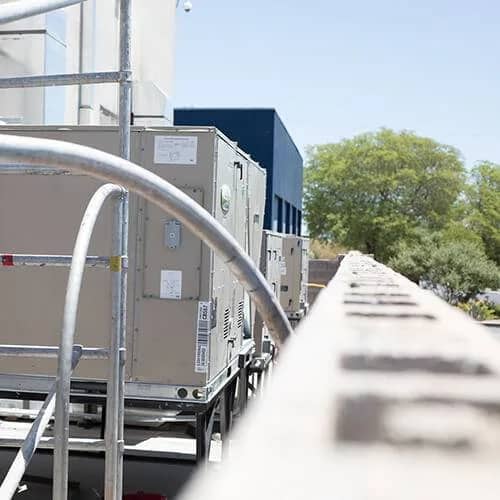
Short answer: Managing HVAC across a Las Vegas rental portfolio requires a fundamentally different approach than single-property ownership. Budget $500-$800 per unit per year for maintenance plus capital reserves, implement preventive maintenance programs that reduce emergency calls by 60-80%, stagger replacements over 3-5 year windows rather than reactive replacement, and establish a clear tenant vs landlord responsibility framework that complies with Nevada landlord-tenant law. The payoff is lower long-term cost, fewer tenant complaints, better retention, and a portfolio that appraises higher when the equipment documentation is clean. The Cooling Company serves property managers across Las Vegas with dedicated commercial accounts, priority dispatch, and portfolio-level maintenance programs. Call (702) 567-0707 to set up a portfolio maintenance consultation.
Key Takeaways
- Budget $500-$800 per unit annually. This covers preventive maintenance ($150-$250/unit/year) plus capital reserves for future replacement ($350-$550/unit/year). Las Vegas's extreme climate shortens AC lifespan to 12-15 years versus the national average of 15-20 years.
- Preventive maintenance cuts emergency calls 60-80%. Property managers on structured maintenance programs average 0.3-0.5 emergency calls per unit per year versus 1.5-2.5 calls for reactive-only portfolios. At emergency rates of $150-$250/hour, the savings are substantial.
- Stagger replacements to manage cash flow. A portfolio with 50 units built in the same year has 50 AC systems aging at the same rate. Without a staggered replacement program, all 50 fail within a 3-5 year window, creating a massive capital event. Proactive age-based replacement spreads this cost smoothly.
- Bulk purchasing saves 10-20% on equipment. A property manager committing 10+ unit replacements per year to a single HVAC contractor typically secures equipment pricing 10-15% below retail and labor rates discounted 5-10% from standard pricing.
- Nevada law places HVAC responsibility firmly on landlords. NRS Chapter 118A requires landlords to maintain rental properties in habitable condition. In Las Vegas where summer temperatures exceed 115 degrees F, a non-functional AC system is an emergency habitability issue requiring prompt repair.
- Smart thermostats deliver ROI at the portfolio level. Deploying programmable thermostats across a 50-unit portfolio costs $5,000-$15,000 and typically reduces cooling-related maintenance calls by 15-25% while giving property managers visibility into which units are being operated at extreme settings.
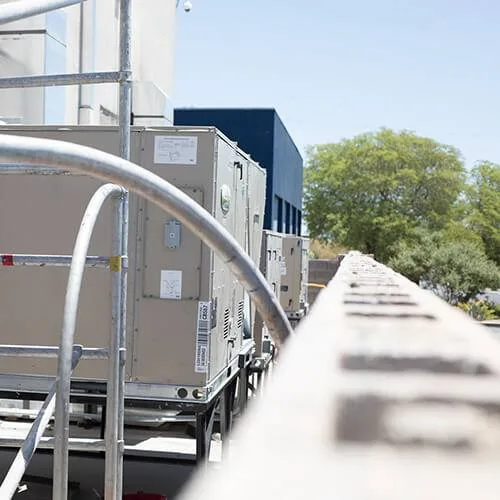
The Property Manager's Unique HVAC Challenge in Las Vegas
Managing HVAC for a rental portfolio in Las Vegas is harder than managing it anywhere else in the country. The city's extreme climate — summers that push 115-120 degrees F for weeks at a time, rapid temperature cycling between 120-degree days and 80-degree nights, and dust storms that clog filters and coat condenser coils — creates a maintenance environment where HVAC systems age faster, fail more often, and matter more when they do fail.
A tenant in Seattle can survive a week without AC in July. A tenant in Las Vegas cannot survive 48 hours without it safely. That changes your legal exposure, your response time obligations, and the financial consequences of deferred maintenance. Nevada courts have not been sympathetic to landlords who treat HVAC repairs as anything but urgent in the summer months.
At the same time, a property manager running 50 or 100 units cannot treat each HVAC system as a one-off event. You need systems, contracts, schedules, and vendor relationships that function at scale. The property managers who handle HVAC best in Las Vegas treat it like an infrastructure program, not a maintenance to-do list. This guide covers that program in detail.
Understanding the Las Vegas HVAC Lifecycle
Before building a budget or replacement schedule, property managers need accurate lifespan expectations for Las Vegas rental conditions. National HVAC longevity data is not accurate for the desert Southwest.
Expected Lifespan by System Type and Maintenance Quality
| System Type | National Average Lifespan | Las Vegas (No Maintenance) | Las Vegas (Preventive Maintenance) |
|---|---|---|---|
| Central AC (standard efficiency) | 15-20 years | 8-12 years | 13-16 years |
| Central AC (high efficiency, inverter) | 18-22 years | 10-14 years | 15-18 years |
| Heat pump | 15-20 years | 10-14 years | 14-17 years |
| Package unit (rooftop) | 15-20 years | 10-13 years | 13-16 years |
| Ductless mini-split | 20-25 years | 12-16 years | 16-20 years |
These figures assume equipment that was properly sized for the space at installation. Undersized systems — extremely common in older Las Vegas rental properties where original installations used residential rather than desert-climate calculations — fail 30-40% earlier than properly sized systems because they run continuously at or near full capacity throughout the cooling season.
Lifecycle Budgeting: The $500-$800 Per Unit Framework
Every property in your portfolio needs two HVAC budget line items: operating maintenance and capital reserves. Conflating them leads to either deferred maintenance (because the capital budget is protecting against future replacement) or unexpected capital events (because the maintenance budget was spent but no reserve was built).
Operating Maintenance Budget ($150-$250 per unit per year)
This covers all preventive maintenance and routine repairs — filter changes, annual tune-ups, minor part replacements, and emergency service calls. The wide range reflects portfolio size (larger portfolios benefit from contract pricing), system age (older systems need more frequent attention), and maintenance program structure.
- Annual preventive maintenance visit — $80-$150 per unit (contract pricing for portfolios of 10+ units)
- Filter replacements — $15-$30 per unit per visit, 2-4 visits per year during summer ($30-$120 per unit annually)
- Average emergency/repair allocation — $50-$100 per unit per year on a well-maintained portfolio
Total operating maintenance target: $160-$370 per unit per year. Portfolios on comprehensive preventive maintenance contracts at the higher end of this range experience significantly fewer emergency calls than those spending at the lower end.
Capital Reserve Budget ($350-$550 per unit per year)
Capital reserves fund future system replacement. The correct reserve amount depends on the age distribution of your portfolio and the current replacement cost for your equipment type.
In Las Vegas in 2026, residential central AC replacement costs (equipment plus installation) typically run:
- Basic replacement (equivalent efficiency, entry-level brand) — $5,000-$8,000
- Mid-tier replacement (16-18 SEER2, mid-range brand) — $8,000-$12,000
- High-efficiency replacement (20+ SEER2, premium brand) — $12,000-$18,000
Using a mid-tier replacement cost of $10,000 and a 15-year Las Vegas lifespan, the annual reserve required per unit is $667. This is the mathematical foundation of the $500-$800 per unit framework — the lower end assumes some cost savings from bulk purchasing and the higher end provides a buffer for larger systems or premium equipment choices.
Portfolio-Size Reserve Calculations
| Portfolio Size | Annual Maintenance Budget | Annual Capital Reserve | Total Annual HVAC Budget | Expected Annual Replacements |
|---|---|---|---|---|
| 10 units | $2,000-$3,700 | $3,500-$5,500 | $5,500-$9,200 | 0-1 units |
| 25 units | $4,000-$7,500 | $8,750-$13,750 | $12,750-$21,250 | 1-2 units |
| 50 units | $8,000-$15,000 | $17,500-$27,500 | $25,500-$42,500 | 3-4 units |
| 100 units | $16,000-$30,000 | $35,000-$55,000 | $51,000-$85,000 | 6-8 units |
Replacement Planning: Staggering Over 3-5 Years
The most common HVAC budgeting mistake in property management is reactive replacement — replacing systems only when they fail. This approach has several problems:
- Emergency premium costs — A system that fails on a Friday in August requires emergency service. If replacement is needed, equipment may not be in stock and the installation is done under time pressure. Emergency replacement typically costs 10-20% more than planned replacement.
- Tenant relations damage — A tenant without AC in Las Vegas summer heat is an angry tenant. Tenants who experience emergency repairs rather than planned maintenance are less likely to renew leases, more likely to leave negative reviews, and in extreme cases may have legal claims for rent reduction during uninhabitable conditions.
- Capital event clustering — If your portfolio was built at the same time (common in Las Vegas subdivision developments from the 1990s-2000s), all systems age at the same rate. Without proactive staggering, you face a capital event where 10 or 20 systems fail in the same 2-3 year window.
The solution is age-based proactive replacement. Once a system reaches 12-13 years in Las Vegas, schedule it for replacement in the next 1-3 years regardless of current function. Coordinate with your HVAC contractor to schedule these during off-peak seasons (October-March) when equipment is in stock, contractors have availability, and installation conditions are favorable.
Staggered Replacement Schedule Example (50-Unit Portfolio)
Consider a 50-unit portfolio where the AC systems have the following age distribution after an audit:
- 8 units: 13-15 years old (replace in Year 1-2)
- 12 units: 10-12 years old (replace in Year 3-4)
- 18 units: 7-9 years old (replace in Year 5-7)
- 12 units: 4-6 years old (replace in Year 8-10)
This distribution allows 4-6 planned replacements per year over a 10-year window, averaging $40,000-$60,000 per year in capital spend — a manageable, predictable budget line. The alternative — waiting for failure — would cluster many of those replacements into 2-3 years at higher per-unit costs and significant tenant disruption.
Bulk Purchasing Power: What Portfolio Scale Delivers
A property manager committing significant volume to an HVAC contractor gains purchasing power that individual homeowners and small landlords do not have. The savings available at different portfolio levels:
| Annual Volume | Typical Equipment Discount | Labor Rate Discount | Priority Service Tier | Dedicated Account Manager |
|---|---|---|---|---|
| 1-5 replacements/year | 0-5% | 0% | Standard | No |
| 6-10 replacements/year | 5-10% | 5% | Preferred | Sometimes |
| 11-20 replacements/year | 10-15% | 8-10% | Priority | Yes |
| 21+ replacements/year | 15-20% | 10-15% | Priority emergency dispatch | Yes |
On a portfolio replacing 15 systems per year at an average cost of $10,000 each, a 12% equipment discount saves $18,000 annually. A 10% labor discount on the same volume saves another $5,000-$8,000. The aggregate savings over a 5-year period exceed the cost of a comprehensive preventive maintenance program — meaning the bulk relationship effectively pays for maintenance out of replacement savings.
To access these tiers with The Cooling Company, call (702) 567-0707 and ask for our commercial property management division. We will review your portfolio size and create a pricing structure appropriate for your volume commitment.
Preventive Maintenance Programs: The 60-80% Emergency Reduction
The claim that preventive maintenance reduces emergency calls by 60-80% is not marketing language. It is based on actual data from our commercial property management accounts and consistent with published ASHRAE research on planned versus reactive HVAC maintenance outcomes. Here is why the reduction is that large:
Most HVAC emergency failures in rental properties have precursor symptoms that are visible during a routine maintenance visit: capacitors with degraded microfarad values, refrigerant charges trending low, coils approaching fouling thresholds, contactors showing arcing damage. A technician performing a proper preventive maintenance inspection finds these and replaces them at standard parts cost. The same components found failed on an emergency call cost standard parts plus $150-$250 per hour emergency labor plus potential secondary damage from the failure cascade.
In Las Vegas, the case for preventive maintenance is especially strong because the consequences of HVAC failure are more severe and more immediate than in moderate climates. A capacitor that fails slowly in Denver may give a homeowner a few days of degraded performance before complete failure. In Las Vegas in July, a failing capacitor often progresses to total failure within hours because the system is running near its thermal limit constantly.
What a Proper Preventive Maintenance Visit Includes
Not all maintenance visits are equal. A complete preventive maintenance inspection for a Las Vegas rental property should include the best practices outlined by the U.S. Department of Energy for AC maintenance. Specifically:
- Air filter inspection and replacement (using tenant-supplied filter or contractor-supplied)
- Thermostat calibration and operation verification
- Electrical component inspection: capacitor microfarad measurement, contactor inspection, wiring connections
- Refrigerant pressure measurement and charge assessment
- Condenser coil cleaning (wash with coil cleaner, rinse)
- Evaporator coil inspection for dirt accumulation and ice
- Condensate drain inspection and flush
- Blower wheel and motor inspection
- Supply and return airflow measurement
- System temperature differential measurement (supply vs return)
- Documentation of findings with photos for landlord records
A maintenance visit that consists only of filter change and a visual inspection is not adequate for Las Vegas rental properties. Verify with any contractor that the above items are included in the quoted maintenance price.
Tenant vs Landlord Responsibilities Under Nevada Law
Nevada Revised Statutes Chapter 118A (the Nevada Landlord-Tenant Act) establishes the baseline obligations for rental property maintenance. For HVAC specifically:
Landlord Obligations (NRS 118A.290)
Landlords are required to maintain rental units in habitable condition, which the statute defines as including adequate heating and cooling facilities. In Nevada, the implied warranty of habitability has been interpreted by courts to include functional air conditioning given the climate. For the complete legal framework, see Nevada Revised Statutes Chapter 118A, which governs landlord-tenant relationships and maintenance responsibilities. Specific landlord obligations include:
- Maintaining HVAC equipment in working order
- Responding to HVAC repair requests within a reasonable time — courts have interpreted "reasonable" as 48-72 hours in summer conditions in Nevada, not the standard 14-day notice period used for non-emergency repairs
- Providing adequate notice before entering for HVAC inspections or maintenance (24 hours minimum under NRS 118A.330, except in emergencies)
- Making repairs at landlord expense for equipment failures that are not caused by tenant negligence
Tenant Obligations
Tenants bear responsibility for:
- Reporting HVAC problems promptly in writing (this protects both parties)
- Changing air filters if the lease specifies this as tenant responsibility and the filter type and frequency are clearly defined
- Avoiding actions that damage HVAC equipment: covering supply vents, blocking return air grilles, removing window AC units improperly, neglecting filter changes if assigned
- Not adjusting or tampering with thermostat systems beyond normal use
- Allowing access for repairs and maintenance with proper notice
The Filter Change Assignment Question
Assigning filter changes to tenants is common in Las Vegas property management leases. Before doing so, consider the tradeoffs:
- Pro: Reduces landlord maintenance visits, potentially reduces filter cost if tenant supplies their own
- Con: Many tenants do not change filters at appropriate intervals, leading to dirty coils, frozen evaporator coils, and system failures that require more expensive repair. In Las Vegas, a filter that should be changed monthly often goes 3-6 months between changes under tenant responsibility.
Our experience across Las Vegas rental portfolios is that landlord-managed filter programs — where a technician changes filters on a defined schedule and the cost is absorbed in the maintenance budget — reduce HVAC repair frequency enough to more than offset the filter and labor cost. A monthly filter change at $20-$30 materials and $15-$25 labor costs $420-$660 per unit annually. The avoided repairs (frozen evaporator coil replacement: $500-$1,500; compressor replacement due to sustained high-head-pressure from restricted airflow: $1,500-$3,000) make the program clearly cost-positive.
Priority Systems for Emergency Calls
When you manage 50-100 units and your HVAC contractor calls to say they can handle two emergency calls today and you have three units down, you need a priority triage system. The framework we recommend for Las Vegas portfolios:
Priority 1 — Immediate Response (Same-Day, 2-4 Hours)
- Tenants over age 65 or with documented heat-related medical conditions
- Families with children under age 5
- Tenants with medical equipment requiring temperature-controlled environments
- Units where temperatures have already exceeded 90 degrees F interior
- Any unit where the tenant has expressed a health emergency
Priority 2 — Urgent Response (Same-Day to Next Morning)
- Units where interior temperature is rising but not yet at dangerous levels
- Units with partial system function (one zone working, one not)
- After-hours calls where interior temperature is manageable through opening windows (spring/fall only)
Priority 3 — Standard Response (24-48 Hours)
- Units where the issue is comfort degradation rather than complete failure
- Units where temporary cooling solutions (window unit, portable AC) have been provided
- Spring and fall calls where outdoor temperatures are mild
Your lease agreement and tenant communication templates should make clear that all HVAC failures are reported promptly, that Priority 1 conditions trigger emergency protocols, and that you maintain a relationship with a contractor capable of same-day response. Establishing this with The Cooling Company through our commercial account program means Priority 1 calls receive guaranteed same-day response rather than waiting in a general service queue.
When making Priority 1 commitments to elderly or medically vulnerable tenants, consider maintaining a small inventory of portable AC units that can be delivered while repairs are scheduled. A $400 portable unit that prevents a heat-related health emergency and a potential tenant legal claim is a sound investment for any significant portfolio.
Seasonal Preparation Strategy
Las Vegas has two HVAC seasons that demand active preparation: summer cooling (May through September) and winter heating (December through February). Both require advance action to avoid the cost and disruption of in-season failures.
Pre-Summer Preparation (March-April)
- Schedule annual HVAC tune-ups for the entire portfolio before May, when demand for HVAC service spikes and appointment availability shrinks
- Replace any filters that were not changed during winter
- Clean condenser coils on all units (critical — desert dust accumulation over winter significantly reduces summer efficiency)
- Inspect condensate drain lines and clear any blockages before high-humidity monsoon season begins
- Check refrigerant charge on systems over 5 years old where low charge is a statistical risk
- Test thermostats for accurate calibration
- Identify and prioritize any systems showing degraded performance for proactive replacement before summer
Pre-Winter Preparation (October-November)
- Inspect heating components: heat strips (for heat pumps), igniter and heat exchanger (for gas furnaces)
- Test heating function on all units before the first cold snap
- Schedule planned system replacements during this window — best contractor availability and weather conditions for installation
- Address any deferred maintenance from summer
Running the pre-summer maintenance sweep in March-April rather than waiting for the first hot day in May means the work happens at standard pricing with full appointment availability. May through August, HVAC service demand in Las Vegas can make routine maintenance appointments 2-3 weeks out, and emergency rates apply to unscheduled calls.
Vendor Selection: Single Provider vs Multiple
Property managers debate whether to concentrate HVAC work with a single provider or spread it across multiple vendors for competitive pricing. The right answer depends on portfolio size and management priorities.
Single Provider (Recommended for 20+ Units)
Advantages:
- Relationship pricing and volume discounts not available on a per-call basis
- Technicians learn your portfolio, its equipment types, and its problem patterns
- Simpler billing, single point of contact, consolidated service history
- Priority dispatch commitment — you are a significant account, not a one-time caller
- Consistent documentation and warranty tracking through one system
Disadvantages:
- Single point of failure if the contractor has capacity problems during a heatwave
- Less price pressure once the relationship is established
Mitigation: Establish a primary vendor relationship for 80-90% of work and a secondary vendor for emergency overflow. Review pricing annually against market rates. Both concerns are addressed without sacrificing the primary relationship benefits.
Multiple Providers (Appropriate for Under 10 Units)
Smaller portfolios may not generate sufficient volume to earn meaningful discounts from a single provider. Using 2-3 contractors and requesting competitive quotes on larger jobs ensures market pricing without the overhead of managing a formal account relationship.
Inventory Management: Keeping Common Parts in Stock
For portfolios of 25 or more units with similar equipment (which is common in Las Vegas subdivision developments where all units were built with the same HVAC model), maintaining a small inventory of high-failure components reduces response time and eliminates emergency parts markup.
Recommended inventory for a 50-unit Las Vegas portfolio running primarily 3-5 ton residential split systems:
- Capacitors — The single most common Las Vegas repair. Stock 5-10 run capacitors in the correct microfarad ratings for your equipment. Cost: $15-$40 each. Failure cost without stock: $150-$300 per call including parts markup.
- Contactors — Second most common electrical failure. Stock 3-5 appropriate for your equipment. Cost: $20-$50 each.
- Air filters (bulk) — Stock a full season's supply for your portfolio. Buying in bulk from a wholesale distributor saves 30-40% versus buying individually. For a 50-unit portfolio changing filters quarterly, that is 200 filters per year — meaningful volume pricing.
- Condensate drain treatments — Algae tabs for condensate drain pans prevent clogs. Stock a case and deploy at every maintenance visit.
- Thermostat batteries — A thermostat that dies on a weekend generates an emergency call that requires nothing more than new batteries. Stock a supply of AA and AAA batteries to avoid this.
Maintain this inventory at a central location — your management office or a storage unit near your properties — and provide your HVAC contractor access to draw from it on routine maintenance visits with parts consumption tracked against each unit's account.
Energy Efficiency Upgrades That Pay for Themselves
Rental property HVAC upgrades are evaluated differently than owner-occupied home upgrades because the landlord bears the capital cost while the tenant benefits from lower utility bills. This misalignment discourages efficiency investment. However, some upgrades offer direct landlord benefits that overcome this barrier:
Smart Thermostat Deployment ($150-$300 per unit installed)
Smart thermostats offer landlords portfolio-level visibility not available with standard programmable thermostats. Features valuable to property managers include:
- Remote temperature monitoring — identify units where tenants are setting unusually extreme temperatures that accelerate HVAC wear
- Filter change reminders sent directly to tenant phones
- Maintenance mode that allows contractor access for diagnostics without requiring tenant to be present
- Occupancy learning that reduces runtime when the unit is empty (valuable for vacant units between tenants)
- Fault detection alerts that notify you of HVAC issues before they become failures
For a 50-unit portfolio, a $10,000-$15,000 smart thermostat deployment typically pays back in 18-24 months through reduced emergency calls alone. The operational visibility is a bonus that improves property management efficiency beyond just HVAC.
High-Efficiency Replacement Systems
When replacing HVAC systems, upgrading to higher SEER2 equipment costs $1,000-$3,000 more per unit but can be marketed as an amenity that supports higher rents. In Las Vegas's competitive rental market, units with energy-efficient AC systems command 3-7% higher rents in comparable buildings. On a $1,500/month rent, a 5% premium is $75/month — $900/year — recovering the upgrade premium in under 3 years while also reducing the risk of tenant complaints about electricity bills. For portfolio-level energy efficiency tracking, the ENERGY STAR Portfolio Manager provides tools for monitoring and comparing building energy performance, helping landlords identify properties where efficiency investments would have the greatest ROI.
Duct Sealing and Insulation
Las Vegas rental properties built before 2000 commonly have ductwork in attic spaces with 20-30% leakage rates. Sealing and insulating ducts costs $500-$2,000 per unit depending on accessibility and condition. The result is a system that performs as designed rather than losing a third of its cooling to attic heat — meaning the existing HVAC runs less, lasts longer, and delivers better comfort. This upgrade reduces tenant complaints about hot rooms and extends equipment life sufficiently to offset its cost in most cases.
When to Replace vs Repair for Rental Properties
The repair-versus-replace calculation for rental properties differs meaningfully from owner-occupied homes. In an owner-occupied home, replacing a working system for efficiency gains makes sense when the homeowner plans to stay long enough to recover the investment. In a rental property, the calculus shifts toward reliability and lifecycle cost:
| System Age | Repair Cost Threshold | Recommendation | Rationale |
|---|---|---|---|
| Under 7 years | Up to $1,500-$2,000 | Repair | System has sufficient remaining life; repairs are cost-effective |
| 7-10 years | Up to $800-$1,200 | Repair if single component; evaluate if multiple systems failing | Remaining life is 3-7 years; major repairs may not justify full remaining life |
| 10-12 years | Up to $400-$600 | Minor repairs only; plan replacement | System is approaching end of Las Vegas lifespan; major investment not recoverable |
| 12+ years | Nothing beyond capacitors and filters | Schedule proactive replacement | System is statistically likely to fail within 1-3 years; replace on your schedule, not failure's schedule |
For a detailed analysis of the replacement decision framework applicable to rental properties, our Complete Guide to Replacing Your Air Conditioner in 2026 covers the financial analysis in depth.
HOA Coordination for Condo Portfolios
Property managers of condominium units face an additional layer of HVAC complexity: the HOA boundary between association-maintained common systems and owner-unit HVAC equipment. This boundary varies significantly between HOAs and is often a source of confusion and disputes.
For Las Vegas condo portfolios, confirm with each HOA's CC&Rs and management:
- Which HVAC components are association-maintained (typically: central building systems, shared air handlers, rooftop equipment in mid-rise buildings)
- Which components are unit-owner responsibility (typically: in-unit air handlers, individual heat pumps, thermostats, ductwork within unit walls)
- HOA pre-approval requirements for HVAC replacements in units (some HOAs specify approved equipment brands or require board approval for rooftop unit replacement)
- Access procedures for rooftop or mechanical room equipment serving individual units
- Insurance boundaries that affect who bears repair costs for water damage from condensate line failures
Document the HOA boundary in writing for each condo property in your portfolio before any HVAC work is performed. Disputes over who is responsible for a $6,000 compressor replacement are easier to prevent with documented clarity than to resolve after the fact.
Documentation and Warranty Tracking
HVAC documentation is an undervalued asset in property management. A well-documented maintenance history:
- Supports warranty claims when equipment failures occur within the manufacturer warranty period
- Provides evidence in tenant disputes about pre-existing conditions vs tenant-caused damage
- Streamlines property sales by demonstrating maintained mechanical systems (buyers discount for unknown HVAC condition)
- Supports tax deductions by clearly categorizing expenses as routine maintenance versus capital improvement
For each unit in your portfolio, maintain a file (digital or physical) containing:
- Equipment model and serial numbers, installation date, and installer
- Current warranty terms (manufacturer equipment warranty, labor warranty from installer)
- All service records with dates, technician names, work performed, and parts replaced
- Photos from each maintenance visit showing coil condition, electrical components, and any noted issues
- Filter change log with dates and filter specifications
- Any tenant-reported issues with dates of report and resolution
The Cooling Company provides digital service documentation to all commercial account clients, including inspection reports, photos, and maintenance records exportable in formats compatible with standard property management software.
IAQ Upgrades That Add Value Across a Rental Portfolio
Indoor air quality upgrades are typically seen as homeowner investments, but property managers who understand the Las Vegas market recognize that IAQ improvements can directly support rent premiums, improve tenant retention, and reduce maintenance complaints related to dust, allergies, and dry air.
Las Vegas's desert environment creates IAQ challenges that are more severe than most U.S. cities: desert dust and particulate matter from wind events, extreme low humidity (15-20% in summer) that causes respiratory discomfort, and wildfire smoke from California that drifts into the valley several times per year. Tenants with allergies or respiratory conditions — a significant share of the Las Vegas renter population — will pay a premium for units where the landlord has invested in air quality solutions. See our detailed breakdown of desert IAQ threats and solutions in our Las Vegas Indoor Air Quality Desert Guide.
Most Impactful IAQ Upgrades for Rental Properties
| Upgrade | Cost Per Unit | Annual Benefit | Tenant Marketability |
|---|---|---|---|
| MERV 13 filter program (landlord-managed) | $80-$150/year | Reduced coil cleaning frequency, fewer allergy complaints | Moderate — marketable to allergy-conscious tenants |
| Whole-home humidifier (bypass) | $400-$700 installed | Reduced winter HVAC complaints, better tenant comfort | High — Las Vegas renters know the dryness problem |
| UV-C coil light | $200-$400 installed | Prevents coil mold, eliminates musty odors, extends coil life | Moderate — reduces maintenance calls |
| 4-inch media filter cabinet (MERV 11) | $350-$600 installed | Filter lasts 6-12 months vs monthly, better particle capture | Moderate — reduces landlord filter change frequency |
| ERV fresh air ventilation | $2,000-$4,000 installed | Improved air quality in tight new construction units | High — especially in newer tightly-built units |
The humidifier upgrade deserves special attention for Las Vegas portfolios. Landlords who include whole-home humidifiers in rental units consistently report higher tenant satisfaction scores, fewer complaints about dry skin and respiratory discomfort in winter, and meaningfully better lease renewal rates among long-term tenants who experienced Las Vegas's first winter in the unit. The $400-$700 per-unit investment is recoverable within 12-18 months through reduced turnover cost if it retains even one tenant who would otherwise have moved.
Multi-Family vs Single-Family Portfolio HVAC Strategies
The property management approach to HVAC differs significantly between single-family rental portfolios and apartment or condo multi-family properties. Understanding these differences prevents applying the wrong framework to each property type.
Single-Family Rental Portfolios
Single-family rentals (SFRs) in Las Vegas — often 3-4 bedroom homes in suburban subdivisions across Henderson, Summerlin, North Las Vegas, and the outer Southwest — typically have individual HVAC systems that are the landlord's sole responsibility. The management considerations are:
- Each unit has its own system with its own age, maintenance history, and failure risk — portfolio management requires individual unit tracking
- System access for maintenance requires tenant coordination (24-hour notice requirement under NRS 118A.330)
- Tenant behavior variability is high — each household has different filter change habits, thermostat use patterns, and reporting practices
- Larger homes (2,000-3,500 sq ft) common in Las Vegas SFR portfolios often have two-zone systems with separate upstairs and downstairs units, doubling the maintenance tracking requirement per property
- HOA restrictions in many Las Vegas master-planned communities (Summerlin, Lake Las Vegas, Green Valley Ranch) govern equipment placement, screening requirements, and sometimes require HOA approval for major mechanical modifications
Apartment and Multi-Family Portfolios
Multi-family properties — from duplex to 100+ unit apartment complexes — have different HVAC architectures depending on property age and design:
- PTACs (Packaged Terminal Air Conditioners) — Common in older Las Vegas apartment buildings and motel conversions. PTACs are wall-mounted units with individual controls per unit. Advantages: no ductwork, simple replacement ($700-$1,500 per unit), no shared system failures. Disadvantages: higher energy cost than central systems, more units to maintain, consistent aesthetic challenges. Las Vegas desert conditions shorten PTAC lifespan to 7-10 years versus the manufacturer's 12-15 year nominal life.
- Ductless mini-splits — Increasingly popular in Las Vegas renovations of older apartment stock. Ductless mini-split systems provide individual zone control, high efficiency, and modern aesthetics without requiring ductwork. Per-unit replacement cost of $1,500-$3,500 for a single-zone system is higher than PTAC but with much better efficiency and longer service life of 15-20 years in Las Vegas with maintenance.
- Centralized chiller and air handler systems — Common in larger mid-rise and high-rise Las Vegas apartment buildings. These central systems are typically HOA or ownership association responsibility (in condo structures) or property management responsibility (in rental apartments). Chiller systems for 50+ unit buildings require specialized commercial HVAC contractors and represent capital expenditures of $100,000+ for full system replacement.
- Individual central air systems per unit — Many Las Vegas apartment complexes built in the 1990s-2010s were constructed with individual central air systems in each unit with separate outdoor condenser units on the roof or ground level. These function like individual SFR systems but with routing and access complexity inherent to multi-family construction.
Tax and Financial Considerations for HVAC in Rental Properties
HVAC expenses in rental properties are tax-deductible, but the deductibility method depends on how the IRS classifies the expense: routine repair (currently deductible) versus capital improvement (depreciated over 27.5 years for residential rental property).
Current Expense vs Capital Improvement
The IRS Tangible Property Regulations (Revenue Procedure 2019-43 and related guidance) provide a framework for this classification:
- Routine repairs and maintenance — Filter changes, coil cleaning, minor component replacements (capacitors, contactors, thermostats), refrigerant recharge, and emergency service calls are generally deductible as current business expenses in the year incurred.
- Full HVAC system replacement — Replacing the entire HVAC system (both outdoor condenser and indoor air handler) is generally treated as a capital improvement and depreciated over 27.5 years under MACRS. A $10,000 HVAC replacement generates $364 per year in depreciation, not a $10,000 current deduction.
- Partial replacements and components — The classification of compressor replacements, coil replacements, and major component upgrades (not the full system) requires judgment. Consult a CPA with rental property experience for guidance on specific situations.
- Safe harbor elections — The IRS de minimis safe harbor election (currently $2,500 per invoice for non-AFS taxpayers) allows immediate deduction of qualifying repair expenses below the threshold. Many routine HVAC repairs fall within this limit.
The Inflation Reduction Act of 2022 created or expanded federal tax credits for energy-efficient HVAC equipment through the Section 25C credit. However, the 25C credit applies to owner-occupied primary residences, not rental property. Rental property owners do not qualify for the 25C credit on rental unit HVAC. The Section 179D commercial energy efficiency deduction may apply to larger multi-family properties — consult a tax professional familiar with real estate energy credits for applicability to your portfolio.
Common Tenant-Caused HVAC Issues
Understanding the most common tenant behaviors that damage HVAC systems helps property managers address them proactively in lease agreements and tenant communication:
- Setting thermostats to extreme temperatures — Tenants who set the thermostat to 62 degrees F in a Las Vegas summer are running the system at maximum load continuously, which accelerates compressor wear and can cause freeze-up on the evaporator coil. Smart thermostats with adjustable limits (minimum setpoint of 68-70 degrees F) prevent this while still providing reasonable comfort control.
- Covering supply or return vents — Furniture placed over supply registers or return air grilles restricts airflow and causes the system to work harder. Return air restriction is particularly damaging — it can cause the evaporator coil to freeze and the compressor to overheat. Annual inspection visits catch this.
- Running the system with doors and windows open — While this does not directly damage equipment, it causes constant runtime that accelerates wear. If you have a smart thermostat system, unusual runtime patterns can be flagged for investigation.
- Not reporting water leaks from condensate lines — Condensate overflow from a clogged drain causes water damage that tenants sometimes ignore until significant damage has occurred. Include in your lease agreement that tenants must report any water near HVAC equipment immediately.
- DIY thermostat or filter tampering — Some tenants attempt to install non-compatible thermostats or use oversized filters that restrict airflow. Your lease should require written approval for any modification to HVAC components.
Frequently Asked Questions: Property Manager HVAC
How quickly do I legally have to repair AC in a Las Vegas rental in summer?
Nevada law requires that landlords maintain habitable conditions, and Nevada courts have consistently treated non-functional air conditioning during Las Vegas summer conditions as an emergency habitability issue. While the statute's general repair timeline allows up to 14 days for non-emergency items, summer HVAC failures in Las Vegas have been treated as emergencies requiring 24-72 hour response by Nevada courts and arbitrators. If you cannot achieve same-day or next-day repair, providing a temporary cooling solution (portable AC unit, hotel accommodations for extreme cases) while permanent repair is arranged demonstrates good faith and reduces your legal exposure. Consult a Nevada landlord-tenant attorney for guidance specific to your situation.
Can I require tenants to change their own air filters?
Yes, Nevada law permits lease provisions requiring tenants to perform routine maintenance tasks including filter changes, provided the requirement is clearly specified in the lease, the filter type and change frequency are defined, and the requirement is not used to avoid the landlord's fundamental habitability obligations. In practice, many Las Vegas property managers who assign filter changes to tenants end up spending more on coil cleanings and repairs caused by dirty filters than they save on labor. Consider whether the assignment actually serves your financial interest before relying on it.
What is the best HVAC maintenance program for a 25-unit portfolio?
For a 25-unit Las Vegas portfolio, we recommend a comprehensive preventive maintenance program that includes: bi-annual visits per unit (pre-summer in March-April, pre-winter in October-November), landlord-managed filter changes every 1-2 months during summer, priority emergency response guarantee for tenant calls, and proactive replacement scheduling for units over 12 years old. Budget $175-$225 per unit per year for this program level. The reduction in emergency calls — typically from 1.5-2.5 per unit per year to 0.3-0.5 — generates net savings well above the program cost for most portfolios within the first 12 months.
Should I upgrade to higher-efficiency HVAC when replacing in rental units?
For rental properties, the efficiency upgrade decision depends on whether you can capture the efficiency benefit through higher rents or lower turnover. A standard efficiency replacement (14-16 SEER2) costs $5,000-$8,000. A high-efficiency replacement (18-20 SEER2) costs $9,000-$14,000. If the higher-efficiency unit supports even a $50-$75/month rent premium — which is reasonable in Las Vegas's competitive rental market — the upgrade pays back within 3-5 years while also reducing tenant complaints and extending equipment life. The upgrade is harder to justify in markets where efficiency is not a differentiating amenity or in properties with long-term below-market leases.
How should I handle HVAC for a vacant unit between tenants?
Las Vegas's extreme summer heat means that even a vacant unit needs some temperature management. A completely unconditioned unit on a 115-degree day can reach 140-150 degrees F interior temperature, which damages paint, flooring adhesives, vinyl surfaces, and any fixtures or appliances left in the unit. Set vacant units to 85-90 degrees F on a setback thermostat rather than turning the system off completely. If using a smart thermostat, the vacancy setback can be programmed remotely. The energy cost of maintaining 85 degrees F rather than off is minimal compared to the repair cost of a unit that has cooked for two weeks between tenants.
What HVAC documentation should I get from my contractor?
After every service visit, request a written service report that includes: the unit address, date of service, technician name and license number, work performed (with specificity — not just "AC tune-up" but each task completed), any components replaced with make and model of replacement parts, any conditions noted for future attention, and the technician's signature. For replacement projects, request the equipment model and serial number, the SEER2 rating, manufacturer warranty terms, and the installer's labor warranty terms in writing. This documentation is your evidence trail for warranty claims, tenant disputes, and property sale documentation.
Need HVAC Service in Las Vegas?
The Cooling Company is a family-owned, Lennox Premier Dealer serving the Las Vegas Valley since 2011. We specialize in serving property management portfolios with the discipline and consistency that rental HVAC demands. With 780+ Google reviews and a 4.8/5 rating, property managers trust us to deliver on our maintenance commitments and respond to emergencies with speed. Licensed, bonded, and insured (NV License #0082413), we provide transparent pricing models with volume discounts, written service reports for every visit, and warranty backup on all equipment and installations. Our portfolio management approach reduces emergency calls by 60-80% while keeping your capital budgets predictable.
Call (702) 567-0707 or visit HVAC services, HVAC maintenance, heating, or AC repair for details.
Property managers managing 10 or more units are eligible for our commercial portfolio program with dedicated account management, priority dispatch, and volume pricing. Visit our property manager HVAC service page or call to set up a portfolio consultation.