

Short answer: Lennox Premier Dealer status is the highest dealer tier Lennox awards, and fewer than 5% of all Lennox dealers nationwide earn it. For Las Vegas homeowners, this means factory-trained technicians, access to the full Lennox lineup including the high-efficiency SL28XCV and XC25, priority parts fulfillment, extended warranty options, and installation quality verified by Lennox corporate. The Cooling Company has maintained Premier Dealer status continuously, which requires meeting rigorous annual standards for customer satisfaction, technical training, and installation excellence. Call (702) 567-0707 to experience the difference a Premier Dealer makes.
Key Takeaways
- Premier Dealer is the top tier: Lennox has three dealer levels — Participating, Allied, and Premier. Premier Dealers must meet the highest standards for training, customer satisfaction scores, and sales volume. Fewer than 5% of Lennox dealers qualify.
- Factory-certified training: Every technician at a Premier Dealer completes Lennox factory training programs annually, including system-specific certification for the Dave Lennox Signature Collection and Merit Series lines.
- Access to the full lineup: Some Lennox models, including certain Dave Lennox Signature Collection configurations, are available exclusively or with priority through Premier Dealers.
- Quantum Coil technology expertise: Lennox's proprietary Quantum Coil — the aluminum alloy coil that resists desert corrosion — requires specific installation and brazing techniques that Premier Dealer technicians are trained to execute correctly.
- Priority parts and faster repairs: Premier Dealers receive priority fulfillment from Lennox's distribution network. In Las Vegas, where a failed AC system in July is a genuine emergency, faster parts access means faster repairs.
- Extended warranty options: Premier Dealers can offer Lennox's extended labor warranties and service agreements that are not available through lower-tier dealers.
What Lennox Premier Dealer Status Actually Means
Lennox runs a tiered dealer program, and the terminology can be confusing because every HVAC manufacturer has its own version. Here is what Lennox's tiers mean in concrete terms, stripped of marketing language.
Participating Dealers are authorized to sell and install Lennox equipment. They have basic product access and standard warranty processing. This is the entry level — it means they have a business license, liability insurance, and a Lennox account.
Allied Dealers have committed to a higher level of Lennox engagement. They complete additional training, maintain higher customer satisfaction scores, and typically stock Lennox parts. They receive better wholesale pricing and co-op marketing funds.
Premier Dealers sit at the top. The requirements include annual recertification in Lennox-specific technical training, consistently high customer satisfaction scores (measured by Lennox's own post-installation surveys), minimum annual sales volume, participation in Lennox's warranty and service agreement programs, and compliance with Lennox's installation quality standards. Lennox conducts periodic audits to verify compliance. Dealers who fall below the standard lose their Premier status.
The Cooling Company has maintained Lennox Premier Dealer status consistently. This is not a lifetime award — it must be earned every year. Our commitment to Lennox training and installation standards is the reason we can offer the deepest expertise on Lennox systems of any dealer in the Las Vegas Valley.

Factory Training: Why It Matters in the Desert
Every HVAC brand trains its dealers, but the depth and frequency of training varies enormously. Lennox Premier Dealers are required to complete annual factory training modules that cover new product releases, updated installation best practices, diagnostic procedures, and refrigerant handling.
For Las Vegas installations specifically, the training that matters most covers three areas.
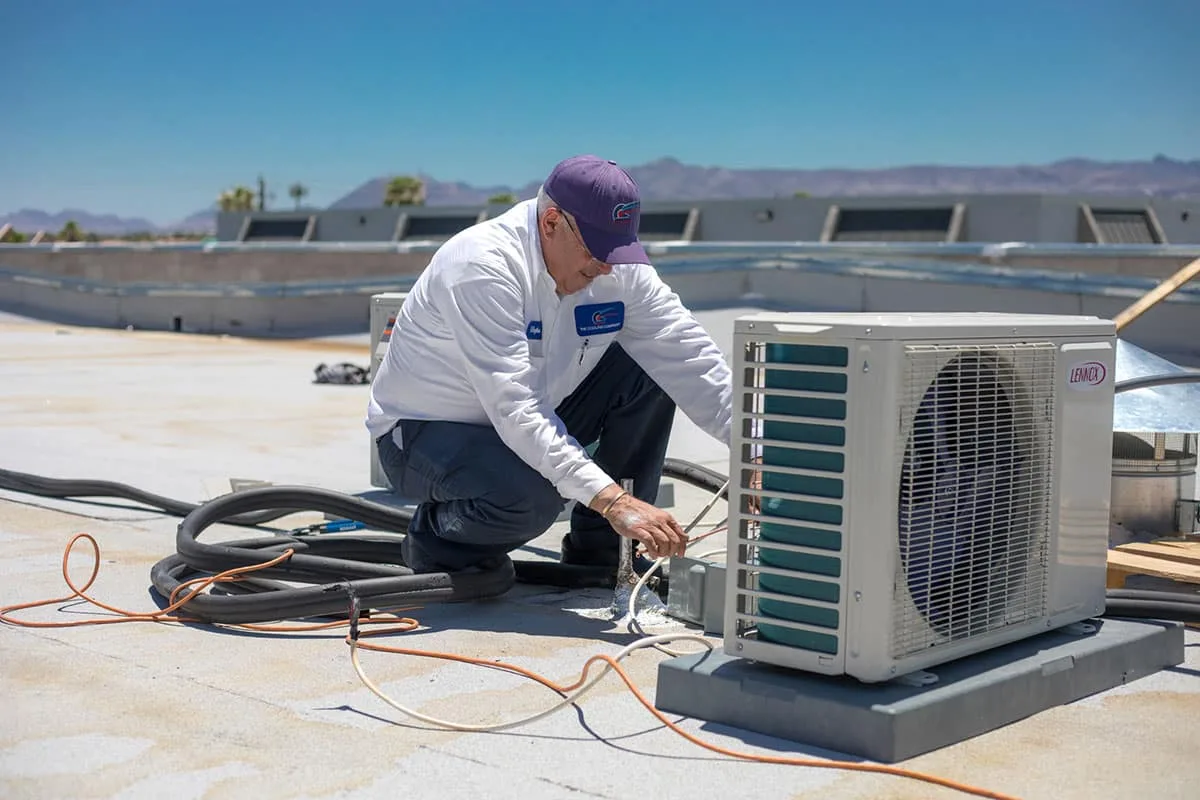
High-ambient installation protocols. Lennox systems like the SL28XCV and XC25 are designed to operate at outdoor temperatures up to 125 degrees Fahrenheit. But achieving rated performance at those temperatures requires correct refrigerant charge, proper airflow across the outdoor coil, adequate condenser clearance, and electrical connections that meet Lennox's specifications. Factory training covers the specific measurements, tolerances, and verification procedures for high-ambient installations. A system installed 5% low on refrigerant might work fine at 95 degrees but lose significant capacity at 115 degrees.
Quantum Coil brazing and handling. Lennox's proprietary Quantum Coil uses an aluminum alloy construction instead of the traditional copper-tube-aluminum-fin design. The Quantum Coil resists the galvanic corrosion that degrades copper-aluminum joints in desert environments — a major advantage for Las Vegas longevity. However, aluminum alloy coils require different brazing techniques, flux types, and handling procedures than copper coils. Premier Dealer technicians are trained in the specific procedures that protect the coil's corrosion-resistant properties during installation.
iComfort smart thermostat integration. Lennox's iComfort S40 and S30 thermostats communicate directly with iComfort-enabled equipment, providing real-time diagnostics, variable-speed fan control, and energy usage reporting. Configuring the thermostat-to-equipment communication correctly — especially in multi-zone or dual-fuel configurations common in Las Vegas homes — requires system-specific training beyond standard thermostat installation.
The Quantum Coil Advantage in Las Vegas
Coil failure is the second most common reason for premature AC system replacement in Las Vegas, behind compressor failure. The Las Vegas environment creates a specific coil-destroying combination: alkaline desert dust, extreme UV exposure, daily temperature swings of 40-60 degrees (causing thermal expansion and contraction), and monsoon-season moisture that accelerates corrosion on stressed metal joints.
Traditional AC coils use copper tubes pressed into aluminum fins. The junction between these two dissimilar metals creates galvanic corrosion potential — essentially, the copper and aluminum corrode each other where they touch, especially in the presence of moisture and alkaline dust. In humid climates, this process is slow. In Las Vegas, the combination of alkaline dust (which creates an electrolyte layer) and monsoon moisture (which activates the electrolyte) can accelerate galvanic corrosion, leading to coil leaks in as few as 8-12 years.
Lennox's Quantum Coil eliminates this problem by using a single aluminum alloy for both tubes and fins. No dissimilar metal junction means no galvanic corrosion pathway. The result is measurably longer coil life in desert environments. In our service records across the Las Vegas Valley, Quantum Coil systems show significantly lower coil-leak rates at the 10-15 year mark compared to traditional copper-aluminum coils from any manufacturer.
The Quantum Coil is standard on Lennox's Dave Lennox Signature Collection and Elite Series systems. For Las Vegas homeowners, this single technology advantage is one of the strongest arguments for choosing Lennox over competing brands. Learn more about coil technology in our coil type comparison guide.
Priority Parts Access
When your AC fails in July in Las Vegas, every hour without cooling matters. Outdoor temperatures above 110 degrees Fahrenheit make an un-air-conditioned home unsafe within hours, especially for children, elderly residents, and pets. The speed of repair depends on two factors: diagnosis time and parts availability.
As a Lennox Premier Dealer, The Cooling Company receives priority fulfillment from Lennox's parts distribution network. This means that when a Lennox system needs a component that we do not carry in stock — a specific control board, a compressor, or a specialized sensor — our parts orders are fulfilled before orders from Allied and Participating dealers.
We also maintain a larger local parts inventory than most dealers. Premier Dealer volume allows us to stock the most common failure components for the Lennox models most widely installed in Las Vegas. For many common repairs, we carry the part on our service trucks, eliminating the wait for parts shipment entirely.
This parts advantage extends to the supply chain disruptions that have affected the HVAC industry in recent years. When specific components are on allocation — meaning the manufacturer cannot fulfill all dealer orders — Premier Dealers receive preferential allocation. During past supply constraints, this priority access has meant the difference between a same-week repair and a multi-week wait for our customers.
Warranty Benefits Through a Premier Dealer
Lennox's standard warranty terms apply regardless of which dealer installs the system: 10-year parts warranty on registered systems, 5-year parts on unregistered systems, and a 1-year labor warranty. But Premier Dealers offer additional warranty benefits that can save significant money over the life of the system.
Extended labor warranties. Premier Dealers can offer extended labor warranty coverage of up to 10 years — matching the parts warranty duration. Labor is the majority of most AC repair costs. A compressor replacement, for example, might be $800 in parts under warranty but $1,500-$2,500 in labor that the standard 1-year labor warranty does not cover. Extended labor coverage through a Premier Dealer protects against those costs.
Streamlined warranty processing. When a warranty claim is needed, Premier Dealers have direct access to Lennox's warranty department with faster claim processing. We can often confirm warranty coverage during the service call rather than requiring a separate authorization step.
Lennox Comfort Matters service agreements. Premier Dealers administer Lennox's service agreement program, which bundles annual maintenance, priority scheduling, and repair discounts into a single plan. These agreements are often more comprehensive than generic maintenance plans because they include Lennox-specific diagnostic checks and firmware updates for iComfort-equipped systems.
What You Get From a Premier Dealer Installation
The physical installation of an HVAC system has more impact on its long-term performance and lifespan than the brand name on the equipment. An excellent system installed poorly will underperform and fail early. A good system installed correctly will meet or exceed its rated specifications for its full expected life.
Premier Dealer installations follow Lennox's installation quality standards, which include specific requirements beyond local building codes. These include verified refrigerant charge using superheat and subcooling measurements (not just pressure readings), static pressure testing to confirm ductwork adequacy for the system's airflow requirements, electrical verification including voltage, amperage, and connection torque specifications, thermostat configuration verification for the specific system model installed, and commissioning documentation that records as-installed performance data for future reference.
We perform a Manual J load calculation for every AC installation to ensure proper system sizing. Oversized systems — a common problem in Las Vegas where some contractors size based on square footage rules of thumb instead of engineering calculations — cycle too frequently, waste energy, and fail to dehumidify during monsoon season. Undersized systems cannot maintain comfort during peak summer heat. Correct sizing requires accounting for your home's insulation, window area and orientation, ceiling height, ductwork capacity, and specific microclimate factors like west-facing exposure or proximity to concrete or asphalt heat islands.
Frequently Asked Questions
Does it matter which Lennox dealer I choose in Las Vegas?
Yes. The dealer tier directly affects the quality of training behind the installation, parts availability for future repairs, and warranty options available to you. A Premier Dealer has met the highest standards Lennox sets for technical competence, customer satisfaction, and installation quality. Lower-tier dealers may install Lennox equipment correctly, but Premier Dealer status provides verification that the installer consistently meets Lennox's own quality benchmarks.
Can a Lennox Premier Dealer install other brands?
Yes. The Cooling Company installs Lennox, Carrier, Trane, Rheem, Goodman, and other major brands. Premier Dealer status reflects our deepest expertise, but our technicians are licensed and trained across all major HVAC brands. If another brand is the right fit for your home, budget, and priorities, we will recommend and install it. See our best HVAC brands for Las Vegas comparison for a full brand breakdown.
Is Lennox more expensive because of the Premier Dealer program?
No. Premier Dealers actually receive better wholesale pricing from Lennox than lower-tier dealers, which means we can offer competitive installed pricing on Lennox systems. The Premier Dealer program does require significant investment in training and quality standards, but those costs are offset by volume pricing advantages. A Lennox system from a Premier Dealer should be priced comparably to the same system from any authorized Lennox dealer — often lower, because of the volume discount.
What happens if I buy a Lennox system from a non-Premier dealer?
You receive the same equipment with the same standard warranty terms. The differences are in installation quality assurance (no Lennox corporate verification of installation standards), parts availability for future repairs (standard priority instead of Premier priority), and warranty options (extended labor warranties and service agreements may not be available). The equipment itself is identical regardless of dealer tier.
How do I verify Premier Dealer status?
Visit Lennox's official dealer locator and search for your zip code. Premier Dealers are marked with a distinct designation. You can also ask any dealer to show their current Premier Dealer certificate — it is issued annually and shows the active year. The Cooling Company's Premier Dealer status is verifiable through Lennox's website for any Las Vegas-area zip code.
Lennox Systems We Recommend for Las Vegas
As a Premier Dealer with extensive Las Vegas installation experience, these are the Lennox systems we most frequently recommend for desert homes:
- SL28XCV — The flagship. Up to 28 SEER, variable-speed, Quantum Coil, and the quietest operation in the industry at 51 dB. Best for homeowners who want the highest efficiency and lowest noise.
- XC25 — 26.0 SEER2, variable-speed, Quantum Coil. Exceptional desert performance at a lower price point than the SL28XCV. Our most recommended premium system.
- XC21 — 21.0 SEER2, two-stage, Quantum Coil. The best value in the Dave Lennox Signature Collection. Strong desert performance with lower upfront cost.
- EL18XCV — 18.0 SEER2, variable-speed. Elite Series efficiency with a more accessible price point. Good choice for mid-range budgets.
- ML18XC1 — 18.0 SEER2, single-stage. Merit Series. Solid desert performance at the most accessible price point in the Lennox lineup.
For detailed specifications and pricing, visit our Lennox AC systems page or call (702) 567-0707 for a free in-home assessment. You can also explore our new AC system buying guide for a complete walkthrough of the purchase process.
Related Brand Guides
- Lennox Brand Hub — Full Overview
- Lennox AC System Lineup & Pricing
- Lennox Heat Pumps for Las Vegas
- Lennox Furnaces for Las Vegas
- Lennox Quantum Coil Desert Advantage
- Lennox vs Carrier Comparison
- Trane vs Lennox Comparison
- HVAC Brand Comparison Hub
Get a Premier Dealer Quote
The Cooling Company is Las Vegas's Lennox Premier Dealer, providing expert installation, service, and maintenance across Las Vegas, Henderson, North Las Vegas, and all of Southern Nevada. Experience the difference factory-certified expertise makes.
Call (702) 567-0707 or request a free quote online.