

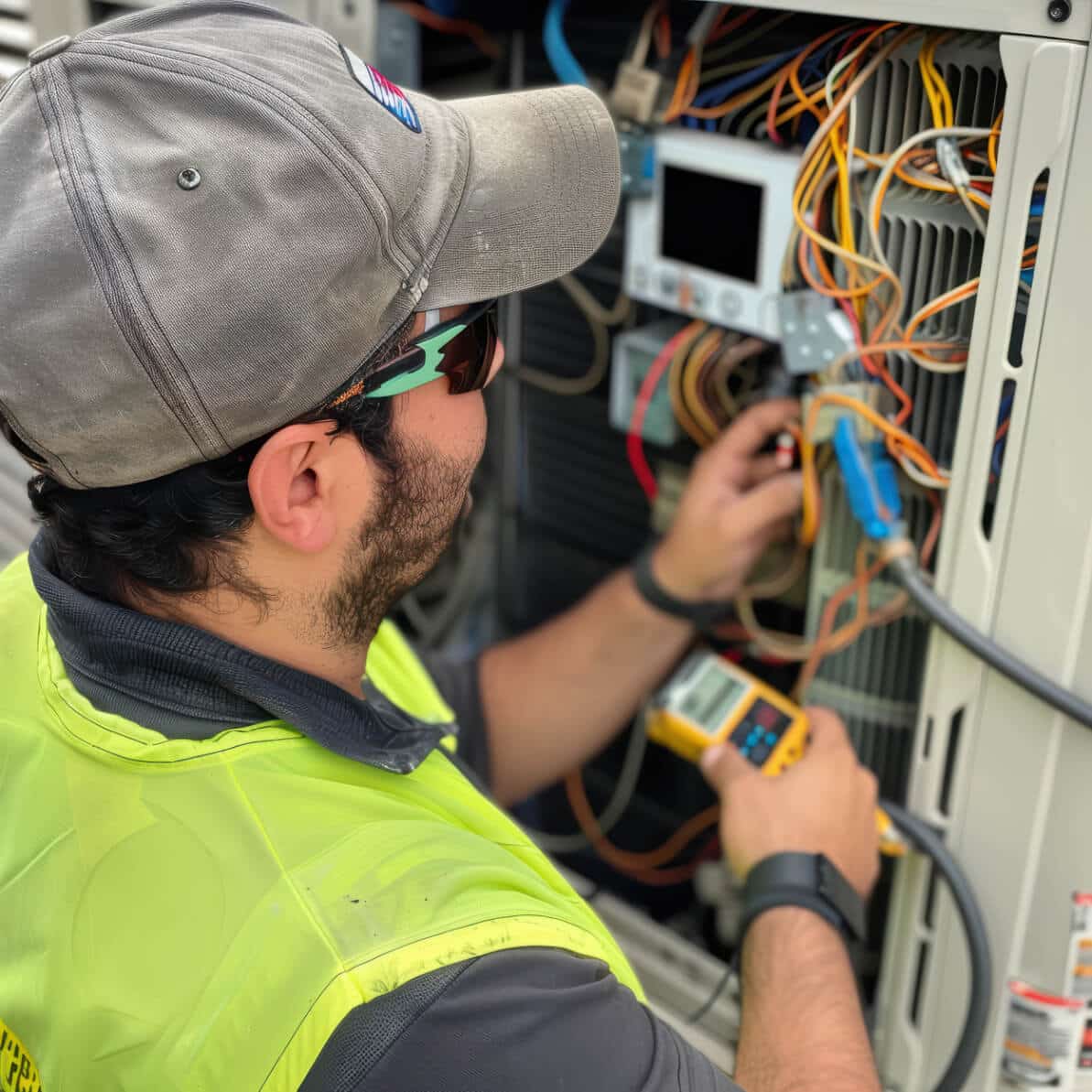
Short answer: Before you take an install job at another Las Vegas shop, get answers on five things: crew size per job, who pays for tools and the vehicle, how warranty callbacks are handled, what equipment you will be installing, and who you call when a job goes sideways. Pay matters, but installers rarely quit over the hourly rate alone. They quit because the work makes them look bad. At The Cooling Company that means 2 to 3 person crews, provided vehicle and tools, commissioning checklists on every install, and dispatch that answers the phone.
Apply here to ask these questions directly.
If you are reading this, you are probably not in crisis. You have a job. You are competent at it. Something is just wearing on you, and you are not sure whether it is bad enough to justify the disruption of switching, or whether the next place will be the same thing with a different logo on the truck.
That is a fair concern. Plenty of installers leave one shop for another and find identical problems six weeks in. This post is about how to tell the difference before you commit, whether you end up applying here or somewhere else.
Key Takeaways
- Diagnose the real reason first. "I want more money" is often actually "I am tired of being set up to fail." Those need different solutions.
- Crew size is the highest-signal question you can ask. A shop that runs solo installers on two-person jobs will not change for you.
- Ask about callbacks specifically. Who eats the time? If the answer is the installer, you will be paying for the estimator's mistakes.
- Ask what brand they install and why. Shops that install whatever is cheapest that week will hand you equipment you would not put in your own house.
- Ask to talk to an installer, not just the manager. A shop that will not put you on the phone with a current crew member is telling you something.
First, Diagnose the Actual Problem
In my experience running install operations in this valley, installers who say they are leaving for money are usually leaving for one of these instead:
- Chronic understaffing. You are doing a three-person job with two people, every day, and the schedule was built assuming you would.
- Being blamed for scope failures. The estimator sold a straight changeout, the job needed a duct transition and a disconnect relocation, and now you are the reason it ran long.
- Callbacks that were never yours. Undersized equipment, existing duct problems nobody addressed, a charge that was wrong on paper before you got there.
- Equipment you cannot defend. The customer asks if this is a good unit and you have to decide between lying and undermining your employer.
- Nobody answers the phone. You are in an attic at 2 PM in July looking at something the scope did not mention, and you cannot reach anyone who can make a decision.
Money is downstream of all five. A raise at your current shop will not fix any of them, which is why installers who negotiate a raise instead of leaving are usually gone within a year anyway.
The Five Questions That Actually Reveal a Shop
1. How many people are on a crew, on a typical residential changeout?
The answer you want is two, with three on package units, full duct replacements, and light commercial. If the answer is "it depends" followed by hedging, it means solo installs happen regularly. At The Cooling Company, install crews run 2 to 3 people. That is not a target we aspire to, it is how the schedule is built.
2. Who provides the vehicle and the tools?
A vehicle stipend is not a vehicle. Once you account for fuel, insurance, maintenance, and what a work truck's resale value does after three years of hauling equipment, a stipend usually covers less than half the real cost. Tools are the same math on a smaller scale, a few thousand dollars a year that quietly comes out of your paycheck.
Here: company vehicle and fuel card for all field staff, tools provided, uniforms and PPE provided. Ask any shop you interview with to be equally specific.
3. How are warranty callbacks handled?
This question tells you more about a company's culture than any other. Some shops send the original installer back on their own time. Some treat every callback as a performance problem regardless of cause. The right answer involves finding out what actually happened first: was it an install defect, an equipment failure, a pre-existing duct or electrical condition, or a scope that was wrong before anyone showed up?
We commission every install against a checklist and document it with photos, which means when something does come back, there is a record of what the system was doing when the crew left. That record protects good installers. It is hard to overstate how much easier the job gets when you are not defending your work from memory.
4. What are you going to have me install?
You will spend years of your life putting this equipment in people's homes and signing your name to it. We are a Lennox Premier Dealer, which is one of the more selective dealer designations in the industry, and it comes with factory training access. We also service and install other major brands as the job requires. What you will not be doing is installing whatever off-brand equipment happened to be cheapest at the supply house this month.
5. Who do I call when the job is not what the scope said?
Every installer has been in an attic looking at a problem that changes the entire job. What happens next is a culture test. Dispatch and leadership here are reachable during the workday and expected to make decisions rather than tell you to figure it out. We are a family-owned company with fewer than 50 people. There is no layer of management insulated from the field.
The Questions to Ask Yourself
Before you switch, be honest about a couple of things on your side too:
- Would a different shop actually solve this? If your complaint is the Las Vegas summer, no employer fixes that. Attics in July are attics in July.
- What do you want in three years? If the answer is crew lead or field supervisor, ask specifically how the last two people got promoted at any shop you are considering. Vague answers mean it does not happen.
- What is your certification situation? If you do not have EPA 608 Universal, getting it is worth more than most job changes. Ask whether the shop will support you in earning it. We do.
What Switching to TCC Actually Involves
Our process is short on purpose, because good installers do not stay on the market long and we know it:
- Application, about 10 minutes.
- Phone screen within a few business days, including a real pay number rather than a range.
- Working or in-person interview. For field roles this can mean riding along on actual work, which is as much for your evaluation of us as ours of you.
- Background check and reference verification.
- Offer. If it is a fit, we move. For urgent needs the whole process can close in under two weeks.
If you have a competing offer with a deadline, say so on the phone screen. We will either meet your timeline or tell you honestly that we cannot.
Questions Installers Ask Us
Will you tell my current employer that I applied?
No. We do not contact a current employer without your explicit permission. Reference checks happen at the offer stage and we work with the references you provide. Las Vegas HVAC is a small community and we treat applications as confidential for exactly that reason.
I have been out of the trade for a couple of years. Am I still a candidate?
Yes, if the fundamentals are there. Equipment changes, but line sets, ductwork, electrical, and airflow do not. Tell us on the application how long you were out and what you were doing. We would rather assess it than have you screen yourself out.
Do you hire installers from outside Nevada?
Yes. Field positions require a valid Nevada driver's license, which you will need to obtain after establishing residency. Tell us your relocation timeline on the phone screen so we can plan the start date around it.
What if I want to move from install to service eventually?
That happens here and it is a normal path. Service technicians earn $24 to $44 per hour and the work rewards diagnostic depth. If that is where you want to end up, say so during the interview so we can build the certification and training path toward it rather than discovering your goals two years in.
How quickly can I start?
As quickly as your notice period allows. We ask candidates to give proper notice to their current employer. This is a small industry, and how you leave a shop is part of your reputation in it.
If You Want to Have the Conversation
Submit an application and we will call you. and ask for the hiring manager if you would rather ask the five questions above before you put anything in writing. Both are fine, and neither commits you to anything.
Details on every open position are on our careers page.
Share This Page