

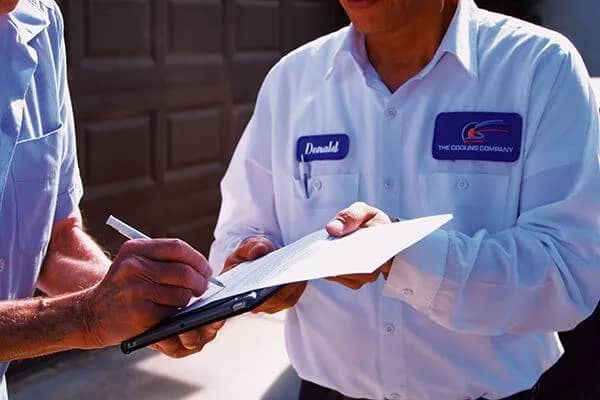
Short answer: Yes, water heater installation in Las Vegas and Clark County requires a building permit in most cases. New installations, fuel type changes, and relocations always require permits. Even like-for-like replacements require permits in the City of Las Vegas and City of Henderson, though requirements vary by jurisdiction within the valley. Permits cost $65-$150, inspections are typically scheduled within 48 hours, and the entire process adds minimal time when handled by a licensed contractor. The Cooling Company pulls all required permits as a standard part of every installation. Call (702) 567-0707 for a compliant installation.
Permits are the part of water heater installation that nobody gets excited about — but they are arguably the most important part of protecting your investment. A permit ensures that your installation meets current building code, is inspected by a trained professional, and creates an official record that protects you during insurance claims and home sales. Skipping the permit to save a few dollars or a few days of waiting is a decision that can cost thousands later.
The challenge in the Las Vegas valley is that permit requirements vary depending on which jurisdiction you live in. Clark County, the City of Las Vegas, the City of Henderson, the City of North Las Vegas, and the City of Boulder City each have their own building department with slightly different requirements for water heater installations. This guide covers the specifics for each jurisdiction so you know exactly what applies to your home.
If you are planning to install a Lennox water heater, the permit process is the same as for any brand — it is the installation work that gets permitted, not the equipment brand. Our installation guide covers the full process from model selection through commissioning.
Key Takeaways
- Permits are required for most water heater installations: Across all Clark County jurisdictions, new water heater installations, fuel type changes (gas to electric or vice versa), and unit relocations require a plumbing or mechanical permit.
- Like-for-like replacement rules vary by jurisdiction: The City of Las Vegas and City of Henderson require permits even for same-type, same-location replacements. Unincorporated Clark County has historically been more lenient on exact replacements, but requirements change — always verify with the local building department.
- Permit costs are modest: $65-$150 for a residential water heater permit depending on the jurisdiction and whether plumbing and electrical permits are both needed (heat pump water heaters may require both).
- Licensed contractors pull permits for you: When The Cooling Company installs your water heater, we handle the entire permit process — application, fees, scheduling the inspection, and meeting the inspector. You do not need to visit a building department office or manage any paperwork.
- Inspections check safety-critical items: Gas connections, venting, electrical wiring, T&P valve installation, expansion tank, seismic strapping, clearances, and drain pan placement. These are not bureaucratic box-checking — each item prevents a specific safety hazard.
- Unpermitted work creates real consequences: Insurance companies can deny water damage claims on unpermitted installations. Home buyers' inspectors flag unpermitted work. Lending appraisers may require correction before closing. The cost of retroactive permitting or removal far exceeds the original permit fee.
- Only licensed contractors can pull permits: In Clark County, plumbing permits require a licensed C-1D plumbing contractor. Homeowners cannot pull their own plumbing permits in most jurisdictions. An unlicensed handyman or general contractor without a plumbing specialty license cannot legally obtain the permit.
When Is a Permit Required for Water Heater Installation?
The answer depends on the type of work being performed and the jurisdiction where your home is located. Here is the general framework that applies across the Las Vegas valley, followed by jurisdiction-specific details.
Situations that always require a permit
New water heater installation where none existed before. Adding a water heater to a home that did not previously have one — or adding a second water heater for capacity — requires a plumbing permit. The new installation involves water supply connections, drainage, venting (gas models), and potentially electrical work that must all meet current code.
Changing fuel type. Converting from a gas water heater to an electric or heat pump model (or vice versa) always requires a permit because the installation requirements are fundamentally different. A gas-to-electric conversion involves capping the gas line, potentially adding a new electrical circuit, and modifying venting. An electric-to-gas conversion requires running a gas line, installing venting, and ensuring combustion air requirements are met. These are major plumbing and mechanical changes that affect life safety.
Relocating the water heater. Moving a water heater to a different location within the home — garage to utility closet, closet to attic, one side of the garage to the other — requires a permit because the new location must be evaluated for clearances, venting, combustion air, drainage, structural support (for attic installations), and access requirements.
Upgrading to a significantly larger unit. Installing a substantially larger water heater may require changes to gas line sizing, electrical circuit capacity, venting diameter, or structural support that trigger a permit requirement. Going from a 40-gallon to an 80-gallon unit, for example, may require a larger gas line or higher-amperage electrical circuit.
Situations where permit requirements vary
Like-for-like replacement in the same location. This is the most common residential scenario — your old 50-gallon gas water heater failed, and you are replacing it with a new 50-gallon gas water heater in the same spot. Permit requirements for this scenario differ by jurisdiction within the Las Vegas valley. The City of Las Vegas and City of Henderson generally require permits for all water heater replacements. Unincorporated Clark County has at times allowed like-for-like replacements without a permit, but policies evolve. When in doubt, we pull the permit — the cost is modest and the protection is substantial.
Permit Requirements by Jurisdiction
The Las Vegas valley spans multiple city and county jurisdictions, each with their own building department. Here is what applies where you live.
What are the permit requirements in unincorporated Clark County?
Clark County Development Services handles permits for homes in unincorporated Clark County — which includes Summerlin South, Enterprise, Spring Valley, Whitney, Sunrise Manor, and other unincorporated areas. Clark County follows the Uniform Plumbing Code (UPC) with local amendments.
For water heater installations, Clark County requires permits for new installations, fuel type changes, relocations, and significant upgrades. Like-for-like replacements may not always require a full permit, but the work must still comply with current code. Even if a permit is not technically required for a straightforward replacement, having one provides documentation that protects you.
Permits are submitted through the Clark County online portal or in person at the Development Services office. Processing is typically same-day for standard residential plumbing permits. Inspections are requested after installation is complete and are typically scheduled within 24-48 hours of the request.
What are the permit requirements in the City of Las Vegas?
The City of Las Vegas Building and Safety Department requires permits for all water heater installations, including like-for-like replacements. The city follows the Uniform Plumbing Code with city-specific amendments. A plumbing permit is required, and for heat pump water heaters that require new electrical circuits, a separate electrical permit may also be needed.
The City of Las Vegas offers online permit applications for licensed contractors. Standard residential plumbing permits are often issued same-day. Inspection scheduling is available online, and inspections are typically completed within 24-48 business hours of the request.
What are the permit requirements in Henderson?
The City of Henderson Development Services Department requires permits for water heater installations, including replacements. Henderson follows the International Plumbing Code (IPC) with local amendments — note this is different from the UPC used by Clark County and Las Vegas, though the practical requirements for water heater installation are very similar.
Henderson has an efficient online portal for permit applications and inspection scheduling. Residential plumbing permits are typically processed within 1-2 business days. Henderson inspectors are known for being thorough, particularly regarding expansion tanks, seismic strapping, and T&P valve drain line routing.
What are the permit requirements in North Las Vegas?
The City of North Las Vegas Building Safety Division follows the Uniform Plumbing Code and requires permits for water heater installations. The requirements and process are similar to Clark County. Permits can be applied for online or in person, with typical processing of 1-3 business days for standard residential plumbing permits.
What Does a Water Heater Permit Cost?
Permit costs in the Las Vegas valley are modest relative to the total installation cost. Here are typical fee ranges.
| Jurisdiction | Standard Plumbing Permit | Electrical Permit (if needed) | Total Range |
|---|---|---|---|
| Clark County | $65-$100 | $50-$75 | $65-$175 |
| City of Las Vegas | $75-$110 | $50-$80 | $75-$190 |
| City of Henderson | $70-$100 | $50-$75 | $70-$175 |
| City of North Las Vegas | $65-$95 | $50-$75 | $65-$170 |
Standard gas and electric water heater replacements typically require only a plumbing permit. Heat pump water heater installations that require a new dedicated 240-volt circuit may need both a plumbing and an electrical permit, which is why the total range is higher. The permit fees are included in The Cooling Company's installation quotes — we do not list them as a surprise add-on.
What Does the Inspector Check?
Understanding what the building inspector evaluates helps you appreciate why the inspection exists. Each item on the checklist addresses a specific safety concern. Here is what inspectors verify during a water heater installation inspection in Clark County jurisdictions.
Gas connections (gas models only)
The inspector verifies that all gas connections are properly tightened, use approved flexible connectors or rigid pipe with proper fittings, and pass a pressure test for leaks. Gas leaks are the primary fire and explosion risk with gas water heaters. The inspector may use a gas leak detector or apply soap solution to every gas fitting to verify zero leaks. Proper gas line sizing for the water heater's BTU rating is also verified.
Venting (gas models only)
Gas water heaters produce combustion gases (including carbon monoxide) that must be safely vented out of the home. The inspector checks that the vent type matches the water heater type (natural draft, power vent, or direct vent), the vent diameter matches the manufacturer's specifications, all vent joints are properly secured with screws, the vent slope is correct (rising toward the exit point), and the vent terminates at the correct location with proper clearances from windows, doors, and property lines. Improper venting is the primary carbon monoxide poisoning risk.
Electrical connections (electric and heat pump models)
The inspector verifies that the electrical supply matches the water heater's requirements — typically a dedicated 240-volt, 30-amp circuit for standard electric models and a dedicated 240-volt, 30-amp or 20-amp circuit for heat pump models. Proper wire gauge, circuit breaker size, grounding, and a disconnect switch within sight of the unit are all checked. For heat pump water heaters like the Lennox models, the inspector also verifies that the unit has adequate clearance around the air intake and exhaust for proper airflow.
T&P (temperature and pressure) relief valve
Every water heater must have a T&P relief valve installed in the manufacturer-designated location (typically a port on the top or side of the tank). The inspector verifies the valve is present, is rated for the unit's maximum temperature and pressure, and has a discharge pipe that runs downward to within 6 inches of the floor or to an approved exterior drain point. The discharge pipe cannot be capped, plugged, reduced in size, or routed uphill at any point. This valve is the last line of defense against tank rupture from over-pressure or overheating.
Expansion tank
In Clark County's closed plumbing system, the inspector verifies that a properly sized expansion tank is installed on the cold water supply line. The inspector checks that the tank is properly supported, connected with approved fittings, and appropriately sized for the water heater capacity. Some inspectors check the pre-charge pressure with a gauge.
Seismic strapping
Nevada adopted seismic strapping requirements for water heaters following the Uniform Plumbing Code. Water heaters must be secured with approved strapping to prevent them from falling over during an earthquake. The strapping must be properly anchored to the wall framing (not just drywall) and positioned at specific heights on the tank — typically one strap in the upper third and one in the lower third of the tank. While major earthquakes are rare in Las Vegas, the strapping requirement reflects Nevada's location in a seismically active region.
Clearances
The water heater must have proper clearances from combustible materials (gas models), adequate access for maintenance and repair, and sufficient space around the unit for the inspector to perform the inspection. Gas water heaters require specific clearances from walls, shelving, and stored items based on the manufacturer's installation manual. Heat pump water heaters require adequate air volume around the unit — typically 700-1,000 cubic feet of space — for the heat pump to operate efficiently.
Drain pan and overflow routing
Water heaters installed in locations where a leak could cause property damage (indoor closets, attic spaces, or elevated platforms) must have a drain pan beneath the unit with a drain line routed to an approved discharge point. In Las Vegas, most water heaters are in garages where a drain pan is recommended but not always required — the garage floor provides natural drainage. Attic and indoor closet installations always require drain pans with proper overflow routing.
The Inspection Timeline
Here is the typical permit and inspection timeline for a water heater installation in the Las Vegas valley.
| Step | Timeline | Who Handles It |
|---|---|---|
| Permit application submitted | Day of installation or day before | The Cooling Company |
| Permit issued | Same day to 3 business days | Building department |
| Water heater installed | Installation day (2-6 hours) | The Cooling Company |
| Inspection requested | Same day as installation completion | The Cooling Company |
| Inspection conducted | Within 24-48 business hours of request | Building inspector |
| Permit finalized | Same day if inspection passes | Building department |
From the homeowner's perspective, the permit process is largely invisible when working with a licensed contractor. You do not need to visit the building department, fill out applications, or schedule inspections. The installer handles all of it. The only involvement from you is being available (or leaving access) for the inspector's visit, which typically takes 15-30 minutes.
Why Permits Matter — The Real Consequences of Unpermitted Work
We understand the temptation to skip the permit. It costs money, it adds a step, and the vast majority of water heater installations would be fine without one. But "fine" is not the standard when it comes to protecting your home, your family, and your financial investment. Here are the real consequences of unpermitted water heater installation.
Insurance claim denial
If your water heater fails and causes water damage, your homeowner's insurance company will investigate the cause. When the adjuster discovers that the water heater was installed without a required permit, the claim can be denied on the basis that the loss resulted from non-code-compliant work. Insurance policies typically include exclusions for losses caused by failure to comply with building codes. In Las Vegas, where water heater failures in garages can damage flooring, drywall, and stored belongings, a denied claim can cost $5,000-$20,000 or more. A $75 permit provides the documentation that supports your claim.
Home sale complications
Every home sale in Las Vegas includes a home inspection. Experienced inspectors check for permit records on water heaters, HVAC systems, and electrical panels. If they find a water heater that was clearly replaced (new unit with old permit records showing a different model), they flag it as potentially unpermitted work. This can trigger buyer requests for a retroactive permit and inspection, a price reduction to cover the cost of bringing the installation into compliance, or in some cases, a requirement to replace the water heater entirely with a properly permitted installation. The cost of resolving unpermitted work during a home sale almost always exceeds the original permit cost by a factor of 10 or more.
Safety hazards
The inspection exists because each checked item prevents a specific hazard. Without an inspection, there is no independent verification that gas connections are leak-free, venting is properly routed, electrical wiring is safely installed, the T&P valve is functional and properly piped, the expansion tank is present and sized correctly, and seismic strapping is in place. A licensed plumber should get all of these right — but the inspection is the verification. Even experienced professionals make occasional mistakes, and the inspector provides a safety net.
Code violation fines
Performing plumbing work without a required permit is a code violation in Clark County, the City of Las Vegas, Henderson, and North Las Vegas. While enforcement on residential water heater replacements is not aggressive in most jurisdictions, fines can be assessed if the violation is discovered — typically during a complaint investigation, a permit application for other work, or a home sale. Fines vary by jurisdiction but can run several hundred dollars plus the cost of the retroactive permit and inspection.
How The Cooling Company Handles Permits
We treat permits as a standard, non-negotiable part of every water heater installation. Here is exactly what we do.
Before installation day: Our office verifies which jurisdiction your home falls under (Clark County, Las Vegas, Henderson, or North Las Vegas) and confirms the current permit requirements. For standard replacements, the permit application is submitted the day of installation. For fuel type conversions, electrical upgrades, or relocations that may require plan review, we submit applications in advance to avoid delays.
On installation day: Our licensed C-1D plumber (license #0078611) installs the water heater to current code, including all required components — expansion tank, seismic strapping, T&P valve with proper discharge pipe, and appropriate gas, electrical, and venting connections. The installer documents the work with photos and details for the permit file.
After installation: We request the inspection through the building department's online scheduling system, typically the same day the installation is completed. We coordinate with you on the inspection window and, if possible, meet the inspector at the home to answer any questions and address any findings immediately.
If the inspector requires corrections: On rare occasions, an inspector may require a minor adjustment — a vent screw, a slightly different drain pipe routing, or additional strapping. We return the same day or next business day to make the correction at no additional charge and schedule the re-inspection. Corrections are uncommon because we install to code consistently, but we stand behind our work if they occur.
Specific Clark County Code Requirements for Water Heaters
Clark County and its municipalities adopt model plumbing codes (UPC or IPC depending on the jurisdiction) with local amendments. Here are the key code provisions that apply to water heater installations in the valley.
Thermal expansion protection (UPC 608.2 / IRC P2903.4): Required on all closed water supply systems. An expansion tank or other approved thermal expansion device must be installed. Las Vegas homes have closed systems due to backflow preventers, so this applies to every installation.
T&P relief valve (UPC 608.5 / IRC P2803.1): Every storage water heater must have a T&P relief valve rated at or below the unit's maximum pressure and temperature. The discharge pipe must be piped to within 6 inches of the floor or to an approved exterior drain, with no reductions, traps, or threading on the discharge end.
Seismic restraint (UPC 507.2): Water heaters must be anchored or strapped to resist displacement during seismic events. Two metal straps, properly anchored to wall framing, are the standard method. This applies to all fuel types and all locations (garage, closet, attic).
Combustion air (UPC 507.13 / IRC G2407): Gas water heaters installed in enclosed spaces (closets, utility rooms) must have adequate combustion air supply — either through direct outdoor venting or through the building's indoor air volume calculation. Garages with standard doors typically meet this requirement, but sealed utility closets often need combustion air ducts.
Drain pan (UPC 508.4): Required when a water heater is installed in a location where leakage would cause damage. The drain pan must be piped to an approved drainage point. Not required for slab-on-grade garage installations in most jurisdictions, but recommended.
Clearance from combustibles (UPC 507.14): Gas water heaters must maintain minimum clearances from combustible materials as specified by the manufacturer's installation manual. Typical clearances are 1-6 inches depending on the model and surface type.
Do I need a permit to replace a water heater in Las Vegas?
In the City of Las Vegas and City of Henderson, yes — permits are required for water heater replacements, including like-for-like same-type, same-location swaps. In unincorporated Clark County, requirements may be more flexible for exact replacements, but policies change and the safest approach is to pull the permit. The cost is $65-$150, the permit protects your insurance coverage and home resale value, and a licensed contractor handles the entire process for you.
Can a homeowner pull their own water heater permit?
In most Clark County jurisdictions, plumbing permits must be pulled by a licensed plumbing contractor (C-1D in Nevada). Homeowners generally cannot pull their own plumbing permits for water heater installation, even for owner-occupied properties. This differs from some other states. The requirement ensures that the person taking responsibility for the work has the training and licensing to perform it safely and to code.
What happens if the inspection fails?
If the inspector identifies an issue, they provide a written correction notice specifying what needs to be addressed. Common corrections include minor adjustments to vent slope, additional seismic strapping screws, or drain pipe routing changes. The correction notice is not a penalty — it is a request to address a specific item before the permit can be finalized. The installer returns to make the correction and schedules a re-inspection (typically at no additional fee from the building department for the first re-inspection). When The Cooling Company installs your water heater, we handle all corrections at no additional cost to you.
How long is a water heater permit valid?
Residential plumbing permits in Clark County jurisdictions are typically valid for 180 days (6 months) from the date of issuance. The work must be completed and the inspection must be passed within that window. For a standard water heater installation that is completed in a single day, this timeline is more than adequate. If a permit expires before inspection, a new permit may need to be obtained.
Do I need separate plumbing and electrical permits for a heat pump water heater?
It depends on the existing infrastructure. If your home already has a dedicated 240-volt circuit where the heat pump water heater will be installed (common if you are replacing an existing electric water heater), only a plumbing permit is needed. If you are converting from a gas water heater to a heat pump and need a new electrical circuit, both a plumbing permit and an electrical permit are required. The Cooling Company holds both C-21 (HVAC, license #0075849) and C-1D (plumbing, license #0078611) licenses, and we coordinate with licensed electricians for any electrical work, pulling all required permits for the complete scope of work.
What if my water heater failed and I need emergency replacement — do I still need a permit?
Yes. Emergency water heater failure does not waive the permit requirement. However, all Clark County jurisdictions allow emergency plumbing work to begin before the permit is issued, with the understanding that the permit will be obtained within a specified timeframe (typically 1-3 business days after the emergency work). This allows us to replace your failed water heater immediately and restore hot water to your home while processing the permit paperwork in parallel. We do this regularly for emergency replacements — your hot water is restored the same day, and the permit and inspection follow within 48 hours.
Does a permit increase the cost of water heater installation?
Permit fees of $65-$150 represent roughly 2-5% of the total installation cost for a water heater in Las Vegas. Compared to the risks of unpermitted installation — potential insurance claim denial ($5,000-$20,000+), home sale complications ($1,000-$5,000+), code violation fines ($200-$500+), and safety hazards (priceless) — the permit fee is a trivial cost for substantial protection. The Cooling Company includes permit fees in our installation quotes. There are no hidden permitting costs or surprise add-ons.
Schedule a Fully Permitted Water Heater Installation
The Cooling Company handles every water heater installation with full permit compliance as standard practice. We pull the permits, schedule the inspections, and meet the inspector. You get a properly installed, code-compliant, fully documented water heater with zero permitting hassle. Licensed C-1D plumber (license #0078611) serving all of Clark County, Las Vegas, Henderson, North Las Vegas, and surrounding communities. Call (702) 567-0707 or schedule online. Browse our complete Lennox water heater lineup to see available models.