


Short answer: A properly installed 3-ton AC system in Las Vegas costs $6,325–$9,775 installed. If someone quotes you $3,500 for the same job, they are cutting corners that will cost you $5,000–$15,000 over the next decade in higher energy bills, premature failure, and repairs. This guide shows you exactly where the money goes — and what happens when it doesn't. We break down line-item costs, the seven corners that lowball contractors cut, the 10-year total cost of ownership for both approaches, and the questions you need to ask before you sign anything. A cheap AC installation in Las Vegas is not a bargain. It is a deferred invoice with interest.
Want a quote you can trust? Call (702) 567-0707 or request a free assessment online. We will show you every line item and explain every dollar.
I have been installing and replacing air conditioning systems in the Las Vegas Valley for over a decade. I have seen what happens inside homes where a previous contractor did a $3,500 installation. I have pulled out compressors that failed in year three because the refrigerant was never properly charged. I have rewired electrical connections that were one bad monsoon away from starting a fire. I have stood on rooftops in July looking at condensers sitting on crumbling pads with no vibration isolation, no proper clearance, and no permit sticker anywhere in sight.
And every single time, the homeowner says some version of the same thing: "I thought I was getting a deal."
This article is not a sales pitch. It is a math problem. I am going to show you, line by line, where the money goes in a proper AC installation, what a lowball contractor eliminates to hit that $3,500 price point, and what each of those eliminations costs you over the next ten years. If you read this and still choose the cheapest quote, at least you will know exactly what you are buying — and what you are not.
Key Takeaways
- A legitimate 3-ton AC installation in Las Vegas costs $6,325–$9,775. That range covers proper equipment, a Manual J load calculation, permits, new refrigerant lines, correct refrigerant charge, a quality thermostat, manufacturer warranty registration, and a two-person crew working a full day. If someone quotes you $3,500, they are eliminating at least four of those items.
- Builder-grade equipment (14.3 SEER2) costs $400–$900 more per year to operate than a 17+ SEER2 system in Las Vegas, where your AC runs 2,500–3,500 hours per year. Over ten years, that is $4,000–$9,000 in extra electricity alone.
- Skipping the Manual J load calculation is the most expensive shortcut. An incorrectly sized system — oversized or undersized — wastes $400–$900/year in energy and shortens equipment lifespan by 3–5 years. Correct sizing is not optional in a 115-degree climate.
- An unregistered manufacturer warranty costs you $1,400–$2,875 when the compressor fails in year 7. Most manufacturers require registration within 60 days of installation. Lowball contractors almost never do this.
- The 10-year total cost of a cheap installation exceeds $17,000 — more than the $15,900 total for a properly installed system. The cheap option costs more every single time when you account for energy, repairs, and early replacement.
- No permit means no inspection, no code verification, and a potential deal-breaker when you sell your home. Clark County requires permits for all HVAC installations. Skipping them is illegal and puts your home's resale value at risk.
- Reusing old refrigerant lines is a compressor killer. Fifteen-year-old copper lines with micro-leaks, oil contamination, and potentially wrong diameter for your new system will destroy even premium equipment.
- You can compare quotes effectively by demanding itemized breakdowns that list equipment model, SEER2 rating, load calculation, permit, line set, thermostat, warranty terms, and labor crew size. Any contractor who refuses to itemize is hiding something.
The $3,500 AC Installation: Where the Money Disappears
Before we talk about what goes wrong, let us talk about what things actually cost. Here is what a legitimate, code-compliant, warranty-preserving AC installation includes — and what a lowball quote eliminates to hit a number that sounds too good to be true.
This comparison assumes a standard 3-ton split system replacement in a typical Las Vegas single-story home with existing ductwork in serviceable condition.
| Cost Component | Proper Installation | Lowball Installation |
|---|---|---|
| Equipment (3-ton, 16 SEER2) | $3,200–$4,500 | $1,800–$2,500 (builder-grade 14.3 SEER2) |
| Manual J load calculation | $150–$300 | $0 (skipped entirely) |
| Permits and inspection | $200–$400 | $0 (skipped entirely) |
| Refrigerant (proper charge) | $150–$300 | $75 (undercharged) |
| Line set (new copper) | $200–$400 | $0 (reused old lines) |
| Disconnect and whip | $75–$150 | $0 (reused existing) |
| Thermostat | $150–$400 | $0 (keep old thermostat) |
| Warranty registration | Included | $0 (not registered) |
| Labor (2-person crew, 6–8 hours) | $1,500–$2,500 | $800–$1,200 (1 person, 3–4 hours) |
| TOTAL | $6,325–$9,775 | $3,000–$4,500 |
Look at that table carefully. The lowball contractor is not performing miracles of efficiency. They are not using some secret supplier or proprietary labor model. They are eliminating $3,000–$5,000 worth of materials, engineering, legal compliance, and quality labor. Every line item they skip is a cost that gets passed on to you — in higher energy bills, in shorter equipment life, in warranty claims that get denied, in failed home inspections, and in emergency repair calls at 2 a.m. in July.
Let me walk you through exactly what each of those eliminations does to your home, your comfort, and your wallet.

The 7 Corners Lowball Contractors Cut
Every lowball quote I have ever examined — and I have reviewed hundreds that homeowners brought to us for comparison — cuts some combination of these seven corners. Some cut all seven. The ones who cut all seven are the ones whose installations I end up ripping out three years later.
Corner 1: No Manual J Load Calculation
A Manual J load calculation is the engineering analysis that determines exactly how many tons of cooling capacity your specific home needs. It accounts for square footage, ceiling height, insulation type and R-value, window size and orientation, number of occupants, appliance heat load, duct losses, and — critically for Las Vegas — the 115-degree outdoor design temperature that makes our cooling loads dramatically higher than national averages.
A proper Manual J takes 45 minutes to two hours to complete, depending on the home's complexity. It requires measuring rooms, inspecting attic insulation, evaluating window types, and running the numbers through ACCA-approved software. The result tells you, to the half-ton, exactly what size system your home needs.
A lowball contractor skips this entirely. Instead, they do one of two things: they match the tonnage of the old system (which may have been wrong from the day the home was built), or they use a crude rule of thumb like "one ton per 500 square feet" — a number that was inaccurate in mild climates and is dangerously wrong in Las Vegas.
What it costs you when the system is oversized: An oversized AC cools the air too quickly, reaching the thermostat setpoint before it has run long enough to remove humidity. In Las Vegas, humidity is not usually a primary concern — but during monsoon season (July through September), indoor humidity spikes when an oversized system short-cycles. Short cycling also means the compressor starts and stops far more often than it should. Each start-up is the hardest moment in a compressor's life — the inrush current is three to five times the running current, and the mechanical stress is enormous. An oversized system that short-cycles 15 times per hour instead of running in longer, steadier cycles will fail years earlier than a correctly sized system.
What it costs you when the system is undersized: An undersized system cannot keep up on the hottest days. When it is 115 degrees outside and your 2.5-ton system needed to be a 3.5-ton system, it will run continuously for 18 to 20 hours — and still not get your house below 82 degrees. Continuous operation at full capacity accelerates wear on every component. The compressor overheats. The fan motor burns out. The evaporator coil ices up from the excessive runtime and restricted airflow. You are uncomfortable, your energy bills are astronomical, and the system dies five years before it should.
Total cost of skipping the Manual J: $400–$900 per year in wasted energy, plus 3–5 years of shorter equipment lifespan. On a system that should last 15–18 years, that is $6,000–$13,500 in energy waste and $5,000–$10,000 in premature replacement costs. The Manual J costs $150–$300. The math is not close.
Corner 2: Builder-Grade Equipment
The cheapest equipment available — typically a 14.3 SEER2 builder-grade unit — is what goes into every lowball installation. This is the federal minimum efficiency standard. It is literally the worst-performing unit that can legally be sold in the United States in 2026.
In a mild climate where the AC runs 600–800 hours per year, the difference between a 14.3 SEER2 and a 17 SEER2 system is modest — maybe $150–$250 per year. In Las Vegas, where the AC runs 2,500–3,500 hours per year, that difference is enormous.
Here is the annual electricity cost comparison for a 3-ton system at Las Vegas runtime, using NV Energy's current residential rate of approximately $0.12 per kWh:
| SEER2 Rating | Annual Cooling Cost (Las Vegas) | Annual Savings vs. 14.3 SEER2 |
|---|---|---|
| 14.3 SEER2 (federal minimum) | ~$2,100 | — |
| 16 SEER2 | ~$1,700 | ~$400/year |
| 17 SEER2 | ~$1,550 | ~$550/year |
| 18+ SEER2 | ~$1,400 | ~$700/year |
| 20+ SEER2 (variable-speed) | ~$1,200 | ~$900/year |
Over ten years, the difference between a 14.3 SEER2 builder-grade unit and a 17 SEER2 quality system is $5,500 in electricity alone. Over fifteen years — the normal lifespan of a quality system — it is $8,250. The builder-grade unit will not last fifteen years in Las Vegas heat, so add the cost of early replacement on top of that.
Beyond efficiency, builder-grade equipment uses cheaper components: single-stage compressors with lower quality windings, thinner condenser coils that corrode faster in desert dust, and smaller contactors that burn out sooner. These are not premium-versus-luxury distinctions. They are the difference between equipment engineered to survive Las Vegas conditions and equipment engineered to hit a price point. For a deeper comparison of how compressor technology affects performance in extreme heat, read our guide to single-stage vs. two-stage vs. variable-speed ACs.
Corner 3: Reusing Old Refrigerant Lines
The refrigerant line set — the copper tubing that carries refrigerant between the indoor evaporator coil and the outdoor condenser — is one of the most commonly reused components in lowball installations. The logic sounds reasonable: "The lines are already there. Why replace them?" Here is why.
Copper refrigerant lines degrade over time. After 12–15 years of thermal cycling — expanding and contracting as refrigerant temperatures vary from below freezing at the evaporator to over 150 degrees at the condenser — the copper develops micro-fractures. These are not visible leaks. They are hairline cracks that allow refrigerant to seep out slowly over months. Your system gradually loses charge, efficiency drops 10–20%, the compressor works harder, and eventually it fails from lubrication starvation (refrigerant carries the oil that lubricates compressor bearings).
Old lines also contain residual oil from the previous system. If the old system used a different refrigerant type (R-22 systems, common in units installed before 2010, used mineral oil; modern R-410A systems use POE oil), the incompatible oil contaminates the new system and damages the compressor from the inside out. Even if both systems use the same refrigerant, the old oil is degraded and full of particulates from years of operation.
Additionally, the old line set may be the wrong diameter for the new equipment. Manufacturers specify precise line sizes for each model. The wrong diameter — too large or too small — creates pressure drops that reduce efficiency and strain the compressor. A proper installer runs new lines matched to the new system's specifications.
Total cost of reusing old lines: Gradual refrigerant loss leading to 10–30% efficiency reduction ($200–$600/year in extra energy), compressor failure 3–7 years earlier than expected ($1,400–$2,875 for replacement), and potential total system replacement if oil contamination damages the compressor beyond repair.
Corner 4: Improper Refrigerant Charge
Proper refrigerant charging is both a science and a skill. The system must contain exactly the amount of refrigerant specified by the manufacturer — not "close enough," not "a little extra to be safe," not "about right." Exactly right. The charge is verified using superheat and subcooling measurements with calibrated instruments, or by carefully weighing the charge using a digital scale.
An undercharged system — even by 10% — loses 10–20% of its cooling capacity and efficiency. The evaporator coil cannot absorb enough heat, the compressor runs hotter than designed, and the system works harder to maintain temperature. In Las Vegas, where the system is already working near its limits on peak days, even a small undercharge can mean the difference between maintaining 76 degrees and struggling to hit 82.
An overcharged system is equally problematic. Too much refrigerant causes liquid slugging — liquid refrigerant reaching the compressor instead of vapor. Compressors are designed to compress gas, not liquid. Liquid slugging damages the compressor's reed valves, connecting rods, and bearings. One severe liquid slugging event can destroy a compressor instantly.
Lowball installers rarely have calibrated instruments. They "eyeball" the charge by feeling the suction line temperature with their hand, or they simply dump in whatever refrigerant amount is printed on the condenser's nameplate without accounting for line length, elevation, or actual operating conditions. Either approach produces a charge that is 10–25% off specification.
Total cost of improper charge: 10–20% efficiency loss ($200–$400/year in Las Vegas), accelerated compressor wear leading to failure 3–5 years early, and potential catastrophic compressor damage from liquid slugging. A proper charge takes 30–45 minutes with the right instruments. It is not complicated. It just requires caring enough to do it.
Corner 5: No Permits
Clark County requires a mechanical permit for all HVAC installations and replacements. The permit costs $200–$400 and triggers an inspection by a county inspector who verifies that the installation meets the International Mechanical Code: proper electrical connections, correct wire gauge, safe refrigerant line routing, adequate condenser clearances, proper drainage, and code-compliant disconnect installation.
A lowball contractor skips the permit for two reasons. First, it saves $200–$400 on the quote. Second — and more importantly — it avoids the inspection. An inspector would fail their work because their work does not meet code. Skipping the permit is not just cost-cutting. It is hiding substandard work from the authority that exists specifically to catch substandard work.
What no permit costs you:
- Safety risk. Improper electrical connections are the leading cause of HVAC-related house fires. The permit inspection is designed to catch exactly these errors. Without it, you are trusting that the installer who cut every other corner also got the electrical connections right.
- Insurance complications. If an unpermitted installation causes property damage — a fire from bad wiring, water damage from improper drainage — your homeowner's insurance may deny the claim. Insurance companies routinely investigate the permitting status of any system involved in a loss.
- Resale problems. When you sell your home, the buyer's inspector will check for permit records on major systems. An unpermitted HVAC installation is a red flag that can derail a sale, reduce your home's appraised value, or force you to bring the installation up to code at your expense — which often means a complete reinstallation.
- Warranty voidance. Several manufacturers include permit compliance in their warranty terms. An unpermitted installation gives the manufacturer grounds to deny warranty claims.
Total cost of skipping the permit: Impossible to predict precisely, but ranges from $200–$400 saved upfront to $5,000–$20,000+ in denied insurance claims, failed home sales, or fire damage. The permit exists to protect you. A contractor who will not pull one is telling you their work cannot pass inspection.
Corner 6: No Warranty Registration
Most major HVAC manufacturers — Lennox, Carrier, Trane, Goodman, Rheem, and others — offer a 10-year parts warranty on residential equipment. But that warranty is not automatic. The installing contractor must register the equipment with the manufacturer within 60 days of installation. If registration does not happen, the warranty defaults to 5 years instead of 10.
Registration takes about five minutes online. It requires the equipment serial number, the installation date, the homeowner's information, and the contractor's dealer number. Five minutes. And lowball contractors still skip it because (a) they are not authorized dealers for the brands they install and do not have a dealer number, (b) they do not want the manufacturer knowing they installed the equipment because they are not insured or licensed properly, or (c) they simply do not care.
When does this matter? When the compressor fails. A compressor is the most expensive single component in your AC system, and it is the component most affected by the installation shortcuts we have already discussed. Improper charge, wrong size, reused contaminated lines — all of them kill compressors. And compressors most commonly fail in years 5 through 10, exactly the window where an unregistered warranty leaves you exposed.
Total cost of no registration: When a compressor fails in year 7 with an unregistered warranty, you pay $1,400–$2,875 out of pocket for a part that would have been covered at no cost. When a condenser coil fails in year 8, you pay $800–$1,725. When a control board fails in year 6, you pay $400–$800. These are not hypothetical scenarios. They happen constantly. I replace unregistered, out-of-warranty components every week. The homeowner always wishes they had asked about warranty registration before they signed the quote.
Corner 7: Single-Person Installation
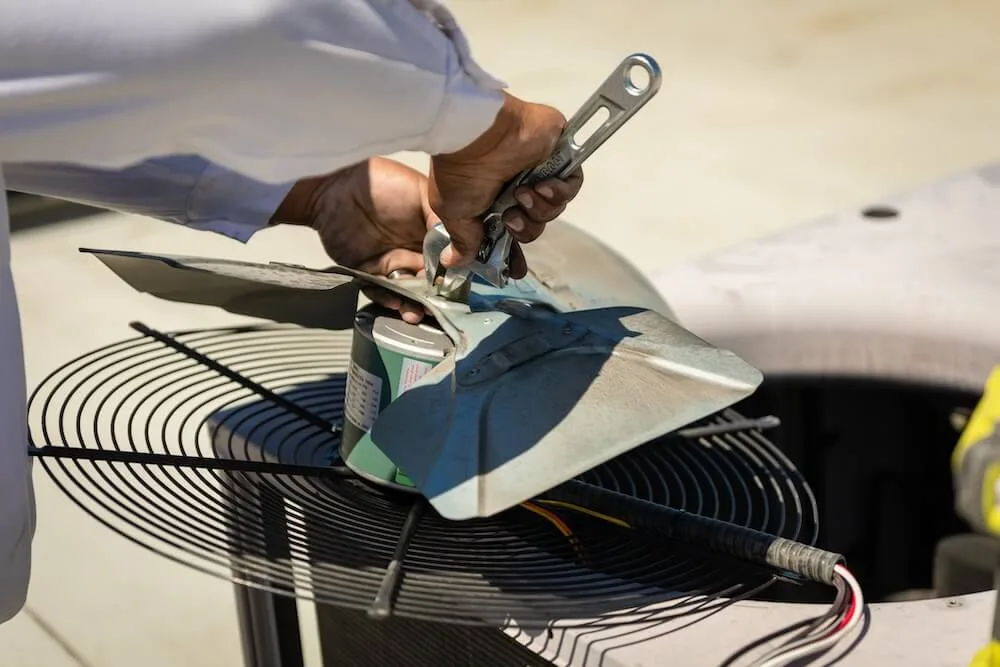
A proper residential AC installation is a two-person job. Full stop. The outdoor condenser unit weighs 150–250 pounds depending on the model. The indoor coil must be positioned precisely and connected to the plenum with zero leaks. Refrigerant lines must be brazed (not just flared), pressure-tested, and evacuated to remove moisture and non-condensables. Electrical connections must be pulled from the panel, routed, and terminated correctly at both the indoor and outdoor units. Ductwork connections must be sealed and insulated.
Doing all of this properly takes two experienced technicians 6–8 hours. One person can physically do most of it in 3–4 hours — but not without shortcuts. Here is what goes wrong with a single-person install:
- Condenser not properly leveled. One person cannot hold a 200-pound unit in place while checking and adjusting the level. Result: vibration, noise, refrigerant pooling, compressor oil starvation.
- Connections not torqued properly. Flare connections on refrigerant lines require a precise torque specification. Holding a fitting with one wrench while torquing with another requires two hands — or two people. Under-torqued fittings leak refrigerant. Over-torqued fittings crack.
- Ductwork connections not sealed. Connecting a new air handler or evaporator coil to existing ductwork requires sealing every joint with mastic or metal tape while holding the duct in position. One person cannot do both simultaneously.
- Rushing. A solo installer working a 3–4 hour job is probably doing two or three installations per day. They are incentivized to get in and get out as fast as possible. Speed and quality are enemies in HVAC installation.
- No quality check. A two-person crew includes built-in peer review. The second technician catches mistakes the first one misses. A solo installer has no second set of eyes.
Total cost of a single-person install: Varies widely, but poorly leveled condensers, leaking connections, and unsealed ductwork collectively reduce system efficiency by 15–30% and accelerate component failure. Over ten years, that is $3,000–$6,000 in excess energy costs and $1,000–$3,000 in avoidable repairs.
10-Year Total Cost of Ownership: Cheap vs. Proper
This is the math that settles the argument. Not the upfront price — the total price. What you actually spend over ten years, including the purchase, the energy bills, the repairs, and the replacement when the cheap system dies early.
| Cost Factor | Cheap Install ($3,500) | Proper Install ($7,900) |
|---|---|---|
| Upfront cost | $3,500 | $7,900 |
| Annual energy cost (Las Vegas average) | $2,100/year | $1,400/year |
| Energy cost over 10 years | $21,000 | $14,000 |
| Repairs (years 1–10 average) | $3,500 | $800 |
| Replacement at year 10 | $7,000 (died early) | $0 (still running strong) |
| 10-Year Total | $35,000 | $22,700 |
The cheap installation costs $12,300 more over ten years. Every time. The numbers are not close. And this is a conservative estimate — it assumes the cheap system limps along for a full ten years before dying, which is optimistic. Many poorly installed systems in Las Vegas fail catastrophically in years 5–7, when the compressor gives out from improper charge and contaminated refrigerant lines, and the unregistered warranty covers nothing.
Even if we use the most generous assumptions for the cheap installation — a slightly better builder-grade unit, no major repairs until year 8, the system lasting a full 12 years — the total cost of ownership still exceeds the proper installation. The energy cost alone, compounding over years, makes up the entire upfront price difference by year 6. Everything after that is pure loss.
Our 2026 AC replacement cost guide has full pricing breakdowns by system size, brand, and efficiency tier if you want to run the numbers for your specific situation.
What Happens When a Cheap Install Fails in Las Vegas
Numbers on a spreadsheet do not capture what it feels like to live with a failed AC installation in Las Vegas. These are real scenarios I see regularly — composites of actual situations, not hypotheticals. If any of them sound familiar, you are not alone.
Scenario 1: Compressor Failure in Year 3
The system was installed by a one-person crew in four hours. No load calculation. Refrigerant was not properly charged — the installer added the nameplate amount without verifying superheat or subcooling. Old refrigerant lines were reused. The warranty was never registered.
By month 18, the refrigerant charge had dropped 15% due to micro-leaks in the old line set. The compressor ran hotter than designed. By month 30, the compressor windings burned out. The homeowner called the installing contractor — disconnected number. Called the manufacturer — warranty had defaulted to 5 years, but the compressor was covered. Wait — the manufacturer required proof of proper installation by a licensed contractor. The original installer had no NV C-21 license. Warranty denied.
Cost to the homeowner: $2,875 for a new compressor, $400 for a new line set (finally), $200 for proper refrigerant charge. Total: $3,475 — essentially paying for the installation all over again, three years later.
Scenario 2: System Cannot Cool Below 82 Degrees on Peak Days
A 1,800-square-foot home with west-facing windows and minimal attic insulation needed a 4-ton system based on a proper load calculation. The lowball contractor matched the old system — a 3-ton unit that the home's original builder had undersized to save costs in 2004. The homeowner now has a brand-new 3-ton system that is exactly as undersized as the twenty-year-old system it replaced.
From May through September, the system runs 18–20 hours per day and cannot maintain the 76-degree setpoint. On 115-degree days, indoor temperatures reach 82–84 degrees. The homeowner's NV Energy bills hit $450–$500 per month because the system runs at 100% capacity nearly around the clock. The compressor, running continuously at full load in extreme heat, is aging at three times the normal rate.
Cost to the homeowner: $200+ per month in excess energy bills (vs. a properly sized system), complete system replacement needed in 8–10 years instead of 15–18, and five months of uncomfortable living every year. Total additional cost over the system's shortened life: $15,000+.
Scenario 3: Mold in the Ductwork
The single-person installation crew did not properly seal the connection between the new air handler and the existing ductwork. A gap at the plenum connection allowed warm, humid attic air to infiltrate the duct system during monsoon season. The temperature differential between the cold supply air and the warm infiltrating air created condensation inside the ductwork. Within two monsoon seasons, mold was growing in the ducts and being circulated through the home every time the system ran.
Cost to the homeowner: $2,000–$5,000 for professional duct cleaning and mold remediation, $500–$1,000 to properly seal the duct connections that should have been sealed during installation, and health concerns for the family — especially anyone with respiratory conditions.
Scenario 4: Failed Home Inspection at Sale
Five years after a lowball installation, the homeowner listed the property. The buyer's home inspector checked Clark County records and found no mechanical permit on file for the HVAC installation. The inspector also noted that the condenser was installed with insufficient clearance from the property fence, the electrical disconnect was not to code, and there was no visible inspection sticker.
The buyer's agent demanded that the seller bring the HVAC installation into code compliance before closing. A licensed contractor evaluated the work and recommended full replacement — the existing installation had too many code violations to remediate piecemeal. The seller had to pay for a new, properly permitted installation to close the sale.
Cost to the homeowner: $8,000–$10,000 for replacement (the system the lowball installer put in five years ago), plus the stress and delay of a nearly collapsed real estate transaction. The $3,500 "deal" ended up costing over $13,000 total.
Scenario 5: $300+ Monthly Summer Electric Bills
A homeowner chose the cheapest quote and received a 14.3 SEER2 builder-grade unit — the absolute federal minimum efficiency. Their neighbor, with a nearly identical home, installed an 18 SEER2 two-stage system. During summer months, the homeowner's NV Energy bills averaged $340 per month. Their neighbor's averaged $190 per month.
The $150 per month difference, sustained over the five-month cooling season, adds up to $750 per year. Over ten years, that is $7,500 in excess electricity — more than the entire price difference between the two installations. And the builder-grade unit requires more frequent repairs, runs louder, produces less consistent temperatures, and will need replacement sooner.
Cost to the homeowner: $7,500+ in excess energy over ten years, an uncomfortable home during the months it matters most, and the slow realization that the "savings" evaporated before the second summer was over.

How to Compare HVAC Quotes Apples-to-Apples
The reason lowball quotes work is that most homeowners compare bottom-line numbers without understanding what those numbers include. A $3,500 quote and a $7,900 quote look like two prices for the same thing. They are not. They are prices for two completely different products.
Here is how to make any HVAC quote comparable. When you receive a quote — from us or from anyone else — demand that it includes every item on this list. If a contractor cannot or will not provide this information, that tells you everything you need to know.
The Quote Comparison Checklist
- Equipment make, model number, and SEER2 rating. Not "a Goodman 3-ton" — the actual model number. The model number tells you the exact efficiency rating, the compressor type (single-stage, two-stage, or variable-speed), and allows you to verify the price independently.
- Manual J load calculation: included or not. If the contractor says "we do not need one" or "we will match your existing system," that is a red flag. They are guessing. Our 17 questions guide covers why this is the single most important question to ask.
- Permit: included or not. Clark County requires a mechanical permit. If the contractor says it is "not necessary" or "optional," they are either uninformed or deliberately avoiding inspection.
- New line set: included or not. If the quote says "reuse existing line set," ask why. There are rare cases where a nearly new line set can be reused — but on a system replacement where the old lines are 10+ years old, new lines should be the default.
- Thermostat: included, and what model. A modern system paired with a 15-year-old thermostat cannot deliver its rated performance. The quote should include a compatible thermostat or explicitly state that your existing thermostat is compatible.
- Manufacturer warranty terms: years for parts and compressor. 10-year parts and 10-year compressor is standard for a registered installation. 5-year coverage means the contractor will not or cannot register the equipment.
- Labor warranty: how many years. A reputable contractor offers at least 1–2 years of labor warranty on their installation work, separate from the manufacturer's equipment warranty. Ask what is covered and what is not.
- Payment terms: in writing. When is payment due? All upfront (red flag), 50/50 (common), or upon completion (ideal)? Are there financing options? Check our HVAC financing page for details on available programs.
- Timeline: start date and expected completion date. A proper installation takes 6–8 hours for a standard replacement. If someone says they will be "in and out in a few hours," they are planning a rushed, shortcut-filled job.
- Crew size. Two-person minimum for a quality installation. Ask who will be there and what their roles are.
Print this list. Bring it to every consultation. Fill it out for every quote you receive. When you lay the completed lists side by side, the reason for the price differences becomes immediately obvious — and the "cheap" quote will not look cheap anymore.
What Good Installation Looks Like
If you have never seen a properly installed AC system, you might not know what to look for when evaluating the work after it is done. Here is what separates professional-quality installation from the work that generates callback complaints.
Outdoor Condenser
- Level condenser pad. The unit sits on a composite pad or concrete slab that is perfectly level in both directions. A unit that is even slightly off-level will develop vibration issues, oil pooling, and drainage problems. You can check this with a simple bubble level.
- Proper clearances. At least 24 inches of clearance on all sides for airflow, per manufacturer specification. Nothing stored against or on top of the condenser.
- Clean electrical connections. The disconnect switch is mounted at the correct height, the wiring is in conduit (not exposed), and the connections inside the disconnect are clean and properly torqued.
- New whip and disconnect. The flexible electrical conduit (whip) connecting the disconnect to the condenser is new and the correct size for the unit's amperage.
- Permit sticker visible. The Clark County inspection sticker should be attached to the condenser or the disconnect box. If there is no sticker, no inspection was performed.
Refrigerant Lines
- New copper lines. Bright copper visible at connections, properly insulated along their entire length (both suction and liquid lines), and supported with hangers at appropriate intervals — no sagging, no kinks.
- Proper routing. Lines follow walls and joists neatly. They are not draped across the attic floor where they can be stepped on or crushed.
- Brazed connections. Connections between line set sections and at the indoor/outdoor units are brazed (silver-soldered), not just flared. Brazed connections are stronger, more reliable, and less prone to leaks.
Indoor Components
- Sealed duct connections. Every joint between the air handler or evaporator coil and the ductwork is sealed with mastic or UL-181 rated tape. No visible gaps, no daylight, no air leaks you can feel with your hand.
- Clean workspace. Professional installers leave the work area cleaner than they found it. No leftover copper shavings, no discarded packaging, no refrigerant cans in your yard. The quality of the cleanup reflects the quality of the work.
- Commissioning paperwork. A proper installation includes documentation of the final refrigerant charge (superheat and subcooling readings), airflow measurements, and system operating temperatures. This paperwork proves the system was set up correctly and serves as a baseline for future service calls.
If your installation does not match this description, something was cut short. If multiple items are missing, you received a lowball installation regardless of what you paid.
NV Energy Rebates: Do Not Leave Money on the Table
NV Energy's PowerShift program offers rebates of $300–$2,000 on qualifying high-efficiency HVAC equipment. These rebates are available for properly installed, permitted systems that meet minimum efficiency thresholds. The key word is "properly" — NV Energy typically requires proof of permit and installation by a licensed contractor.
A lowball installation that skips permits and uses builder-grade equipment usually disqualifies you from these rebates in two ways: the equipment does not meet the minimum efficiency threshold, and the lack of a permit means you cannot provide the documentation NV Energy requires.
On a qualifying system, stacking an NV Energy rebate with any available manufacturer promotions can reduce your net cost by $1,000–$2,500. That means the price difference between a proper installation and a lowball installation shrinks significantly — while the quality difference remains enormous. Our pricing page has current rebate information, and our team handles the rebate paperwork for every qualifying installation.
Questions to Ask Before Signing
We wrote an entire article dedicated to this topic: 17 Questions Smart Las Vegas Homeowners Ask Before Buying a New HVAC System. It covers every question you should ask, what the right answers sound like, and what responses should make you walk away.
But here are the five questions most directly relevant to avoiding a lowball installation:
- "Will you perform a Manual J load calculation before recommending a system size?" The only acceptable answer is yes. If they say anything else — "we will match your old system," "we go by square footage," "we have been doing this long enough to know" — they are guessing, and guessing in a 115-degree climate is not acceptable.
- "Is the permit included in this price?" The only acceptable answer is yes. If they say the permit is "not required," "optional," or "extra," walk away.
- "Will you register the equipment warranty with the manufacturer?" The only acceptable answer is yes, and they should tell you the specific warranty terms — 10-year parts, 10-year compressor — that registration provides.
- "How many people will be on the installation crew, and how long will it take?" Two people, 6–8 hours is the standard for a straight replacement. One person, 3–4 hours is a shortcut installation.
- "Can I see an itemized breakdown of this quote?" A quality contractor will welcome this question. They are proud of what they include. A contractor who gives you a single number with no breakdown is hiding what they are not including.
If you want the full list, read the 17 questions article. It was written by our co-CEO specifically for homeowners navigating this decision.
How The Cooling Company Handles Installation Differently
We are a Lennox Premier Dealer with a 4.9-star rating across 740+ reviews. That is not marketing language — it is what happens when you do 10,000+ installations and maintain a standard. Here is what every Cooling Company installation includes:
- Manual J load calculation on every installation. No exceptions, no shortcuts.
- Permits pulled on every job. We handle all Clark County paperwork and scheduling.
- New refrigerant line sets on full system replacements. We do not reuse degraded copper.
- Proper refrigerant charge verified with calibrated instruments — superheat and subcooling measurements documented and provided to the homeowner.
- Two-person crews minimum on every residential installation.
- Manufacturer warranty registration completed within 48 hours of installation.
- Post-installation commissioning with documented system operating parameters.
- Itemized quotes that show you every component, every cost, and every warranty term before you sign anything.
We also carry every major brand — including Lennox, Carrier, Goodman, and others — so we can match the right equipment to your home and budget. We do not push a single brand because we get the highest margin on it. We recommend what is right for your specific situation. Visit our AC buying guide to explore your options, or see our Carrier vs. Lennox vs. Trane comparison and Goodman vs. Lennox comparison for brand-specific analysis.
Not sure whether you need a repair or a full replacement? Our repair vs. replace guide helps you make that decision with real numbers, not sales pressure.
Frequently Asked Questions
How much should a new AC installation cost in Las Vegas?
A properly installed central air conditioning system in Las Vegas costs $5,200–$13,800 depending on system size and efficiency tier. For the most common size — a 3-ton system — expect to pay $6,325–$9,775 for a quality installation that includes a Manual J load calculation, permits, new refrigerant lines, proper charging, and manufacturer warranty registration. If a quote falls significantly below these ranges, critical components of a proper installation are being eliminated. Our pricing page has current rates for every system size.
Why is one AC quote so much cheaper than the others?
A dramatically lower quote typically means the contractor is using builder-grade equipment (14.3 SEER2 minimum efficiency), skipping the Manual J load calculation, not pulling permits, reusing old refrigerant lines, not registering the manufacturer warranty, and using a single-person crew. Each of these shortcuts saves the contractor $200–$2,000 on the job but costs the homeowner $1,000–$10,000 over the life of the system in higher energy bills, earlier failure, and unwarrantied repairs.
Is a 14.3 SEER2 air conditioner good enough for Las Vegas?
A 14.3 SEER2 unit is the federal minimum — it is the least efficient system that can legally be sold. In Las Vegas, where your AC runs 2,500–3,500 hours per year, the efficiency difference between 14.3 SEER2 and 17+ SEER2 translates to $400–$900 per year in extra electricity. Over ten years, that is $4,000–$9,000. A 14.3 SEER2 unit also qualifies for fewer or no NV Energy rebates, compounding the cost penalty. For most Las Vegas homeowners, a 16 SEER2 minimum is the practical floor, and 17–18 SEER2 delivers the best value when you factor in energy savings.
What happens if my AC was installed without a permit?
An unpermitted HVAC installation creates several risks: the work was never inspected for code compliance (including electrical safety), your homeowner's insurance may deny claims related to the system, and the unpermitted work can complicate or block a home sale. In Clark County, you can retroactively apply for a permit and request an inspection, but if the installation fails inspection — which unpermitted work often does — you will need to pay for remediation or replacement to bring it into compliance.
Does reusing old refrigerant lines really matter?
Yes, significantly. Copper refrigerant lines degrade over 12–15 years of thermal cycling, developing micro-fractures that cause slow refrigerant leaks. Old lines also contain degraded oil and potential contaminants from the previous system. If the old system used R-22 refrigerant with mineral oil and the new system uses R-410A with POE oil, the incompatible oil will damage the new compressor. Even matching refrigerants, the old oil contains particulates that accelerate wear. New lines matched to the new system's specifications cost $200–$400 and protect a $4,000–$8,000 investment.
How do I know if my contractor registered my warranty?
Ask for the warranty registration confirmation. Every manufacturer provides a registration confirmation number or certificate that includes the equipment serial number, installation date, warranty start date, and warranty duration. If your contractor cannot provide this documentation within 60 days of installation, the warranty likely was not registered. You can also contact the manufacturer directly with your equipment serial number (found on the condenser's data plate) to verify registration status. If it was not registered, some manufacturers allow homeowner self-registration within 60 days — but after that window closes, you are limited to the reduced default warranty.
Can I save money by installing a smaller AC system?
Installing a system smaller than what the Manual J calculation recommends is one of the most expensive mistakes you can make in Las Vegas. An undersized system runs continuously on hot days without reaching the setpoint, resulting in higher energy bills than a correctly sized system (because it runs at 100% capacity nonstop), accelerated wear on every component, inability to maintain comfortable temperatures on peak days, and a shortened lifespan of 8–12 years instead of 15–18 years. The "savings" of $500–$1,500 on a smaller unit disappear within the first summer of operation.
What is the best time of year to install a new AC in Las Vegas?
Spring (March through May) and fall (September through October) are the best times for AC installation in Las Vegas. Contractors are less busy, scheduling is more flexible, and you may find better pricing — typically $500–$1,500 less than emergency replacement during peak summer. You also have time for a proper Manual J calculation, quote comparison, and permit processing without the pressure of a broken system in 115-degree heat. If your current system is 12+ years old and you are starting to see increased repair frequency, schedule a replacement assessment before summer arrives.
Should I finance a more expensive AC installation or pay cash for a cheap one?
Financing a quality installation almost always costs less over time than paying cash for a cheap one. The math: a $7,900 proper installation financed at 7% over 5 years costs roughly $9,400 total. A $3,500 cash installation plus the excess energy costs ($700/year), excess repairs ($350/year), and early replacement at year 10 ($7,000) totals $17,500+. Even with financing costs, the quality installation saves $8,000+ over its lifetime. Many contractors, including us, offer 0% financing for 18–36 months on qualifying systems. Visit our HVAC financing page for current terms.
How can I verify that an HVAC contractor is properly licensed in Nevada?
Search the Nevada State Contractors Board database for the company name or license number. A legitimate HVAC contractor in Nevada holds a C-21 (Refrigeration and Air Conditioning) license. Verify that the license is active, not expired or suspended. Also check that the contractor carries general liability insurance and workers' compensation coverage — a contractor without workers' comp insurance exposes you to liability if someone is injured on your property during the installation.
What is the difference between manufacturer warranty and labor warranty?
The manufacturer warranty covers parts — the compressor, condenser coil, evaporator coil, and other components — for a specified period (10 years with registration, 5 years without). If a covered part fails, the manufacturer provides the replacement part at no cost. However, the manufacturer warranty does not cover the labor to diagnose, remove, and install the replacement part. That is what the labor warranty covers. A reputable installer provides a separate labor warranty (typically 1–5 years) that covers the technician's time and travel for warranty repairs. Without a labor warranty, a "free" compressor replacement under manufacturer warranty still costs $500–$1,000 in labor.
What should I do if I already got a cheap installation?
If you suspect your AC was not properly installed, schedule a diagnostic evaluation with a reputable HVAC contractor. A thorough assessment ($79 diagnostic fee at The Cooling Company) will check refrigerant charge levels, verify system sizing against a load calculation, inspect electrical connections, evaluate duct connections, and check for permit documentation. If issues are found, some — like improper refrigerant charge or unregistered warranty — can be corrected after the fact. Others, like wrong system size, may require more significant remediation. The sooner you identify and address installation deficiencies, the less damage they do over time. Call us at (702) 567-0707 to schedule an assessment.
The Bottom Line
A $3,500 AC installation is not a $3,500 AC installation. It is a $3,500 down payment on a $17,000+ ten-year expense that leaves you uncomfortable, exposed to unwarrantied failures, and potentially unable to sell your home without paying for a second installation.
A $7,900 properly installed system is not expensive. It is the actual cost of doing the job correctly — with the right equipment, the right engineering, the right permits, the right labor, and the right warranty protection. Over ten years, it costs less than the cheap alternative. Every single time.
I did not write this to scare you or to sell you the most expensive system we carry. I wrote it because I am tired of walking into homes where a homeowner thought they got a deal and ended up paying twice. The information in this article is everything you need to avoid that outcome. Use it. Compare quotes with the checklist above. Ask the questions we outlined. Demand itemized breakdowns. Verify licenses and permits.
And if you want a quote from a company that will show you every line item and explain every dollar, call (702) 567-0707 or request a quote online. We will earn your business by being the most transparent option in the Las Vegas Valley — not the cheapest.
Related Reading
- AC Replacement Cost in Las Vegas: 2026 Price Guide
- 17 Questions Smart Las Vegas Homeowners Ask Before Buying a New HVAC System
- Carrier vs. Lennox vs. Trane: Las Vegas Comparison
- Goodman vs. Lennox AC: Las Vegas Comparison
- Single-Stage vs. Two-Stage vs. Variable-Speed AC in Las Vegas
- New AC System Buying Guide
- Should You Repair or Replace Your AC?
- AC Installation Services
- AC Replacement Services