
NATE-Certified Technicians
North American Technician Excellence
Every residential repair tech completes ongoing manufacturer and safety training for Las Vegas desert conditions.


Heat pump not heating? Not cooling? Our NATE-certified technicians diagnose defrost failures, reversing valve issues, refrigerant leaks, and electrical problems with upfront pricing.
Las Vegas heat pumps are winter emergencies when heating mode fails on cold desert nights. For backup furnace issues, see furnace repair. Need a new system? Explore heat pump installation.
What is heat pump repair?
Heat pump repair is diagnosing and fixing issues that prevent your system from heating or cooling efficiently. A certified technician tests refrigerant levels, defrost controls, the reversing valve, electrical components, and airflow, then restores proper operation with the right parts and verified performance checks.
Source: The Cooling Company
Book Heat Pump RepairHeat pump repair is the diagnosis and correction of any mechanical, electrical, or refrigerant-circuit fault that keeps your system from delivering its rated heating or cooling output. Unlike a furnace-and-AC setup with two separate systems, a heat pump shares one refrigerant circuit for both jobs. The reversing valve switches the direction of refrigerant flow, and that shared architecture means a single failed component can knock out heating and cooling at the same time. A proper repair therefore starts by isolating whether the fault lives in cooling mode, heating mode, or the valve that links them.
Repair work on a Las Vegas heat pump typically involves:
Electrical diagnostics. Testing capacitors, contactors, control boards, relays, and wiring under load. A weak capacitor or a pitted contactor mimics a much larger failure, so this is where most diagnostics start.
Refrigerant system service. Leak detection, leak repair, evacuation, and recharge to the manufacturer specification. Topping off a leaking system without fixing the leak is an incomplete repair.
Mechanical component replacement. Fan motors, blower motors, compressors, reversing valves, and defrost controls, each tested before replacement so a salvageable part is not swapped out.
Thermostat and communication diagnostics. Confirming the thermostat sends the correct signals for heating, cooling, and auxiliary heat staging. Heat pumps use a different wiring protocol than a conventional furnace and air conditioner.
Coil cleaning and airflow restoration. Removing desert dust and mineral deposits that restrict heat transfer, then verifying temperature split and airflow in the mode you actually needed fixed.
Most heat pump repairs cost $150 - $2,000 after a $79 diagnostic in Las Vegas. Winter heating failures often involve defrost boards and reversing valves. Compressor replacement sits above that range and usually opens a repair-or-replace conversation. The table below shows real pricing for the most common heat pump repairs.
| Component | Typical Cost | Price Range |
|---|---|---|
| Capacitor | $275 | $175 - $400 |
| Contactor | $225 | $150 - $325 |
| Refrigerant recharge | $375 | $225 - $575 |
| Defrost control board | $500 | $350 - $700 |
| Reversing valve | $1,300 | $800 - $2,000 |
| Blower motor | $525 | $350 - $750 |
| Outdoor fan motor | $425 | $300 - $575 |
| Compressor | $2,000 | $1,400 - $2,875 |
| Diagnostic fee | $79 | Flat rate |
* Prices shown are for reference and may vary based on your specific needs. We provide a detailed, upfront quote, including parts, labor, and any additional services, before work begins. No surprises, guaranteed.
Las Vegas heat pumps work in heating mode during cold snaps. These signs need same-day service.
Often a stuck reversing valve, failed defrost board, or low refrigerant. The system may still run but cannot produce heat.
Normal briefly during defrost, but persistent ice indicates defrost failure or restricted airflow. Turn off and call for service.
Electric backup heat strips running non-stop indicate the heat pump cannot keep up. May need refrigerant charge or defrost repair.
Rapid on/off cycles waste energy and stress the compressor. Often caused by dirty filters, failing capacitors, or refrigerant issues.
Fan motor bearing failure or compressor issues. Turn off the system to prevent further damage.
Seven failures we diagnose most often, what causes each one here, and how we fix it.
The reversing valve is what makes a heat pump a heat pump. It shifts refrigerant flow to switch between heating and cooling. When the valve sticks, either mechanically or because its solenoid coil fails, the system locks in one mode: cooling with no heat, or heat with no cooling. Las Vegas heat pumps switch modes often as the seasons turn, and that repeated switching wears the solenoid. A stuck reversing valve is one of the most common heat pump repairs we perform, and a partially stuck valve that bleeds capacity between the two sides is one of the easiest to misdiagnose.
A heat pump pulls heat from outdoor air even in cold weather. When Las Vegas winter nights drop below 40 degrees, moisture can freeze on the outdoor coil and block airflow. The defrost cycle is supposed to melt that ice automatically. When the defrost control board, outdoor temperature sensor, or defrost relay fails, the coil ices over and heating stops. You may see the outdoor unit buried in ice, or the system running in heat mode while blowing cool air indoors. Because desert air is so dry, genuine frost is rare here, so we also check that the defrost board is not configured for a humid climate. A board set that way triggers needless defrost cycles and stresses the reversing valve every time it flips.
A heat pump needs a precise refrigerant charge to run efficiently. Leaks develop from vibration fatigue at line-set fittings, corrosion on the coil, or a factory defect. In Las Vegas, extreme outdoor heat pushes the refrigerant circuit to higher pressures than in cooler climates, which speeds up leak development at connection points. Signs include ice on the refrigerant lines, reduced heating and cooling output, a hissing sound near the outdoor unit, and higher energy bills. We locate the leak, repair it, and recharge to the manufacturer specification. Topping off a leaking system without fixing the leak is an incomplete repair.
The compressor is the most expensive component in any heat pump. Las Vegas units run their compressors harder than those in most other U.S. cities, because high ambient temperatures force the circuit to operate at elevated discharge pressures and put thermal stress on the windings. Common failures are hard starting, where the compressor struggles to start and draws excess current, locked rotor, where it seizes, and winding failures. We test before we replace: a hard-starting compressor can sometimes be saved with a hard-start kit, which avoids a much larger repair. A compressor that has truly failed on an older system usually opens the repair-or-replace conversation further down this page.
Heat pumps use a different wiring protocol than a conventional furnace-and-AC system. The Y2 terminal, the O/B reversing valve wire, and auxiliary heat staging all have to be configured correctly at the thermostat. A thermostat that was never programmed for heat pump operation, or one whose wiring was disturbed during a DIY swap, sends the wrong signals: the system runs in the wrong mode, engages auxiliary heat when it should not, or never switches between heating and cooling at all. These misconfigurations are often misdiagnosed as component failures, so we verify control wiring early in every diagnostic.
Beyond a failed defrost cycle, heavy ice on the outdoor unit can come from a dirty air filter restricting indoor airflow, low refrigerant, a failed outdoor fan motor, or blocked return vents. When airflow is restricted the refrigerant circuit cannot absorb heat properly, and coil temperatures fall below freezing even in mild weather. Full ice blockage stops all heat transfer and can damage the compressor if the system keeps running. Never chip ice off a heat pump coil; the fins bend and the damage is permanent. Switch the system to fan-only to start thawing and call for a diagnosis so the underlying cause is corrected.
A heat pump is designed to carry a Las Vegas heating load with little help from its electric heat strips. If auxiliary heat runs constantly, which shows up as a sudden spike in your electric bill or an Aux Heat indicator that stays lit, the heat pump itself is not producing enough output. Causes include low refrigerant, a failing reversing valve, a weakening compressor, or an incorrect balance-point setting at the thermostat. Resistance strips cost two to three times more to run than the refrigerant cycle, so this is a problem worth diagnosing quickly.
24/7 emergency • Same-day service
Upfront pricing after diagnostics
Price depends on:
* Prices shown are for reference and may vary based on your specific needs. We provide a detailed, upfront quote, including parts, labor, and any additional services, before work begins. No surprises, guaranteed.
We verify heating or cooling failure, error codes, ice buildup, and whether backup heat is engaged.
💡 Pro Tip: If the heat pump blows cold air in winter, note whether the outdoor unit is iced over.
We test refrigerant pressures, defrost cycle, reversing valve operation, electrical components, and airflow.
You receive clear pricing and options before any work begins, including repair vs. replace guidance.
We complete the repair, confirm heating and cooling modes, and test performance before we leave.
A heat pump does the work of both your air conditioner and your heater, so when it fails you lose comfort in both directions. Las Vegas heat pumps run under unusual stress: cooling through 115-degree summers, handling the swing between scorching afternoons and cool desert nights, then heating on winter mornings in the 30s. That workload accelerates wear on every component from the reversing valve to the compressor, and it produces failure patterns that behave differently here than in cooler, more humid climates. The Cooling Company has diagnosed and repaired heat pumps across Las Vegas, Henderson, North Las Vegas, and the surrounding valley since 2011, so those patterns are familiar to our technicians.
Las Vegas heat pumps handle both summer cooling and winter heating. When overnight lows drop to the 30s, defrost cycles and reversing valves work harder. A failed defrost board leaves the outdoor unit iced over, and the system cannot produce heat until repaired.
Dual-fuel systems pair a heat pump with a gas furnace for backup heat below ~35°F. If your backup furnace is not engaging, see our furnace repair page for ignition and gas system diagnostics.
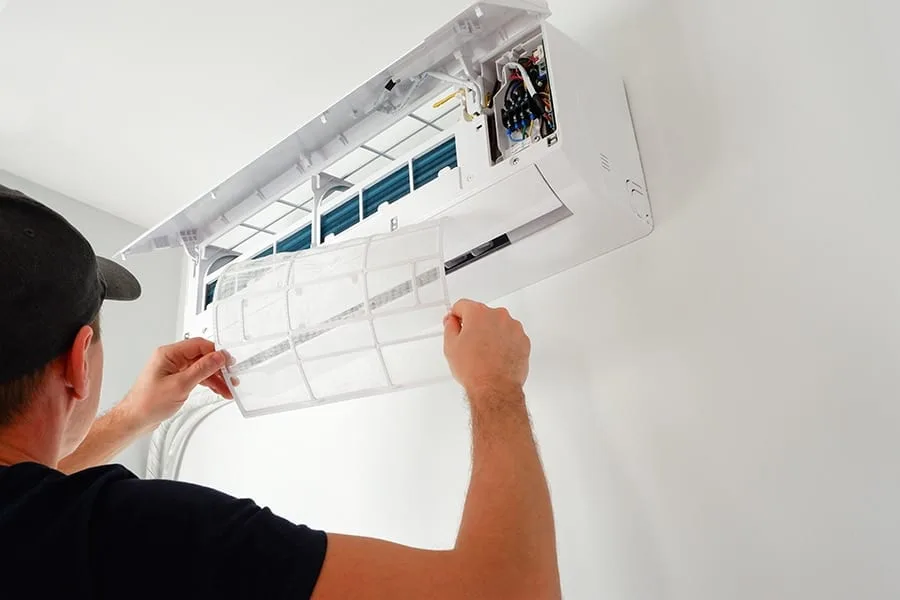
Three local conditions shorten heat pump life here, and each one leaves a signature we look for.
Heat pumps are rated for efficiency at a standard outdoor temperature of 95 degrees. Las Vegas runs above 110 degrees for weeks at a time. At those temperatures the refrigerant circuit operates at discharge pressures 20 to 30 percent above design, which subjects the compressor, the reversing valve, and the refrigerant lines to stress they were not built to sustain indefinitely. Capacitors and contactors, the small electrical parts that handle high current, degrade fastest: inside the outdoor unit cabinet on a 110-degree afternoon, temperatures can reach 140 degrees or more.
Las Vegas sits in a desert basin that generates heavy airborne dust, especially during wind events and monsoon season. Dust packs the outdoor coil fins, cutting airflow and heat transfer. A restricted coil forces the circuit to work harder, raising discharge pressure and compressor temperature. Dust also gets into the electrical compartment and coats capacitors, contactors, and control boards. An annual coil cleaning is not optional here. It is what keeps a heat pump on a normal service life.
Las Vegas municipal water is among the hardest in the country, with high concentrations of calcium and magnesium. When condensate drips across the outdoor coil fins, or when a homeowner rinses the unit with tap water, mineral deposits build up on the aluminum over time. Calcium scale is an insulator that reduces heat transfer. Unlike dust, which brushes off, scale needs chemical treatment to remove, and a severely scaled coil cannot be restored. If you see a white, crusty buildup on the outdoor coil, schedule a coil cleaning before the restriction damages the compressor.
Not every repair is worth doing. The decision comes down to four factors: the age of the system, the cost of the repair relative to a new system, the efficiency of what you have now, and whether recurring failures point to overall decline. These are the same rules our repair-or-replace guide applies to every system we service.
Repair almost always makes sense, even for a mid-sized repair. A well-maintained heat pump has years of service life left.
Apply the 50% rule. If the repair costs more than half of a new system's installed price, replacement usually delivers better long-term value.
This is the typical lifespan of a heat pump in Las Vegas, shorter than the 15 to 20 years systems reach in milder climates. A compressor or reversing valve failure at this age warrants a serious replacement discussion, because one major repair often precedes the next.
Two or more breakdowns in a year, or the same repair twice in two to three years, signal system decline rather than an isolated fault.
Heat pumps built before 2010 may run R-22, which is no longer produced in the U.S. Recharging them requires expensive reclaimed refrigerant, so replacement with a modern R-410A or R-32 system is typically the better financial decision.
Our technicians give you both numbers and an honest recommendation. If replacement is the smarter move, we will say so, and you can compare options on our heat pump installation page with transparent quotes and no pressure.
Our technicians are trained and equipped to repair heat pumps from every major manufacturer:
Lennox. Lennox Premier Dealer with factory-trained technicians and direct access to Lennox parts.
Carrier. Full-line repair coverage, including Infinity, Performance, and Comfort series.
Trane. XR, XL, and XV series heat pumps.
Rheem. Prestige and Classic series heat pumps.
Goodman. GSZ, GSZC, and DSZC series.
Daikin. Including Daikin-branded Goodman systems and ductless mini-splits.
Mitsubishi Electric. Ductless and multi-zone mini-split heat pumps.
American Standard, York, Heil, Armstrong. And every other major brand.
If your brand is not listed, call (702) 567-0707. We carry universal components that fit most systems and can source brand-specific parts quickly through our supplier network.
Google reviews from Las Vegas homeowners
Local heat pump repair across the Las Vegas Valley.
Do you offer emergency heat pump repair?
Yes. We offer 24/7 emergency appointments for no-heat situations when your heat pump fails during cold weather. Call us and we will confirm the fastest available window.
Why is ice on my heat pump outdoor unit?
Brief ice during defrost is normal. Persistent ice means the defrost cycle is failing, often due to a bad defrost board, failed sensor, or low refrigerant. Turn off the system and call for service to prevent compressor damage.
Clear answers on pricing, winter failures, and what to expect from professional repair.
Upfront pricing, done-right repairs, and 100% satisfaction on every visit.
Questions? Call (702) 567-0707 or contact us online.
Heat pump repair is a big decision. We publish license-verified comparisons, NSCB records, bid limits, complaint counts, and ownership, so you can see how The Cooling Company stacks up before you book. Family-owned since 2011. 4.8★ from 858+ Google reviews. Dual C-21 + C-1D licenses. Zero NSCB complaints.
Licensed, background-checked professionals, not a random subcontractor dispatch. Real people accountable to our family-owned shop.
North American Technician Excellence
Every residential repair tech completes ongoing manufacturer and safety training for Las Vegas desert conditions.
Same-visit repairs when possible
Capacitors, contactors, ignitors, and common parts on every truck, fewer return trips, faster relief in 110° heat.
Cooling Company Comfort Promise
You approve the repair in writing before we turn a wrench. No surprise fees, no pressure to replace when repair makes sense.
Our goal is to reach you within minutes.

