

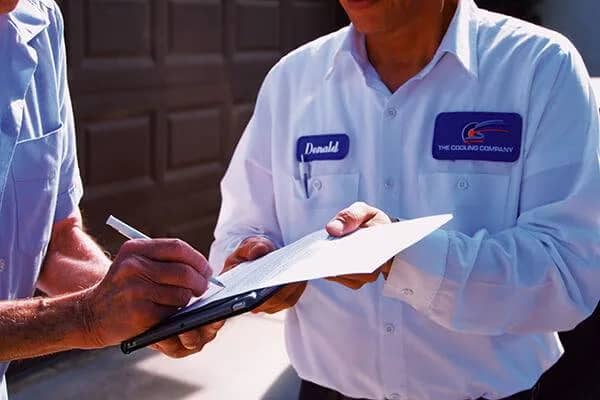
Your AC is running but your house is still hot. Before calling anyone, check these 3 things: thermostat set to COOL and below your current room temperature, breaker not tripped, air filter not clogged. These three checks solve roughly 40% of no-cooling calls we receive. If all three check out fine, your system has a mechanical or refrigerant issue that requires a licensed technician. Call (702) 567-0707 for a $79 diagnostic — we are available 24/7 and dispatch same-day across the entire Las Vegas valley.
Key Takeaways
- 8 DIY checks solve 40% of no-cooling calls — thermostat, breaker, filter, outdoor unit, vents, drain line, ice, and temperature split. Try all 8 before calling.
- The most common cause of "AC not cooling" in Las Vegas is a failed capacitor — a $150–$400 same-day repair that every technician carries on their truck.
- Most AC repairs cost $150–$2,000. Compressor replacement runs $1,500–$3,500. Full system replacement: $11,000–$27,000.
- At 115°F+, your system can only maintain 20–25°F below outdoor temp. A house at 90°F when it is 115°F outside may be your system working at full capacity — not a malfunction.
- The $5,000 rule decides repair vs. replace: multiply system age by repair cost. Over $5,000 means replace.
- Las Vegas air filters need changing every 30 days in summer — not the 90 days printed on the package. Desert dust loads them 3x faster.
- Duct leaks waste 20–30% of cooled air into your attic — where it is 150°F. This is the most overlooked cause of persistent cooling problems.
- 24/7 emergency service: (702) 567-0707. $79 diagnostic, waived for Comfort Club members.
I have been running AC service calls in Las Vegas for fifteen years. During that time, I have personally diagnosed thousands of systems that were running but not cooling — and the pattern is remarkably consistent. About 40% of those calls turned out to be something the homeowner could have fixed themselves in under five minutes. Another 30% were a single failed component — usually a capacitor — that we repaired same-day. The remaining 30% were more involved, but even those had clear, identifiable causes with well-defined repair paths.
This guide gives you everything I know about why your AC is not cooling your Las Vegas home right now. I will start with the 8 things you can check yourself before calling anyone. Then I will walk through every common cause, what each repair actually costs, how to decide whether to repair or replace, and the Las Vegas-specific problems that make cooling failures more common here than almost anywhere else in the country.
If your AC has completely stopped working — not just underperforming but totally dead — start with our AC emergency guide instead. If it is running but blowing warm or hot air specifically, our AC blowing warm air guide covers that scenario in detail. This guide covers the full spectrum: systems that are running but not cooling, systems that cool some rooms but not others, and systems that cannot keep up with extreme heat.
If you are reading this on your phone while your house heats up, skip straight to the first section. That is where the immediate fixes live.
8 Things to Check Before You Call Anyone?
These eight checks take about ten minutes total and solve a surprising number of no-cooling problems without a service call. I am going to walk you through them in the order I would check if I were standing in your house right now.
Check 1: Your Thermostat
The thermostat is the single most common source of "my AC is not cooling" calls. It sounds too simple, but it is true. Here is exactly what to look at:
Is the screen blank? If you have a battery-powered thermostat, dead batteries will shut the entire system down. Most thermostats use AA or AAA batteries. Replace them and see if the screen comes back. If the screen was blank and the system kicks on after new batteries, you just solved the problem for about two dollars.
Is it set to COOL? Not AUTO, not HEAT, not FAN ONLY, not OFF. Someone in your household may have bumped the setting, a power surge may have reset it, or a child may have pressed buttons. Verify it says COOL.
Is the set temperature below the current room temperature? If the thermostat reads 84°F and it is set to 85°F, the system will not turn on. Set the target temperature at least 3 degrees below the current reading.
Is the fan set to AUTO? This one catches people all the time. When the fan is set to ON, the blower runs continuously — including when the compressor is not actively cooling. The result is air coming from your vents that feels warm or room-temperature. It is not warm air — it is uncooled air being pushed through the ducts. Switch it to AUTO so the fan only runs during active cooling cycles.
Is the thermostat in the right location? If your thermostat is in direct sunlight, near a heat-producing appliance, or directly above a supply vent, it may be reading a temperature that does not reflect the rest of the house. A thermostat sitting in a 90°F sunbeam while the rest of the house is 82°F will tell the system the house is already warm and keep calling for more cooling — but it will never be satisfied because the sun keeps heating that one spot. This is more of a long-term fix, but it is worth noting.
Check 2: Your Breaker Panel
Your AC system has two breakers — one for the indoor air handler and one for the outdoor condenser unit. If either trips, part of your system stops working while the other part continues. The most confusing scenario: the air handler breaker is fine (so you feel air from the vents) but the condenser breaker is tripped (so the compressor is not running and the air is not being cooled). It feels exactly like the AC is running but blowing warm air.
Open your electrical panel. Look for any breaker in the middle position — not fully ON, not fully OFF. That is a tripped breaker. Also look for any breaker in the full OFF position that should be ON.
Reset protocol: Flip the tripped breaker fully to OFF, wait 60 seconds, then flip it to ON. Wait five minutes and check whether your system starts cooling.
Critical rule: reset a breaker only once. If it trips again within a few minutes, you have an underlying electrical fault — a short circuit, a grounded compressor winding, or a wiring issue. Repeatedly resetting a tripping breaker is a fire hazard. Leave it off and call a licensed technician. In Las Vegas, where attic temperatures exceed 140°F in summer, the fire risk from electrical faults is amplified.
Check 3: Your Air Filter
A clogged air filter is the most preventable cause of cooling failure, and it happens in Las Vegas faster than anywhere else in the country. The desert dust, construction particulate from all the development in the valley, and monsoon-season fine sediment load your filter far faster than the 90-day lifespan printed on the packaging.
Pull out your air filter — it is usually in the return air grille on a wall or ceiling, or inside the air handler cabinet. Hold it up to a light source. If you cannot see light through the filter media, it is too dirty and it is restricting airflow enough to cause cooling problems.
Here is what happens when a filter is severely clogged: the evaporator coil (the cold coil inside your air handler) is not getting enough warm air flowing across it. Without that warm air to absorb heat from, the coil's surface temperature drops below freezing. Moisture in the air freezes onto the coil, building a layer of ice. A frozen coil cannot cool your home — the air that does manage to get past the ice block arrives warm and humid.
Fix: Replace the filter. If you suspect the coil has frozen (you will see ice on the copper refrigerant lines or the coil itself), turn the system OFF and set the fan to ON for one to three hours to thaw the coil. Then restart in COOL mode with the new filter in place.
Las Vegas rule of thumb: Change your filter every 30 days during summer. Every 45 to 60 days during the milder months. If you have pets, construction nearby, or live near an unpaved lot, change it every 20 to 25 days.
Check 4: Your Outdoor Unit
Go outside and look at your condenser — the large metal box with a fan on top, usually on the side of your house or on a rooftop platform. This check tells you a lot about what is happening.
Is the fan spinning? If the fan is spinning and you can hear the compressor humming, the outdoor unit is working. Your problem is likely indoors — frozen coil, blower motor, ductwork, or a thermostat issue.
Is the unit humming but the fan is not spinning? This is the signature symptom of a failed run capacitor — the single most common AC repair in Las Vegas during summer. The capacitor gives the fan motor the electrical boost it needs to start. When the capacitor dies, the motor hums because it has power but cannot start spinning. This is a same-day repair that every HVAC technician carries parts for. Call (702) 567-0707.
Is the unit completely silent? No hum, no fan, nothing. The outdoor unit is not getting power. This could be a tripped breaker (see Check 2), a failed contactor relay inside the unit, or a more serious compressor or electrical failure.
Is the unit coated in debris? Las Vegas condenser units collect an astonishing amount of desert dust, cottonwood fluff (especially in spring), and dirt. If the condenser coils are so caked with debris that you cannot see through the fins, airflow is severely restricted and the unit cannot reject heat effectively. You can gently rinse the coils with a garden hose — spray from the inside out to push debris away from the coil. Do NOT use a pressure washer, which will flatten the delicate aluminum fins.
Check 5: Your Vents and Returns
Walk through your house and check every supply vent and return air grille. This takes three minutes and catches problems people overlook for months.
Are all supply vents open? Closed vents in unused rooms is one of the most persistent myths in HVAC. Closing vents does not save energy — it increases static pressure in the duct system, forces the blower to work harder, and can cause the evaporator coil to freeze. If you have more than two or three vents closed, open them all and see if cooling improves.
Is furniture blocking vents or returns? A couch pushed against a return air grille, a bed placed over a floor vent, curtains draped over a wall vent — all of these restrict airflow in ways that degrade cooling performance. The return air path is especially critical: if the system cannot pull air back to the air handler, it cannot cool it and send it back out.
Are dampers in the correct position? If your duct system has manual dampers (levers on the ductwork in your attic or closet), verify they are open. A damper that was closed during winter and forgotten about will block airflow to an entire zone.
Check 6: Your Drain Line
Your AC system removes humidity from indoor air as part of the cooling process. That moisture condenses on the evaporator coil, drips into a drain pan, and flows out through a PVC drain line — usually to the outside of your house or to a floor drain.
When that drain line clogs — and in Las Vegas, algae, dust, and mineral deposits from hard water clog drain lines regularly — the water backs up into the drain pan. Most modern systems have a safety float switch that detects a full drain pan and shuts the system off to prevent water damage. Your system may be off or cycling erratically because of a clogged drain, not a cooling problem.
Signs of a clogged drain line: Water pooling around the indoor unit. Water stains on the ceiling below the air handler if it is in the attic. The system shuts off and then restarts on its own. An error code on a communicating thermostat.
Quick fix attempt: Find the drain line cleanout — a capped PVC pipe near the indoor unit, usually at the top of the drain line. Remove the cap and pour a cup of white vinegar or a 50/50 bleach-water solution down the line. Wait 30 minutes, then flush with warm water. If the clog clears, the system should resume normal operation.
Check 7: Ice on Lines or Coils
Look at the copper refrigerant lines running from your outdoor unit to the indoor air handler. One of these lines (the larger one, called the suction line) should be cold and sweating with condensation during normal operation. But if that line is covered in ice, or if you can see ice forming on the evaporator coil inside the air handler, you have a problem.
A frozen system cannot cool your home. The ice acts as an insulator, blocking heat transfer and restricting airflow.
Two main causes of a frozen system:
- Restricted airflow — a clogged filter, closed vents, or a failing blower motor. This is the more common cause and the easier fix.
- Low refrigerant — a leak in the sealed refrigerant loop. Low refrigerant causes the evaporator coil temperature to drop too low, freezing the moisture on its surface.
What to do if you see ice: Turn the system OFF completely. Set the fan to ON to circulate room-temperature air across the coil and speed up thawing. This process takes one to three hours depending on how much ice has built up. Do NOT try to chip or scrape ice off — you will damage the coil fins.
After the ice has fully melted, check your air filter (replace if dirty) and restart the system. If it freezes again within a few hours, the cause is likely low refrigerant, and you need a professional with refrigerant recovery equipment and an EPA Section 608 certification. Call (702) 567-0707.
Check 8: The Temperature Split Test
This is the single best diagnostic test a homeowner can perform with nothing more than a basic thermometer — even a kitchen meat thermometer will work.
How to do it: Place a thermometer directly inside a supply vent (where cold air comes out) and note the temperature. Then place the same thermometer inside the return air grille (where the system pulls air in) and note that temperature. The difference between the two numbers is your temperature split.
What the split tells you:
- 15°F to 22°F split: Normal. Your system is cooling properly. If the house still feels warm, the problem is likely ductwork, insulation, or the system running against extreme outdoor heat (see the section on 115°F performance below).
- 10°F to 14°F split: Below normal. The system is cooling but underperforming. Likely causes: dirty coil, low refrigerant, dirty filter, or a partially failing compressor.
- Under 10°F split: The system is barely cooling. This points to a significant issue — very low refrigerant, compressor failure, or a major airflow restriction.
- 0°F to 5°F split: The system is blowing uncooled air. The compressor is likely not running, or refrigerant has leaked to the point where no meaningful cooling is occurring.
This test gives any technician you call a massive head start. When you call and say "my supply-to-return split is 8 degrees," the technician immediately knows the severity and can prepare the right equipment.
Why Is My AC Running But Not Cooling in Las Vegas?
If you worked through all eight checks and the system is still not cooling, the problem is mechanical, electrical, or related to the refrigerant circuit. Here are the root causes I see most frequently in Las Vegas, ranked roughly by how often they show up on my service tickets.
Failed Run Capacitor
The capacitor is the most failure-prone component in a Las Vegas AC system. It is a small cylindrical part — about the size of a soup can — that stores electrical charge to start and run the compressor and fan motors. Capacitors are rated for specific temperature ranges, and in Las Vegas, the outdoor unit sits in ambient air that regularly exceeds 115°F inside a metal cabinet that can reach 150°F or more. That sustained heat degrades the capacitor's internal dielectric material over one to three seasons.
A weakening capacitor often works fine in spring but fails on the first truly hot day of summer — the day you need it most. The extra load of running in extreme heat pushes a degraded capacitor past its failure point.
Symptoms: The outdoor fan does not spin (but you may hear a humming sound). The system trips the breaker. The outdoor unit starts and then shuts down within minutes.
Repair cost: $150–$400 installed. The part itself is $20–$60; the rest is labor and the service call fee. Every reputable HVAC technician carries multiple capacitors on their truck, making this a same-day repair in virtually every case.
Low Refrigerant (Leak)
Refrigerant is the working fluid that carries heat from inside your home to the outside. It does not get consumed or used up — it circulates in a sealed loop. If your refrigerant is low, the only explanation is a leak somewhere in the system.
In Las Vegas, refrigerant leaks develop more frequently than in moderate climates because of thermal cycling. Copper refrigerant lines expand when they are hot and contract when they cool. When your system runs from 6 AM to midnight and then shuts off, those lines go through a temperature swing of 60 to 80 degrees every single day. Over years, that repeated expansion and contraction fatigues solder joints, flare fittings, and the copper itself — creating slow leaks that lose a few ounces of refrigerant per month.
Symptoms: Gradual loss of cooling over days or weeks. The house gets to 80°F instead of 76°F, then 82°F, then the system runs all day and never reaches the set temperature. Ice forming on the suction line or evaporator coil. A hissing or bubbling sound near the outdoor unit.
Repair cost: $200–$600 for a recharge on a simple leak. $500–$1,500 if the leak is in a difficult location (inside the coil, in the line set buried in a wall). Any technician who offers to "top off" your refrigerant without finding and fixing the leak is selling you a temporary fix.
Dirty Condenser Coil
The condenser coil is the large coil wrapped around the inside of your outdoor unit. Its job is to release the heat your system pulled out of your house. When that coil is coated in desert dust, dirt, cottonwood fluff, or other debris, it cannot release heat efficiently. The system works harder, runs longer, and eventually cannot keep up — especially when outdoor temperatures push above 110°F.
Las Vegas is one of the worst environments in the country for condenser coil fouling. Fine desert dust, construction particulate, and landscape debris accumulate relentlessly. A condenser coil that was cleaned in March can be significantly fouled by June.
Symptoms: The system runs constantly but the house gets warmer through the afternoon. The outdoor unit may sound louder than normal. The temperature split test shows a number on the low end of normal or slightly below.
Repair cost: A condenser coil cleaning during a maintenance visit runs $150–$300. If the coil is severely fouled and chemical cleaning is needed, expect $200–$400. This is preventable with regular AC maintenance.
Compressor Failure
The compressor is the heart of your cooling system — the component that pressurizes refrigerant and drives the entire refrigeration cycle. When it fails, there is zero cooling. The air handler blower keeps running, pushing completely uncooled air through the house.
Compressor failure in Las Vegas is often the final consequence of other problems that went unaddressed: a system that ran low on refrigerant for months (starving and overheating the compressor), a failed capacitor that forced the compressor into hard-start cycles, or simply age-related wear on a unit that has logged 30,000+ hours of runtime over a decade.
Symptoms: The outdoor unit is completely silent, or you hear a loud buzzing or clicking as the compressor attempts to start and fails. The breaker may trip repeatedly. Zero cooling from any register in the house.
Repair cost: $1,500–$3,500 for compressor replacement alone. For a system over 8 years old, full system replacement almost always makes more financial sense — see the repair vs. replace section below.
Ductwork Leaks
Your ductwork is the delivery system. If the supply ducts running through your attic are leaking, you are paying to cool your attic instead of your living space. And in Las Vegas, your attic reaches 150°F or higher during summer — the cooled air that leaks out is immediately overwhelmed by that heat, and the air that does reach your living space arrives partially warmed.
The U.S. Department of Energy estimates that the average home loses 20–30% of conditioned air to duct leaks. In Las Vegas homes where the ductwork runs through a 150°F attic, the actual energy loss from a given leak is substantially worse than the same leak in a moderate climate.
Symptoms: Some rooms stay warm while others cool fine. The system runs constantly but never reaches the set temperature. Your energy bills are higher than neighbors with similar homes. You can feel warm air in the attic near the ductwork.
Repair cost: $500–$2,000 for professional duct sealing. Full duct replacement: $2,500–$6,000 depending on home size and complexity.
Undersized System
A system that is too small for your home and the Las Vegas climate may cool adequately in spring and fall but fail to keep up when temperatures hit 110°F and above. This is not a malfunction — it is a design limitation. The system is working at 100% capacity and simply does not have enough cooling power for the conditions.
This is especially common in Las Vegas tract homes where the original builder installed the minimum-sized system that met code requirements at the time. If you have added square footage, converted a garage, or have significant west-facing glass that was not accounted for in the original load calculation, your system may be genuinely undersized.
Symptoms: The system runs nonstop from late morning through evening on hot days. The house slowly warms from the afternoon peak and does not recover until well after dark. The temperature split test shows a normal 15–22°F range — the system is cooling properly, there is just not enough of it.
Fix: A proper Manual J load calculation is the only way to determine if your system is undersized. If it is, the solution is a correctly sized replacement — not a repair.
Thermostat Malfunction
A malfunctioning thermostat can cause the system to behave erratically: running when it should not, failing to engage the compressor, reading the wrong temperature, or cycling off before the house has cooled. Smart thermostat wiring errors after DIY installation are a growing cause of service calls.
Symptoms: The displayed temperature does not match a separate thermometer reading. The system cycles on and off rapidly (short cycling). The compressor never engages even though the air handler is running.
Repair cost: $150–$400 for thermostat replacement plus labor. Smart thermostat installation or reconfiguration: $200–$500. If you recently installed a smart thermostat and the problems started immediately after, the "common wire" (C-wire) may be missing or misconnected.
How Much Does It Cost to Fix an AC That's Not Cooling?
These are current Las Vegas market prices based on what we see daily in the field. Your exact cost depends on system size, equipment accessibility, parts availability, and whether you need after-hours service (which adds $50–$150 to the diagnostic fee).
| Repair | Cost Range | Time on Site | Notes |
|---|---|---|---|
| Run capacitor replacement | $150–$400 | 30–45 min | Most common summer repair. Same-day fix. |
| Refrigerant recharge + leak repair | $200–$600 | 1–3 hours | Higher end if leak is in a hard-to-access location. |
| Contactor replacement | $200–$450 | 45–90 min | Another common same-day repair. |
| Blower motor replacement | $400–$900 | 2–3 hours | Variable-speed motors cost more. Indoor access required. |
| Evaporator coil replacement | $800–$2,000 | 3–5 hours | May require refrigerant recovery and recharge. |
| Compressor replacement | $1,500–$3,500 | 4–6 hours | On older systems, full unit replacement often makes more financial sense. |
| Duct sealing | $500–$2,000 | Half day to full day | Aerosol sealing is faster; mastic sealing is more thorough. |
Our diagnostic fee is $79, which covers a full system evaluation and diagnosis. If you proceed with the repair, the diagnostic fee is typically rolled into the total cost. For Comfort Club members, the diagnostic is waived entirely.
One more note on pricing: be cautious of any company that quotes you a price over the phone without seeing the system. A legitimate HVAC contractor cannot accurately diagnose or price a repair remotely. If someone tells you it will be $300 to "add some Freon" before they have even looked at your unit, they are guessing — and they are probably planning to charge you for refrigerant without finding the leak, which means you will be calling again in three to six months.
When Your AC Can't Keep Up With Las Vegas Heat — Is That Normal?
This is one of the most important sections in this guide, and it is the one that saves homeowners from spending money on a problem that is not actually a problem.
Every air conditioning system has a design limit. In the HVAC industry, we size systems based on a "design temperature" — the extreme outdoor temperature the system is expected to handle. For Las Vegas, the ASHRAE design temperature is approximately 108°F. Most residential systems are sized to maintain a 20 to 25 degree temperature difference between outdoor and indoor air at that design temperature.
Here is what that means in practice:
When it is 108°F outside, your system should be able to maintain approximately 78–83°F inside. That is the system working at its rated maximum capacity.
When it is 115°F outside — which happens multiple times every Las Vegas summer — you are 7 degrees beyond the design temperature. At 115°F, most systems can only deliver indoor temperatures of 90–95°F while running at absolute maximum output. The house hits 90°F inside and the system runs nonstop trying to push it lower but cannot.
When it is 118°F outside, the gap widens further. Indoor temperatures of 92–98°F are what a correctly sized, perfectly functioning system can achieve. This is not failure. This is physics.
When It IS a Problem
The situation above assumes your system is correctly sized, properly maintained, and fully functional. If your home cannot maintain a reasonable temperature at moderate outdoor conditions — say 95°F to 105°F — something is wrong. Specifically, you should be concerned if:
- The house cannot reach the set temperature when outdoor temps are below 105°F
- The temperature split test shows less than 15°F even during mild conditions
- Cooling performance has noticeably declined compared to previous summers
- The system runs continuously at temperatures where it used to cycle normally
- Some rooms are 8–10 degrees warmer than others
If any of these describe your situation, the issue is not the desert heat — it is your system, your ductwork, or your building envelope. Call for a diagnostic.
What You Can Do on Extreme Heat Days
On the days when outdoor temperatures exceed 110°F and your system is working at its limit, these steps help your system keep up:
- Pre-cool your home by setting the thermostat 2–3 degrees lower than normal before 10 AM, when the outdoor temperature is still manageable. Your system can build a thermal buffer before the afternoon peak.
- Close all blinds and curtains, especially on south and west-facing windows. Direct solar gain through glass can add 10–15 degrees to room temperature.
- Avoid heat-generating activities during the hottest hours: oven cooking, dryer use, and dishwasher cycles all add heat load to your home that your AC must compensate for.
- Make sure every vent is open and unobstructed. Your system needs every bit of its designed airflow capacity on extreme days.
Repair or Replace? The Las Vegas Decision Framework?
When a repair estimate lands in front of you — especially one in the $1,000 to $3,500 range — the natural question is whether it makes more sense to put that money toward a new system. Here is how HVAC professionals actually make that calculation, adapted for Las Vegas conditions where systems have shorter lifespans.
The $5,000 Rule
Multiply the age of your system (in years) by the cost of the repair. If the result exceeds $5,000, replace the system.
Examples:
- 6-year-old system needs a $700 blower motor: 6 x $700 = $4,200. Repair.
- 10-year-old system needs a $600 refrigerant leak repair: 10 x $600 = $6,000. Replace.
- 12-year-old system needs a $300 capacitor: 12 x $300 = $3,600. Repair — but start planning for replacement.
This rule works because it factors in remaining useful life. A $1,500 compressor repair on a 4-year-old system gives you 6–8 more years of service. That same repair on a 12-year-old system in Las Vegas might give you one or two seasons before the next failure.
Age Thresholds for Las Vegas
Forget the national average lifespan of 15–20 years. In Las Vegas, AC systems typically last 8–12 years. The extreme heat, near-constant runtime (3,000+ hours per year vs. 1,500–2,000 in moderate climates), and harsh conditions accelerate wear on every component.
- Under 6 years old: Repair almost anything. The system has substantial useful life remaining.
- 6 to 8 years old: Repair makes sense for most issues under $1,500. Start budgeting for replacement.
- 8 to 12 years old: Repair only for simple fixes under $800. For major component failures ($1,500+), replacement is usually the better investment.
- Over 12 years old: Any repair over $500 is questionable. The system is living on borrowed time in Las Vegas conditions.
R-22 Refrigerant: Replace Immediately
If your system uses R-22 (Freon), replacement is not optional — it is overdue. R-22 was phased out of production in 2020. The remaining supply is extremely limited and the price reflects that scarcity. A refrigerant recharge that might cost $200–$600 for a modern R-410A system can cost $800–$2,000+ for R-22. And every time your system leaks and needs a recharge, you face that inflated price again.
If a technician tells you your system uses R-22, skip the repair conversation entirely and start discussing replacement options. You can read our complete guide: When to Replace Your AC in Las Vegas — The 2026 Timeline.
The Efficiency Math
A 15-year-old system with a 10 SEER rating running in Las Vegas costs significantly more to operate than a modern 16+ SEER2 system. The energy savings from a new, properly sized system can be $50–$150 per month during summer. Over 10 years, that is $3,000 to $9,000 in electricity savings alone — before you factor in avoided repairs and improved comfort.
NV Energy PowerShift rebates currently cover up to $3,200 for qualifying heat pump systems in 2026. The federal HEEHR rebate (up to $8,000 for heat pumps) is expected to become available in Nevada during 2026 as well. These programs make the financial case for replacement even stronger.
For a full walkthrough of costs, rebates, and the replacement process, see our detailed guide: AC Replacement in Las Vegas.
Las Vegas-Specific AC Problems That Cause No Cooling?
Las Vegas is not like other cities. The specific combination of extreme heat, desert environment, monsoon humidity, hard water, and grid stress creates AC failure patterns that are unique to this valley. Understanding these patterns helps you know what to watch for and how to prevent them.
Desert Dust on Condenser Coils
The fine, powdery desert dust that blankets everything in Las Vegas is especially damaging to AC systems. It infiltrates the condenser coil fins — the thin aluminum slats on your outdoor unit — and creates an insulating layer that prevents heat dissipation. Unlike larger debris that sits on the surface, Las Vegas dust works into the coil structure and is difficult to remove with a simple hose rinse.
During dust storms and high-wind events, a condenser coil can go from clean to significantly fouled in a single day. Homes near unpaved lots, construction sites, or the western valley edge where desert meets development are especially affected.
Prevention: Schedule professional condenser coil cleaning at least once per year — ideally in spring before the cooling season begins. Between professional cleanings, rinse the outdoor unit with a garden hose monthly during summer. A Comfort Club membership includes condenser coil cleaning as part of the annual tune-up.
Monsoon Season Humidity and Frozen Coils
From roughly mid-June through September, Las Vegas experiences monsoon season — periods of elevated humidity that are dramatically different from the bone-dry conditions the rest of the year. Humidity levels can spike from 10% to 50% or higher during active monsoon moisture surges.
When a system that has been running in 10% humidity suddenly encounters 50% humidity, the evaporator coil has far more moisture to condense. If the system is already marginal — slightly low on refrigerant, a dirty filter, or restricted airflow — the additional moisture load can be enough to push the coil below freezing and trigger icing. I see a significant spike in frozen-coil service calls every July and August for this exact reason.
Prevention: Change your air filter more frequently during monsoon season. If you know your system is older or has needed refrigerant in the past, schedule a pre-monsoon check in early June.
UV Degradation of Outdoor Components
Las Vegas receives more direct sunlight and UV radiation than almost any other metro area in the country. That constant UV exposure degrades plastics, rubber, and insulation on the outdoor unit over time. Wiring insulation becomes brittle and cracks, exposing conductors to shorts. Rubber isolator mounts deteriorate, allowing vibration damage. Capacitor casings weaken.
This UV-driven degradation is slow but cumulative. A system that was installed in Arizona or Nevada will show visible material degradation years before an identical system installed in the Pacific Northwest. It is one of the reasons Las Vegas systems have shorter lifespans.
Prevention: If possible, provide shade for the outdoor unit without restricting airflow — a purpose-built shade structure with at least 24 inches of clearance on all sides helps. Avoid planting bushes or installing solid fences right up against the unit, which blocks airflow.
Hard Water Damage
Las Vegas has some of the hardest water in the country. If your system has an evaporative component — such as an evaporative cooler pre-cooler attachment, or if hard water contacts any part of the system through irrigation overspray or roof drainage — mineral buildup creates problems. Scale deposits on heat exchange surfaces act as insulators, reducing efficiency and eventually causing component failure.
Prevention: Ensure irrigation sprinklers do not spray onto the outdoor unit. If you have a whole-house water softener, it will not help the outdoor unit directly, but it protects any indoor plumbing and components from scale buildup.
Power Brownouts and Voltage Fluctuations
During peak summer demand, the Las Vegas electrical grid operates near capacity. NV Energy manages load through controlled voltage reductions (brownouts) and rolling demand-response programs. These voltage fluctuations are hard on AC compressors, which are designed to operate within a specific voltage range.
A compressor that receives low voltage draws more amperage to compensate, which generates excess heat in the motor windings. Over time, repeated low-voltage operation degrades the compressor's internal insulation and shortens its life. A surge protector designed for HVAC systems can help protect against voltage spikes, but sustained low voltage is harder to mitigate without a whole-home voltage regulation system.
Symptoms: The system trips the breaker during the hottest part of the afternoon (when grid demand and voltage drops are worst). The compressor makes labored sounds during peak hours but runs normally at night.
What to Expect When You Call for AC Repair?
If you have worked through the eight checks, tried the fixes within your control, and your system is still not cooling — it is time to call a professional. Here is exactly what happens when you call The Cooling Company, so you know what to expect and can evaluate any contractor you choose.
Dispatch and Scheduling
When you call (702) 567-0707, you will speak with a dispatcher who will ask a few questions about your system and the symptoms. Be ready to share the results of your checks — especially the temperature split test if you performed it. This helps us prioritize and prepare.
During normal demand periods (spring, fall, mild summer days), we typically dispatch a technician the same day — often within two to four hours. During peak summer demand (July–August heat waves), wait times can extend to six to eight hours for non-emergency calls. If you have a medical emergency related to heat, let the dispatcher know — we prioritize medically urgent calls.
You can also book online to schedule at a time that works for you.
The $79 Diagnostic
Our diagnostic fee is $79. The technician will perform a comprehensive evaluation of your system: checking electrical connections, measuring refrigerant pressures, testing capacitors, evaluating airflow, inspecting the condenser and evaporator coils, and running a full operational test. The goal is not just to find the symptom — it is to identify the root cause so we fix the problem once.
For Comfort Club members, the $79 diagnostic fee is waived. Given that membership starts at $19.99/month and includes two annual tune-ups plus priority scheduling and repair discounts, it pays for itself with a single service call.
Options Presented — Not Pressure
After the diagnosis, the technician will explain what they found, what the repair options are, and what each option costs — in writing, before any work begins. If the repair is straightforward (a capacitor, a contactor, a thermostat), you will get a single clear price. If the repair is more significant (compressor, coil, refrigerant leak), you may be presented with both a repair option and a replacement option, so you can make an informed decision.
No legitimate HVAC company should pressure you into a decision on the spot. If a technician ever tells you they cannot leave until you decide, or that the price goes up if you wait, that is a red flag.
Repair Timeline
Most common repairs — capacitor, contactor, thermostat, refrigerant recharge — are completed the same day, often within one to two hours of diagnosis. The technician carries these parts on the truck.
Larger repairs — blower motor, evaporator coil, compressor — may require ordering a specific part for your system. In those cases, the repair is typically completed within one to three business days. During peak summer, parts availability can extend this timeline, which is one more reason spring maintenance is so valuable — it catches failing components before they fail completely during the season when parts are hardest to get.
Should I Turn Off My AC If It's Not Cooling?
It depends on what is happening. If the system is running but producing no cooling at all — the temperature split test shows near zero — then yes, turn it off. Running a compressor with no refrigerant or a severe electrical fault can cause additional damage and increase the eventual repair bill.
If the system is producing some cooling but not enough — the split test shows 10–14°F — you can leave it running. It is still removing some heat from your home, which is better than nothing while you wait for a repair. However, if you see ice forming on any part of the system, turn it off immediately and set the fan to ON to thaw the coil.
Why Does My AC Cool Fine at Night But Not During the Day?
This is one of the most common questions we hear, and it usually points to one of two things. First, your system may be slightly undersized or losing capacity due to a developing problem (low refrigerant, dirty coil) that only becomes apparent when the heat load is at its highest during the afternoon. At night, when outdoor temperatures drop to 90–95°F, the system has enough capacity to cool the home. During the day, when it is 110°F+, it cannot keep up.
Second, solar heat gain through your windows and roof adds a massive heat load during daylight hours that disappears at night. South and west-facing windows are the worst offenders. A home with significant west-facing glass can require 1.5 to 2 tons more cooling capacity during the afternoon peak than the same home needs at midnight.
If your system cools fine at night but struggles by 2 PM, start with the temperature split test during both periods. If the split is the same (normal range), your system is working fine — it just needs help from window treatments, insulation, or a capacity upgrade. If the split drops significantly during the day, you have a developing mechanical or refrigerant issue.
Can a Dirty Air Filter Really Stop My AC From Cooling?
Absolutely. A severely clogged filter is the single most common cause of preventable cooling failure in Las Vegas. The mechanism is straightforward: a blocked filter restricts airflow across the evaporator coil. Without adequate warm air flowing across it, the coil temperature drops below 32°F. Moisture freezes on the coil surface. Within hours, you have a solid block of ice that prevents any meaningful cooling.
In Las Vegas, this happens faster and more frequently than in other climates because our air carries more particulate. Desert dust, construction debris, and monsoon-season fine sediment clog filters at roughly three times the rate of moderate climates. The 90-day replacement interval printed on most filter packaging is based on national averages and is completely inadequate for Las Vegas summers.
Replace your filter every 30 days during cooling season. If you have pets, live near construction, or have family members with allergies, every 20 to 25 days. This one habit prevents more service calls than any other single maintenance action.
How Long Can I Run My AC Without It Cooling Before It Gets Damaged?
If the system is running but producing no cooling because the compressor is not engaging (electrical issue, capacitor, thermostat), the air handler is simply blowing uncooled air. There is minimal risk of additional damage in this scenario — but you are wasting electricity.
If the system is running with low refrigerant, you are actively damaging the compressor. A compressor that operates with insufficient refrigerant overheats because the refrigerant also serves as a coolant for the compressor motor itself. Running in this state for hours or days can escalate a $200–$600 refrigerant repair into a $1,500–$3,500 compressor replacement.
If the system is icing up and you continue running it, the ice can damage the evaporator coil fins and the blower motor that is fighting against the restricted airflow.
Rule of thumb: If your temperature split is near zero, turn the system off and call for service. Running a non-cooling system does not help your home and may make the repair more expensive.
What Is the Most Common AC Repair in Las Vegas?
The capacitor. Without question. We replace more capacitors during Las Vegas summers than any other single component. The combination of extreme ambient heat (the outdoor unit sits in 115°F air inside a metal cabinet that reaches 150°F), constant cycling (the system turns on and off hundreds of times per month), and voltage fluctuations during peak grid demand creates conditions that are uniquely destructive to capacitors.
A capacitor that lasts five to seven years in a moderate climate typically lasts two to four years in Las Vegas. Some of our regular customers are on their third or fourth capacitor in a 10-year-old system. At $150–$400 per replacement, it adds up — but it is still far cheaper than the compressor damage that results from a failed capacitor forcing the compressor into hard-start mode.
Why Is Only One Room Not Cooling in My House?
When the rest of the house cools normally but one room stays warm, the problem is almost always in the ductwork serving that room, not in the AC system itself. Common causes:
- A duct has become disconnected in the attic. This happens more often than you would think — the vibration from the air handler, combined with Las Vegas attic temperatures that make duct tape adhesive fail, causes duct connections to loosen or separate entirely. The conditioned air meant for that room is being dumped into the attic.
- A damper is closed. Check the ductwork for a manual damper lever that may have been turned to the closed position.
- The duct run is too long or too small. If the room is far from the air handler or the duct was undersized during construction, the air loses too much velocity and temperature by the time it reaches the register.
- The room has excessive heat gain. A room with large west-facing windows, above-garage location, or poor insulation can absorb more heat than the duct serving it can remove.
This is not a do-it-yourself problem for most homeowners. A duct inspection — which includes checking all connections, measuring airflow at each register, and identifying leaks — is the diagnostic step. If you suspect ductwork issues, mention it when you call for service.
Is It Worth Getting an AC Tune-Up to Prevent No-Cooling Problems?
This is the most valuable thing I can tell you in this entire guide: a spring tune-up is the single most cost-effective thing you can do for your AC system in Las Vegas. It is not a sales pitch — it is math.
A tune-up costs $79–$150. During that tune-up, a technician checks the capacitor (replacing it proactively if it tests weak, before it fails on the hottest day of the year), cleans the condenser coil, checks refrigerant pressures (catching a slow leak before it becomes a no-cooling emergency), tests the electrical connections, verifies the temperature split, and inspects the drain line.
Every one of the major causes of "AC not cooling" covered in this guide — capacitor failure, low refrigerant, dirty coil, clogged drain, electrical issues — is detectable during a tune-up before it becomes a failure. The $100 you spend in April prevents the $400 emergency repair in July, the missed day of work waiting for a technician, and the hours spent in a 95°F house.
Schedule your tune-up now, before summer: AC Maintenance. Or call (702) 567-0707.
Should I Buy a Portable AC Unit as a Backup?
A portable AC unit is not a substitute for a working central air system in Las Vegas — but as a temporary measure while waiting for repair, it can make one room livable during an emergency. A 14,000 BTU portable unit can cool a single bedroom to a comfortable temperature even when the rest of the house is in the 90s.
If you decide to keep one as emergency backup, store it in a closet with the window kit ready. When your main system fails on a 115°F day, you do not want to be figuring out how to install it for the first time. A good portable unit costs $300–$600 and can serve as a bridge during the one to three days a major repair might take.
That said, a portable unit cooling one bedroom while the rest of your house is 95°F is a band-aid. The real investment is maintaining your primary system so it does not fail in the first place.
How Fast Can Someone Come Fix My AC in Las Vegas?
Response time depends on the season, the day of the week, and the severity of the problem. At The Cooling Company:
- Spring and fall (non-peak): Same-day service, typically within two to four hours of your call.
- Summer weekdays: Same-day service in most cases, with typical wait times of four to six hours during busy periods.
- Summer peak (July–August heat waves): Wait times can extend to six to eight hours for non-emergency calls. Emergency calls (elderly, infants, medical conditions) are prioritized.
- Nights, weekends, and holidays: We dispatch 24/7. After-hours calls carry an additional $50–$150 fee beyond the standard $79 diagnostic.
The fastest way to get service is to call (702) 567-0707 directly. You can also book online, but phone calls are dispatched faster during peak periods.
One more thing: Comfort Club members receive priority scheduling. During peak summer, that priority can mean the difference between a four-hour wait and an eight-hour wait.
What Should I Tell the Technician When I Call?
The more information you provide during the call, the faster and more accurate the diagnosis will be. Here is exactly what to have ready:
- The results of the 8 checks above — which ones you tried and what you found
- The temperature split if you measured it (supply vent temp minus return vent temp)
- How long the problem has been occurring — did it start suddenly or develop gradually over days or weeks?
- Your system's approximate age — check the data plate on the outdoor unit for the manufacture date
- Any unusual sounds — humming, buzzing, clicking, grinding, hissing
- Whether you see ice anywhere on the system
- Whether the system uses R-22 (older systems) or R-410A (systems installed after 2010)
A call that starts with "my AC is blowing warm air, the outdoor fan is not spinning but I can hear a hum, and the system is about 8 years old" tells the technician almost certainly what the problem is before they even leave the shop. That means they arrive with the right parts and solve it faster.
Your AC Not Cooling Is a Solvable Problem
Whether you are reading this at midnight with your house at 88°F or during a 115°F afternoon while your system runs nonstop without making a dent, I want you to know something: this problem has a solution. In fifteen years of Las Vegas HVAC work, I have never encountered a no-cooling situation that could not be diagnosed, explained, and resolved — usually the same day.
Start with the 8 checks. They cost nothing and solve the problem nearly half the time. If the checks do not fix it, you now know exactly what the possible causes are, what each repair costs, and how to decide between repair and replacement.
When you are ready for professional help:
- Call: (702) 567-0707 — available 24/7
- Book online: Schedule Now
- AC repair page: AC Repair Services | Las Vegas AC Repair
- Emergency service: 24/7 Emergency AC Repair
Our $79 diagnostic covers a complete system evaluation. We will tell you exactly what is wrong, what it costs to fix, and whether the repair makes financial sense for your system's age and condition. No pressure, no guessing, no surprises.
Stay cool, Las Vegas.