

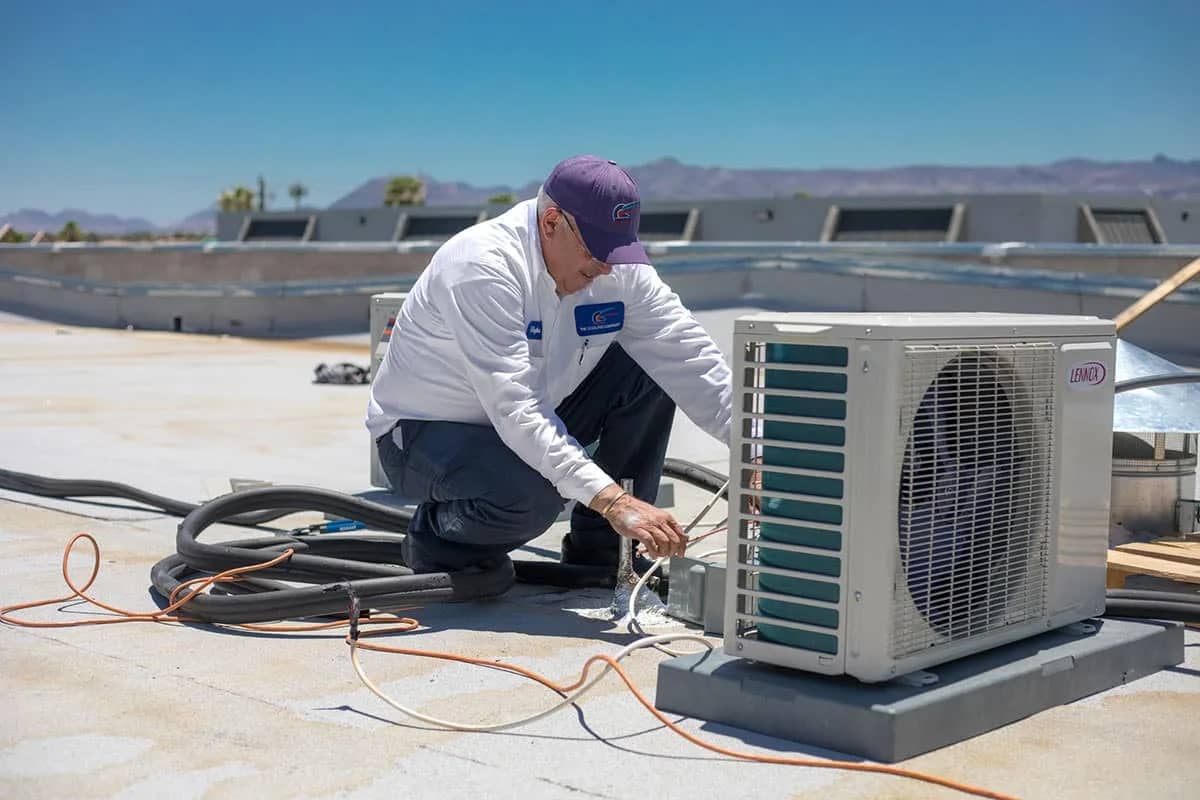
Short answer: Las Vegas commercial HVAC systems require a structured maintenance program with monthly filter inspections (every 30 days from April through October), quarterly professional service visits, and two full-system seasonal tune-ups — one in April before peak cooling and one in October before heating season. A consistent maintenance program reduces emergency repair calls by 40-60%, extends equipment life by 3-5 years beyond the Las Vegas average of 12-15 years, and keeps energy costs 15-25% lower than neglected systems. Property managers overseeing rooftop units, packaged systems, and split systems across multiple tenant spaces need a documented schedule, a reliable contractor, and a clear understanding of what each visit should include.
See our commercial HVAC maintenance services for details on what we inspect.
Check our HVAC pricing guide for current cost estimates.
Why Commercial HVAC Maintenance in Las Vegas Is Not Optional
Managing commercial properties in Las Vegas means managing heat. From June through September, outdoor temperatures routinely exceed 110 degrees F, and rooftop equipment — where the vast majority of commercial HVAC systems sit — operates in surface temperatures that can exceed 150 degrees F on the roof deck. That kind of thermal stress accelerates every failure mode: capacitors degrade faster, contactors pit and weld, compressor oil breaks down sooner, and condenser coils foul with desert dust at twice the rate of systems in moderate climates.
The math is straightforward. A 10-ton packaged rooftop unit running 14-16 hours per day during peak summer accumulates more runtime in four months than most units in the Midwest see in an entire year. That compressed wear cycle means the difference between a maintained and an unmaintained system is not academic — it is the difference between a unit lasting 15 years and one failing at 9.
For property managers, the consequences of deferred maintenance are not just mechanical. Tenant comfort complaints escalate into lease disputes. Emergency repair calls at 2:00 AM during a July heat wave cost three to five times what a scheduled service visit costs. And a failed system in a restaurant, medical office, or retail space does not just create discomfort — it shuts down the tenant's business.
This checklist is built for Las Vegas conditions. It accounts for our extreme heat, monsoon dust events, hard water scale, UV degradation, and the specific maintenance demands of commercial rooftop equipment.
Month-by-Month Maintenance Schedule
The following schedule assumes standard commercial occupancy (office, retail, restaurant, or light industrial). Adjust frequency upward for 24-hour operations, facilities with heavy cooking exhaust, or buildings near active construction sites.
January and February: Off-Season System Assessment
These are your lowest-demand months. Use them to plan and budget.
- Review the prior year's service history. Pull every work order, emergency call, and parts replacement from the previous 12 months. Identify units with repeat issues — a unit that needed two capacitor replacements and a contactor in the same year is signaling compressor stress.
- Inspect heating systems. Las Vegas winters are mild, but commercial spaces still need functional heating. Check gas furnace ignitors, flame sensors, and heat exchangers for cracks. On heat pump systems, verify defrost cycles operate correctly.
- Check thermostat and control calibration. Walk each zone with a calibrated thermometer. If the thermostat reads 72 but the space measures 68 or 76, the sensor needs recalibration or replacement.
- Inspect roof penetrations and curb seals. Winter rains — though infrequent — expose failed curb seals around rooftop units. Water intrusion around RTU curbs causes structural damage and mold issues in the ceiling below.
- Budget for spring and summer. Get quotes for any units flagged during the prior year. Schedule replacements for March or April — before installation crews are booked solid.
March: Pre-Season Preparation
March is your transition month. Cooling demand starts building, and this is your last window for non-urgent work.
- Replace all air filters system-wide. Start the cooling season with fresh filters across every unit. Use MERV 8-11 for standard commercial applications; MERV 13 for medical or sensitive-occupancy spaces.
- Clean condenser coils. Desert dust accumulates all winter. A coil that looks clean from the ground may have a thick layer of fine particulate that is invisible until you are on the roof. Chemical cleaning with coil cleaner and a low-pressure rinse is required — never use a pressure washer on condenser fins.
- Test capacitors and contactors. Measure capacitor microfarad values against the rated spec. Replace any capacitor that has drifted more than 5% from its rated value. Inspect contactor faces for pitting.
- Verify refrigerant charge. Measure subcooling and superheat at design conditions. Do not simply check pressures — pressure-only readings miss charge issues that subcooling and superheat measurements catch.
- Clear condensate drain lines. Flush with a vinegar or bleach solution. Las Vegas hard water creates mineral deposits that clog drain lines by mid-summer if they are not cleared in spring.
April: Full Spring Tune-Up
This is your most important service visit of the year. Every rooftop unit, split system, and packaged unit should receive a comprehensive tune-up.
What the spring tune-up must include:
- Complete electrical inspection: amp draw on compressors and fan motors, contactor condition, wiring for heat damage or UV degradation
- Refrigerant charge verification with subcooling and superheat measurements
- Condenser and evaporator coil cleaning
- Blower wheel inspection and cleaning
- Belt inspection and tension adjustment (on belt-drive units)
- Thermostat and controls verification across all zones
- Economizer testing — verify dampers open and close correctly, sensors read accurately, and the changeover setpoint is calibrated for Las Vegas conditions (typically 65-70 degrees F outdoor air)
- Safety controls: high-pressure cutout, low-pressure cutout, and freeze protection
- Document everything: system pressures, amp draws, temperatures, and any deficiencies found
Common items property managers miss during spring tune-ups:
- Economizer dampers stuck open or closed — an economizer stuck in the open position during July forces the compressor to fight 115-degree outdoor air instead of recirculating conditioned air, increasing energy costs 20-30%
- UV-degraded wiring on rooftop units — Las Vegas UV exposure degrades wire insulation within 3-5 years, creating short-circuit risks
- Clogged condensate drain pans — the primary drain may flow, but the secondary pan may have a clogged drain, letting water pool until it overflows into the ceiling
May: Pre-Peak Verification
- Run each unit at full cooling capacity for 30+ minutes. Measure supply and return air temperatures. You should see a 16-22 degree split across the evaporator coil. Less than 14 degrees indicates low airflow, low refrigerant, or a coil issue.
- Check tenant comfort zones. Walk occupied spaces during afternoon hours when heat load is highest. Note any hot spots.
- Verify programmable schedule accuracy. Ensure occupied and unoccupied schedules match current tenant hours. An office suite that closes at 5:00 PM but has HVAC running until 9:00 PM is wasting 4 hours of energy daily.
- Inspect roof deck around units. Look for ponding water, debris accumulation, and anything that could restrict airflow to condenser coils.
June Through September: Peak Season Monthly Visits
During peak cooling season, monthly professional visits are the standard for Las Vegas commercial properties. Each visit should include:
- Filter inspection and replacement. In Las Vegas, commercial filters in standard office environments last 30-45 days during summer. Restaurants and spaces near parking lots or construction may need filter changes every 2-3 weeks.
- Condenser coil inspection. Look for dust buildup, cottonwood debris (June), and monsoon mud (July-September). A dirty condenser coil raises head pressure, increases energy consumption by 10-20%, and accelerates compressor wear.
- Condensate drain verification. Confirm primary and secondary drains are flowing. During monsoon season (July-September), humidity spikes produce significantly more condensate than dry months.
- Compressor amp draw check. Compare to nameplate rating. Amp draw trending upward over consecutive visits indicates developing mechanical issues.
- Tenant temperature complaints log review. Track complaints by zone and time of day. Patterns reveal system issues before they become failures.
Post-monsoon storm protocol (July-September):
After any significant dust storm or monsoon event, schedule an additional service visit within 48 hours. These storms deposit massive amounts of fine particulate on condenser coils and can flood condensate pans with debris-laden water. The cost of one reactive cleaning visit ($200-400) is negligible compared to the compressor damage caused by operating with fouled coils in 115-degree heat.
October: Fall Transition and Heating Prep
- Full system cleaning. The cooling season has deposited four months of dust, debris, and scale on every component. Clean condenser coils, evaporator coils, blower wheels, and drain pans.
- Heating system activation. Test furnace ignition, flame sensor response, heat exchanger integrity, and gas pressure. On heat pump systems, verify reversing valve operation and defrost controls.
- Economizer recalibration. Reset economizer changeover to take advantage of mild fall temperatures. Properly functioning economizers can provide free cooling from October through April in Las Vegas, significantly reducing compressor runtime.
- Belt replacement on belt-drive units. Replace belts annually regardless of visible wear. A belt that snaps in January means a no-heat call.
- Annual refrigerant leak check. If any unit required refrigerant additions during summer, perform a thorough leak search with electronic detection.
November and December: Minimal Demand Period
- Filter replacement. Change all filters to start the winter season clean.
- Verify heating operation during first cold snap. Las Vegas typically sees first overnight lows below 40 degrees in late November or December. Confirm all heating systems activate correctly.
- Update maintenance records and budget forecasts. Document all work performed during the year. Identify units approaching end-of-life and begin planning replacements for spring.
What to Inspect vs. When to Call a Professional
Property managers and building engineers can handle some tasks in-house. Others require a licensed HVAC technician.
In-house tasks (maintenance staff or building engineer):
- Visual filter inspection and replacement
- Thermostat schedule programming
- Clearing visible debris from around condenser units
- Monitoring tenant comfort complaints and documenting patterns
- Checking for unusual noises, odors, or visible refrigerant oil stains
- Verifying condensate drains are flowing (visual check only)
- Resetting tripped breakers (one reset only — if it trips again, call a pro)
Licensed technician required:
- Refrigerant charge measurement and adjustment (EPA 608 certification required)
- Electrical testing (amp draw, capacitor values, voltage measurements)
- Compressor and motor diagnostics
- Economizer calibration and repair
- Gas furnace heat exchanger inspection
- Any work involving opening refrigerant circuits
- Controls programming beyond basic scheduling
- Warranty-covered repairs (must be performed by a licensed contractor to maintain warranty)
The critical rule: If your maintenance staff resets a breaker and it trips again, if a unit is making a noise it did not make last month, or if a compressor is cycling on and off rapidly (short cycling), stop the unit and call a licensed technician. Running a malfunctioning compressor can turn a $400 repair into a $4,000 replacement.
Cost-Saving Strategies for Multi-Property Managers
Negotiate Preventive Maintenance Agreements
A commercial maintenance agreement with a single contractor across your portfolio provides leverage. Typical agreement benefits include:
- Priority scheduling during peak season (same-day or next-day vs. 3-5 day wait for non-contract customers)
- 10-15% discount on parts and labor for repairs outside the agreement scope
- Consistent documentation and reporting across all properties
- Fixed quarterly costs for budgeting predictability
For Las Vegas commercial properties, expect to pay $300-600 per unit per year for a comprehensive maintenance agreement covering quarterly visits and emergency priority. That investment typically pays for itself by preventing one emergency call per unit per year.
Track Energy Consumption by Unit
Modern building automation systems and smart thermostats can track energy consumption at the unit level. If a 10-ton rooftop unit that typically draws 11 kW starts drawing 13 kW for the same cooling output, the 18% increase signals a problem — dirty coils, low refrigerant, or a failing compressor. Catching that drift early prevents both the energy waste and the eventual breakdown.
NV Energy commercial accounts can access interval data showing 15-minute demand readings. Review this data monthly during summer to identify units that are consuming disproportionate energy.
Time Replacements Strategically
Equipment replacement in Las Vegas follows a predictable pricing cycle:
- Lowest cost: January through March — contractors have open schedules, manufacturers offer early-season pricing, and NV Energy rebate funds are fully available
- Moderate cost: April through May — schedules are filling but still manageable
- Highest cost: June through September — emergency replacements command premium pricing, equipment availability is limited, and installation crews are working overtime
Planning replacements during the winter window can save 15-25% compared to emergency summer replacements.
Invest in Economizer Maintenance
Economizers are the most neglected and most valuable component on commercial rooftop units in Las Vegas. A properly functioning economizer provides free cooling whenever outdoor temperatures are below the changeover setpoint — roughly October through April in Las Vegas. That is six months of reduced compressor runtime.
A stuck or miscalibrated economizer costs nothing in obvious ways — the system still cools. But it costs 20-30% more in energy by running the compressor during months when outdoor air alone could handle the cooling load. Annual economizer calibration ($150-250 per unit) typically pays for itself within one billing cycle.
Building a Maintenance Documentation System
Effective commercial HVAC maintenance requires documentation that survives staff turnover, contractor changes, and multi-year budget cycles.
For each unit, maintain:
- Equipment make, model, serial number, installation date, and warranty expiration
- Refrigerant type and factory charge weight
- Service history with dates, findings, and parts replaced
- Annual energy consumption trends
- Tenant comfort complaints correlated to the unit
- Remaining useful life estimate, updated annually
For each property, maintain:
- Complete equipment inventory with roof location map
- Contractor contact information and agreement terms
- Emergency protocol: who to call, in what order, with what authorization limits
- Annual maintenance budget vs. actual spending
- Capital replacement forecast (5-year rolling)
This documentation is not administrative overhead. It is the difference between a property manager who reacts to breakdowns and one who prevents them. When a new contractor takes over a property, complete records cut diagnostic time in half.
Emergency Protocol for Las Vegas Heat Waves
When the National Weather Service issues an Excessive Heat Warning — which happens 15-25 days per year in Las Vegas — commercial HVAC systems face their highest stress loads. Property managers should implement a heat wave protocol:
- Pre-heat wave (48 hours before): Verify all units are operational. Replace any questionable filters. Confirm condensate drains are clear.
- During the event: Monitor tenant temperatures twice daily. Check rooftop units for tripped breakers or locked-out compressors each morning.
- Post-heat wave: Schedule a walkthrough of all rooftop equipment within 48 hours. Heat waves reveal weak components — a capacitor that survived the event may be thermally damaged and fail within days.
- Emergency contractor access: Ensure your maintenance contractor has roof access codes, equipment locations, and authorization to make repairs up to a pre-approved dollar amount without waiting for management approval. During a 118-degree day, a 4-hour delay waiting for authorization can create a habitability issue.
Why The Cooling Company Works with Las Vegas Property Managers
The Cooling Company maintains commercial HVAC systems across office buildings, retail centers, restaurants, and multi-tenant properties throughout the Las Vegas Valley. We understand the specific demands property managers face: multiple units, multiple tenants, and zero tolerance for downtime during peak season.
Our commercial maintenance agreements include quarterly service visits, priority emergency response, detailed documentation for each unit, and direct communication with property managers — not a call center. Call (702) 567-0707 to discuss a maintenance program for your portfolio.
Frequently Asked Questions
How often should commercial HVAC filters be changed in Las Vegas?
Every 30 days from April through October during the cooling season. Standard office environments may stretch to 45 days, but restaurants, spaces near parking lots, and buildings adjacent to construction should change filters every 2-3 weeks during summer. From November through March, every 60-90 days is typically sufficient. Las Vegas desert dust, construction particulates, and high system runtime during summer clog commercial filters significantly faster than in moderate climates.
What does a commercial HVAC maintenance agreement cost in Las Vegas?
Commercial HVAC maintenance agreements in Las Vegas typically cost $300-600 per unit per year for quarterly service visits, priority scheduling, and repair discounts. Multi-unit properties can often negotiate volume pricing. The agreement typically pays for itself by preventing one emergency call per unit per year — a single after-hours emergency visit during peak summer can cost $500-1,200, while a quarterly preventive visit costs $150-300.
What is the most commonly missed item in commercial HVAC maintenance?
Economizer calibration. Economizers on rooftop units provide free cooling whenever outdoor temperatures are below the changeover setpoint — roughly October through April in Las Vegas. A stuck or miscalibrated economizer forces the compressor to run during months when outdoor air alone could cool the space, wasting 20-30% in energy costs. Most maintenance programs check refrigerant and filters but skip economizer testing, leaving thousands of dollars in annual savings on the table.
Should I shut down HVAC units in vacant tenant spaces?
Not completely. Vacant spaces should maintain a cooling setpoint of 85 degrees F during summer to prevent heat-related damage to finishes, prevent mold growth from condensation when occupants in adjacent spaces create temperature differentials, and keep the HVAC system exercised. Completely shutting down a system for months can lead to seized compressors, stuck valves, and rodent nesting in ductwork. Run the system in a reduced-capacity mode and continue monthly filter checks.
How long do commercial HVAC units last in Las Vegas?
Well-maintained commercial rooftop units and packaged systems in Las Vegas typically last 15-20 years. Neglected systems often fail at 10-12 years. The national average is 15-25 years, but Las Vegas systems face accelerated wear from extreme heat exposure, desert dust fouling, UV degradation of exposed components, and extended runtime hours — commercial systems here accumulate 2,500-4,000 runtime hours per year during cooling season alone. A structured preventive maintenance program is the single biggest factor in pushing equipment toward the upper end of its lifespan.
Neighborhoods We Serve for Commercial HVAC Maintenance
We maintain commercial HVAC systems across Downtown Las Vegas, Summerlin, Spring Valley, Enterprise, Paradise, Henderson, North Las Vegas, Centennial Hills, Silverado Ranch, Green Valley, and the Las Vegas Strip corridor.
Why Property Managers Trust The Cooling Company
- Serving Las Vegas since 2011
- 55+ years combined experience
- Licensed, EPA-certified technicians
- 100% satisfaction guarantee
- BBB A+ rated
- Lennox Premier Dealer
Service Area Map
Share This Page
Related reading: See our complete commercial HVAC guide for system types, costs, and optimization strategies. For rooftop unit pricing, read our RTU cost breakdown.
Need Commercial HVAC Maintenance in Las Vegas?
The Cooling Company provides expert commercial HVAC maintenance throughout Las Vegas, Henderson, and North Las Vegas. Our licensed technicians deliver honest assessments, upfront pricing, and reliable results for property managers across the valley.
Call (702) 567-0707 or visit commercial HVAC services, maintenance, or commercial repair for details.