

Las Vegas Garage Cooling: How to Beat 150 Degrees F Garage Temperatures
Short answer: An uninsulated Las Vegas garage reaches 130-150 degrees F in summer, making it unusable and dangerous for stored items, vehicles, and anyone trying to work out or complete projects. The most effective solution is a ductless mini-split system ($3,000-5,500 installed) combined with garage door insulation ($200-600). For budget-conscious homeowners, insulation plus a high-CFM exhaust fan ($300-800) drops temperatures by 20-30 degrees F, making the space tolerable but not comfortable. Evaporative coolers work well in Las Vegas's dry heat but struggle during monsoon season humidity.
Ready for a cool garage? Book a consultation or call (702) 567-0707.

Why Las Vegas Garages Get So Hot
Understanding what makes your garage a furnace explains why some solutions work and others fail:
The Garage Door
A standard single-layer steel garage door has an R-value of approximately R-0 to R-2. It absorbs solar radiation all day, heats to surface temperatures of 140-160 degrees F, and radiates that heat directly into the garage interior. West-facing and south-facing garages are the worst offenders because they receive the most intense afternoon sun during the hottest hours.
The garage door also has gaps around its perimeter, along the bottom seal, and between panels. These gaps allow hot outside air to infiltrate freely. On windy days, which are common in the Las Vegas valley, this infiltration accelerates heat gain.
No Insulation
Most Las Vegas garages are built with bare stud walls, exposed ceiling joists, and no insulation. The roof directly above the garage, often with dark shingles, reaches 150-170 degrees F on the surface. Without insulation between the roof and the garage ceiling, that heat transfers directly into the space through radiation and convection.
Even garages with insulated walls still suffer if the ceiling is uninsulated, because heat enters primarily from above. The roof is the largest heat source, not the walls.
Concrete Thermal Mass
The concrete garage floor acts as a thermal battery. It absorbs heat throughout the day and releases it slowly, keeping the garage warm well into the evening hours. A garage that reaches 145 degrees F at 4 PM may still be 100+ degrees F at 10 PM because the concrete is slowly releasing stored heat.
No Ventilation
A sealed garage with no air exchange traps hot air with nowhere to go. Without ventilation, heat builds throughout the day with no relief. Opening the garage door helps briefly but introduces more hot air from outside once the interior temperature drops below the outdoor temperature.
Solution 1: Insulation First (The Foundation)
No cooling system works efficiently in an uninsulated garage. Before investing in any cooling equipment, insulating the garage is the essential first step. Insulation alone can reduce peak garage temperatures by 10-20 degrees F and makes every subsequent cooling solution work dramatically better.
Garage Door Insulation
- DIY insulation kits ($100-200): Reflective foam board panels that cut to fit between door panels. Easy to install in 2-3 hours. Adds R-4 to R-8 to the door. Reduces door surface temperature by 20-30 degrees F.
- Pre-insulated replacement door ($800-2,500 installed): Polyurethane-filled steel doors with R-12 to R-18 insulation. The most effective option and also improves the door's structural integrity and noise reduction. Worth considering if the door is aging or damaged.
- Reflective garage door covers ($50-150): Temporary or semi-permanent reflective tarps that attach to the interior of the door. Less effective than foam insulation but inexpensive and easy to install.
Ceiling Insulation
- Batt insulation between joists ($1.50-3.00 per square foot): R-19 to R-30 fiberglass batts installed between ceiling joists. Cost for a typical 400-square-foot garage ceiling: $600-1,200. This is the most impactful single improvement because it blocks the primary heat source.
- Radiant barrier stapled to rafters ($0.75-1.50 per square foot): Reflects radiant heat before it reaches the insulation. Adds significant value in Las Vegas where radiant heat from the roof is the dominant heat transfer mechanism.
- Spray foam ($3.00-7.00 per square foot): The best performing option, providing both insulation and air sealing. Cost for a typical garage: $1,200-2,800. Appropriate for garages being converted to dedicated climate-controlled workshops or gyms.
Wall Insulation
If the garage has exposed stud walls, adding R-13 batt insulation ($1.00-2.00 per square foot) and covering with drywall or OSB provides a meaningful improvement. Walls facing west and south benefit the most. For garages attached to the house, insulating the shared wall also prevents garage heat from migrating into the living space and increasing your home cooling costs.
Solution 2: Ventilation (Budget-Friendly Cooling)
Ventilation does not cool the garage below the outdoor temperature, but it prevents the greenhouse effect that pushes garage temperatures 15-30 degrees above outdoor temperatures. In a 115-degree Las Vegas day, bringing the garage down from 145 degrees F to 115-120 degrees F makes a meaningful difference.
Exhaust Fans
- Wall-mounted exhaust fan ($150-400 installed): A 1,000-2,000 CFM exhaust fan mounted high on the garage wall pulls hot air out. Best when paired with a passive inlet vent low on the opposite wall to create cross-ventilation. This setup creates constant air movement that prevents heat buildup.
- Gable-mount attic-style fan ($200-500 installed): For garages with attic space above, a powered gable fan exhausts superheated air from the garage attic area.
Ceiling Fans
A 52-60-inch industrial ceiling fan ($100-300 installed) does not lower the temperature but creates a wind chill effect of 4-8 degrees F on exposed skin. For a workshop where you are moving around, a ceiling fan combined with ventilation can make a 120-degree garage feel closer to 110 degrees F. Not comfortable, but survivable for short work sessions.
Cost and Effectiveness
A complete ventilation setup with exhaust fan, inlet vent, and ceiling fan costs $300-800 installed. Operating costs are minimal, typically $5-15 per month. This is the most cost-effective first step for homeowners on a tight budget, but it does not create a truly comfortable space in peak summer heat.
Solution 3: Evaporative Coolers (The Desert Advantage)
Las Vegas's extremely low humidity, typically 5-15% on summer afternoons, makes evaporative (swamp) coolers surprisingly effective for garage cooling. These units work by pulling hot, dry air through water-saturated pads, dropping the temperature by 15-25 degrees F through evaporation.
Portable Evaporative Coolers
- Cost: $200-600 for units rated at 1,000-3,000 CFM
- Performance: Can drop garage temperatures by 15-25 degrees F when humidity is below 20%. On a 115-degree day at 10% humidity, expect output air around 80-90 degrees F.
- Pros: Low purchase cost, low operating cost ($10-25/month), no installation required, provides fresh air
- Cons: Requires a water supply connection or frequent tank refills, adds humidity to the space, effectiveness drops dramatically during monsoon season (July-September) when humidity can spike to 40-60%
Permanently Mounted Evaporative Coolers
- Cost: $800-2,000 installed with dedicated water line
- Performance: Higher-capacity units (3,000-5,000 CFM) provide more consistent cooling for larger garages
- Best for: Homeowners who want reliable cooling 9-10 months of the year and can tolerate reduced performance during monsoon season
The Monsoon Problem
Las Vegas monsoon season runs from roughly mid-June through September, with the worst humidity in July and August. During monsoon events, outdoor humidity can reach 40-60%, which cuts evaporative cooler performance roughly in half. A cooler that drops temperatures 25 degrees F in dry conditions may only manage 10-12 degrees F during monsoon humidity. If you need reliable cooling during monsoon months, a refrigerated system (mini-split or portable AC) is the better choice.
Solution 4: Mini-Split Systems (The Complete Solution)
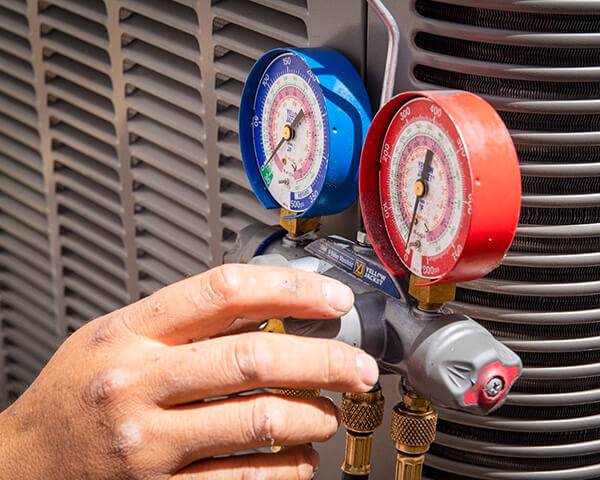
A ductless mini-split system is the most effective way to create a genuinely comfortable garage in Las Vegas, regardless of outdoor temperature or humidity. Mini-splits provide refrigerated cooling that maintains a precise setpoint, just like the AC in your house.
Why Mini-Splits Are Ideal for Garages
- No ductwork required: A small refrigerant line connects the outdoor unit to the indoor head through a 3-inch hole in the wall. No attic ducts to lose cooling through.
- Independent operation: The garage system runs independently of your home HVAC, so cooling the garage does not affect your home's comfort or energy bills.
- Precise temperature control: Set any temperature from 60-86 degrees F and the system maintains it automatically.
- Heating included: Mini-splits are heat pumps, providing heating during Las Vegas's cold winter mornings when the garage drops to 40-50 degrees F.
- Quiet operation: Indoor sound levels of 25-40 dB, quieter than a conversation. Important for workshops and home gyms where you spend extended time.
- Energy efficient: Modern mini-splits rated at 20-25 SEER2 use significantly less electricity than portable AC units or window units.
Sizing for Las Vegas Garages
- Single-car garage (200-250 sq ft): 12,000 BTU (1-ton) mini-split. Cost: $3,000-4,000 installed.
- Two-car garage (400-500 sq ft): 18,000-24,000 BTU (1.5-2 ton) mini-split. Cost: $3,500-5,500 installed.
- Three-car garage (600-750 sq ft): 24,000-36,000 BTU (2-3 ton) or multi-head system. Cost: $5,000-8,000 installed.
These sizes assume the garage is insulated. An uninsulated garage needs 30-50% more capacity, which increases cost and energy consumption. Always insulate before installing a mini-split for the best return on investment.
Operating Costs
A 24,000 BTU mini-split cooling an insulated two-car garage to 78 degrees F during Las Vegas summer costs approximately $40-80 per month in electricity, depending on how many hours per day the space is used. A well-insulated garage with a high-efficiency mini-split costs roughly the same to cool per square foot as the rest of your home.
Solution 5: Portable AC Units (The Quick Fix)
Portable air conditioners offer immediate relief without installation, but they come with significant limitations in Las Vegas heat:
- Cost: $300-700 for 10,000-14,000 BTU units
- Performance: Marginally effective in enclosed garages. Most portable ACs cannot overcome the heat load of an uninsulated Las Vegas garage. They work better in insulated garages or for spot cooling a small work area.
- Exhaust hose problem: Portable ACs exhaust hot air through a hose that must vent outside, typically through a window or wall opening. In a garage, this means cracking the garage door, which allows hot air back in, or cutting a hole in the wall.
- Efficiency: Portable ACs are the least efficient cooling option, using 30-50% more electricity than a mini-split for the same cooling output.
- Best for: Temporary cooling needs, renters who cannot install permanent equipment, or garages used only occasionally.
What About Extending Your Home AC to the Garage?
Homeowners frequently ask whether they can simply run a duct from their existing home AC system into the garage. This is almost always a bad idea for several reasons:
- Building code issues: Most building codes require a fire separation between the garage and living space. Running ductwork through this barrier can violate code and create a fire and carbon monoxide hazard.
- System overload: Your home AC is sized for the living space, not the living space plus an uninsulated garage. Adding the garage load can overwhelm the system, resulting in inadequate cooling throughout the entire house.
- Contamination risk: Garage air contains vehicle exhaust, chemical fumes, and other contaminants. Connecting garage air to your home duct system introduces these pollutants into your living space.
- Energy waste: Cooling an uninsulated garage through ductwork running through a hot attic compounds every inefficiency. The energy loss would be enormous.
A separate, dedicated system such as a mini-split is the correct approach. It maintains the fire separation, does not affect your home's comfort, and avoids contamination issues.
Recommended Approach by Use Case
Occasional Workshop Use (Budget: $300-1,000)
- Insulate the garage door ($100-200 DIY)
- Install a wall-mounted exhaust fan ($150-400)
- Add a portable evaporative cooler ($200-400)
- Expected result: 95-105 degrees F during peak summer, comfortable for 1-2 hour work sessions with breaks
Regular Workshop or Hobby Space (Budget: $1,500-3,500)
- Insulate garage door, ceiling, and exposed walls ($600-1,500)
- Install a permanently mounted evaporative cooler or large portable unit ($400-1,000)
- Add a ceiling fan for air circulation ($100-300)
- Expected result: 85-95 degrees F during peak summer, usable for extended sessions
Home Gym, Studio, or Daily-Use Space (Budget: $4,000-7,000)
- Full insulation package including garage door, ceiling with radiant barrier, and walls ($1,000-2,500)
- Install a properly sized ductless mini-split system ($3,000-5,500)
- Expected result: Any temperature you want, year-round. The garage becomes a fully climate-controlled extension of your home.
Protecting What is Stored in Your Garage
Even if you do not use your garage as a workspace, extreme heat damages items stored there. Temperatures above 120 degrees F can cause:
- Paint, adhesives, and solvents: Can degrade, separate, or become hazardous
- Electronics and batteries: Heat accelerates battery degradation and can damage circuit boards
- Wine and beverages: Ruined at sustained temperatures above 80 degrees F
- Musical instruments: Wood warping, glue failure, and finish damage
- Photographs and documents: Accelerated deterioration and yellowing
- Tires and rubber products: Accelerated dry rot and cracking
For storage protection alone, insulating the garage and adding basic ventilation is a worthwhile investment that extends the life of everything stored inside.
Need Garage Cooling in Las Vegas?
The Cooling Company installs ductless mini-split systems, exhaust ventilation, and complete garage climate control solutions throughout the Las Vegas valley. Our NATE-certified technicians evaluate your garage's insulation, size, orientation, and intended use to recommend the most cost-effective cooling approach.
As a Lennox Premier Dealer and BBB A+ rated company with a 100% satisfaction guarantee, we provide honest assessments and transparent pricing. We serve Summerlin, Henderson, North Las Vegas, Green Valley, Centennial Hills, Mountains Edge, Aliante, Anthem, Southern Highlands, and all surrounding communities.
Call (702) 567-0707 for a free garage cooling consultation, or visit AC installation for whole-home systems and AC repair for same-day service on your existing equipment.