

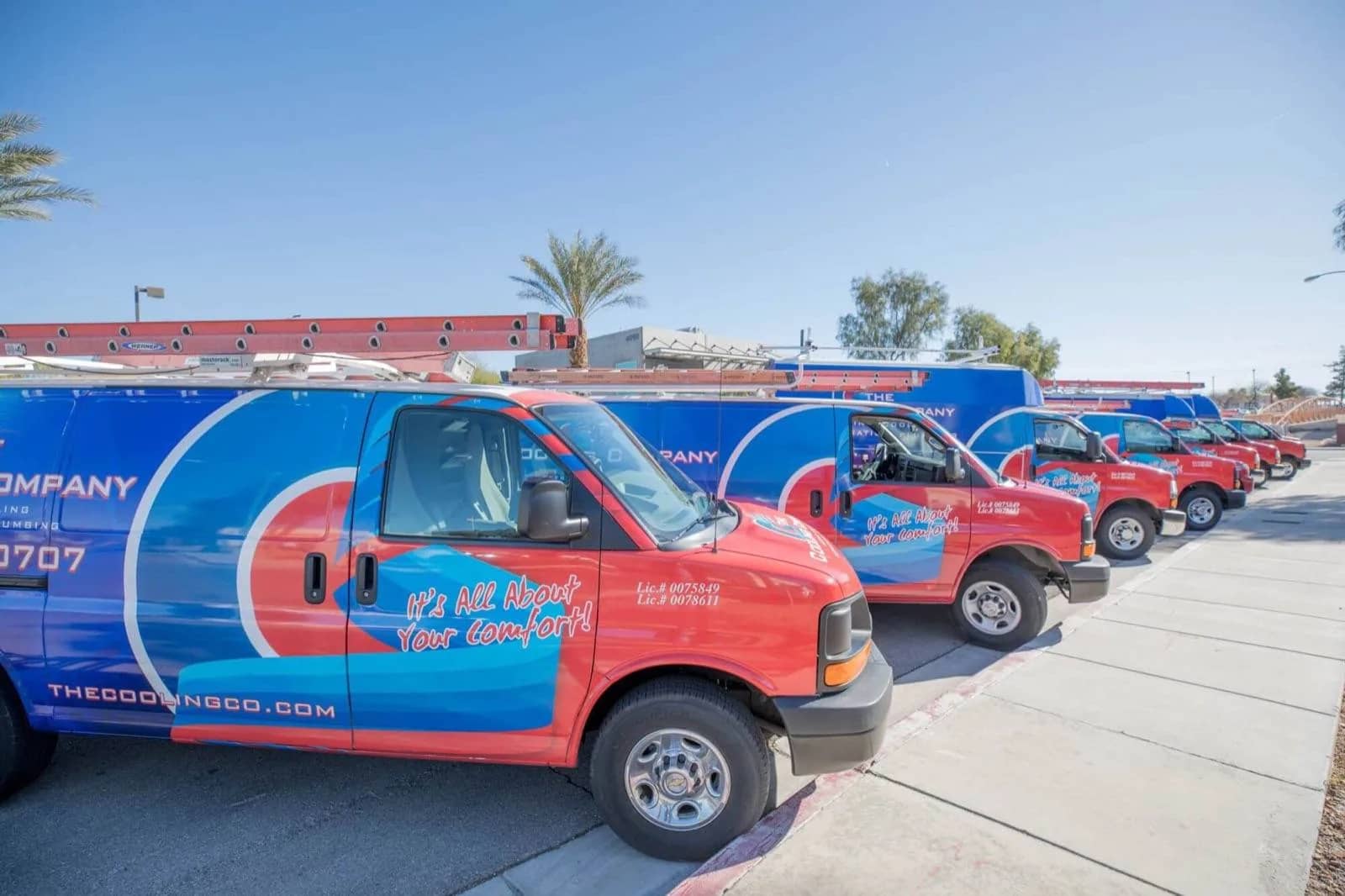
Short answer: A peak-season install day at The Cooling Company starts early to get the heavy outdoor and attic work done before the worst of the heat. A 2 to 3 person crew loads out against the work order, demos the existing equipment, sets the new system, runs the line set and electrical, commissions against a checklist, documents with photos, and walks the customer through what changed before leaving. Most residential changeouts are one day. Package units, duct replacements, and light commercial can run longer.
Want this to be your day? Apply here.
Job descriptions are abstractions. "Install complete HVAC systems in residential and light commercial settings" is accurate and tells you nothing about what the day feels like. So here is a concrete one: a residential split system changeout in Las Vegas in July, start to finish, as it actually runs.
Key Takeaways
- Peak season days start early so the attic and rooftop work happens before the afternoon heat, not during it.
- Load-out is against the work order, not against memory. Our warehouse stages parts and equipment ahead of the job.
- The first 30 minutes on site are protection and prep, not demo. Floors covered, path planned, power confirmed off.
- Commissioning is a checklist, and the job is not finished until it is complete and photographed.
- Scope surprises get a phone call, not a shrug. Dispatch and leadership are reachable and expected to make decisions.
- The customer walkthrough is part of the job. You explain what you did and what changed.
Early Morning: Load-Out
Peak season starts early. The reason is simple physics: attic temperatures in a Las Vegas July climb through the morning and become genuinely hazardous by afternoon. Getting the demo and the attic portion of the work done in the cooler hours is a safety decision before it is a productivity one.
Load-out is against the work order. The equipment, the line set, the pad, the disconnect, the whip, the drain assembly, the fittings, the filter, and whatever accessories the job calls for. Our warehouse team stages this ahead of time, which is one of the underrated advantages of working here. An install crew that has to hunt for parts at 6 AM has already lost an hour of the coolest part of the day.
If something is missing or wrong, you find out in the yard rather than in the customer's driveway. That is the entire point of a staged load-out.
On Site: Protection and Prep
The first thing that happens at a customer's house is not demo. It is protection: floor coverings on the path from the door to the equipment, the work area cleared, and the route for hauling equipment in and out planned. Then power confirmed off at the disconnect and the panel, refrigerant recovered per EPA requirements, and a quick verification that the existing conditions match what the work order describes.
That verification step matters. Las Vegas housing stock includes a lot of homes built in the 1970s and 1980s where the previous work was, generously, improvised. Undersized returns. Disconnects in places code no longer permits. Duct transitions that were never sealed. You want to find those in the first 20 minutes, not at 2 PM.
Mid-Morning: Demo and Set
Recovery, disconnect, and removal of the old equipment. Then the new set: pad or curb prepared and level, air handler or furnace positioned and secured, condenser set with proper clearances for service access and airflow.
This is where a 2 to 3 person crew earns its structure. Equipment gets moved with help. Nobody is trying to walk a condenser through a side gate alone or lift an air handler into an attic solo. We staff crews at 2 to 3 people because that is what the work requires, not as a nice-to-have when we happen to have the bodies.
Midday: Line Set, Electrical, and Condensate
Line set brazed with nitrogen flowing, evacuated to spec, and pressure tested. Electrical connections made and torqued. Condensate routed correctly with a proper trap and secondary protection where required, which in this valley is a detail that separates installs that hold up from installs that produce a ceiling stain in two years.
Then the charge, verified against actual conditions rather than assumed from a chart. In a market where the outdoor temperature is 112 degrees, the difference between a charge that was verified and a charge that was guessed at shows up immediately in performance and eventually in a compressor failure.
When the Job Is Not What the Scope Said
It happens on a meaningful share of changeouts. The plenum is the wrong size for the new equipment. The existing duct is disconnected in a place nobody could see. The electrical service will not support what was sold.
Here, the answer is a phone call. Dispatch and leadership are reachable during the workday, and the expectation is that a decision gets made: additional scope authorized and priced for the customer, a return trip scheduled, or a different approach agreed on. What does not happen is a crew being told to absorb it and finish anyway.
We are a family-owned company with fewer than 50 people. There is no layer of management between the field and the person who can say yes.
Afternoon: Commissioning
The system starts up, and then the real work of the last hour begins. Commissioning against our checklist:
- Refrigerant charge verified against actual measured conditions
- Static pressure measured
- Airflow confirmed
- Temperature split checked
- Electrical connections verified
- Condensate flow and safety switch tested
- Thermostat configured and cycle tested
- The whole thing documented with photos
If you have worked at a shop where commissioning meant "it blows cold, we are done," this is the biggest adjustment. It adds time to the day. It also means the system you installed performs the way the manufacturer says it will, the customer is not calling in August, and your name is on work you can defend.
Close-Out: Cleanup and Walkthrough
Site cleaned, old equipment loaded for disposal, floor coverings removed, and a walkthrough with the customer. You show them the new equipment, explain the thermostat, point out the filter and how often it needs changing in a valley this dusty, and answer their questions.
Some installers dislike this part. Most get to like it, because it is the one moment in the day when someone says thank you for work you did well. It is also the difference between a job and a trade you are respected in.
Then close out the work order, return the vehicle, and go home. Vehicle and fuel card are provided, so your personal truck stayed in your own driveway all day.
What the Day Is Not
- It is not a sales day. Install technicians install. Nobody is scoring you on what you upsold from inside an attic.
- It is not solo. Crews are 2 to 3 people.
- It is not the same job every day. Split systems, package units, mini-splits, duct replacements, light commercial. The variety is what keeps installers here.
- It is not easy in July. We are not going to tell you otherwise.
Questions About the Install Day
What time do install crews start in the summer?
Peak season starts early so the attic, rooftop, and demo work happens in the cooler hours. Exact start times shift with the schedule and the job, and your crew lead sets the plan the day before. Winter and shoulder-season starts are later.
How many installs does a crew do in a day?
Most residential split system changeouts are a full day for a crew. Package units, full duct replacements, and light commercial work can run longer than a day. We do not build schedules that require finishing a one-day job in half a day, because that is how installs get rushed and callbacks get created.
How does peak season affect installer pay?
Installers are paid in credit units, a set amount for each item installed, rather than by the clock, so overtime does not apply. June through September is the busiest stretch of the year, which means more work available to complete, and completed work is what raises earnings.
What happens if I damage something on a customer's property?
You report it immediately and we handle it with the customer. Nobody is expected to hide a mistake or pay for an honest accident out of pocket. What we care about is that it is disclosed the same day rather than discovered later by the homeowner.
Do install techs work weekends?
Peak season demand sometimes extends into weekends, and those hours are available for people who want them. It is not the standard schedule year round.
If This Sounds Like Your Kind of Day
Install technicians at The Cooling Company earn $28 to $38 per hour based on experience and certifications, with a company vehicle, fuel card, tools, uniforms, and PPE provided, health insurance for full-time employees, paid time off, and Lennox factory training access.
Start your application, see every open role on our careers page.
Share This Page