

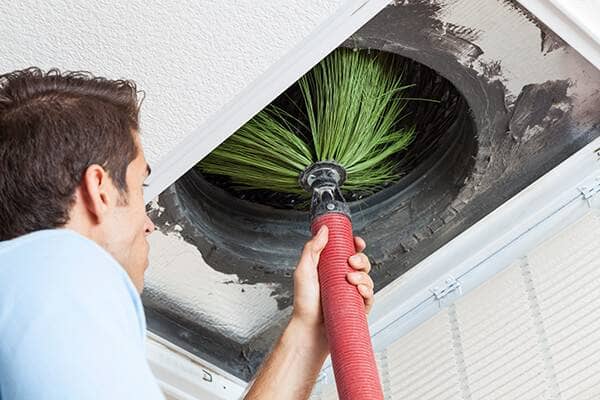
Short answer: Duct cleaning isn't always worth it — the EPA says evidence linking it to better health is limited in typical homes. But Las Vegas is not a typical environment. Desert dust, caliche particulates, relentless construction, zero rainfall, and an AC system running 18+ hours a day create real accumulation in your ducts. For most Las Vegas homeowners who haven't cleaned in 7–10 years, own pets, or have had renovation work done, professional duct cleaning ($300–$700 for a typical home) is genuinely worthwhile. The key word is "professional" — done right, by NADCA-trained technicians with proper negative-pressure equipment. Done by someone who knocked on your door offering $99? That's almost certainly a scam.
Key Takeaways
- The EPA acknowledges duct cleaning hasn't been proven to prevent health problems in most homes — but Las Vegas presents conditions far more extreme than the national average.
- Desert dust, caliche particulates, haboob debris, and construction fallout accumulate in ducts faster here than almost anywhere in the US.
- With your AC running 18+ hours a day, Las Vegas ducts circulate that accumulated debris through your home constantly.
- Duct cleaning IS worth it after renovation, new home purchase, visible mold, pest infestation, or 7–10+ years without cleaning.
- Duct cleaning is NOT worth it if your ducts were recently cleaned and you have no visible issues — especially if someone is pushing a $99 deal.
- Expect to pay $300–$700 for a properly done cleaning in a typical Las Vegas home (1,500–3,000 sq ft). Beware anything significantly cheaper.
- NADCA-certified technicians using negative-pressure equipment are the only ones worth hiring.
What the EPA actually says about duct cleaning
Let's start here, because if you've done any research on duct cleaning, you've probably come across the EPA's position — and it's not what the duct cleaning industry wants you to know.
The EPA states explicitly that duct cleaning has not been shown to prevent health problems and that the evidence for its benefits remains inconclusive. They don't recommend it as a routine measure, and they flag it as a service that's often oversold.
That's a pretty significant thing for an HVAC company to admit, right? We know. But here's the thing: we'd rather give you the full picture than sell you something you don't need. That's how trust actually gets built.
The EPA's caution is well-founded in the context of the average American home — a climate with regular rainfall to settle particulates, moderate AC use, and relatively stable construction activity. In those environments, ductwork doesn't accumulate enough debris to justify routine cleaning every year or two.
But then there's Las Vegas.
Why Las Vegas is genuinely different
Las Vegas is not an average environment. Not even close. The conditions here create a dust and particulate accumulation problem that is categorically different from most of the country — and your ductwork bears the brunt of it.
Desert dust, caliche, and haboobs
The Mojave Desert soil is loaded with caliche — a calcium carbonate-rich, fine-grained material that breaks apart into airborne dust with the slightest wind. This stuff is fine enough to penetrate standard HVAC filters, and it's everywhere. Walk outside after a dry spell and you'll see it coating your car, your patio furniture, every horizontal surface.
When the wind kicks up — and it does, frequently — Clark County air quality monitoring registers significant spikes in particulate matter. Haboobs (dust storms) push walls of this fine desert soil across the valley. A single haboob can deposit more particulates in a day than a humid-climate home accumulates in a year.
That dust gets into your home through gaps around doors, windows, and — critically — through your HVAC system's return air vents. Your AC pulls air in from the house and circulates it through the duct system constantly. Every bit of caliche and desert dust in your indoor air eventually ends up coating the inside of your ductwork.
Constant construction and drywall dust
Las Vegas has been in a near-constant state of construction for decades. New master-planned communities are going up in Summerlin, Henderson, North Las Vegas, and the outlying areas on a rolling basis. Even established neighborhoods see constant renovation — kitchen remodels, bathroom updates, room additions.
Construction dust is particularly problematic for ductwork. Drywall dust (gypsum and silica), concrete dust, and sawdust are coarse enough to settle quickly but fine enough to get airborne with any disturbance. If you've had any work done inside or near your home, that construction debris almost certainly ended up in your duct system — especially if the AC was running during or after the work.
For new construction homes specifically, duct contamination is essentially guaranteed. Contractors run HVAC systems during the build process to control temperature and humidity. By the time you move in, your brand-new ducts may have a significant layer of drywall dust and construction debris inside them. This is one of the clearest cases where professional air duct cleaning service is genuinely warranted.
No rain to clean the air
Las Vegas averages about 4.2 inches of rain per year. Compare that to Houston (49 inches), Atlanta (52 inches), or even Phoenix (8 inches). Rain is nature's air scrubber — it pulls particulates out of the atmosphere and settles them on the ground, dramatically reducing what ends up inside your home.
With essentially no rainfall, the particulates that get stirred up stay airborne. There's no natural cycle to clear the air. The dust that gets inside your house doesn't get washed out — it recirculates through your HVAC system, gradually building up in your ducts, on your coils, and on your blower motor.
Think of your pool filter. If you stopped running it and it rained constantly, the rain would help dilute and flush the debris. But in Las Vegas, the pool analogy breaks down — the particulate load keeps going up, and nothing's flushing it. Your ducts are similar. Without some form of maintenance, they're accumulating in one direction only.
Your AC runs constantly — pushing all that dust through your ducts
In most of the country, homeowners run their AC four to six hours a day during the warm months. Las Vegas isn't like that. From May through September, your system may run 16–20 hours a day. Even in April and October, it's running most of the day.
That means the air in your home — including all the desert dust, pet dander, skin cells, and whatever came in through the door — passes through your ductwork multiple times every hour. The airflow creates turbulence inside the ducts that keeps lighter particles suspended longer, and over years, the accumulation builds up on duct walls, at bends and junctions, inside the plenum, and around registers.
When your system has a higher static pressure due to dirty or restricted ducts, your blower motor works harder, your HVAC efficiency drops, and the buildup can eventually start shedding debris back into your living spaces. High static pressure also accelerates wear on your equipment — something we cover in more detail in our guide on ductwork and HVAC efficiency.
Desert allergens accumulating in your ductwork
The Mojave has its own roster of allergens that aren't common in other parts of the country. Mulberry pollen (the trees were planted everywhere in old Las Vegas neighborhoods), desert ragweed, olive trees, and creosote bushes release pollen that becomes fine enough to infiltrate homes and HVAC systems.
Valley fever (coccidioidomycosis) is another real concern — it's caused by a soil fungus (Coccidioides) that's endemic to the Southwest and goes airborne when the soil is disturbed. While your HVAC filter is your main defense, debris accumulation in ducts can harbor organic material over time.
The combination of biological allergens and mineral particulates is particularly unpleasant for anyone with indoor air quality sensitivities. Families with asthma, severe allergies, or respiratory conditions feel the difference more acutely here than they would in, say, coastal climates where humidity suppresses particulate levels.
When duct cleaning IS worth it in Las Vegas
Given everything above, here are the situations where we'd tell any Las Vegas homeowner — without hesitation — that a professional duct cleaning is a good investment:
After any renovation or remodel
This is the clearest case. Drywall work, flooring removal, ceiling work — all of it sends fine dust directly into your HVAC system. If you've had any significant work done in the past few years without a subsequent duct cleaning, your ducts likely have a notable buildup. Schedule a duct inspection first to confirm, then proceed with cleaning.
Moving into a new (or newly purchased) home
New construction is especially prone to duct contamination from the build process. Resale homes are a crapshoot — you don't know what the previous owners had going on (pets, smokers, renovations). Starting fresh with a duct cleaning when you take possession is a reasonable step, especially if the previous owners can't confirm it was ever done.
Visible mold inside duct surfaces or components
If there's visible mold in your ductwork — or if you're getting a persistent musty smell that intensifies when the AC kicks on — you need professional cleaning and likely sanitizing. Note that mold in ducts often signals a moisture problem that also needs to be addressed at the source. Cleaning treats the symptom; fixing the humidity issue treats the cause. See our indoor air quality hub for more on moisture management.
Evidence of rodents or insects in the duct system
Rodent droppings, nesting material, or insect debris in ducts is a definitive reason to clean. The particulates from rodent droppings are a genuine health concern, and cleaning is non-negotiable in this situation. You'd also want a duct repair to seal the entry points and prevent re-infestation.
Ducts never cleaned in 7–10+ years (Las Vegas-specific threshold)
The general recommendation for most climates is to clean every 5–10 years. For Las Vegas, given everything above, we'd push that toward the shorter end — 5–7 years for homes without other accelerating factors, sooner if you have pets, run the system heavily, or have had construction nearby. If you genuinely don't know the last time your ducts were cleaned (or if it was never), it's overdue.
Severe allergy or asthma in the household
If someone in your home has clinically diagnosed asthma or severe allergies, the dust load in your ducts matters more than it does for a healthy household. Cleaning alone isn't a cure, but reducing the particulate reservoir in your duct system is a logical part of a broader indoor air quality strategy — alongside upgrading your air filter to a higher MERV rating and maintaining regular AC maintenance.
Pets in the home
Pet dander and fur accelerate duct accumulation significantly. Homes with multiple large dogs or cats may need cleaning every 3–5 years rather than 7–10.
When duct cleaning is NOT worth it
To be fair — and honesty is the point here — there are plenty of situations where duct cleaning would be a waste of your money:
- Your ducts were professionally cleaned in the last 3–5 years and conditions haven't changed. Don't let anyone talk you into annual cleanings. That's overselling.
- You're hoping duct cleaning will fix your AC's poor performance. If your system is running poorly, that's likely a refrigerant issue, a dirty coil, failing components, or a duct sealing problem — not dirty ducts. A duct inspection will tell you what's really going on.
- You have no symptoms and no identifiable trigger. If you have good indoor air quality, no renovation history, pets, or health sensitivities, and your ducts were cleaned reasonably recently, you probably don't need it yet.
- You're responding to a door-to-door offer. We'll say more about this below, but the $99 duct cleaning offer that showed up in your mailbox or at your door is almost never what it seems.
One thing worth saying clearly: duct cleaning is not a replacement for regular AC maintenance, quality air filtration, or duct sealing. If your ducts are leaking conditioned air into the attic, cleaning them won't fix that problem. If your air filtration is inadequate, ducts will re-contaminate faster. Duct cleaning is one tool — not the whole toolbox.
Duct cleaning scams: red flags to watch for
The duct cleaning industry has a legitimate fraud problem. The Federal Trade Commission has documented "bait and switch" duct cleaning scams repeatedly, and they're especially prevalent in markets like Las Vegas where homeowners know their ducts get dusty.
Here's how the typical scam works: A company offers duct cleaning for $49–$99 — sometimes through direct mail, door-to-door, or online ads. When the technician arrives, they "discover" mold, debris, or other problems that require additional treatments costing $500–$1,500. The initial cleaning itself is often cursory at best — a portable shop-vac pressed against a few registers, not a real NADCA-standard cleaning.
Red flags to watch for:
- Price under $200 for a whole-home cleaning. A legitimate cleaning of a 2,000 sq ft Las Vegas home with standard ductwork takes 3–5 hours with proper equipment. The labor and equipment costs alone make $99 impossible.
- No mention of negative pressure equipment. Proper duct cleaning uses a large truck-mounted or portable negative-pressure HEPA vacuum to contain debris. If they're not mentioning this, they're not doing it right.
- Pushy upsells for chemical biocides. While sanitizing has its place (post-mold remediation, for instance), reputable companies don't push it on every job. The EPA has specific guidance on this — chemical biocide use in ducts is not recommended as a routine step.
- No NADCA certification. The National Air Duct Cleaners Association (NADCA) sets the industry standard. Ask for NADCA membership and ask if the technician is an Air Systems Cleaning Specialist (ASCS). Legitimate companies can produce this.
- Before/after photos not offered. A reputable company will show you camera footage or photos of your ducts before and after cleaning. If they won't — or can't — that's a problem.
- Pressure to decide on the spot. Any company telling you there's an emergency in your ducts that requires immediate treatment is using high-pressure sales tactics. Real mold or contamination issues are real, but they won't get worse in the 24 hours it takes you to get a second opinion.
What proper duct cleaning actually involves (NADCA standards)
A legitimate duct cleaning following NADCA's ACR standard is a methodical, hours-long process — not a quick vacuum job. Here's what it should look like:
1. Inspection first
A proper cleaning starts with a duct inspection, ideally with a camera. The technician maps your ductwork system, identifies problem areas, and documents baseline conditions. This also catches issues like disconnected ducts, leaks, or signs of pests that cleaning alone won't solve.
2. Negative pressure containment
The technician connects a large truck-mounted or portable HEPA-filtered vacuum to your duct system — typically at the air handler — and creates negative pressure throughout the system. This is critical: it ensures that debris dislodged during cleaning gets pulled toward the vacuum rather than blown into your living space. Without this step, you're just stirring up dust.
3. Mechanical agitation of every duct
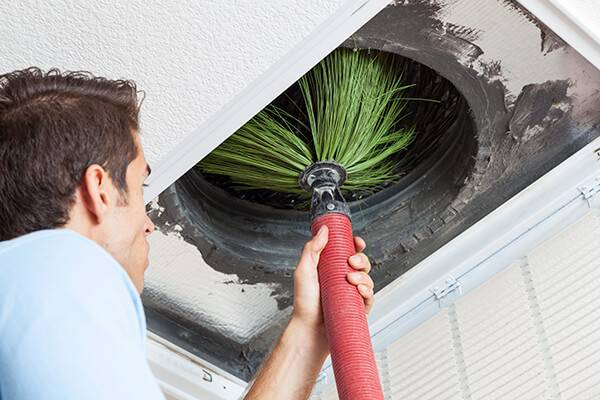
With negative pressure established, technicians use rotating brushes, compressed air whips, and/or pneumatic agitation tools to mechanically break loose the debris coating the duct walls. Each supply and return branch is addressed individually. Supply registers and return grilles are removed, cleaned, and replaced. The plenum and air handler cabinet are cleaned as well.
4. Access points
For larger duct systems, the technician may need to cut small access holes in the ductwork to reach all areas. These are sealed afterward with sheet metal patches and mastic. If a company claims to clean your whole system through register openings alone, they're not being truthful — the physics don't work for a system longer than a few feet from the registers.
5. Sanitizing (when warranted)
After mechanical cleaning, if there's confirmed mold or microbial contamination, an EPA-registered antimicrobial can be applied. This is situational — not a routine step on every cleaning. Per EPA guidance, it should only be used when there's a confirmed contamination problem, not as a preventive measure.
6. Post-cleaning documentation
A reputable company provides before-and-after photos or camera footage, documents what was found, and gives you a written report. This is your proof the work was done properly and a baseline for future reference.
The whole process for a typical Las Vegas home (1,500–3,000 sq ft) takes 3–5 hours. Anyone claiming to do it faster is cutting corners.
What duct cleaning costs in Las Vegas
Pricing for a professional Las Vegas duct cleaning varies based on home size, system complexity, and what's found during the job. Here's what to expect:
| Home Size | Typical Cost Range | Notes |
|---|---|---|
| Under 1,500 sq ft | $250–$400 | Smaller duct systems, fewer vents |
| 1,500–2,500 sq ft | $350–$550 | Most Las Vegas single-family homes |
| 2,500–4,000 sq ft | $500–$700 | Larger homes, multi-zone systems |
| 4,000+ sq ft / multi-system | $700–$1,200+ | Per-system pricing may apply |
Additional costs that may apply:
- Sanitizing/antimicrobial treatment: $100–$200 (only if warranted)
- Dryer vent cleaning: $80–$150 (often bundled; a separate but related service)
- Access hole cutting and patching: Usually included in reputable quotes
- Post-remediation work: If mold is found, expect costs to escalate significantly — mold remediation is a different scope entirely
Our full pricing guide covers HVAC services broadly. For ductwork cost context, our ductwork cost per linear foot guide is also useful if you're evaluating whether repair or replacement makes more sense than cleaning.
One thing worth flagging: two-system homes are common in Las Vegas (one unit for upstairs, one for down). If you're getting pricing, make sure to clarify whether the quote covers both systems. Some companies quote per system; others quote per home. Know what you're getting.
How often should you clean ducts in Las Vegas?
The standard industry recommendation from NADCA is every 3–5 years. But recommendations are general — what makes sense for your home depends on your specific situation.
For Las Vegas specifically, here's how we think about it:
- Every 3–5 years: Homes with pets, smokers, or residents with allergies/asthma; homes near active construction; homes with older ductwork that tends to accumulate more due to rougher interior surfaces
- Every 5–7 years: Average Las Vegas home in an established neighborhood, no significant health sensitivities, no recent renovation
- Immediately: After any renovation, after moving into a new or newly purchased home, after pest infestation, after confirmed mold, after a major dust storm event with evidence of infiltration
Honestly? The single best indicator is a duct inspection. A technician with a camera can tell you what's actually in there — and you can make a data-driven decision rather than guessing based on generalizations. That's the approach we recommend.
Between professional cleanings, the most impactful thing you can do is maintain a quality air filter and change it on schedule — every 1–3 months in Las Vegas depending on conditions. In dusty periods (spring, after haboobs), err toward monthly changes. A MERV rating of 8–11 is the sweet spot for most residential systems — high enough to catch meaningful particulates without restricting airflow enough to strain your system. Going to MERV 13+ or a HEPA filter without verifying your system can handle the static pressure increase isn't advisable without an HVAC professional confirming compatibility. Our air filtration guide has the full breakdown.
Beyond cleaning: what else improves your indoor air in Las Vegas
Duct cleaning addresses what's already built up, but it's one piece of a larger indoor air quality strategy. If you're serious about air quality in a Las Vegas home, here's what matters beyond cleaning:
Duct sealing
This is arguably more important than cleaning in many Las Vegas homes. Leaky ducts in attics — where summer temps can hit 160°F — don't just waste energy; they pull unconditioned, dust-laden attic air into your living spaces. Duct sealing with mastic compound stops those leaks. Studies show that sealing leaky ducts can reduce energy waste by 20–30% — a significant number in Las Vegas where cooling costs dominate summer utility bills. See our energy saving tips guide for more.
Air filtration upgrades
Upgrading to a media air cleaner or a whole-home filtration system installed in your air handler is far more effective than standard 1-inch filters at catching the fine particulates that dominate Las Vegas air. We cover the options in our air filtration section.
Regular AC maintenance
Your evaporator coil accumulates dust and can grow mold in Las Vegas's dry-heat-with-humid-indoor-air combination. A dirty coil reduces efficiency and can harbor biological growth. Annual AC maintenance that includes coil cleaning keeps things running cleanly. The ventilation system as a whole performs better when all components are clean — not just the ducts.
Duct repair and replacement for older systems
If your ductwork was installed before the mid-1990s, you may have flex duct that's deteriorated, duct board that's compromised, or connections that have separated over time. Cleaning can only do so much if the ductwork itself is in poor condition. A duct inspection will reveal whether duct repair or, in cases of severe deterioration, duct replacement is the more appropriate path. For context on what that involves, our duct installation guide covers the process, and the HVAC buying guide can help you evaluate system-level decisions.
Keep up with it after cleaning
After a professional cleaning, you want to protect the investment. Change filters on schedule, address any water leaks promptly (moisture is what enables mold in otherwise dry Las Vegas ducts), and schedule annual AC maintenance. Think of it like keeping your car's engine clean — the maintenance between services matters as much as the service itself.
Need HVAC Service in Las Vegas?
The Cooling Company provides expert HVAC service throughout Las Vegas, Henderson, and North Las Vegas. Our licensed technicians deliver honest assessments, upfront pricing, and reliable results — which means we'll tell you when cleaning genuinely makes sense for your home, and we'll tell you when it doesn't.
Call (702) 567-0707 or visit duct cleaning, indoor air quality, AC maintenance, or AC repair for details.
Neighborhoods we serve for duct cleaning
- Summerlin, The Lakes, and Queensridge
- Henderson, Green Valley, and Anthem
- North Las Vegas, Aliante, and Centennial Hills
- Spring Valley, Paradise, and Winchester
- Downtown Las Vegas, Rancho, and Arts District