

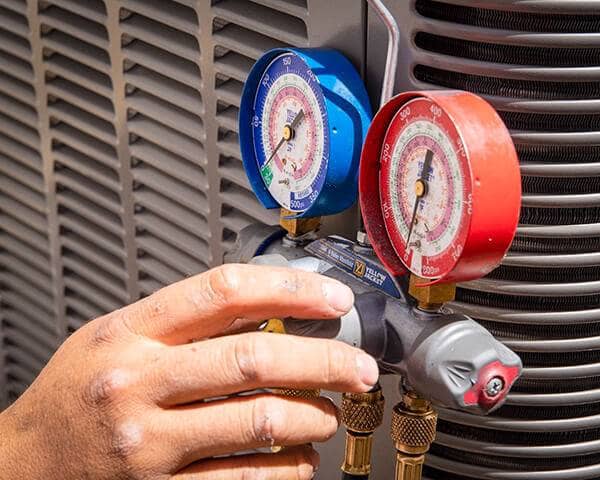
Short answer: The three AC failures we see most every June — frozen evaporator coils, burned-out compressors, and flooded ceilings from clogged drain lines — are all caused by problems that existed for months before the breakdown. A single spring tune-up catches all three. If you haven't had your system inspected this year, call The Cooling Company at (702) 567-0707 before the first heat wave.
Key Takeaways
- June is when Las Vegas HVAC companies go to war. Emergency call volume triples in the first week of sustained 100°F+ heat. Wait times for service jump from same-day to three or four days.
- Frozen coils trace back to refrigerant leaks that started months earlier. A slow leak loses 1–3 pounds over winter. The system works fine at 80°F but chokes when you need it at 110°F.
- Compressor burnout almost always starts with a weak capacitor. A $150 capacitor replacement in March prevents a $2,500–$4,000 compressor replacement in July.
- Ceiling water damage from AC drain lines is the most expensive "cheap" fix. A $20 drain cleaning prevents $3,000–$8,000 in drywall, mold remediation, and paint.
- Every one of these failures is caught during a 45-minute tune-up. The entire visit costs less than the emergency service fee alone during peak season.
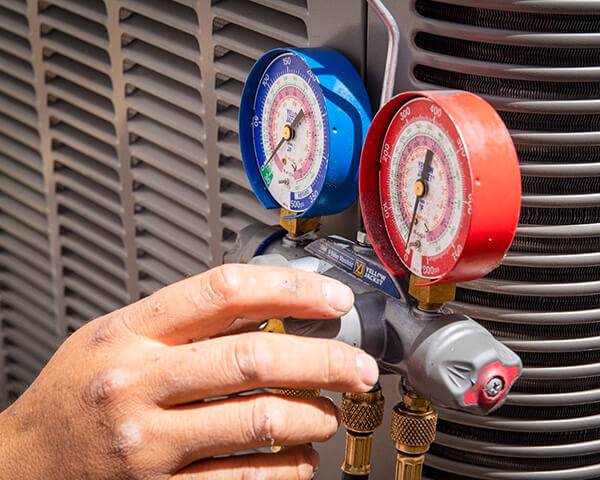
What June Looks Like From Our Side of the Phone
I want to give you an honest picture of what happens when the first sustained heat wave arrives in Las Vegas. Not the marketing version. The real version.
Our call volume starts climbing in late May. By the first week of June — when overnight lows stop dropping below 80 and daytime highs lock in above 105 — the phones become relentless. On a typical June Monday after a hot weekend, we'll field 80 to 120 service calls before noon. Our normal daily volume in March is around 15.
Most of those calls sound identical: "My AC was working fine yesterday. Now it's blowing warm air and won't cool below 85." Or: "There's water dripping from my ceiling near the hallway vent." Or: "The outside unit is making a loud buzzing sound and then it shuts off."
After 35 years of answering those calls, I can tell you that roughly 70% of them trace back to one of three problems — all of which were silently developing for months before the breakdown, and all of which a spring tune-up would have caught.
Here are the three failures, explained from the technician's perspective.
Failure #1: The Frozen Evaporator Coil
What the Homeowner Sees
The AC runs but the house won't cool down. The air coming from the vents feels lukewarm or barely cool. If the homeowner looks at the indoor unit (usually in a closet, attic, or garage), they might notice frost or ice on the copper refrigerant lines — sometimes extending all the way to the outdoor unit.
Some homeowners see actual ice buildup on the indoor coil through the access panel. In extreme cases, the entire coil is encased in a block of ice the size of a car battery.
What Actually Happened
The system is low on refrigerant. Not empty — just low enough that the evaporator coil temperature drops below 32°F during operation. Moisture in the air condenses on the coil surface and freezes instead of dripping into the drain pan.
The ice insulates the coil, which makes it colder, which creates more ice. Within hours, the coil is completely blocked. Airflow drops to near zero. The compressor overheats because it's not getting enough warm air across the coil to maintain normal suction pressure.
Where It Actually Started
Months ago. The refrigerant leak that caused this was almost certainly present last summer, last fall, or even longer. A micro-leak at a flare fitting, a pinhole in the evaporator coil, a rubbed-through line — these leaks are measured in ounces per month, not pounds per day.
During mild weather (70–85°F outdoor temperatures), a system running a pound or two low on refrigerant still cools adequately. The homeowner doesn't notice anything wrong. The coil temperature stays above freezing because the heat load is modest.
But when outdoor temperatures jump to 105–115°F, the system has to work at maximum capacity. Now that missing refrigerant matters. The evaporator pressure drops too low, the coil surface crosses the 32°F threshold, and the freeze cycle begins.
The Cost Comparison
| Scenario | What's Involved | Typical Cost |
|---|---|---|
| Spring tune-up catches it | Technician checks pressures, finds low charge, locates leak, seals it, recharges system | $200–$450 |
| Emergency call in June | Emergency service fee + defrost wait (2–4 hours) + leak search + repair + recharge + possible coil replacement if ice damaged the fins | $600–$1,800 |
| Worst case (compressor damage) | Prolonged low-charge operation burns out the compressor. Full compressor replacement or system replacement. | $2,500–$7,000+ |
I've seen the worst case play out dozens of times. The homeowner runs the system for weeks with a slow leak, notices the ice, turns the system off for a few hours, then turns it back on — repeating the freeze-thaw cycle until the compressor finally gives out. By that point, we're not talking about a tune-up. We're talking about AC replacement.
Failure #2: Compressor Burnout from a Failed Capacitor
What the Homeowner Sees
The thermostat is set to cool. The indoor fan blows air. But the outdoor unit either makes a humming/buzzing sound without the fan or compressor starting — or it starts briefly, runs for a few seconds, then shuts off with a click.
Some homeowners describe the outdoor unit as "trying to start but can't." That description is more accurate than they realize.
What Actually Happened
The start capacitor failed. This is the component that provides the initial surge of electrical energy the compressor motor and condenser fan motor need to begin spinning. Without it, the motor stalls under load.
When a compressor motor stalls, it draws locked-rotor amperage — typically four to six times its normal running amps. This massive current draw generates extreme heat in the motor windings. The thermal overload protector trips to prevent fire, cutting power to the compressor. After a cool-down period, the system tries again. Same result. Stall, overheat, trip.
If the homeowner keeps the thermostat set to "cool" while this is happening — and most do, because they don't know what's going on — the compressor goes through this stall-overheat cycle repeatedly. Each cycle degrades the motor winding insulation. After enough cycles, the insulation breaks down, the windings short-circuit, and the compressor is dead.
Where It Actually Started
The capacitor was weakening for months. Capacitors have a finite lifespan, and their performance degrades gradually — not suddenly. A capacitor rated at 45 microfarads might test at 42 in year three, 38 in year five, and 30 by year seven. At 30, it can still start the compressor in mild weather when the refrigerant pressures are low and the motor doesn't need much torque. But at 110°F ambient, with high head pressure and a hot compressor, 30 microfarads isn't enough.
During a spring tune-up, we test the capacitor with a multimeter. Takes 60 seconds. If the reading is more than 5% below the rated value, we recommend replacement. The homeowner decides — no pressure, no urgency. Just a data point and a recommendation.
The Cost Comparison
| Scenario | What's Involved | Typical Cost |
|---|---|---|
| Spring tune-up catches it | Capacitance test shows weakness. Proactive replacement during the same visit. | $120–$180 |
| Capacitor fails in June | Emergency service call + diagnosis + capacitor replacement. System is down for hours or a full day depending on technician availability. | $250–$400 |
| Capacitor failure damages compressor | Repeated stall cycles burn out motor windings. Compressor replacement required — or full system replacement if the unit is over 10 years old and the compressor is no longer under warranty. | $2,500–$4,500 |
This is the one that frustrates me most as a technician. A $150 part that we can test in a minute and replace in 15 minutes — and when it's missed, it can kill a compressor worth 20 times that. Every single time a homeowner tells me "it was fine last summer," I think about how a $150 capacitor swap would have kept it that way.
Failure #3: Flooded Ceiling from a Clogged Condensate Drain
What the Homeowner Sees
Water stain on the ceiling. Dripping from a light fixture. Wet carpet under the air handler closet. In severe cases, water running down a wall or pooling in the attic.
Sometimes the homeowner doesn't see the water at all — they smell it. Mold growing behind drywall from a slow, hidden leak that's been going on for days before the visible signs appeared.
What Actually Happened
The condensate drain line clogged. When your AC cools air, it also removes moisture — a healthy system in a Las Vegas home can produce 5 to 15 gallons of condensation per day during peak summer. That water collects in a drain pan beneath the evaporator coil and flows through a PVC drain line to the outside of the house or into a plumbing drain.
When the drain line is blocked, water has nowhere to go. The primary pan fills up. If the system has a float switch (a safety device that shuts off the AC when the pan is full), it kills the system before flooding occurs. But many systems — especially older installations — either don't have a float switch or have one that's stuck or bypassed.
Without a functioning float switch, the overflowing pan sends water into the attic, ceiling cavity, or closet where the air handler is installed. By the time the homeowner notices, gallons of water have already soaked into insulation, drywall, and framing.
Where It Actually Started
During winter. When the AC stopped running, residual moisture in the drain pan mixed with the fine desert dust that settled into the air handler over idle months. This formed a paste-like sludge that partially blocked the drain line opening. Over winter, algae and biofilm grew in the stagnant moisture inside the pipe.
When the AC starts running again in spring or early summer, condensation flows into the drain pan and hits the partial blockage. Water backs up slowly. Maybe it drains, just not fast enough to keep up with the condensation rate during sustained operation. Over days or weeks, the water level creeps up — and eventually overflows.
The Cost Comparison
| Scenario | What's Involved | Typical Cost |
|---|---|---|
| Spring tune-up catches it | Technician flushes drain line with compressed nitrogen or a wet-dry vac. Verifies float switch operation. Clears the pan. | Included in tune-up |
| Emergency drain clearing | Service call + drain clearing. Minimal damage if caught early. | $150–$300 |
| Ceiling/attic water damage | Emergency AC repair + drywall replacement + paint + potential mold remediation + insulation replacement. | $3,000–$8,000+ |
The irony here is hard to overstate. The drain line flush is a five-minute task during a standard tune-up. It costs nothing extra. And when it's skipped, the resulting water damage can exceed the cost of the entire AC system.
Why These Three Failures Cluster in June
There's a reason these breakdowns all hit at the same time. It's not coincidence — it's thermodynamics.
Las Vegas has a specific heat pattern. In April, highs reach the mid-80s. In May, low-to-mid 90s. The system runs occasionally, handling moderate loads without straining. Components that are slightly degraded — a weak capacitor, a partially clogged drain, a slow refrigerant leak — can still keep up.
Then June arrives. The first 105°F day hits. The system goes from running four to six hours per day to running 12 to 16 hours per day. Suddenly, every marginal component is pushed past its threshold:
- The low refrigerant charge that was adequate at 90°F fails at 110°F. Coil freezes.
- The weak capacitor that could start the compressor at 85°F can't generate enough torque at 110°F. Compressor stalls.
- The partially blocked drain that kept pace with light condensation can't handle the volume produced during sustained, heavy cooling. Pan overflows.
June doesn't create these problems. June reveals them.
And by June, every HVAC company in the valley is overwhelmed. Wait times for non-emergency calls stretch to three or four days. Emergency calls get prioritized, but even those can take 24 to 48 hours during a sustained heat wave. The homeowner is stuck in a 90-degree house, calling contractors who are fully booked, paying premium rates when they do get service.
The Math on Prevention
Let's put the numbers side by side.
| Item | Spring Tune-Up Cost | Summer Emergency Cost |
|---|---|---|
| Refrigerant leak detection + repair | $200–$450 | $600–$1,800 |
| Capacitor replacement | $120–$180 | $250–$400 (or $2,500–$4,500 if compressor is damaged) |
| Drain line flush | Included in tune-up | $150–$300 (or $3,000–$8,000 if water damage occurs) |
| Emergency service fee | N/A | $150–$250 |
| Total preventive visit | $89 tune-up + repairs if needed | $1,150–$14,950 |
The tune-up is $89 plus $79 service fee. If everything checks out clean, you've spent $168 for peace of mind and verified system readiness. If the technician finds a weak capacitor or slow drain, you're adding $120–$450 for targeted repairs done on your schedule, at standard rates, before the summer crunch.
Compare that to the emergency scenario: minimum $400 for a simple fix with a service call, potentially $5,000 to $15,000 if the failure cascades into compressor replacement or water damage restoration.
What to Do Right Now
If you haven't had your AC inspected since last summer, here's the move:
Replace your air filter today. Pull the old one, check the size, buy a MERV 13 replacement at any hardware store. Two minutes, $15, immediate improvement. Our air filter guide covers sizing and selection.
Walk outside and look at your condenser unit. Clear any debris, weeds, or objects within two feet. Look through the grille — can you see the coil fins, or is there a layer of dust and debris? If it looks dirty, don't hose it down yourself (you can bend the fins and make it worse). Just note it for the technician.
Schedule a spring tune-up now. Not in May. Not "when it gets warmer." Now — while our schedule has same-week availability and our technicians have the time to be thorough. Call (702) 567-0707 or book online.
Ask about a maintenance plan. If you want this handled automatically every year — spring tune-up for cooling, fall tune-up for heating — our maintenance plan covers both visits plus priority scheduling and repair discounts. See our HVAC maintenance page for details on what each visit includes. It's the "set it and forget it" approach for people who don't want to think about HVAC until they need to think about HVAC.
We've been doing this in the Las Vegas Valley since 2011. We serve Henderson, Summerlin, North Las Vegas, Green Valley, Southern Highlands, Enterprise, and every neighborhood in between. NV License #0075849.
Don't be the call we get on the first 110-degree day. Be the appointment we handle in March.