

Short answer: If your AC is running but blowing warm air, check three things first: make sure the thermostat is set to "cool" (not "on" or "heat"), replace the air filter if it's dirty, and look at your outdoor breaker panel for a tripped switch. These three account for about 40% of the "warm air" calls we get. If none of those fix it, you likely have a refrigerant, electrical, or mechanical problem that needs a technician. Call The Cooling Company at (702) 567-0707.
Key Takeaways
- The most embarrassing cause is the most common one. About 15% of our "AC not cooling" calls are resolved at the thermostat in under a minute. No judgment — it happens more often than anyone admits.
- A dirty air filter can make your AC blow warm air within hours. Restricted airflow drops evaporator pressure, freezes the coil, and shuts down cooling — even though the fan keeps running.
- Your outdoor unit has its own breaker — and it trips separately. If the indoor fan blows but the condenser isn't running, check the breaker box for a tripped 30- or 40-amp double-pole switch.
- Refrigerant doesn't "run out" like gas in a car. If you're low, you have a leak. Recharging without fixing the leak is temporary at best and wasteful at worst.
- The order you check things matters. Start free and easy, work toward expensive and complex. Don't call for a $250 service call when a $12 air filter was the problem.
This Is the Call That Never Stops
In 35 years of HVAC work in the Las Vegas Valley, I've answered every version of this question. "My AC is blowing but it's not cold." "The air feels room temperature." "It was working yesterday." "I woke up sweating at 3 a.m."
During peak summer, we'll get 30 to 40 of these calls per day. Some are genuine emergencies — a compressor that's given up. But a surprising number are things the homeowner could have checked before picking up the phone.
I'm going to walk through the seven most common causes in the order I check them, starting with the ones that cost you nothing to fix and working up to the ones that need professional attention. This isn't theoretical — this is the exact diagnostic sequence I've trained my technicians to follow on every single warm-air call.
Cause #1: The Thermostat Is Set Wrong
I know. Nobody wants to hear that the first thing a technician checks is whether the thermostat is on the right setting. But here's why it's first on the list: it's the culprit about 15% of the time, and it takes ten seconds to rule out.
Here's what happens. Someone bumps the mode switch from "cool" to "heat" or "off." A kid presses buttons. A power outage resets a programmable thermostat to its factory defaults. The fan switch gets moved from "auto" to "on" — which means the fan runs constantly, even when the compressor isn't cycling, blowing unconditioned air that feels warm.
What to check: Make sure the mode is set to COOL, the fan is set to AUTO (not ON), and the temperature is set at least 3 degrees below the current room temperature. If you have a smart thermostat, open the app and check for any schedules, geofencing rules, or eco modes that might be overriding your settings.
Cost to fix: $0.
Cause #2: The Air Filter Is Clogged
This is the single most preventable AC failure I see. A clogged filter restricts airflow across the evaporator coil. When airflow drops, the coil temperature plunges below 32°F and the moisture on it freezes. Ice builds on the coil, further blocking airflow. The compressor still runs, the fan still blows, but the air coming through your vents gets progressively warmer because it's bypassing a coil that's encased in ice.
In Las Vegas, filters clog faster than anywhere I've worked. The desert dust, the construction activity, the pool equipment kicking particulates around — a filter that lasts three months in Oregon might last six weeks here. During dust storm season, I've seen brand-new filters look like dryer lint in three weeks.
What to check: Pull the filter out and hold it up to a light. If you can't see light through it, it's done. Replace it with a MERV 8 to MERV 13 filter (higher isn't always better — check our air filter guide for sizing and rating details).
Cost to fix: $8–$25 for a new filter.
Important: If you suspect your coil is already frozen, turn the system to FAN ONLY for two to four hours to let the ice melt before running it in cooling mode again. Running the compressor with a frozen coil can cause liquid refrigerant to slug back to the compressor, which damages the valves.
Cause #3: The Outdoor Breaker Tripped
Here's one most homeowners don't think to check. Your AC system has two separate electrical circuits: one for the indoor air handler (fan, control board) and one for the outdoor condenser (compressor, condenser fan). They're on different breakers in your electrical panel.
If the outdoor breaker trips — from a power surge, a momentary short, or even a monsoon-related event — your indoor fan keeps blowing air through the house, but the outdoor unit isn't running. No compressor means no refrigerant circulation. No refrigerant circulation means no cooling. The air feels warm because it's just recirculating unconditioned air.
What to check: Go to your main breaker panel. Look for a 30-amp or 40-amp double-pole breaker (it'll be one of the larger ones). If it's in the middle position — not fully ON and not fully OFF — it's tripped. Flip it all the way OFF, wait ten seconds, then flip it back ON. Walk outside and listen for the condenser to start. You should hear the compressor and fan kick on within a minute.
Cost to fix: $0 — but if the breaker trips again immediately, stop. That means there's a short in the outdoor unit and you need a technician.
Cause #4: The Evaporator Coil Is Frozen
If you checked the filter and it was fine, and the outdoor unit is running, but the air is still warm — you might have a frozen evaporator coil from a different cause.
Low refrigerant is the usual suspect (see Cause #5), but it's not the only one. A dirty evaporator coil, a failed blower motor running at reduced speed, or a kinked refrigerant line can all drop evaporator pressure enough to freeze the coil.
What to check: If your air handler is accessible (garage, utility closet, attic), look at the refrigerant lines — the larger copper pipe (the suction line) coming out of the indoor unit. If it's sweating heavily, frosted, or covered in ice, the coil is frozen.
What to do: Turn the system to FAN ONLY and let the ice melt completely — usually two to four hours. Don't try to chip ice off the coil. Don't pour hot water on it. Just let the fan do its job. Once the ice is fully melted, turn the system back to cooling mode. If it freezes again within a few hours, you have an underlying problem that needs professional diagnosis.
Related reading: We covered the freeze-thaw cycle in detail in our post on preventable AC failures in Las Vegas.
Cause #5: Refrigerant Leak
If your AC was cooling less and less over weeks or months before giving up entirely, a slow refrigerant leak is very likely.
Refrigerant doesn't get "used up." Your AC is a sealed system — the same refrigerant circulates in a loop between the indoor coil (where it absorbs heat) and the outdoor coil (where it releases it). If the charge is low, there's a leak somewhere: a corroded fitting, a vibration-induced crack, a pinhole in the coil itself.
In the Las Vegas heat, a system that's even a pound low on refrigerant can struggle once outdoor temps pass 105°F. The compressor runs longer, the coil gets colder, and you get the freeze cycle from Cause #4 — except this time, it'll keep happening until the leak is found and repaired.
You'll notice: The air gets progressively less cold over days or weeks. The system runs longer cycles. Your electric bill climbs. Eventually, the coil freezes or the compressor overheats.
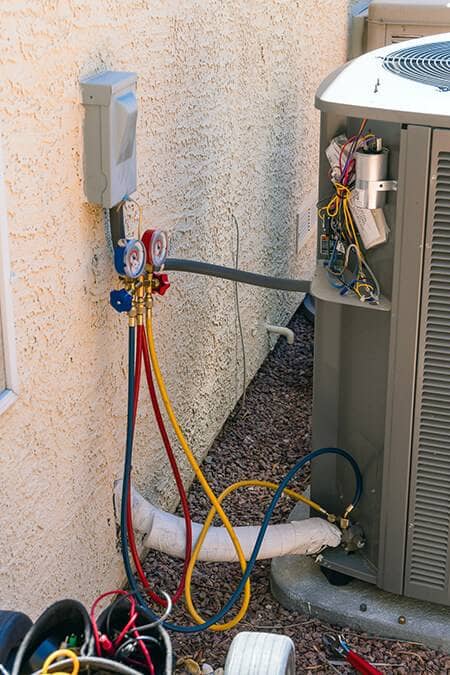
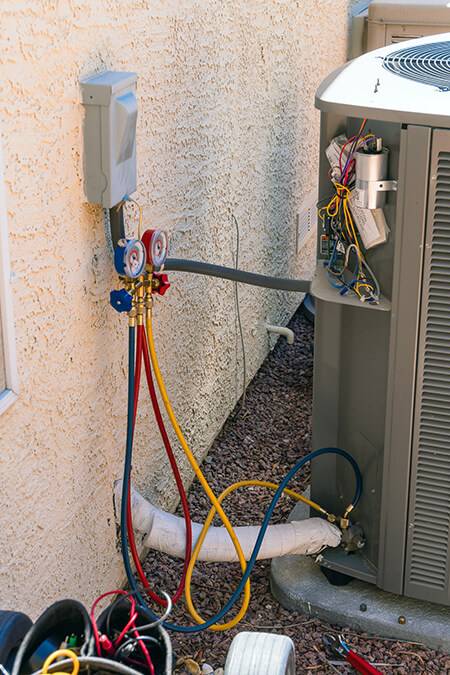
What a technician does: We connect pressure gauges to measure the actual refrigerant charge against the manufacturer's specification. If it's low, we use electronic leak detectors and UV dye to find the source, repair it, pressure-test the repair, pull a vacuum to remove moisture, and recharge to spec.
Cost range: $200–$600 for a minor leak repair and recharge. $800–$1,800 for a major leak (like an evaporator coil replacement). If someone offers to "just add a couple pounds of Freon" without finding the leak, you'll be having this same conversation again in three months.
Cause #6: Failed Capacitor
The capacitor is the component that gives the compressor and fan motors the electrical kick they need to start spinning. Capacitors degrade over time — and they degrade faster in extreme heat. Las Vegas is uniquely hard on capacitors because the outdoor unit sits in direct sun at 115°F+ ambient temperatures.
When a capacitor fails, the compressor either won't start at all or starts and immediately shuts off. The outdoor fan might spin, or it might not, depending on whether it shares the capacitor or has its own.
What you'll hear: Humming or buzzing from the outdoor unit, followed by a click as the overload protector trips. Or complete silence from the outdoor unit while the indoor fan blows normally.
Can you check this yourself? Not safely. Capacitors store electrical charge even when the system is off. Testing and replacing a capacitor requires a multimeter and knowledge of safe discharge procedures. This is a job for a technician.
Cost range: $150–$350 including the service call. But here's the critical part: if the failed capacitor caused the compressor to go through repeated stall-overheat cycles before you noticed (or before you called), the compressor motor windings may be damaged. That's when a $200 fix turns into a $2,500–$4,500 compressor replacement. Read more about this failure cascade in our AC capacitor failure guide.
Cause #7: Compressor Failure
This is the worst-case scenario, and thankfully the least common on this list. The compressor is the heart of your AC system — it's the pump that circulates refrigerant. When it fails, there's no cooling. Period.
Compressor failure in a system that's less than 8 or 9 years old usually means something else went wrong first: a capacitor that wasn't replaced, a refrigerant leak that ran unchecked, electrical damage from a power surge, or chronic overheating from a dirty condenser coil. Compressors rarely fail on their own — they're killed by the conditions around them.
In systems over 12 to 15 years old, compressor failure is often the moment we have the repair-vs-replace conversation. A compressor replacement on an aging system with R-22 refrigerant (the old Freon) or outdated SEER ratings rarely makes financial sense.
Cost range: $2,500–$4,500 for compressor replacement alone. $6,000–$15,000 for a full system replacement, depending on size, brand, and efficiency tier.
What to Check Before You Call — The 5-Minute Sequence
Save yourself time, money, and the frustration of waiting for a service call by running through this checklist first:
- Thermostat — Mode set to COOL, fan set to AUTO, temperature at least 3° below room temp.
- Air filter — Pull it out. If it's dirty, replace it. Turn system off for 2 hours if you suspect ice buildup.
- Outdoor breaker — Check the panel for a tripped 30/40-amp breaker. Reset once. If it trips again, stop.
- Outdoor unit — Walk outside. Is the condenser fan spinning? Is the compressor humming? Or is it silent/buzzing?
- Refrigerant lines — Look at the large copper line at the indoor unit. Frost or ice means a freeze problem.
If Steps 1–3 don't fix it, and you see ice, silence from the outdoor unit, or a buzzing-then-clicking pattern — call a technician. You've done the smart troubleshooting. The remaining causes require tools, refrigerants, and electrical knowledge that aren't DIY-safe.
When to Treat It as an Emergency
Most "warm air" situations are uncomfortable but not dangerous. You can survive a few hours with fans and open windows while you wait for service.
But call immediately — or consider emergency HVAC service — if:
- Anyone in the home has a medical condition affected by heat (elderly, infants, heart conditions, respiratory issues)
- Indoor temperature exceeds 95°F and isn't coming down
- You hear hissing from the refrigerant lines — this could be a rapid leak
- You smell burning from the indoor or outdoor unit — shut the system off at the breaker and call immediately
- Water is actively leaking from the air handler into your ceiling or walls
Cost Comparison: DIY Check vs. Service Call vs. Emergency
| Cause | DIY Fix Cost | Standard Service | Emergency / After-Hours |
|---|---|---|---|
| Thermostat setting | $0 | N/A | N/A |
| Dirty air filter | $8–$25 | N/A | N/A |
| Tripped breaker | $0 | N/A | N/A |
| Frozen coil (filter-related) | $8–$25 + time | $150–$250 | $250–$400 |
| Refrigerant leak | Not DIY | $200–$600 | $400–$1,800 |
| Failed capacitor | Not DIY | $150–$350 | $250–$500 |
| Compressor failure | Not DIY | $2,500–$4,500 | Same + rush fee |
Frequently Asked Questions
Can I just add refrigerant myself?
No. For both legal and practical reasons. R-410A (the current standard refrigerant) is sold only to EPA-certified technicians. More importantly, adding refrigerant without finding and fixing the leak is throwing money away — and running a system with the wrong charge can damage the compressor. If your system is low, there's a leak, and the leak has to be found first.
How long can I run my AC if it's blowing warm air?
If the thermostat or filter was the issue and you fixed it, you're fine. If the outdoor unit isn't running at all, running the indoor fan won't hurt anything — it's just circulating air. But if the compressor is short-cycling (starting and stopping every few minutes) or making unusual sounds, shut the system off to prevent further damage and call for service.
My AC cools fine during the day but blows warm air at night. What gives?
This is a classic sign of a thermostat location problem or a system that's slightly oversized. During the day, high heat load keeps the system running in long cycles. At night, when the load drops, the system short-cycles — running for a few minutes, satisfying the thermostat, shutting off, then repeating. Short cycles don't run long enough to dehumidify the air, which makes the house feel clammy and warmer than the thermostat reading suggests.
Should I cover my outdoor unit?
No. The outdoor condenser needs unrestricted airflow to operate. Covering it while running is a guaranteed way to overheat the compressor. If you're thinking about covering it during winter when the AC is off, use a breathable cover on the top only — never wrap the sides, because trapped moisture causes corrosion. Honestly, in Las Vegas, I don't recommend covers at all. We don't get enough snow or rain to justify them, and they create more problems than they solve.
What to Do Right Now
If your AC is blowing warm air and none of the DIY checks fixed it, here's the move:
- Turn the system to FAN ONLY (not off) to circulate air while you wait for service.
- Close blinds on south- and west-facing windows to reduce solar heat gain.
- Call (702) 567-0707 or book online. We prioritize warm-air calls because they tend to escalate if left unaddressed.
We serve every neighborhood in the valley — Henderson, Summerlin, North Las Vegas, Green Valley, Enterprise, Southern Highlands, and everywhere in between. NV License #0075849.
And if your system is over 10 years old and this isn't the first warm-air episode, it might be worth having the replacement conversation before the next breakdown happens at the worst possible time.