

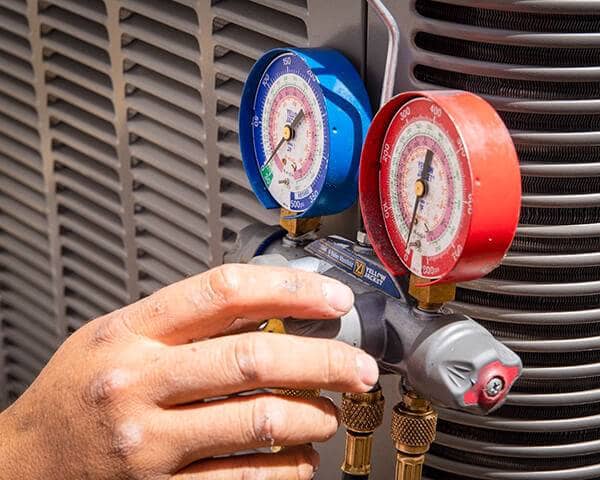
Short answer: An AC blowing warm air in Las Vegas is almost always caused by one of seven things: a dirty filter choking airflow, a refrigerant leak, a frozen evaporator coil, a failed run capacitor, compressor failure, a misconfigured thermostat, or duct leaks bleeding conditioned air into attic space. Most fixes run $150 to $1,200. Compressor failure or full replacement lands between $1,500 and $27,000. In a city where summer highs regularly hit 110–115°F and your system runs nearly 3,000 hours a year, every day of warm air is costing you real money — and risking real harm. This guide walks you through a 3-minute self-check, explains every cause with honest repair costs, and gives you a clear framework for the repair-or-replace decision.
Key Takeaways
- 7 most common causes: dirty filter, refrigerant leak, frozen coil, bad capacitor, compressor failure, thermostat issue, duct leaks.
- Most repairs cost $150–$1,200. Compressor replacement or full system replacement: $1,500–$27,000.
- The $5,000 rule: Multiply system age × repair cost. Over $5,000 = replace. Full breakdown here.
- Running a broken AC in 110°F+ heat can waste $200–$300/month in electricity while not actually cooling your home.
- 24/7 emergency service: Call (702) 567-0707. $79 diagnostic, waived for Comfort Club members.
- Replacement rebates: NV Energy PowerShift covers up to $3,200 on qualifying systems in 2026.
Las Vegas is the worst place in America for your AC to blow warm air. In Chicago or Denver, a struggling system means discomfort. Here, it means a house at 95°F by noon, potential heat illness for anyone vulnerable, and an energy bill that keeps climbing as your system runs constantly without actually cooling anything. This is not a problem to wait on.
The good news: the vast majority of warm-air failures have a clear cause and a well-defined fix. Let's find yours.
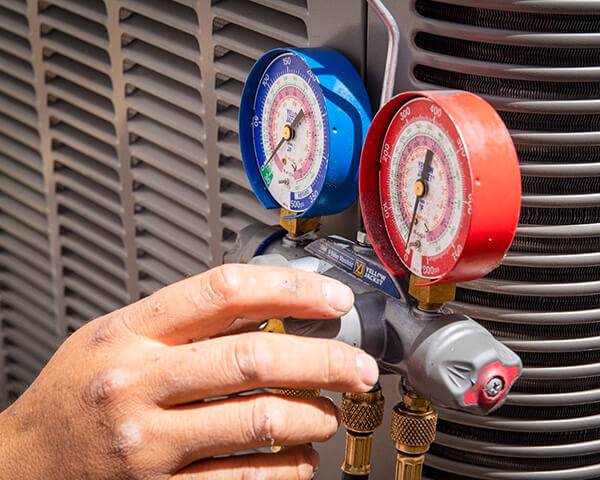
The 3-Minute Self-Diagnostic
Before you call anyone, run through these four checks. They take three minutes and will either solve the problem immediately or give your technician a head start when they arrive.
1. Check the thermostat — and check it carefully.
Walk to your thermostat and confirm: (a) it's set to COOL, not HEAT or OFF; (b) the target temperature is below the current room temperature; (c) the fan setting is AUTO, not ON. The "fan ON" setting runs the blower continuously — including when the system isn't actively cooling, which pushes warm room air through the vents and feels exactly like the AC is blowing warm. This is the single most common cause of "warm air" calls we get. It costs $0 to fix.
2. Check your air filter.
Find your filter — usually in the return air grille or the air handler itself — and pull it out. If you can't see light through it, it's too dirty. A completely blocked filter starves the system of airflow, causes the evaporator coil to freeze, and can make the air coming from your vents feel warm or humid even when the compressor is running. Replace it with the correct size, reset the system, and wait 20–30 minutes. If the air turns cold, you found your problem.
3. Check the outdoor unit.
Go outside and look at the condenser unit. Is it running? You should hear the compressor humming and see the condenser fan spinning. If the outdoor unit is completely off while the indoor air handler is running, you likely have an electrical issue — a tripped breaker, a blown fuse on the disconnect, or a failed capacitor. A unit that's running but coated in ice along the refrigerant lines points to a refrigerant problem or airflow restriction.
4. Check the circuit breaker.
Open your electrical panel. Look for any breaker in the middle position (partially tripped) or the OFF position. Most HVAC systems have two breakers: one for the air handler and one for the outdoor condenser. If either is tripped, reset it once. If it trips again immediately, stop — there's an underlying electrical fault that needs a licensed technician.
If none of these checks apply and the system is not turning on at all, that's a different problem — start with our dead-AC troubleshooting guide. If you've run all four checks and the system is still blowing warm, you need a professional diagnosis. Call The Cooling Company at (702) 567-0707 — our diagnostic fee is $79 (waived for Comfort Club members), and we're available 24/7 for emergency AC service.
The 7 Most Common Causes of Warm Air from Your AC
1. Dirty or Clogged Air Filter
A blocked filter is the most preventable cause of warm air. When the filter is too clogged to allow airflow, several bad things happen in sequence: the evaporator coil gets too cold (no warm air to absorb heat from), the coil ices over, airflow drops to near zero, and what little air does reach your vents passes over a frozen coil — emerging warm and humid.
Las Vegas makes this worse than most cities. Between desert dust, monsoon particulate in July and August, and systems running nearly year-round, filters here load up faster than anywhere else in the country. A filter that lasts 90 days in Seattle might be completely blocked in 30 days in a Las Vegas home with pets.
Fix: Replace the filter. If the coil has iced over, turn the system off and set the fan to ON to thaw the coil — this takes 1–3 hours. Once thawed, replace the filter and restart in cooling mode.
Cost: $5–$30 for the filter. If ice damage or a frozen-coil secondary issue requires a service call, add the $79 diagnostic fee.
2. Refrigerant Leak
Refrigerant is the working fluid that carries heat from inside your home to the outside. When you're low on refrigerant, the system can't transfer heat effectively — air comes out the vents at ambient temperature or warmer.
Here is something many homeowners don't know: refrigerant doesn't get "used up." It circulates in a closed loop. If you're low on refrigerant, the only explanation is a leak. Any technician who offers to "top you off" without finding and fixing the leak is selling you a temporary fix that will cost you again in six months.
Signs of a refrigerant leak: warm air from vents, ice forming on the refrigerant line where it enters the air handler, a hissing or bubbling noise near the outdoor unit, or a system that runs constantly but never cools down.
Fix: Leak detection, repair (soldering or sealing the breach), and refrigerant recharge. All refrigerant work must be performed by an EPA Section 608-certified technician.
Cost: $300–$1,500 depending on where the leak is. A simple Schrader valve repair is on the low end; a leak inside the evaporator coil is at the high end or may require coil replacement.
3. Frozen Evaporator Coil
Your evaporator coil lives inside the air handler. Refrigerant flows through it and absorbs heat from air moving across it — that's how cooling happens. When airflow is restricted (dirty filter, closed vents, blocked return) or refrigerant is low, the coil surface temperature drops below freezing and moisture from the air freezes onto the coil, forming a layer of ice.
A frozen coil can't absorb heat. Air passing over it emerges at room temperature or warmer. In advanced cases, so much ice builds up that airflow stops almost entirely.
The fix for a frozen coil always involves addressing the root cause — not just the ice. Thawing the coil without fixing what caused the freeze means it will freeze again within hours.
Fix: Thaw the coil (turn system to fan-only mode for 1–3 hours), then diagnose and fix the root cause — replace the filter, fix the refrigerant leak, clear blocked vents, or repair the blower motor.
Cost: $0 if the cause is a filter you replace yourself. $300–$1,500 if refrigerant work is involved. $400–$900 if a blower motor is the culprit.
4. Failed Run Capacitor
The run capacitor is a small cylindrical component — about the size of a soup can — that stores electrical charge and helps start and run the compressor and condenser fan motor. It's one of the most failure-prone parts in any HVAC system.
In Las Vegas, capacitors fail at an extraordinary rate. The combination of extreme ambient heat (the outdoor unit sits in 115°F air), constant cycling, and voltage fluctuations from peak demand degrades capacitors far faster than in moderate climates. We replace more capacitors per AC unit here than virtually anywhere else in the country.
A failed start/run capacitor presents in two ways: the outdoor unit hums but the fan or compressor won't start, or the unit starts but shuts down on thermal overload shortly after. Meanwhile, the indoor air handler keeps running, pushing uncooled air through the vents.
Fix: Capacitor replacement. Quick job — typically 30–45 minutes on a standard residential system.
Cost: $150–$350 all-in. The capacitor itself costs $20–$60; the rest is labor and the service call.
5. Compressor Failure
The compressor is the engine of your entire cooling system. It compresses refrigerant, driving it through the refrigeration cycle that moves heat from inside your home to the outdoors. When the compressor fails, nothing cools — the air handler keeps blowing, but the air is completely uncooled.
Compressor failure in Las Vegas is often caused by low refrigerant (which starves and overheats the compressor), a chronically failed capacitor that forces the compressor to hard-start repeatedly, or simply age-related wear on a unit that has run 3,000 hours a year for a decade.
Signs of compressor failure: the outdoor unit doesn't hum at all, or you hear a hard clicking sound as it attempts to start and fails. The circuit breaker may trip repeatedly. Warm air from every register.
Fix: Compressor replacement — or, more often in an older system, full outdoor unit replacement.
Cost: $1,500–$3,500 for compressor replacement alone. For a system over 10 years old, a full outdoor unit replacement is usually the better financial decision. See the repair vs. replace section below.
6. Thermostat Malfunction
A thermostat that's reading the wrong temperature or sending incorrect signals can cause the system to run in heat mode, fail to engage the compressor, or cycle off before the home has cooled. Smart thermostat wiring errors — common after DIY installations — are a growing cause of service calls.
Signs of a thermostat problem: the display shows a temperature that doesn't match the room (or is blank), the system behaves erratically, or the AC runs but the compressor never engages.
Fix: Thermostat replacement or reconfiguration. If you recently installed a smart thermostat, the "common wire" (C-wire) may be missing or misconnected — a very common issue.
Cost: $150–$400 for a standard thermostat replacement plus labor. Smart thermostat installation runs $200–$500 depending on wiring complexity.
7. Duct Leaks
Your ductwork is the delivery system. If the supply ducts are leaking conditioned air into your attic — where it's 150°F in August — you're cooling your attic instead of your living space. Air that does reach your registers arrives partially warmed, and your system runs nonstop trying to compensate.
The U.S. Department of Energy estimates that the average home loses 20–30% of conditioned air to duct leaks. In Las Vegas, with attic temperatures that exceed 150°F during summer, this loss is especially punishing. A home with significant duct leakage can see its effective cooling capacity drop by a third or more.
Signs of duct leakage: some rooms stay warm even when others are comfortable, higher-than-expected energy bills, visible gaps or disconnected sections in accessible ductwork.
Fix: Duct sealing (mastic or aerosol sealing) or duct replacement in severe cases.
Cost: $300–$1,500 for professional duct sealing on a residential system. Full duct replacement: $2,500–$6,000 depending on home size.
What Each Repair Actually Costs in Las Vegas
These are honest, current price ranges for the Las Vegas market. Your exact cost will depend on system size, access, parts availability, and timing. After-hours and weekend service adds $50–$150 to the base diagnostic fee.
| Repair Type | Cost Range | Typical Time on Site | Notes |
|---|---|---|---|
| Air filter replacement (DIY) | $5–$30 | 5 minutes | Do this first, before calling anyone |
| Thermostat replacement | $150–$500 | 1–2 hours | Higher end for smart thermostats with wiring issues |
| Capacitor replacement | $150–$350 | 30–60 minutes | Most common single repair in Las Vegas summer |
| Contactor replacement | $150–$400 | 30–60 minutes | Often replaced alongside capacitor |
| Refrigerant leak repair + recharge | $300–$1,500 | 2–4 hours | Cost varies by leak location; recharge is separate |
| Frozen coil thaw + root cause repair | $79–$1,500 | 2–5 hours | Low end if just a filter; high end if refrigerant leak |
| Condenser fan motor replacement | $300–$650 | 1–2 hours | Fails frequently in Las Vegas heat |
| Blower motor replacement | $400–$900 | 2–3 hours | Variable-speed ECM motors cost more |
| Evaporator coil replacement | $1,200–$2,500 | 4–8 hours | Consider system age before proceeding |
| Duct sealing (residential) | $300–$1,500 | 4–8 hours | Aerosol sealing vs. manual varies widely |
| Compressor replacement | $1,500–$3,500 | 4–8 hours | Often triggers replacement discussion for older systems |
| Full outdoor unit replacement | $3,500–$7,500 | 4–8 hours | Usually better value than compressor-only on 10+ yr systems |
| Full system replacement | $11,000–$27,000 | 1–2 days | NV Energy PowerShift rebates up to $3,200 available |
Our standard diagnostic fee is $79, which is applied toward any repair you approve. Comfort Club members have the diagnostic fee waived. Schedule Now online or call (702) 567-0707.
The Real Cost of Ignoring Warm Air
Here's the calculation most homeowners don't run: what does it actually cost to keep running an AC that isn't cooling?
When your system is low on refrigerant, has a dirty coil, or has a failing compressor, it enters a state engineers call "thermal runaway" — it runs constantly trying to hit the thermostat setpoint, never getting there, drawing full power the entire time.
A standard 3-ton residential AC in Las Vegas draws about 3,000–3,600 watts when running. NV Energy's residential rate is approximately $0.12–$0.16 per kilowatt-hour (more during peak summer hours under time-of-use pricing).
The math on a system running full-blast but not cooling:
- Running 18 hours/day (typical during Las Vegas summer): 3.3 kW × 18 hours = 59.4 kWh/day
- At $0.14/kWh average: $8.32/day in electricity
- Over 30 days: $250 in extra electricity — just for the wasted runtime
- Over a full summer (June–September, 120 days): $998 in wasted energy
That's before counting the accelerated wear on the compressor from running at extreme load in extreme heat without adequate refrigerant or airflow. Every hour of deferred repair shortens the remaining life of the most expensive component in the system.
Put differently: a $350 capacitor replacement, done the day the problem appears, might prevent a $3,500 compressor replacement six weeks later. In Las Vegas summer heat, that six-week gap can mean the difference between a tune-up bill and a replacement conversation.
Don't let the house get hot while you think about it. Call (702) 567-0707 or book a 24/7 emergency appointment — we dispatch same-day, including nights and weekends.
Repair vs. Replace: The $5,000 Rule Applied

When a repair quote comes in above a few hundred dollars, the honest question is whether that money is better applied toward a new system. Here's the framework we use — and share openly with every customer facing this decision.
The Age × Repair Cost Rule
Multiply the system's age (in years) by the repair cost. If the result exceeds $5,000, replacement is almost always the better financial decision.
- 12-year-old system needing a $500 repair: 12 × $500 = $6,000 → lean toward replacement
- 6-year-old system needing a $600 refrigerant repair: 6 × $600 = $3,600 → repair is justified
- 14-year-old system needing a $2,500 coil replacement: 14 × $2,500 = $35,000 → replace without question
This formula isn't perfect, but it captures the key insight: money spent repairing old equipment has a lower expected return than money spent on new equipment, because the old equipment is more likely to fail again soon.
Las Vegas-specific factors that tilt toward replacement
A system that would last 20 years in Portland, Oregon may reach the end of its useful life at 12–14 years in Las Vegas. The combination of extreme runtime hours (2,800–3,000 per year versus 800–1,200 in moderate climates), ambient temperatures that push the system near its design limits every afternoon, and desert particulate that abrades components means Las Vegas systems age faster than the national averages suggest.
If your system is more than 12 years old and is experiencing its second or third significant repair, the math on replacement almost always wins — especially when you factor in:
- Efficiency gains: Modern systems are rated at 16–22 SEER2 versus the 10–13 SEER of systems installed before 2010. A new high-efficiency system can cut your cooling energy costs by 30–40%.
- NV Energy PowerShift rebates: Up to $3,200 in rebates are currently available through NV Energy's PowerShift program for qualifying high-efficiency equipment. These are active as of 2026.
- Financing: We offer flexible payment plans on new installations, so you're not forced to choose between a functional AC and your monthly budget.
"I tell homeowners to think about it like a car with 200,000 miles. You can keep replacing parts, but at some point every repair is just buying time before the next one. In Las Vegas, that tipping point comes faster because the heat ages everything — compressors, coils, wiring, capacitors. When I see a system that is 12 years old needing a $1,500 repair, I owe it to the homeowner to show them the replacement math, not just hand them a repair bill."
— Frank Santana, General Manager, The Cooling Company
When repair is clearly the right call
If your system is under 10 years old, has been reasonably maintained, and the repair is a single well-defined component — a capacitor, a contactor, a thermostat, a refrigerant leak at an accessible fitting — repair is almost always the right answer. Fix it, get a maintenance plan to catch the next problem early, and get years more life from the equipment.
For a full side-by-side cost comparison, explore your options at our AC repair page or book a consultation and we'll run the numbers with you on site.
What to Expect When You Call The Cooling Company
We know that calling an HVAC company can feel uncertain — especially when you've been hit with surprise charges or vague estimates before. Here's exactly what happens when you call us at (702) 567-0707.
Step 1: Same-day dispatch. We run 24/7 emergency service for Las Vegas, Henderson, Summerlin, North Las Vegas, and surrounding communities. If your AC is blowing warm air in July, we treat that as an emergency. Most calls result in same-day service.
Step 2: $79 flat diagnostic fee. Our technician arrives, runs a complete system diagnostic — thermostat calibration, refrigerant pressure test, electrical component testing, airflow measurement, and coil inspection. You get a complete picture of what's wrong and why.
Step 3: Written estimate before any work begins. We will not touch anything until you've approved a written quote with itemized parts and labor. No surprise charges. No "while we were in there" add-ons without your explicit approval.
Step 4: Repair or honest recommendation. If repair is the right call, we complete it same-day in the vast majority of cases — our trucks stock the most common parts for Las Vegas residential systems. If replacement is the better financial decision, we'll tell you clearly and provide an installation quote with NV Energy rebate information included.
Step 5: Comfort Club members get priority. If you're a Comfort Club member, your diagnostic fee is waived, you move to the front of the service queue during peak summer months, and you receive discounts on parts and labor. During a Las Vegas heat wave when every HVAC company in the Valley is booked two weeks out, that priority dispatch has real value.
Learn more about our Comfort Club maintenance plans.
How to Prevent This From Happening Again
The majority of warm-air failures we service are predictable and preventable. These are the steps that keep Las Vegas AC systems running reliably through summer.
Change your filter every 30–45 days. In Las Vegas, the standard 90-day guidance is too long. Desert dust, monsoon particulate, and year-round operation load filters much faster. Set a recurring reminder and buy a few filters at a time so there's always one on hand.
Schedule a pre-summer tune-up every spring. A professional spring tune-up in March or April — before the heat arrives — lets a technician catch weak capacitors, low refrigerant, dirty coils, and other issues before they become failures at 3 PM on a 112°F day in July. Our tune-ups include a complete 21-point inspection.
Keep the outdoor unit clear. Trim shrubs to maintain 18 inches of clearance on all sides. Rinse the condenser coil with a garden hose a few times per season to clear dust buildup. A dirty condenser coil can reduce system efficiency by 20–30% and significantly shorten compressor life.
Don't close registers to "save energy." Closing registers increases static pressure in the duct system, stresses the blower motor, and can cause coil freeze. Run the system with all supply and return registers fully open.
Watch your energy bill. A sudden increase in your NV Energy bill — without a weather explanation — is often the first sign of a failing system. If your June bill is 25% higher than last June with the same thermostat settings, something is working harder than it should. Schedule a diagnostic before it becomes a failure.
Join a maintenance plan. Our Comfort Club plans include two scheduled tune-ups per year, priority emergency dispatch, waived diagnostic fees, and discounts on repairs. For most Las Vegas homeowners, the plan pays for itself in the first emergency call it prevents.
"The systems we see failing in July almost always have the same story — no maintenance in two or three years, a filter that should have been changed months ago, and a condenser coil packed with desert dust. The ones that make it through summer without a single emergency call? They had a spring tune-up. Every time. It is the most predictable pattern in this business."
— The Cooling Company service team
Related Guides
- AC Not Turning On? — 8 things to check before calling for repair
- When to Replace Your AC in Las Vegas — the 2026 homeowner's replacement timeline
- NV Energy PowerShift Rebate 2026 — save up to $3,200 on a qualifying system
- Spring AC Tune-Up Checklist — prevent warm-air failures with this pre-summer checklist
Frequently Asked Questions
Why is my AC running but not cooling the house?
The most common causes of an AC running but not cooling are a frozen evaporator coil (usually from a dirty filter or low refrigerant), a failed capacitor preventing the compressor from starting, low refrigerant from a leak, or a thermostat in the wrong mode. Run the 3-minute self-check at the top of this guide first — check the thermostat mode (make sure it's COOL, not HEAT), replace the filter if it's dirty, check that the outdoor unit is actually running, and reset any tripped breakers. If the system is still blowing warm air after those checks, call a licensed technician. Do not run the system continuously when it's not cooling — you're burning energy and potentially damaging the compressor.
How much does it cost to fix AC not cooling in Las Vegas?
The cost depends entirely on the cause. A dirty air filter costs $5–$30 to fix yourself. A failed capacitor runs $150–$350. Refrigerant leak repair and recharge is $300–$1,500 depending on where the leak is. A blower motor replacement is $400–$900. Evaporator coil replacement is $1,200–$2,500. Compressor replacement is $1,500–$3,500. A full system replacement runs $11,000–$27,000, with NV Energy PowerShift rebates of up to $3,200 currently available. The Cooling Company charges a $79 diagnostic fee (waived for Comfort Club members) — you'll know the exact cost before any work begins.
Can a dirty filter cause AC to blow warm air?
Yes — and it's the most common and most overlooked cause. A heavily clogged filter restricts airflow so severely that the evaporator coil drops below freezing, accumulates ice, and can no longer absorb heat. Air passing over a frozen coil emerges warm or at ambient temperature. The fix is to turn the system off (or set to fan-only), let the coil thaw for 1–3 hours, replace the filter, and restart in cooling mode. In Las Vegas, plan to replace your filter every 30–45 days — not every 90 days as the packaging often suggests. Desert dust loads filters much faster here.
How long can you run an AC that's blowing warm air without causing damage?
That depends on the cause. If the issue is just a thermostat setting or a dirty filter, running the system briefly while you diagnose won't cause harm. But if the problem is low refrigerant, a failed capacitor, or compressor stress, continuing to run the system accelerates the damage significantly. Low refrigerant starves and overheats the compressor. A capacitor failure causes the compressor to hard-start repeatedly, destroying the motor windings. In Las Vegas summer heat, a damaged compressor can fail completely within hours of the problem appearing. Our recommendation: if the self-check doesn't identify an obvious fix, turn the system off and call for same-day service. The repair cost for a failed compressor is 10–20 times the cost of a capacitor or refrigerant repair.
Does NV Energy have rebates for AC replacement in Las Vegas?
Yes. NV Energy's PowerShift program currently offers rebates of up to $3,200 for qualifying high-efficiency AC systems and heat pumps installed in Nevada. These rebates are active as of 2026. Eligibility depends on the equipment's efficiency rating (SEER2), the installation contractor, and your NV Energy account status. The Cooling Company handles the rebate paperwork as part of every qualifying installation — you don't have to navigate the program yourself. Ask us for current rebate details when we provide your installation quote.
What should I do if my AC starts blowing warm air at night or on a weekend?
Call The Cooling Company at (702) 567-0707. We provide 24/7 emergency AC repair throughout Las Vegas, Henderson, Summerlin, and North Las Vegas — including nights, weekends, and holidays. In Las Vegas, a nighttime temperature of 90°F is common in July and August, and a home without air conditioning can reach dangerous temperatures within hours. We treat loss of cooling in summer as an emergency and dispatch same-day whenever possible. After-hours calls carry a modest additional fee, which we'll quote clearly before dispatching.
How do I know if my AC needs repair or full replacement?
Use the Age × Repair Cost rule: multiply your system's age in years by the repair cost. If the result is above $5,000, replacement is usually the better financial decision. A 12-year-old system needing a $500 repair (12 × $500 = $6,000) is a strong replacement candidate — especially in Las Vegas, where systems age faster due to extreme runtime hours and heat. A 5-year-old system needing a $600 refrigerant repair (5 × $600 = $3,000) is worth fixing. Beyond the formula, consider efficiency: modern high-efficiency systems cut cooling costs by 30–40% over older 10–13 SEER systems, and NV Energy rebates of up to $3,200 reduce the upfront cost of replacement. We'll give you an honest side-by-side comparison on site.
Get Your AC Cooling Again — Today
Warm air from your AC is a problem that gets more expensive every hour you wait. Whether it's a $5 filter or a conversation about a new system, the answer starts with an honest diagnostic.
The Cooling Company has served Las Vegas, Henderson, Summerlin, and surrounding communities with licensed, straightforward AC repair and installation. No bait-and-switch pricing, no unnecessary upsells, no vague quotes that change once we're in your home.
- Diagnostic fee: $79 (waived for Comfort Club members)
- Available: 24 hours a day, 7 days a week
- Service area: Las Vegas, Henderson, Summerlin, North Las Vegas, and all surrounding communities
Need HVAC Service in Las Vegas?
The Cooling Company provides expert HVAC service throughout Las Vegas, Henderson, and North Las Vegas. Our licensed technicians deliver honest assessments, upfront pricing, and reliable results.
Call (702) 567-0707 or visit AC repair, maintenance, emergency service, or maintenance plans for details.