


Short answer: For most Las Vegas homeowners replacing a failed AC system, a heat pump is the better long-term investment. Heat pumps cool as effectively as traditional AC units in summer and provide efficient electric heating in winter, eliminating the need for a separate gas furnace. Las Vegas winters rarely drop below 35°F, which is well within a heat pump's optimal operating range. The upfront cost is $1,500-$3,500 more than a comparable AC + furnace combo before rebates, but NV Energy PowerShift rebates of $250–$550 for qualifying heat pumps (verify tiers at nvenergy.com) for qualifying heat pumps (versus $300–$1,200 for qualifying central AC) narrow or eliminate that gap. The federal Section 25C tax credit expired December 31, 2025 and is not available for 2026 installations. Combined with lower winter heating bills, most homeowners break even by year 1-3 and save $8,000-$15,000 over the system's 15-18 year lifespan.
The Moment of Decision
Your 14-year-old Carrier just died. The compressor locked up on a Thursday afternoon in September, two weeks after summer peak, naturally, because HVAC equipment has a dark sense of timing. The repair estimate is $2,800 for a compressor replacement in a system that's already past its expected lifespan.
So you call for a replacement quote. The technician looks at your equipment, runs a load calculation, and says something you didn't expect: "Have you considered a heat pump instead?"
Your first thought: "I live in Las Vegas. Why would I need a heat pump? It's 108 degrees outside."
Fair question. And the answer has changed dramatically in the last five years.

How a Heat Pump Actually Works (and Why Las Vegas Is Ideal)
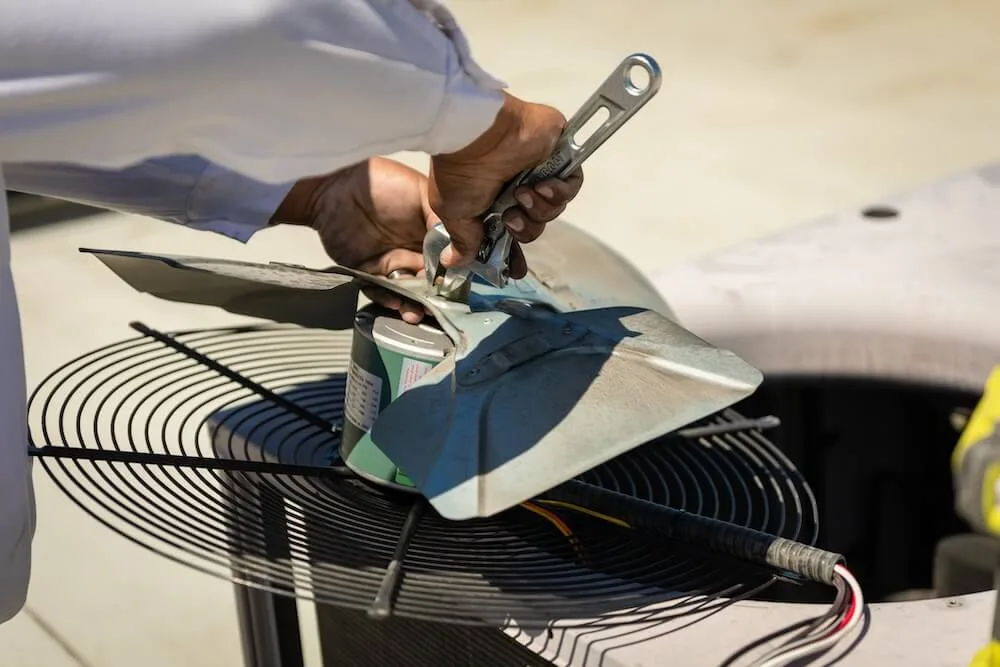
A heat pump is an air conditioner that can run in reverse. In cooling mode, it works identically to a traditional AC, it absorbs heat from inside your home and dumps it outside through the condenser coil. Same compressor, same refrigerant cycle, same cooling performance.
The difference is a component called a reversing valve. When you switch from cooling to heating, the reversing valve flips the direction of refrigerant flow. Now the system absorbs heat from the outdoor air and moves it inside. It's not generating heat the way a gas furnace does, it's moving heat from one place to another, which takes significantly less energy.
The common misconception about heat pumps is that they "don't work in cold weather." This was partially true 15-20 years ago, when heat pumps lost significant capacity below 40°F and became nearly useless below 25°F. Modern inverter-driven heat pumps maintain 80-100% of their heating capacity down to 30°F, and many cold-climate models operate efficiently at 5°F or below.
Las Vegas? Las Vegas winter overnight lows average 37-42°F from December through February. The temperature drops below 30°F maybe 5-8 nights per year. Below 25°F? Essentially never, it's happened three times in the last twenty years.
This means a heat pump operates in its most efficient heating range for the entirety of a Las Vegas winter. No supplemental heat strips needed. No backup gas furnace required (though some homeowners opt for one, more on that below). Just quiet, efficient heating from the same equipment that cooled your house all summer.
Summer Cooling: Heat Pump vs. AC Performance
Here's what surprises most homeowners: in cooling mode, a heat pump performs identically to a traditional AC of the same SEER2 rating. An 18-SEER2 heat pump cools exactly as well as an 18-SEER2 air conditioner. Same BTU output, same energy consumption, same dehumidification.
The refrigerant cycle is the same. The compressor is the same (or equivalent). The condenser coil, evaporator coil, and metering device are functionally identical in cooling mode. The only physical difference is the reversing valve, which is inactive during cooling. You are not compromising summer performance by choosing a heat pump.
On the extreme heat days Las Vegas is known for, the 115-117°F days in July, both systems face the same thermodynamic limitations. Neither can cool efficiently when the outdoor temperature exceeds the system's design rating. Your home's insulation, duct integrity, and maintenance history matter far more than whether the outdoor unit has a reversing valve.
Winter Heating: Where the Savings Actually Happen
This is where the economics shift decisively in the heat pump's favor.
A traditional AC system requires a separate heating source, in Las Vegas, that's typically a gas furnace. Gas furnaces in the valley run on Southwest Gas, and a mid-efficiency 80% AFUE furnace converts about 80 cents of every dollar of gas into heat (the other 20 cents goes up the flue as waste). A high-efficiency 96% AFUE furnace does better, but it costs $2,000-$4,000 more upfront.
A heat pump doesn't burn fuel. It moves heat using electricity, and it does so at an efficiency of 250-350%, meaning for every unit of electricity consumed, it delivers 2.5 to 3.5 units of heat. This is expressed as COP (Coefficient of Performance) or HSPF2 (Heating Seasonal Performance Factor).
At Las Vegas winter temperatures (35-55°F on most heating days), a modern heat pump delivers a COP of 3.0-3.5, three to three-and-a-half times more heat per dollar of electricity than a resistance heater, and roughly 1.5-2x cheaper than a gas furnace on a per-BTU basis when comparing local NV Energy electricity rates against Southwest Gas rates.
Annual winter heating cost comparison
| Heating Source | Efficiency | Annual Heating Cost (Las Vegas, ~1,200 heating hours) |
|---|---|---|
| 80% AFUE gas furnace | 80% | $480 - $680 |
| 96% AFUE gas furnace | 96% | $380 - $560 |
| Electric resistance heat (backup strips) | 100% | $720 - $1,050 |
| Heat pump (9.0 HSPF2) | ~300% COP at 40°F | $240 - $380 |
| Heat pump (10.5 HSPF2) | ~350% COP at 40°F | $190 - $310 |
Estimates based on a 2,000 sq ft home, NV Energy residential electric rates and Southwest Gas residential rates as of 2026. Actual costs vary by insulation, thermostat habits, and exact rate tier.
The heat pump saves $140-$370 per winter compared to a gas furnace, and Las Vegas winters are short. The savings look modest in isolation, but they're consistent year after year, they require no gas line or gas service (which carries its own monthly fixed charges), and they compound over the system's lifespan.
Head-to-Head Cost Comparison
| Factor | AC + Gas Furnace | Heat Pump (Ducted) |
|---|---|---|
| Equipment + installation (3-ton, mid-tier) | $8,500 - $13,000 | $9,500 - $15,000 |
| Federal 25C credit (expired Dec 2025) | $0 | $0 (expired Dec 31, 2025) |
| NV Energy PowerShift rebate | $300 - $1,200 | $250 - $550 |
| Net cost after incentives | $7,300 - $12,700 | $6,300 - $14,500 |
| Annual cooling cost | $850 - $1,400 | $850 - $1,400 (identical) |
| Annual heating cost | $380 - $680 | $190 - $380 |
| Annual total operating cost | $1,230 - $2,080 | $1,040 - $1,780 |
| Annual maintenance cost | $200 - $350 (2 systems) | $100 - $200 (1 system) |
| Gas service fixed charges (Southwest Gas) | $15 - $22/month ($180 - $264/year) | $0 (can eliminate gas service) |
| Expected lifespan | 15-20 years (AC), 20-25 years (furnace) | 15-18 years |
| Warranty (typical) | 10-year parts (AC), 20-year heat exchanger (furnace) | 10-year parts, 10-year compressor |
The Federal 25C Tax Credit: Expired December 31, 2025
The federal Section 25C Energy Efficient Home Improvement Credit expired December 31, 2025 and is not available for 2026 installations. If you installed qualifying HVAC equipment in 2025, you can still claim it on your 2025 federal tax return. For 2026, NV Energy PowerShift rebates are the primary financial incentive, up to $550 for qualifying heat pumps (PowerShift; verify tiers), substantially more than the $600 maximum that AC-only systems could have earned under the old 25C program. The heat pump's incentive advantage still exists, but now through NV Energy rebates rather than federal tax credits.
NV Energy Rebates: Additional Savings
NV Energy offers rebates for qualifying high-efficiency HVAC equipment through its PowerShift program. As of 2026, ducted heat pump rebates range from $500–$2,000 depending on efficiency tier, with up to $550 for top-tier dual-fuel (PowerShift; verify tiers) systems with variable-speed compressors. Qualifying central AC systems receive $300–$1,200.
The federal Section 25C tax credit expired December 31, 2025 and is not available for 2026 installations, so PowerShift is the primary active incentive. A homeowner installing a qualifying premium or dual-fuel heat pump could receive $250–$550 through PowerShift (verify tiers at nvenergy.com), often covering the entire cost difference between a heat pump and a traditional AC + furnace system.
Check nvenergy.com/save-with-powershift for current program details and qualifying equipment lists. Your installing contractor should be familiar with the application process and can often handle the paperwork.
Break-Even Analysis: When Does the Heat Pump Pay Off?
| Scenario | Heat Pump Premium (After Incentives) | Annual Operating Savings | Break-Even Year |
|---|---|---|---|
| Best case: max incentives, eliminating gas service | $0 - $500 (near parity; may be slightly higher) | $440 - $750 | Year 0-2 (operating savings) |
| Typical: $250–$550 NV Energy PowerShift (verify tiers) rebate | $0 - $800 | $370 - $560 | Year 1-3 |
| Conservative: partial NV Energy rebate, keeping gas service | $1,500 - $3,000 | $190 - $380 | Year 4-8 |
| Worst case: no incentives claimed | $2,000 - $4,000 | $190 - $380 | Year 5-10 |
In the best-case scenario, a premium-tier or dual-fuel heat pump qualifying for $250–$550 in PowerShift rebates (verify tiers), plus eliminating Southwest Gas service, upfront costs can approach or beat AC + furnace. A mid-tier 16-SEER2 heat pump (see Scenario 1) usually stays $1,300–$1,550 higher after rebates. In the typical high-rebate scenario, break-even occurs within 1-3 years, leaving 12-15 years of pure savings.
The only scenario where the heat pump doesn't pay off within a reasonable timeframe is when the homeowner doesn't claim any incentives at all, which is uncommon. Note: the federal Section 25C tax credit expired December 31, 2025 and is not available for 2026 installations. If you're also deciding between a heat pump and a gas furnace specifically, not just comparing heat pump to AC, our gas furnace vs heat pump guide breaks down the heating side of the comparison in detail.
The Dual-Fuel Hybrid Option: For the "What If" Crowd
Some Las Vegas homeowners aren't ready to fully commit to all-electric heating, even though the climate data supports it. The concern is understandable: "What if we get a freak cold snap? What if the heat pump can't keep up when it's 25°F?"
The dual-fuel hybrid system addresses this by pairing a heat pump with a small gas furnace. The heat pump handles heating down to a set "balance point", say 35°F, and the gas furnace kicks in only when outdoor temperatures drop below that threshold.
In Las Vegas, the gas furnace in a dual-fuel system runs maybe 50-100 hours per year. Some years, it doesn't run at all. You're paying for insurance, essentially, keeping the gas line and furnace as a backup that activates only during the handful of genuinely cold nights the valley experiences.
The tradeoffs
- Upfront cost: $2,000-$4,000 more than a heat-pump-only system (you're buying two heating sources)
- Ongoing cost: Southwest Gas fixed monthly charges ($15-$22/month) even in months the furnace doesn't run
- Maintenance: Two systems to maintain instead of one
- Peace of mind: High. If the heat pump has a problem in January, the furnace takes over automatically
For most Las Vegas homeowners, a heat-pump-only system is sufficient and more cost-effective. But if the idea of all-electric heating feels like an unacceptable risk, or if your home has gas appliances (water heater, stove, dryer) that you're keeping regardless, dual-fuel is a reasonable middle ground.
Real-World Scenarios: Three Las Vegas Homes
Scenario 1: Single-story ranch in Henderson, 1,800 sq ft, built 2005
- Current system: 3-ton, 13-SEER AC with 80% AFUE gas furnace, original to the house. Compressor failed.
- Replacement option A: 3-ton, 15-SEER2 AC + 80% AFUE gas furnace, $9,200 installed
- Replacement option B: 3-ton, 16-SEER2 heat pump, $10,800 installed
- After NV Energy rebates (~$450 on option A for qualifying 15-SEER2 central AC; ~$500–$750 PowerShift on option B at standard tier for 16-SEER2): Option A: ~$8,750. Option B: ~$10,050–$10,300.
- Annual savings (heat pump vs. AC/furnace): $280-$420 (heating savings + elimination of Southwest Gas service)
- Verdict: The heat pump costs roughly $1,300–$1,550 more upfront after incentives, not parity with AC + furnace at this efficiency tier. Break-even on operating savings alone is about 3–5 years; the heat pump still wins long-term on lower annual operating costs and single-system maintenance.
Scenario 2: Two-story in Summerlin, 2,800 sq ft, built 2012, two HVAC zones
- Current system: Two 2.5-ton, 14-SEER AC units with a shared 96% AFUE furnace. Upstairs unit needs replacement.
- Complication: Replacing only the upstairs system as a heat pump creates a mixed setup, heat pump upstairs, AC + shared furnace downstairs.
- Recommendation: Replace the upstairs unit with a heat pump and use it for both cooling and heating on the second floor. The downstairs system continues using the existing furnace for heating. When the downstairs AC eventually needs replacement (likely 3-7 years later), convert that zone to a heat pump as well. This phased approach spreads the cost and lets you evaluate heat pump performance before committing both zones.
- Upstairs heat pump cost: $8,500-$11,000 installed, minus $250–$550 NV Energy PowerShift (verify tiers) rebate = $5,300-$9,500 net.
Scenario 3: Older home in North Las Vegas, 1,400 sq ft, built 1988, minimal insulation
- Current system: 2.5-ton, 10-SEER AC (still using R-22, which is no longer manufactured) with gas wall furnace.
- Challenge: The home's insulation is below current code. Ductwork hasn't been evaluated in 30+ years. Any new system will underperform if the building envelope isn't addressed.
- Recommendation: Before installing any new equipment, invest in a duct seal and insulation upgrade ($2,500-$5,000). Then install a 3-ton heat pump sized to a proper Manual J load calculation, the original 2.5-ton system was likely undersized for a poorly insulated home. Total project: $12,000-$18,000. After a qualifying NV Energy PowerShift heat pump rebate ($250–$550, verify tiers) and potential NV Energy weatherization rebates ($500-$1,500), net cost: $7,300-$16,000. The combined insulation + heat pump upgrade typically reduces total annual energy costs by 35-50% compared to the original system.
SEER2 and HSPF2 Ratings: What the Numbers Actually Mean
SEER2 (Seasonal Energy Efficiency Ratio 2) measures cooling efficiency. Higher is better. As of January 2023, SEER2 replaced the old SEER rating using more realistic testing conditions (higher external static pressure simulating real-world duct systems). A 16-SEER2 system is roughly equivalent to an 18-SEER system under the old standard.
For Las Vegas, cooling efficiency matters more than in most markets because you cool 6-7 months per year. The jump from 15-SEER2 to 16-SEER2 saves approximately $60-$100 per year in cooling costs. From 16 to 20-SEER2, savings increase to $120-$200 per year, but the equipment cost premium is $2,000-$5,000, so the payback is longer.
HSPF2 (Heating Seasonal Performance Factor 2) measures heating efficiency. Higher is better. Many NV Energy–qualifying heat pumps require 9.0+ HSPF2. High-efficiency units reach 10.0-12.0 HSPF2.
For Las Vegas, HSPF2 matters less than in colder climates because you heat for only 3-4 months and outdoor temperatures stay in the efficient range. The difference between 9.0 and 10.5 HSPF2 saves approximately $50-$90 per winter in Las Vegas, meaningful but not the primary driver of your equipment decision.
Buying advice: Prioritize SEER2 (cooling efficiency) in Las Vegas. Get the HSPF2 high enough to qualify for NV Energy PowerShift rebates (often 9.0+), but don't overspend chasing a marginal heating efficiency improvement in a market where cooling dominates your energy bill. See our full HVAC buying guide for detailed equipment comparisons.
Questions to Ask Your Installer
- "Did you run a Manual J load calculation?" If not, the system is being sized by guesswork. Walk away.
- "Does this unit qualify for NV Energy PowerShift rebates?" Ask for the specific SEER2, EER2, and HSPF2 ratings and verify they meet NV Energy's qualifying efficiency thresholds. Note: The federal 25C tax credit expired December 31, 2025.
- "What NV Energy rebates apply to this equipment?" Your installer should know the current program or be willing to look it up.
- "What's the total installed cost, including permits and any duct modifications?" A low equipment price that doesn't include permit fees, line set replacement, or thermostat wiring is a bait-and-switch.
- "Do you recommend a backup heating source, or is the heat pump sufficient for this home?" In Las Vegas, the honest answer for most homes is "the heat pump is sufficient." If they push a dual-fuel system, ask why, there may be a legitimate reason (very old, poorly insulated home) or it may be a higher-margin sale.
Installation Details That Matter
Refrigerant line set
If you're replacing an older AC with a heat pump, the existing refrigerant line set (the copper tubing connecting the indoor and outdoor units) may need to be replaced. Older systems used R-22 with different line sizes than modern R-410A or R-454B systems. Reusing an incompatible line set causes performance problems from day one. A new line set adds $300-$800 to the installation, it's worth doing right.
Thermostat compatibility
Heat pumps require a thermostat with an O/B terminal for the reversing valve. Most smart thermostats (Nest, Ecobee, Honeywell) support heat pump wiring. Your old AC-only thermostat will not work correctly with a heat pump, plan on a thermostat upgrade as part of the installation. Professional thermostat installation ensures the changeover settings are correct for Las Vegas conditions.
Electrical requirements
Heat pumps draw similar amperage to AC units in cooling mode. In heating mode, the amperage is typically lower (no backup strip heat in Las Vegas installations). Your existing electrical circuit, usually a 30-40 amp, 240V dedicated circuit, is almost always adequate. If you're upgrading from a very old, small system to a larger heat pump, your electrician will verify the circuit capacity during installation.
Frequently Asked Questions
Will a heat pump cool my Las Vegas home as well as a traditional AC?
Yes, identically. In cooling mode, a heat pump operates the same way as a traditional air conditioner, same refrigerant cycle, same compressor technology, same cooling output per BTU. A 16-SEER2 heat pump cools exactly as well as a 16-SEER2 AC unit. The reversing valve (which enables heating mode) is inactive during cooling and has no impact on performance.
What happens to a heat pump when Las Vegas temperatures hit 117°F?
The same thing that happens to a traditional AC: performance degrades because the outdoor unit can't reject heat efficiently against extreme ambient temperatures. Both systems face identical thermodynamic limits in cooling mode. A heat pump doesn't perform worse than an AC in extreme heat, they're mechanically equivalent in cooling operation. Proper maintenance (clean condenser coil, correct refrigerant charge, functioning capacitors) is what determines whether either system survives a 117°F day.
Can I eliminate my Southwest Gas service if I install a heat pump?
If your gas service only feeds your furnace, yes, and you'll save the monthly fixed charges ($15-$22/month, or $180-$264/year). If you also have a gas water heater, gas stove, gas dryer, or gas pool heater, you'll need to keep gas service for those appliances. Some homeowners convert all appliances to electric during a major renovation, at that point, eliminating gas entirely makes sense. For most households, keeping gas for the water heater and stove while switching HVAC to a heat pump is the practical first step.
How long does a heat pump last in the Las Vegas climate?
Expect 15-18 years with proper maintenance. This is comparable to traditional AC lifespan in Las Vegas (most AC units here last 12-18 years). The desert climate is hard on all outdoor HVAC equipment, UV degradation, dust infiltration, and extreme thermal cycling affect heat pumps and ACs equally. Regular heat pump maintenance (spring and fall tune-ups, monthly filter changes, annual coil cleaning) maximizes lifespan.
Is a heat pump too noisy for my backyard?
Modern inverter-driven heat pumps are quieter than the traditional AC they replace. A typical modern heat pump runs at 55-65 decibels at full capacity, roughly the volume of a normal conversation. Inverter models run at 40-50 decibels at low speed (overnight, mild weather), which is quieter than a refrigerator. If your current AC unit is 10+ years old and loud, the replacement heat pump will almost certainly be noticeably quieter.
What's the difference between a heat pump and a mini-split?
A mini-split IS a heat pump, it's a ductless version. Traditional ducted heat pumps connect to your existing ductwork, just like a traditional AC. Mini-splits use individual wall-mounted or ceiling-mounted indoor units connected directly to the outdoor compressor, bypassing ducts entirely. For homes with existing ductwork in good condition (most Las Vegas homes built after 1990), a ducted heat pump is the straightforward replacement. Mini-splits are ideal for room additions, converted garages, or homes without existing ductwork. We handle both heat pump installations, ducted and ductless.
Do NV Energy rebates apply if I finance the heat pump?
Yes. NV Energy PowerShift rebates apply regardless of how you pay, cash or financing. You typically finance the full installed price at signing, then receive the rebate check in 6–10 weeks and can apply it to your loan balance. The federal Section 25C tax credit expired December 31, 2025 and is not available for 2026 installations. Consult your contractor about NV Energy rebate eligibility for the specific model being installed.
Should I wait for new refrigerant systems (R-454B) before buying?
R-454B is replacing R-410A in new equipment starting in 2025, driven by the AIM Act phasedown of HFC refrigerants. If you need a replacement now, buy now, R-410A systems will be supported with refrigerant and parts for 20+ years (the installed base is massive). R-454B systems are just entering the market and will be more widely available throughout 2026. There's no reason to wait, the efficiency gains from R-454B are modest (2-5%), and delaying means running a failing system through another summer.
Ready to Compare Your Options?
The decision between a heat pump and a traditional AC comes down to math specific to your home, square footage, insulation quality, duct condition, current gas appliances, and whether you qualify for NV Energy PowerShift rebates on your chosen equipment.
We run the numbers for every replacement quote we provide. You'll see both options, AC + furnace and heat pump, with the exact installed cost, applicable incentives, projected annual operating cost, and break-even timeline. No pressure toward one option over the other. Just the information you need to make the right call for your home and your budget.
Call us at (702) 567-0707 or Schedule Now to get your personalized comparison. If you want to learn more about heat pump technology before we come out, our guides on heat pump replacement and heat pump installation cover the details.
Share This Page