

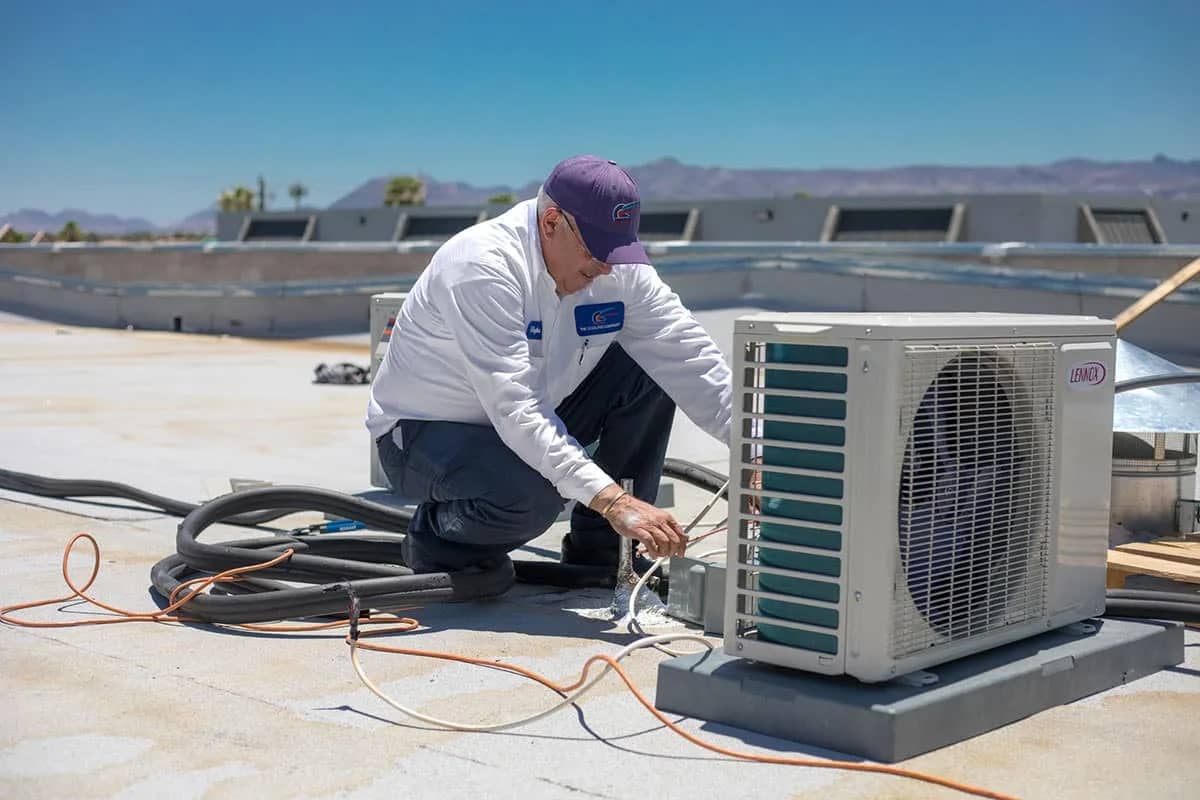
Short answer: Multi-zone HVAC systems allow independent temperature control for each area of a luxury home — master suites, guest rooms, living areas, wine cellars, home theaters, garages, and outdoor living spaces can each maintain their own setpoint simultaneously. In Las Vegas, where a west-facing great room might need 4 tons of cooling while the east-facing master bedroom needs 1.5 tons, zoning eliminates the compromise of a single-thermostat system. The three main approaches are ducted zoning with motorized dampers (retrofit-friendly, $3,000-$8,000 per zone), variable refrigerant flow (VRF) systems ($6,000-$12,000 per indoor unit installed), and ductless mini-split systems ($3,500-$7,000 per zone). The right choice depends on the home's size, construction type, and the level of control required.
See our HVAC zoning services for residential and custom home applications.
The Single-Thermostat Problem in Large Las Vegas Homes
A 5,000-square-foot Las Vegas home with a single thermostat and a single HVAC system has a fundamental problem: the thermostat is in one location, and it controls the climate for the entire house based on the temperature at that one point. Meanwhile, the thermal loads across the home vary enormously.
The west-facing great room with 12-foot ceilings and floor-to-ceiling windows absorbs massive solar heat gain from 2:00 PM to sunset. The east-facing master bedroom, shaded by the house itself during afternoon hours, stays comfortable with minimal cooling. The wine cellar needs to maintain 55 degrees F year-round. The home theater, loaded with electronics and bodies during movie night, generates 3,000-5,000 BTU of internal heat. The guest wing, unoccupied most of the time, wastes energy being cooled to the same temperature as the rest of the house.
A single thermostat cannot solve this. When the thermostat reads 75 degrees in the hallway, the great room is 82 and the master bedroom is 68. The homeowner turns the thermostat down to cool the great room, and the bedroom becomes an icebox. This is not a system malfunction — it is a design limitation.
Multi-zone HVAC eliminates this limitation by treating each area of the home as an independent climate zone with its own thermostat, its own temperature sensor, and its own ability to call for heating or cooling independent of every other zone.
How HVAC Zoning Works
At its core, zoning divides a home into independently controlled climate zones. Each zone has a thermostat or sensor that communicates with a zone control panel, which directs conditioned air (or refrigerant, in ductless systems) only to the zones that are calling for it.
Ducted Zoning with Motorized Dampers
The most common zoning approach for luxury homes that already have (or are being built with) traditional ducted HVAC systems.
How it works:
- Motorized dampers are installed in the ductwork at each zone's branch take-off
- A zone control panel receives signals from multiple thermostats
- When a zone calls for cooling, the panel opens that zone's damper and signals the HVAC system to run
- When a zone is satisfied, the damper closes, redirecting airflow to zones that still need conditioning
- A bypass damper or variable-speed blower manages excess static pressure when only one or two zones are calling
Best for:
- New construction where ductwork is designed for zoning from the start
- Existing homes where ductwork can accommodate damper installation
- Homes with 2-4 distinct zones (more than 4 zones pushes the limits of ducted zoning)
- Budgets that need to keep costs moderate while gaining zone control
Las Vegas considerations:
- Variable-speed air handlers are strongly recommended for ducted zoning in Las Vegas. Single-speed blowers at reduced airflow (when only one zone is calling) lose efficiency and can freeze the evaporator coil. A variable-speed blower adjusts airflow to match the number of open zones.
- Duct sizing must account for the highest-demand zone running independently. In Las Vegas, that is typically the zone serving the west-facing living areas during afternoon peak.
- Attic-mounted damper actuators must be rated for high-temperature environments. Standard actuators can fail prematurely at the 150+ degree attic temperatures common in Las Vegas summers.
Installed cost: $3,000-$8,000 per zone (dampers, thermostats, zone panel, and labor), plus the cost of a compatible variable-speed air handler if the existing system is single-speed.
Variable Refrigerant Flow (VRF) Systems
VRF technology, originally developed for commercial buildings, is increasingly specified in luxury residential applications where precise zone control and energy efficiency are priorities.
How it works:
- A single outdoor unit (or multiple units for large homes) connects to multiple indoor units via refrigerant piping
- Each indoor unit serves one zone and has independent temperature control
- The outdoor unit modulates compressor speed and refrigerant flow to match the exact demand of each indoor unit in real time
- Heat recovery VRF systems can simultaneously heat one zone while cooling another — for example, cooling the great room while heating the wine cellar air handler's reheat coil
Best for:
- Custom homes over 5,000 square feet with 5+ distinct zones
- Homes where different areas have dramatically different thermal loads (wine cellars, server rooms, gyms, home theaters)
- Homeowners who prioritize energy efficiency and are willing to invest in premium technology
- Homes where ductwork routing is difficult or architecturally undesirable
Las Vegas considerations:
- VRF outdoor units must be rated for high-ambient-temperature operation. Standard VRF units may derate (reduce capacity) above 115 degrees F. Specify units rated for 122 degrees F or higher outdoor ambient for Las Vegas.
- Refrigerant line runs can extend up to 500 feet from the outdoor unit, which accommodates large estate properties
- VRF systems achieve 20-30% energy savings compared to conventional systems in Las Vegas because they avoid the inefficiency of single-speed compressors running at full capacity when only partial cooling is needed
Installed cost: $6,000-$12,000 per indoor unit installed, including the proportional cost of the outdoor unit, refrigerant piping, controls, and commissioning. A 6-zone VRF system for a 6,000-square-foot home typically runs $50,000-$80,000 fully installed.
Ductless Mini-Split Systems
Ductless mini-split systems provide zone control with minimal construction impact, making them ideal for specific rooms or additions where running ductwork is impractical.
How it works:
- A wall-mounted, ceiling-cassette, or concealed indoor unit serves a single zone
- Each indoor unit connects to an outdoor unit via a small refrigerant line (3-inch wall penetration)
- Each zone operates completely independently
- Multi-zone outdoor units can support 2-8 indoor units
Best for:
- Additions, bonus rooms, and converted spaces (casitas, pool houses, guest suites)
- Homes where running ductwork would require significant construction
- Individual rooms with unique requirements (wine cellars, home offices, gyms)
- Supplemental cooling for hot spots in an otherwise adequate ducted system
Las Vegas considerations:
- Select outdoor units rated for high-ambient operation. Many mini-split outdoor units are rated to 115 degrees F, which is the minimum acceptable for Las Vegas — 122-degree-rated units provide more reliable operation during extreme heat events.
- Concealed (ducted) mini-split indoor units mounted in soffits or closets offer the same performance as wall-mounted units without the visible indoor unit — a common preference in luxury applications.
- Mini-split systems handle Las Vegas's dry climate well and do not have the humidity-related issues that occur in humid climates.
Installed cost: $3,500-$7,000 per zone for wall-mounted units; $5,000-$9,000 per zone for concealed ceiling-cassette or ducted units.
Specialty Climate Zones in Luxury Las Vegas Homes
Wine Cellar Cooling
Wine storage requires precise, year-round climate control that a standard HVAC system cannot provide. The requirements are specific:
- Temperature: 55 degrees F, maintained within +/- 2 degrees year-round
- Humidity: 55-70% relative humidity (too low dries corks; too high promotes mold)
- Air movement: Minimal — strong airflow disturbs sediment and dries labels
- Vibration: None — vibration from compressors or fans disrupts aging
System options for Las Vegas wine cellars:
- Self-contained wine cooling units ($2,000-$6,000): Through-wall or ducted units designed specifically for wine storage. Adequate for walk-in closet-sized cellars up to 500 cubic feet.
- Split-system wine cooling ($5,000-$12,000): A dedicated condensing unit (located remotely — in the garage, mechanical room, or outdoors) connected to an evaporator in the wine cellar. Eliminates compressor noise and vibration from the cellar space. Required for cellars over 500 cubic feet.
- VRF indoor unit dedicated to the wine cellar ($8,000-$15,000): Integrates the wine cellar into the whole-home VRF system. The VRF controller maintains the 55-degree setpoint year-round, and the heat recovered from cooling the wine cellar can be redirected to heat the pool or another zone.
Las Vegas-specific wine cellar challenge: The cooling load on a Las Vegas wine cellar is significant because the surrounding environment (garage, un-conditioned space, or exterior wall) can be 120-150 degrees F during summer. Insulation is critical — wine cellar walls, ceiling, and floor should be insulated to R-19 minimum (R-30 preferred for exterior walls), with a vapor barrier on the warm side to prevent condensation within the wall assembly.
Home Theater Climate Control
Home theaters present a unique HVAC challenge: they need precise temperature control, extremely low noise, and the ability to handle variable heat loads (a theater with 12 people generates significantly more heat than an empty room).
Requirements:
- Temperature: 70-72 degrees F (slightly cooler than living spaces, because seated audiences are less tolerant of warmth)
- Noise: NC-25 or lower (a standard HVAC register at normal airflow produces NC-30-35, which is audible during quiet dialogue scenes)
- Airflow: Diffused, not directional — drafts are distracting in a theater environment
Solutions:
- Oversized ductwork and low-velocity supply. Larger ducts at lower air velocity produce less noise. A theater zone typically needs ducts sized 50-75% larger than a standard room of the same size to achieve acceptable noise levels.
- Insulated flex duct for the last 6-10 feet. Rigid metal ductwork transmits blower noise. A transition to insulated flex duct before the registers dampens mechanical noise.
- Linear slot diffusers or perforated ceiling supply. These distribute air uniformly across the room without the drafts created by standard registers.
- Dedicated zone with variable-speed control. The theater zone should respond quickly when the room fills with people and scale back when empty.
Master Suite Whisper-Quiet Operation
The master suite in a luxury home demands the lowest possible noise from the HVAC system. Homeowners who invest $1-5 million in a home do not tolerate duct noise, compressor cycling hum, or air rush from registers while sleeping.
Strategies for quiet master suite operation:
- Variable-speed compressors and air handlers. These systems ramp up and down gradually rather than cycling on and off. The elimination of the startup noise alone makes a transformative difference.
- Remote equipment location. Keep the air handler, furnace, or VRF indoor unit at least 15 feet from the bedroom, separated by walls and insulated chases.
- Low-velocity register design. Size registers for face velocities below 300 FPM (feet per minute). Standard residential registers at 500+ FPM create audible air noise.
- Vibration isolation. Mount air handlers on vibration isolation pads or spring mounts. Connect ductwork to the air handler with flexible connectors rather than rigid sheet metal.
- Insulated supply boots. Wrap the last 4 feet of ductwork before the register in additional insulation to prevent conducted noise.
Target: NC-20 or lower in the master suite. For reference, NC-20 is the sound level of a quiet whisper at 5 feet. Most high-quality variable-speed systems can achieve this with proper design.
Outdoor Living Spaces
Las Vegas luxury homes increasingly include covered patios, outdoor kitchens, pool cabanas, and enclosed but unconditioned entertainment areas. These spaces present unique challenges:
- Covered patios with misting systems. Misting systems provide evaporative cooling that works well in Las Vegas's dry climate. HVAC-based cooling of outdoor spaces is generally impractical and energy-wasteful.
- Pool houses and casitas. Enclosed pool houses and casitas should have dedicated mini-split or VRF zones. They operate on different schedules than the main house and have distinct cooling loads (wet bodies, open doors, high solar gain through windows facing the pool).
- Enclosed outdoor kitchens. If the outdoor kitchen is enclosed enough to trap heat and smoke, it may need ventilation comparable to an indoor kitchen — including exhaust and make-up air.
Smart Controls and Home Automation Integration
Luxury home HVAC zoning systems should integrate with the home automation platform. The most common platforms in Las Vegas luxury homes are Control4, Savant, Crestron, and Lutron (lighting, with HVAC integration through third-party drivers).
What Smart Integration Provides
- Unified interface. All zones visible and controllable from a single touchscreen, phone app, or wall panel
- Scene-based control. "Movie night" dims lights, closes shades, and sets the theater zone to 70 degrees. "Away" sets all zones to 85 degrees except the wine cellar (55 degrees).
- Occupancy-based conditioning. Motion sensors or occupancy detectors in each zone allow the system to condition only occupied areas. A guest wing that is unoccupied for weeks reverts to setback temperatures automatically.
- Remote monitoring. Homeowners traveling internationally can monitor and adjust every zone remotely. System alerts (high temperature in the wine cellar, filter replacement due, equipment fault) push to the homeowner's phone.
- Energy reporting. Track energy consumption by zone and identify which areas of the home cost the most to condition.
Thermostat and Sensor Options
- Standard zone thermostats ($200-$500 each): Digital thermostats with temperature display and scheduling. Adequate but basic.
- Smart thermostats with occupancy sensing ($250-$500 each): Smart thermostats like Ecobee with room sensors provide temperature readings at multiple points within a zone. Learning algorithms optimize schedules based on usage patterns.
- Automation system integration ($500-$2,000 per zone): Custom integration with Control4 or Savant provides the highest level of control and the most seamless user experience, but requires a home automation installer for setup and maintenance.
- VRF native controls (included with system): VRF systems include manufacturer-provided zone controllers with centralized management capability. These integrate with some home automation platforms via BACnet or Modbus gateways.
Designing a Zoning System for a Las Vegas Luxury Home
Step 1: Define Zones Based on Use and Thermal Load
The most common zoning layout for a 4,000-8,000 square foot Las Vegas luxury home:
| Zone | Typical Setpoint | Special Requirements |
|---|---|---|
| Living/great room (west-facing) | 75 degrees F | Highest cooling load; variable-speed required |
| Kitchen/dining | 74 degrees F | Internal heat from cooking appliances |
| Master suite | 72 degrees F | Ultra-quiet operation (NC-20) |
| Guest bedrooms (2-4 rooms) | 76 degrees F (setback 82 when unoccupied) | Independent schedule per room |
| Home office | 73 degrees F | Daytime-only conditioning |
| Home theater | 70 degrees F | Low noise, variable occupancy |
| Wine cellar | 55 degrees F | Year-round, tight tolerance |
| Garage/workshop | 80 degrees F (summer), 60 degrees F (winter) | High cooling load from solar gain on garage doors |
Step 2: Select the Right Technology
| Home Size | Recommended System | Why |
|---|---|---|
| Under 3,500 sq ft, 2-3 zones | Ducted zoning with motorized dampers | Cost-effective, uses existing ductwork |
| 3,500-6,000 sq ft, 3-5 zones | Ducted zoning (2 systems) or VRF | Larger homes need multiple systems or VRF's modulation |
| Over 6,000 sq ft, 5+ zones | VRF or VRF + dedicated units | Most efficient, most precise, justifies the investment |
| Retrofit/addition | Ductless mini-splits | Minimal construction required |
| Wine cellar or server room | Dedicated split system | Specific temperature and humidity requirements |
Step 3: Size for Las Vegas Peak Conditions
Every zone must be sized for its individual peak load, not just the home's total divided equally. In Las Vegas:
- West-facing zones peak at 3:00-5:00 PM and need 30-50% more capacity per square foot than north-facing zones
- Second-floor zones with attic exposure need 20-30% more capacity than first-floor zones with the same floor area
- Rooms with vaulted ceilings need 15-25% more capacity than rooms with standard 9-foot ceilings
- A home theater zone should be sized for full-occupancy heat gain plus electronics heat, not empty-room conditions
The Cooling Company: Luxury Home HVAC Zoning in Las Vegas
The Cooling Company designs and installs multi-zone HVAC systems for custom homes and luxury estates throughout the Las Vegas Valley. We work directly with homeowners, architects, and builders to create zoning solutions that deliver room-by-room comfort without compromising noise levels, efficiency, or aesthetics.
Our team understands the thermal challenges unique to Las Vegas luxury homes — extreme west-facing solar loads, wine cellar cooling against 150-degree attic temperatures, and the need for systems that perform flawlessly when outdoor temperatures exceed 115 degrees. Call (702) 567-0707 to schedule a consultation.
Frequently Asked Questions
How many HVAC zones does a luxury home in Las Vegas need?
Most Las Vegas luxury homes between 4,000 and 8,000 square feet benefit from 4-8 independent zones. At minimum, west-facing living areas, the master suite, guest bedrooms, and any specialty spaces (wine cellar, home theater, home office) should each have independent control. Homes under 3,500 square feet typically need 2-3 zones. Homes over 8,000 square feet often need 8-12 zones or more. The right number depends on the home's layout, orientation, ceiling heights, and the homeowner's comfort expectations.
What is the quietest HVAC system for a luxury bedroom in Las Vegas?
Variable-speed systems — either variable-speed ducted systems or VRF with concealed indoor units — achieve the lowest noise levels. A properly designed variable-speed system with oversized ductwork, low-velocity registers, and remote equipment placement can achieve NC-20 or lower in a master suite, which is comparable to the background noise of a quiet rural area. The key factors are variable-speed operation (no startup cycling noise), low-velocity airflow through registers, and physical separation between the equipment and the bedroom.
Can I add zoning to my existing HVAC system in Las Vegas?
Yes, but with limitations. Ducted zoning with motorized dampers can be added to most existing duct systems, dividing the home into 2-4 zones. The existing air handler should ideally be variable-speed — adding zoning to a single-speed system requires a bypass damper and may reduce efficiency. For more than 4 zones or for adding control to individual rooms, ductless mini-splits are the most practical retrofit solution because they require only a small wall penetration for refrigerant lines, not new ductwork. A site evaluation determines what is feasible for your specific system and home.
How much does a whole-home VRF system cost for a Las Vegas luxury home?
A whole-home VRF system for a 5,000-8,000 square foot Las Vegas luxury home with 6-10 zones typically costs $50,000-$120,000 fully installed, including outdoor units, all indoor units, refrigerant piping, zone controls, and commissioning. This is 40-80% more than a conventional ducted system with zoning, but VRF delivers 20-30% lower energy costs, precise zone control, simultaneous heating and cooling capability, and 20-25 year equipment life. The payback period on energy savings alone is typically 8-12 years, with the comfort and control benefits realized immediately.
What temperature should I set my wine cellar in Las Vegas?
55 degrees F is the standard for long-term wine storage, maintained within a 2-degree tolerance year-round. Humidity should be 55-70% relative humidity. In Las Vegas, the biggest challenge is the cooling load — surrounding spaces (attics, garages, exterior walls) can reach 120-150 degrees F in summer, creating a massive temperature differential that the wine cooling system must overcome continuously. Proper insulation (R-19 minimum walls, R-30 on exterior walls) with a vapor barrier on the warm side is essential. A power outage during a Las Vegas summer heat wave can raise wine cellar temperatures above 80 degrees within 24-48 hours in a poorly insulated cellar.
Neighborhoods We Serve for Luxury Home HVAC
We design and install zoned HVAC systems in luxury homes across Summerlin, The Ridges, MacDonald Highlands, Ascaya, Henderson, Lake Las Vegas, Mountains Edge, Southern Highlands, Tournament Hills, and all Las Vegas Valley custom home communities.
Why Luxury Homeowners Trust The Cooling Company
- Serving Las Vegas since 2011
- 55+ years combined experience
- Licensed, EPA-certified technicians
- 100% satisfaction guarantee
- BBB A+ rated
- Lennox Premier Dealer
Service Area Map
Share This Page
Related reading: See our complete commercial HVAC guide for commercial zoning options. Learn about smart thermostat options for zone control integration.
Need Luxury Home HVAC Zoning in Las Vegas?
The Cooling Company provides expert HVAC zoning design and installation for luxury homes throughout Las Vegas, Henderson, and surrounding communities. Our licensed technicians deliver precision comfort systems tailored to your home's unique requirements.
Call (702) 567-0707 or visit HVAC zoning, AC installation, or ductless systems for details.