


Short answer: In Las Vegas, the ideal outdoor AC unit placement is the north or east side of your home with at least 24 inches of clearance on all sides, no direct afternoon sun exposure, and unobstructed airflow. Proper placement can extend your system's lifespan by 5-8 years and reduce cooling costs by 8-12% compared to a poorly placed unit. The worst location is the west side with no shade — exactly where many Las Vegas homes have their condensers installed. Call (702) 567-0707 for a free installation placement assessment or request a quote online.
Key Takeaways
- North-side placement keeps your condenser 15-25 degrees F cooler than west-side placement. That temperature difference translates to 8-12% better efficiency, lower energy bills, and 5-8 additional years of equipment life. In a climate where outdoor units already operate beyond their design limits for 60+ days per year, every degree matters.
- Minimum clearances are non-negotiable: 24 inches on all sides, 60 inches above. A condenser crammed into a tight corner between two walls recirculates its own exhaust heat and can overheat the compressor. This is the single most common code violation we find during home inspections across the Las Vegas Valley.
- Shade helps only when airflow is maintained. A shade sail mounted 3+ feet above the unit can reduce condenser inlet air temperature by 5-10 degrees F. A solid privacy fence 18 inches away traps heat and makes efficiency worse, not better.
- Refrigerant line distance matters more than most homeowners realize. Every additional foot of line between the condenser and indoor air handler costs efficiency. Under 25 feet is ideal. Over 50 feet introduces capacity loss and oil return problems that shorten compressor life.
- Relocating a poorly placed condenser costs $800-$2,500 and often pays for itself in 3-5 years through reduced energy bills and avoided repairs. If your system is already struggling and your condenser bakes in afternoon sun, relocation is one of the highest-ROI investments you can make.
- Clark County building code requires a minimum 4-6 inches above grade for condenser placement — critical in flash flood zones across Henderson, Summerlin, and parts of North Las Vegas. A flooded condenser is typically a total loss.
- HOA restrictions in Summerlin, Southern Highlands, Anthem, and Green Valley Ranch may dictate which side of your home the condenser can be placed on, equipment screening requirements, and noise limits. Check your CC&Rs before installation.
Why Condenser Placement Matters More in Las Vegas Than Anywhere Else
I have been managing AC installations across the Las Vegas Valley for over fifteen years. In that time, I have watched identical systems — same brand, same model, same tonnage, installed within weeks of each other in the same neighborhood — live dramatically different lives. One homeowner in Centennial Hills got 18 years from a Carrier system. His neighbor three doors down replaced the exact same model at 11 years. The equipment was identical. The maintenance schedules were similar. The difference was placement.
The first unit sat on the north side of the home, shielded from direct sun by the house itself, with ample clearance and good airflow. The second unit was wedged into a south-facing corner between the house and a block wall, in full afternoon sun, with barely 14 inches of clearance on one side. That second condenser spent every summer afternoon trying to reject heat into air that was already 140 degrees F at ground level. It never had a chance.
Here is why Las Vegas is different from almost every other market in the country. Most AC manufacturers rate their equipment for a design day of 95 degrees F. That is the outdoor temperature at which the system is engineered to deliver its rated capacity and efficiency. In Phoenix and Las Vegas, we exceed 95 degrees F for roughly 120 days per year and hit 110 degrees F or higher for 30-40 days. On those extreme days, your condenser is already operating 15-20 degrees beyond its design conditions. Every additional degree of heat from poor placement — sun-baked concrete radiating upward, a hot block wall reflecting heat sideways, recirculated exhaust air trapped in a corner — pushes the system further past its limits.
The consequences are cumulative and measurable. A condenser running in ambient temperatures 10-15 degrees F above the surrounding air temperature experiences higher refrigerant pressures, longer run times, greater electrical draw, and accelerated wear on the compressor, contactor, and capacitor. The compressor — the most expensive component in the system at $1,500-$3,500 to replace — is the component most affected by sustained high-temperature operation. It is also the component whose failure most often triggers a full system replacement rather than a repair.
Desert dust and sand add another layer of punishment. Las Vegas averages 15-20 significant dust events per year, and fine particulate matter accumulates on condenser coils regardless of placement. But a unit on the west side facing the prevailing wind direction catches more airborne debris than one on the sheltered north side. Coils clogged with dust and caliche cannot transfer heat efficiently, forcing the system to work harder and run longer — which generates more heat, which attracts more dust. It is a vicious cycle that proper placement can significantly mitigate.

The Four Sides of Your Home: Which One Wins?
Every home has four exterior walls, and the side you choose for your condenser placement makes a measurable difference in system performance and longevity. In Las Vegas, the sun's path creates dramatically different thermal environments on each side of your house. Here is what I have observed across thousands of installations throughout Henderson, Summerlin, North Las Vegas, Paradise, Enterprise, and every community in between.
North Side — The Best Location
The north side of your home never receives direct sunlight in the Northern Hemisphere. The house itself acts as a permanent shade structure. On a 115 degree F afternoon in July, the ground temperature on the north side of a typical Las Vegas home measures 100-110 degrees F. The ground on the west side of that same home measures 145-160 degrees F. That 40-50 degree F difference in ground surface temperature directly affects the air temperature surrounding the condenser.
North-side condensers in our service territory consistently outperform identical units on other sides of the same home. The compressor runs at lower pressures, the refrigerant subcooling stays in the optimal range, and the electrical draw drops by 8-12% compared to a sun-exposed unit. Over a 15-year equipment life, that efficiency advantage translates to $3,000-$6,000 in reduced energy costs — and significantly less wear on the compressor, capacitors, and contactors.
East Side — The Second Best Option
The east side receives morning sun only. By 11:00 AM to noon in summer, the house shadow covers the east wall and the ground beside it. This matters because peak AC demand in Las Vegas falls between 3:00 PM and 6:00 PM — precisely when the east side is already in shade. Morning sun exposure does raise ground and wall temperatures slightly, but the thermal mass has time to dissipate before the system hits its heaviest workload.
East-side placements perform within 2-4% of north-side placements in our measurements. If your home's layout, lot configuration, or refrigerant line routing makes the north side impractical, the east side is an excellent alternative.
South Side — Acceptable With Shade
The south side receives direct sun for most of the day — roughly 10-12 hours in summer. Without intervention, a south-side condenser operates in conditions similar to a west-side unit. However, the south side is uniquely suited to shade mitigation because the sun angle is high and predictable. A properly designed shade structure — an awning, shade sail, or architectural extension — can reduce the effective solar load on a south-side condenser to levels comparable to an east-side placement.
If the south side is your only viable option, budget $300-$800 for a shade solution and you can recover most of the efficiency loss.
West Side — The Worst Location
The west side is where good condensers go to die early. It receives direct afternoon sun from approximately noon to sunset — and the sun angle is low enough in the afternoon that it hits the condenser coils almost directly rather than from overhead. The western wall and surrounding hardscape absorb solar radiation all afternoon and radiate it back as infrared heat well into the evening.
On a 115 degree F day, I have measured ground-level air temperatures of 135-145 degrees F on the west side of homes in Enterprise and Paradise. That means a west-side condenser is trying to reject heat into air that is 20-30 degrees hotter than the already extreme ambient temperature. The SEER rating printed on the equipment nameplate becomes meaningless under those conditions.
Here is a comparison of what each side of your home means for your condenser:
| Home Side | Peak Sun Exposure | Ground Temp at 4 PM (115 F Day) | Efficiency Impact vs. North | Recommendation |
|---|---|---|---|---|
| North | None (always shaded by house) | 100-110 F | Baseline (best) | Ideal — first choice for every install |
| East | Morning only (6 AM - noon) | 110-120 F | 2-4% lower | Excellent — shaded during peak demand |
| South | All day (10-12 hours) | 125-140 F | 6-10% lower | Acceptable with shade structure |
| West | Afternoon (noon - sunset) | 135-160 F | 8-12% lower | Avoid — worst placement in desert climate |
Clearance Requirements That Contractors Sometimes Ignore
Clearance is not a suggestion. It is an engineering requirement backed by manufacturer specifications, building codes, and thermodynamic reality. A condenser works by pulling ambient air through its coils, absorbing heat from the refrigerant, and exhausting that heated air upward through the top of the unit. If any part of that airflow cycle is restricted, the system cannot reject heat efficiently and the compressor works harder, runs hotter, and fails sooner.
Minimum 24 inches on all sides. This is the baseline requirement from virtually every manufacturer — Carrier, Lennox, Trane, Rheem, Goodman, and others all specify a minimum of 24 inches of unobstructed space around the unit. This allows adequate air intake through the coil fins on all sides. Some high-efficiency units with larger coil surface areas require 30 inches.
60 inches of vertical clearance. The top of the condenser exhausts hot air upward at 10-15 mph. If that air hits a low eave, patio cover, or balcony within 60 inches, it recirculates back down into the intake. The condenser ends up trying to cool itself with its own exhaust — a condition we call short-cycling the airflow. I see this routinely in homes across Summerlin and Green Valley where condensers are placed under second-floor balconies or deep eave overhangs.
36 inches from vegetation, decorative rock walls, or fencing. Desert landscaping is popular across the valley, and homeowners often surround their condenser with decorative block walls or stacked stone for aesthetics. If these barriers are closer than 36 inches, they restrict intake air and trap radiated heat. The same applies to ornamental grasses, bougainvillea, and any vegetation that grows toward the unit over time.
Corner placements between two walls are efficiency killers. This is the most common clearance violation I encounter. The condenser sits in an L-shaped corner where the house wall meets a property wall or fence. Even if each wall individually provides 24 inches of clearance, the corner geometry creates a pocket where exhaust heat cannot escape laterally. The heated air pools, raises the ambient temperature around the unit by 10-20 degrees F, and the system runs as if the outdoor temperature is 125-135 degrees F when it is actually 115 degrees F. Over a full summer, this corner-pocket effect can add $200-$400 to a homeowner's energy bill and take years off the compressor.
Clark County building code requirements govern condenser placement relative to property lines, egress paths, and setbacks. In Clark County's jurisdiction — which covers unincorporated areas including Paradise, Spring Valley, Enterprise, and Sunrise Manor — condensers must not block required egress paths and must comply with setback requirements from property lines. The City of Henderson, City of North Las Vegas, and City of Las Vegas each have their own codes that largely mirror these requirements but may differ in specifics. Your HVAC contractor should verify compliance during the installation planning phase, not after the concrete pad is already poured.
Common violations I see regularly: units placed within 12 inches of a property line (the neighbor's yard is not your clearance), units blocking the side gate or emergency egress path, and units installed under low eaves with less than 36 inches of vertical clearance. Each of these violates code and hurts performance.
The Refrigerant Line Distance Factor
The refrigerant lines connecting your outdoor condenser to your indoor air handler are the arteries of your AC system. Liquid refrigerant flows from the condenser to the evaporator coil through the smaller line, and cold refrigerant gas returns through the larger suction line. The length, routing, and insulation quality of these lines directly affect system capacity, efficiency, and compressor longevity.
Under 25 feet is ideal. At distances below 25 feet, refrigerant pressure drop is minimal, oil return to the compressor is reliable, and the system operates close to its rated capacity. Most single-story homes in Las Vegas with a condenser on the nearest exterior wall and an air handler in the garage or a central closet achieve line runs of 15-25 feet.
25-50 feet is acceptable with proper installation. At this distance, the installer must account for pressure drop when selecting the line diameter and may need to add refrigerant charge beyond the factory pre-charge. Insulation quality becomes more critical because every foot of line run exposed to attic temperatures leaches cooling capacity. Proper brazing, leak testing, and insulation wrapping are essential — not optional.
50+ feet introduces real problems. Beyond 50 feet of total equivalent line length (including vertical rises), you begin to see measurable capacity loss — typically 3-7% depending on the system and line diameter. Oil return becomes unreliable at longer distances, especially on systems with scroll compressors. Poor oil return means inadequate compressor lubrication, which means premature compressor failure — the $1,500-$3,500 repair that often triggers a full system replacement.
Two-story homes in communities like Seven Hills, Southern Highlands, and Anthem present a particular challenge. When the condenser sits at ground level on one side of the home and the air handler is in the attic above the second floor, the vertical rise alone can be 20-25 feet. Add horizontal distance and you are easily at 40-60 feet of total line run. In these situations, the installer must account for the vertical lift by ensuring proper oil traps and, in some cases, oversizing the suction line to maintain adequate gas velocity for oil return.
The lineset-in-the-attic problem. In many Las Vegas homes — particularly those with side-yard condensers and centrally located air handlers — the refrigerant lines run through the attic for 10-30 feet. Attic temperatures in Las Vegas reach 150-170 degrees F in summer. Even with insulation on the suction line, some heat transfer is unavoidable. A suction line entering the evaporator coil at 65 degrees F instead of 55 degrees F reduces cooling capacity and increases compressor superheat. If your lines run through the attic, insulation quality is not a nice-to-have — it is a performance requirement. We recommend R-6 or higher insulation for any attic-routed refrigerant lines, and we inspect insulation condition on every service call.
When choosing condenser placement, shorter refrigerant line runs should always be a factor in the decision. Sometimes the "best" side of the house for sun exposure is the worst side for line distance. A good installer weighs both factors. As a general rule, moving from the north side to the east side to save 20 feet of line run is usually worth the tradeoff. Moving to the west side to save line distance almost never is. For more on how your home's air distribution system affects AC performance, see our ductwork assessment guide.
Shade Strategies That Actually Work (And One That Backfires)
Shade is the most misunderstood factor in condenser placement. Homeowners hear that shade helps AC efficiency — which is true — and then build or buy something that actually makes things worse. The key principle is simple: shade helps only when airflow is maintained. Block the sun without blocking the air, and you gain 5-10% efficiency. Block the air while blocking the sun, and you lose more than you gain.
Here is what works and what does not.
Strategies That Improve Efficiency
Shade sails mounted 3+ feet above the unit. A UV-resistant shade sail stretched between the house wall and posts, positioned at least 36 inches above the top of the condenser, blocks direct solar radiation while allowing hot exhaust air to escape freely upward and outward. This is the most cost-effective shade solution I recommend — typically $150-$400 for materials and basic installation. In testing, shade sails reduce condenser inlet air temperature by 5-10 degrees F during peak afternoon hours.
Awnings attached to the house extending over the unit. A fixed or retractable awning mounted on the house wall above the condenser achieves the same effect as a shade sail with a cleaner aesthetic. This works particularly well on south-facing placements where the sun angle is predictable. Budget $200-$600 for a permanent awning installation.
Desert landscaping trees planted 6+ feet away. Mesquite, palo verde, and other desert-adapted trees planted at least 6 feet from the condenser provide natural shade without restricting airflow. The critical detail is the 6-foot minimum distance. Tree roots can damage the concrete pad, falling leaves and seed pods can accumulate on the coil, and branches that grow toward the unit over 3-5 years will eventually restrict airflow if they are too close. I have seen mesquite trees provide excellent condenser shade in neighborhoods across Henderson and Green Valley — but only when planted with future growth in mind.
Strategies That Make Things Worse
Solid privacy fences or walls within 2 feet. This is the most common mistake I see. A homeowner builds a 6-foot solid block wall or wood fence 18-24 inches from the condenser to hide it from view. The fence blocks airflow through the coil on that side, traps radiated heat between the fence and the unit, and creates a thermal pocket that raises ambient temperature around the condenser by 10-20 degrees F. The condenser now works harder than it would with no shade at all. If you need screening for aesthetics or HOA compliance, use slatted fencing with at least 50% open area, positioned 36+ inches from the unit.
Condenser covers or blankets during operation. I need to be direct: never cover your condenser while it is running. I have received service calls where a homeowner placed a tarp or insulated blanket over the unit to "protect it from the sun" and then ran the AC. The unit overheated within minutes. Condenser covers have a place — they protect the unit from hail or heavy debris during the off-season (if you even have an off-season in Las Vegas). They have no place on an operating system.
Enclosure boxes or decorative cages with solid tops. Decorative condenser enclosures sold at home improvement stores look nice in the catalog but most have solid or near-solid tops that trap exhaust heat. If you must use an enclosure, verify it has a completely open top and at least 36 inches of clearance on all sides. Most off-the-shelf enclosures fail both tests.
Elevation and Flood Risk in the Las Vegas Valley
Las Vegas is a desert, but it floods. The valley floor is a shallow basin surrounded by mountains, and when monsoon storms drop heavy rain between July and September, water flows downhill fast with nowhere to soak in. Flash flooding is a documented hazard in portions of Henderson, parts of Summerlin near Red Rock, northwest Las Vegas near the Centennial Hills foothills, and multiple wash crossings throughout North Las Vegas and the eastern valley.
Clark County code requires condensers to be elevated a minimum of 4-6 inches above surrounding grade. This is not excessive caution — it is the bare minimum. I have seen condensers in flood-prone areas of Enterprise and Paradise that were installed at grade level and destroyed in a single monsoon event. A flooded condenser is almost always a total loss. Water enters the electrical components, corrodes the contactor and capacitor connections, contaminates the compressor oil, and saturates the fan motor bearings. The repair cost often exceeds the value of the equipment.
Condenser pad options. The standard installation uses a pre-cast concrete pad or a composite polymer pad (brands like DiversiTech) rated for the unit's weight. In flood-risk areas, I recommend a raised concrete pad poured 6-8 inches above grade with a slight crown for drainage. The additional cost is $100-$300 — trivial insurance against a $4,000-$8,000 equipment loss. For homes with known drainage issues, a pad raised 12 inches above grade with gravel drainage underneath provides the highest level of protection.
Desert soil settling and expansion. Las Vegas soils — particularly the caliche-heavy clay soils common in Henderson and the eastern valley — expand when wet and contract when dry. Over 10-15 years, this cycle can shift a condenser pad enough to tilt the unit, stress refrigerant line connections, and cause vibration issues. A properly compacted gravel base beneath the pad minimizes settling. When I inspect older systems in neighborhoods like Green Valley, Silverado Ranch, and the older sections of North Las Vegas, pad settling is a common finding that most homeowners never noticed until we pointed it out.
Monsoon drainage considerations. Water should always flow away from the condenser pad, not toward it. If grading around the unit directs storm runoff toward the equipment, a French drain or simple re-grading can redirect water. This is a $200-$500 investment that prevents thousands in potential damage. During installation planning, I always evaluate the drainage slope around the proposed condenser location — it takes five minutes with a level and saves enormous headaches during monsoon season.
Noise, Neighbors, and HOA Rules
Condenser noise is a placement factor that homeowners often ignore during installation and regret for the next 15 years. A standard single-stage condenser operates at 72-80 decibels measured at 3 feet — roughly the volume of a vacuum cleaner. That sound is acceptable outside your garage. It is not acceptable outside your bedroom window or your neighbor's bedroom window.
Clark County noise ordinance limits equipment noise to 65 dB measured at the property line during daytime hours and 55 dB at night. Most condensers comply at the property line if placed at least 10-15 feet from the line. But place that same unit 5 feet from the property line — which happens frequently on narrow lots in Paradise, downtown Las Vegas, and older Henderson subdivisions — and you may exceed the nighttime limit. Noise complaints are rare but enforceable, and the remedy is expensive: relocating the unit or replacing it with a quieter model.
HOA restrictions across the valley add another layer. Communities in Summerlin, Anthem in Henderson, Green Valley Ranch, Southern Highlands, Seven Hills, and The Lakes each have CC&R provisions addressing exterior mechanical equipment. Common restrictions include: required screening (slat fencing or walls that, as we discussed, can hurt efficiency if too close), placement only on specific sides of the home, maximum noise levels stricter than county code, and setback requirements from shared walls in attached homes or townhomes.
Placement relative to bedroom windows — both yours and your neighbors' — deserves serious consideration. A condenser on the north side of your home is thermally ideal, but if the north side faces your neighbor's master bedroom 12 feet away, you have a noise problem. The solution is not to move the unit to the thermally inferior west side but to invest in a variable-speed condenser that operates at 56-65 dB at low speed — which is where it spends most of its runtime. Variable-speed units from Carrier, Lennox, and Trane run at full speed only during peak demand. The rest of the time, they modulate down to 40-60% capacity, and noise drops proportionally.
Sound blanket wraps are an aftermarket solution that reduces condenser noise by 3-5 dB. They wrap around the compressor inside the condenser cabinet and absorb vibration. At $100-$200 installed, they are a cost-effective option for existing units that are louder than desired. They do not restrict airflow when properly installed.
For a deeper look at quiet AC options, including specific models and decibel ratings, see our guide to quiet AC systems.
Common Placement Mistakes I See Every Week
After fifteen years and thousands of installations, service calls, and home inspections across the Las Vegas Valley, I have developed a mental catalog of condenser placement failures. Some are understandable — a homeowner working within the constraints of a small lot. Others are inexcusable — a contractor who chose convenience over performance. Here are the ones I see most often.
Unit directly under the dryer vent. Lint from a clothes dryer is the fastest coil killer I know. A condenser placed below or adjacent to a dryer exhaust vent will accumulate lint on the coil fins within weeks. Within months, the coil is so clogged that the system cannot reject heat and the compressor overheats. I have seen dryer lint completely plug a condenser coil in a single summer in homes across Centennial Hills and Aliante. The fix is simple — relocate the dryer vent or relocate the condenser. The cost of ignoring it is a $2,000-$3,500 compressor replacement or a $1,200-$1,800 coil cleaning and repair.
Unit next to the outdoor grill or kitchen. Outdoor kitchens are popular in Las Vegas, and for good reason — the climate supports year-round outdoor cooking. But a condenser placed 3-4 feet from a gas grill or outdoor kitchen vent draws grease-laden air through its coils. Grease plus desert dust creates a sticky, insulating layer on the coil surface that is far harder to clean than dust alone and degrades heat transfer faster than any other contaminant I have encountered. Keep condensers at least 10 feet from any cooking appliance exhaust.
Unit in a fully enclosed equipment cage with no airflow. I mentioned this in the shade section, but it bears repeating here because I encounter it so frequently. Homeowners — often at the HOA's direction — build or buy a full enclosure around the condenser for aesthetics. If that enclosure has a solid top, solid sides with less than 50% open area, and less than 36 inches of clearance, it is an oven. The condenser overheats, the high-pressure safety switch trips, and the system short-cycles until something fails. I have diagnosed brand-new systems less than two years old that were already showing compressor damage because of inadequate enclosure design.
Unit at ground level where landscaping gravel piles against it. Desert landscaping typically uses decorative rock, and over time that rock migrates. I routinely find condensers in homes throughout Henderson, Summerlin, and Green Valley with 4-6 inches of gravel piled against the base of the unit, restricting airflow through the lower coil fins and trapping moisture against the base pan. The base pan corrodes, the coil fins get damaged, and the system loses efficiency gradually enough that the homeowner does not notice until the first 115 degree F day when the system cannot keep up.
Dogs urinating on condenser fins. This one surprises people, but it is a genuine and common problem. Dog urine is acidic — pH 5.5-7.0 — and when applied repeatedly to aluminum condenser fins, it causes corrosion that eats through the fin material and eventually penetrates the copper tubing. I have replaced condenser coils that looked like they had been dipped in acid, and the cause was a family dog that had chosen the condenser as its preferred territory marker for years. If you have dogs and a ground-level condenser, consider a decorative barrier that keeps the dog 24+ inches away while maintaining airflow — an open-slatted fence or a row of large decorative pots works well.
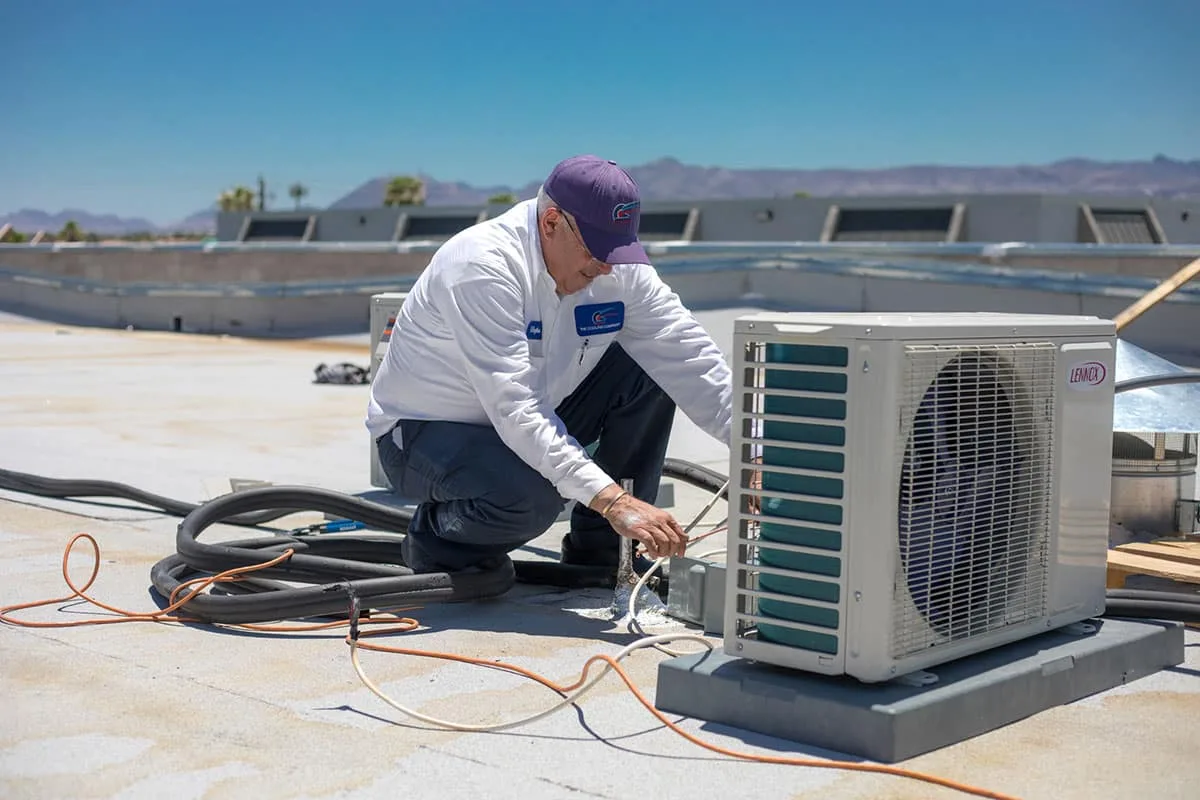
Unit on the roof without proper vibration isolation. Rooftop condensers must be mounted on vibration-isolating curbs or spring mounts. Without them, compressor vibration transmits directly through the roof structure into the living space below. I have been in homes in the older sections of Las Vegas — particularly near downtown and the Arts District — where the homeowner could feel the AC compressor cycling on and off through the ceiling. Beyond the noise and comfort issue, direct vibration transfer accelerates fatigue on refrigerant line joints and electrical connections.
Roof-Mounted vs Ground-Level: The Las Vegas Debate
Many Las Vegas homes — especially single-story ranch homes built from the 1960s through the 1980s — were originally equipped with rooftop package units or rooftop condensers. This was common practice in the desert Southwest during that era: flat roofs made rooftop installation easy, yard space was preserved, and the industry had not yet fully appreciated the thermal penalty of placing equipment on a sun-baked roof.
The case against roof mounting. A rooftop condenser sits on the hottest surface of your home. Flat roof surface temperatures in Las Vegas regularly exceed 170 degrees F in summer. The condenser is essentially sitting on a frying pan, surrounded by air that is 10-20 degrees F hotter than ground-level ambient temperature. It also catches the full force of wind-driven dust and sand, and it is exposed to UV radiation that degrades wiring insulation, refrigerant line insulation, and cabinet paint faster than a ground-level installation. Maintenance is more difficult and more expensive — every service call requires roof access, and many homeowners defer maintenance because of the inconvenience. Deferred maintenance in Las Vegas heat is a compressor death sentence.
The case for roof mounting. In certain home configurations, rooftop placement is the only practical option. Townhomes and zero-lot-line homes in communities like The Lakes, parts of Henderson, and downtown Las Vegas condominiums often have no yard space for a ground-level condenser. Some HOAs in these communities require rooftop placement to maintain streetscape aesthetics. In these situations, the thermal penalty is unavoidable, and the mitigation strategy shifts to equipment selection — choosing a unit rated for extreme ambient temperatures (look for models rated to 125 degrees F or higher), ensuring proper vibration isolation, and committing to biannual professional maintenance.
Ground-level is better in almost every measurable way. Cooler ambient air, easier maintenance access, lower installation cost (no crane or hoist needed), reduced vibration transfer to the home structure, and longer equipment lifespan. If you have the option, ground-level wins. The only ground-level disadvantage — flood risk and yard space — is manageable with a raised pad and thoughtful placement.
Transitioning from roof to ground. If you are replacing a rooftop system and have available yard space, consider relocating to ground level during the replacement. The additional cost for new refrigerant lines, electrical routing, and a concrete pad is typically $1,500-$3,500 — but the equipment will run cooler, last longer, cost less to maintain, and operate more efficiently for its entire 15-20 year lifespan. For many homeowners in the older neighborhoods of Las Vegas, this transition is one of the best investments they can make during a replacement.
What to Do If Your Current Unit Is in a Bad Location
If you have read this far and realized your condenser is in a bad spot — west-facing, in a tight corner, under the dryer vent, baking in full afternoon sun — you have three options, each with different costs and benefits.
Option 1: Relocate the condenser. This involves disconnecting the refrigerant lines, moving the unit to a new pad on a better side of the home, running new refrigerant lines and electrical, and reconnecting everything. Cost: $800-$2,500 depending on the distance moved and whether new lines are needed. This is the most effective solution and the one I recommend whenever the current placement is significantly hurting performance. A condenser relocated from the west side to the north side of a typical Las Vegas home recovers 8-12% efficiency immediately. At an average summer electric bill of $300-$400 per month, that is $25-$50 per month in savings — which means the relocation pays for itself in 2-5 years, and the remaining 10-15 years of the equipment's life are pure savings.
Option 2: Add a shade structure. If the condenser's location is otherwise acceptable — adequate clearance, good airflow, reasonable line distance — but it bakes in afternoon sun, a shade structure is the fastest and cheapest intervention. A shade sail, awning, or pergola-style cover mounted 3+ feet above the unit costs $200-$800 and recovers 5-10% efficiency during peak sun hours. This is the right move when relocation is impractical or when the unit is nearing end of life and full relocation does not justify the investment.
Option 3: Replace with a higher-efficiency unit rated for extreme heat. If your system is already 10-15 years old and struggling in a bad location, the most economical path may be a full replacement with a unit engineered for extreme ambient temperatures. Modern variable-speed condensers from Carrier, Lennox, and Daikin are rated for operation at 125 degrees F and higher, with compressors and coil designs optimized for desert conditions. Combined with a better placement during the new installation, this approach solves both the equipment age problem and the placement problem simultaneously.
No matter which option you choose, the first step is the same: an honest assessment of your current placement and its impact on performance. That is something we do during every service call and every installation consultation — because fixing the placement problem is often the highest-ROI recommendation we can make.
Frequently Asked Questions
Where is the best place to put an outdoor AC unit in Las Vegas?
The north side of your home is the best location for an outdoor AC unit in Las Vegas. It never receives direct sunlight, stays 15-25 degrees F cooler than the south or west side, and allows your condenser to operate 8-12% more efficiently during peak summer heat. The east side is the second-best option because it only receives morning sun and is shaded during the critical 3-6 PM peak demand hours. Always ensure at least 24 inches of clearance on all sides and 60 inches above the unit regardless of which side you choose.
How far should an AC condenser be from the house?
Manufacturers require a minimum of 24 inches between the condenser and the house wall. This clearance allows adequate airflow through the coil fins for proper heat rejection. Some high-efficiency models with larger coil areas require 30 inches. The vertical clearance above the unit should be at least 60 inches to prevent hot exhaust air from recirculating. If your condenser is placed in a corner where two walls meet, ensure at least 36 inches of clearance to prevent the heat-trapping pocket effect that raises ambient temperature around the unit by 10-20 degrees F.
Does shading your AC unit save money?
Yes — but only when done correctly. A shade structure that blocks direct sunlight while maintaining full airflow around and above the condenser can reduce cooling costs by 5-10% during peak summer months. For a Las Vegas home with $300-$400 monthly summer electric bills, that is $15-$40 per month in savings. However, a solid fence, wall, or enclosure that blocks airflow while providing shade will actually increase costs by forcing the system to work harder. The rule is simple: shade the unit from above, never enclose it from the sides.
Can I put my AC unit on the roof?
You can, but ground-level placement is better in almost every measurable way. A rooftop condenser sits on a surface that reaches 170+ degrees F in Las Vegas summers, surrounded by air 10-20 degrees F hotter than ground level. It runs less efficiently, costs more to maintain (every service call requires roof access), and has a shorter lifespan. Rooftop placement makes sense only when ground-level space is unavailable — townhomes, zero-lot-line homes, and some condominiums in downtown Las Vegas and The Lakes. If you are replacing a rooftop unit and have yard space, consider relocating to ground level for $1,500-$3,500 — the long-term savings in efficiency and maintenance typically exceed the relocation cost.
How much clearance does an outdoor AC unit need?
The minimum is 24 inches on all sides and 60 inches above the top of the unit. These are manufacturer-specified requirements, not suggestions. You also need 36 inches from any vegetation, decorative rock walls, or fencing. Corner placements where two walls meet are especially problematic — even if each wall individually provides 24 inches, the corner geometry traps exhaust heat and raises the effective ambient temperature by 10-20 degrees F. Clark County building codes also require that the unit not block emergency egress paths and comply with property line setbacks.
Can I build a fence around my AC unit?
You can, but it must be designed to preserve airflow. A solid fence within 2 feet of a condenser traps heat and reduces efficiency — sometimes worse than having no fence at all. If you need screening for aesthetics or HOA compliance, use slatted fencing with at least 50% open area positioned a minimum of 36 inches from the unit on all sides, with no top covering. Louvered fencing panels angled to deflect sound while allowing air through are the best option. Many HOAs in Summerlin, Southern Highlands, and Anthem require equipment screening — work with your HVAC contractor to design a solution that satisfies the HOA without hurting system performance.
Does desert dust damage outdoor AC units?
Yes. Las Vegas averages 15-20 significant dust events per year, and fine desert particulates accumulate on condenser coils continuously. Dust buildup insulates the coil surface, reducing heat transfer efficiency and forcing the compressor to work harder and run hotter. Over a season without cleaning, a heavily dusted coil can lose 10-15% of its heat rejection capacity. Caliche — the calcium carbonate mineral common in Las Vegas soil — is particularly problematic because it bonds to aluminum fins when mixed with moisture and is difficult to remove without professional cleaning. I recommend professional coil cleaning at least twice per year in Las Vegas: once in spring before cooling season and once in mid-summer to clear accumulated dust from monsoon-season storms.
How often should I clean my outdoor AC unit in Las Vegas?
Professional coil cleaning should happen at least twice per year: once in April or May before cooling season begins, and once in August or September after the peak of monsoon-season dust storms. Between professional cleanings, homeowners should rinse the condenser coils monthly with a garden hose — spraying from inside out to push debris off the coils rather than further into them. Never use a pressure washer, which can bend the delicate aluminum fins and create permanent airflow restrictions. If you live in an area with heavy construction activity — many neighborhoods in North Las Vegas, Inspirada, and Cadence qualify — increase the rinsing frequency to every two weeks during active construction phases.
Can I relocate my existing outdoor AC unit?
Yes. Condenser relocation involves disconnecting the refrigerant lines and electrical, moving the unit to a new concrete or composite pad, running new refrigerant lines and electrical wiring to the new location, and reconnecting and testing the system. Cost ranges from $800 for a short move (same side of the house, just repositioned for better clearance) to $2,500 for a full relocation to a different side of the home requiring new line runs. The investment pays for itself in 2-5 years through improved efficiency if the current placement is significantly hurting performance. A licensed contractor should evaluate the new location for sun exposure, clearance, line distance, drainage, and code compliance before committing to the move.
Do HOAs in Las Vegas restrict where I can put my AC unit?
Many do. Master-planned communities including Summerlin, Anthem, Green Valley Ranch, Southern Highlands, Seven Hills, Inspirada, and Providence have CC&R provisions governing exterior mechanical equipment. Common restrictions include placement only on specific sides of the home (typically away from street-facing elevations), required screening or enclosures, maximum noise levels (sometimes stricter than the Clark County ordinance), and minimum setbacks from shared walls in attached homes. Review your CC&Rs before installation and submit an architectural review application if required. Your HVAC contractor should be familiar with the major HOA requirements in your community — if they are not, that is a red flag.
Related Reading
- AC Installation Services in Las Vegas — full installation assessment including placement evaluation
- AC Repair Services — same-day diagnostics for condensers struggling with heat or placement issues
- Why Your New AC Needs a Ductwork Assessment — the other factor that determines whether your new system performs
- Quiet AC Options for Las Vegas — decibel ratings, variable-speed technology, and noise reduction strategies
- AC Not Cooling Troubleshooting Guide — when poor placement contributes to cooling failures
- AC Replacement Cost by Las Vegas Neighborhood — how placement and home age affect replacement costs across the valley
- Best Air Conditioners for Extreme Heat (2026) — systems engineered to handle 115+ degree F ambient temperatures
- Desert Dust Damage to Air Conditioners — how Las Vegas dust affects your outdoor unit and what to do about it
Planning a new AC installation or thinking about relocating your existing unit? Call us at (702) 567-0707. We evaluate placement as part of every installation quote — because where your condenser goes matters as much as which brand you choose. Nevada C-21 license #0075849.