

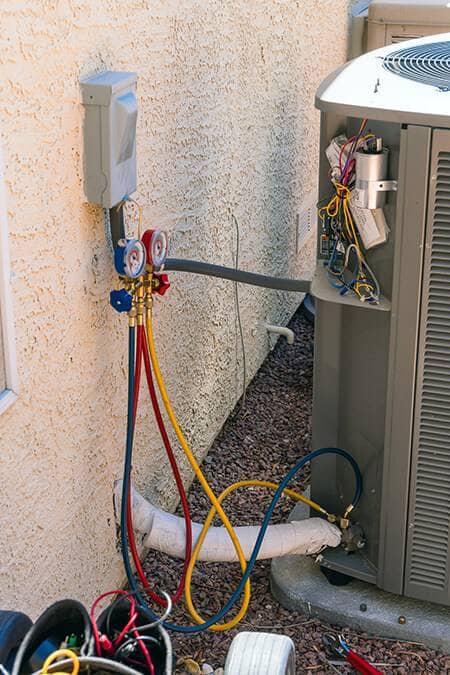
Short answer: Most AC units in Las Vegas last 10–14 years — compared to 15–20 in cooler climates — because they run 2,500–3,500 hours per year in extreme heat. The clearest signs you need replacement: your system is over 12 years old and needs a repair exceeding $1,500, your energy bills have climbed 20–30% without explanation, your unit uses R-22 refrigerant (banned since 2020 and now astronomically expensive), or your system simply cannot maintain 75°F when it's 110°F outside. If two or more of these apply, you're almost certainly past the repair-or-replace tipping point.
Call (702) 567-0707 for a free replacement assessment, or visit our AC replacement page to learn more.
Key Takeaways
- Las Vegas AC units age in dog years. A 12-year-old system here has worked as hard as a 20-year-old system in Chicago. The extreme heat, 2,500–3,500 annual operating hours, and UV exposure accelerate every form of wear.
- Use the 5,000 Rule. Multiply your system's age by the estimated repair cost. If the number exceeds $5,000, replacing your heating and air conditioning system is almost always smarter than repair.
- R-22 refrigerant is a dealbreaker. It was phased out in 2020 and now costs $100–$200 per pound. A system that needs a refrigerant recharge could cost $800–$2,500 just for the refrigerant — plus the underlying leak repair. At that point you're funding a dying system.
- A new high-efficiency system saves real money. Replacing a 10-SEER unit with a 16 SEER2 system cuts cooling costs by roughly 37%. In Las Vegas, that's $600–$1,200 per year in energy savings on the average home.
- Stack your incentives before signing anything. NV Energy rebates (up to $2,000), federal 25C tax credits (up to $2,000), and manufacturer promotions can reduce your net cost by $3,000–$4,000 on qualifying systems.
How Las Vegas Ages AC Units Faster Than Anywhere Else
Before we get into the specific warning signs, it helps to understand why the standard rule-of-thumb — "AC units last 15–20 years" — simply doesn't apply here.
In Las Vegas, your AC runs from roughly May through October at near-maximum load. On a 115°F July day in Summerlin or Henderson, a typical 3-ton system might run 18 hours straight. That's not exaggeration — it's physics. The system is fighting a 40-degree temperature differential between inside and outside, all day long. In Minneapolis, that same system might run 6–8 hours total on their hottest days of the year.
Add in the UV radiation baking the outdoor unit on a south-facing pad, the alkaline well water that accelerates coil corrosion, and the constant wind-blown dust clogging condenser fins, and you have a recipe for equipment that ages at roughly double the national average. We tell homeowners that a Las Vegas AC unit ages in "dog years" — every calendar year is closer to two years of mechanical wear.
The practical result: plan for replacement at 10–14 years, not 15–20. Systems that make it to 15 years here are genuinely uncommon, and they've almost always had exceptional maintenance histories. Factor in that HVAC efficiency standards have risen dramatically — a system installed in 2010 operates at SEER ratings that are now considered bottom-tier — and the financial math of replacement gets even more compelling as your system ages.
With that context in place, here are the 10 signs that tell you it's time to stop repairing and start replacing.
Sign #1: Your System Is 12+ Years Old
Age alone isn't an automatic replacement trigger. But once your system crosses the 12-year mark in Las Vegas, it belongs in a different decision framework. Every repair you make on an old system buys a smaller amount of remaining useful life for the same dollar spent.
Here's why: the major components — the compressor, the evaporator coil, the condenser coil, the blower motor — all wear together. When your 13-year-old system needs a new capacitor today, it doesn't mean just the capacitor is failing. It means the capacitor was the first component to fail on a system where every component has 13 years of Las Vegas desert wear. The compressor is right behind it. So is the contactor. So is the refrigerant line set, which gets brittle after years of UV exposure and thermal cycling.
Systems manufactured before 2010 also predate the current SEER rating standards. A 2008 system was legally sold at 10 SEER. Today's minimum is 14.3 SEER2 (which translates to roughly 15–15.5 SEER under the old test methodology). That's a 50% efficiency improvement built into even the most basic new equipment. In a market where you run your AC 2,500–3,500 hours per year, that efficiency gap represents $500–$1,000 annually in wasted electricity on the average Las Vegas home.
The threshold: If your system is 12 years old or older, factor age into every repair decision. If it's 15+ years old and needs anything more than a capacitor or contactor swap, replacement deserves serious consideration regardless of what the repair costs.
You can check your system's age by locating the nameplate on the outdoor condenser unit. The manufacture date is encoded in the serial number — the format varies by brand, but most manufacturers use the first four digits to indicate week and year, or year and week. If you can't decode it, we can identify the age during any service call.
Sign #2: Repair Bills Are Stacking Up
One $400 repair on a 10-year-old system? Probably fine. Two $800 repairs in the same year? Now we're having a different conversation.
The industry standard framework is the 5,000 Rule: multiply your system's age (in years) by the cost of the current repair (in dollars). If the result exceeds $5,000, replace. A $600 repair on a 6-year-old system gives you 3,600 — repair it. A $600 repair on a 10-year-old system gives you 6,000 — replacement is worth serious consideration. A $1,200 compressor repair on a 12-year-old system gives you 14,400 — replace without hesitation.
We also use the 50% Rule as a gut check: if the repair costs more than 50% of what a replacement system would cost, replace. A compressor replacement on an older system can run $1,800–$3,200 parts and labor. If replacement would cost $7,000–$8,000, the math still might favor repair — but if you're looking at a $3,000 compressor job on a system that needs a new coil in two years anyway, you've just turned a $3,000 problem into a $10,000 one over three years.
Our detailed breakdown at the AC repair cost guide covers the full spectrum of repair costs and how to think about each one relative to system age. And if you're genuinely torn, the repair-or-replace guide walks through the full decision framework in detail.
Specific repair costs that almost always justify replacement on older systems:
- Compressor replacement: $1,800–$3,200 (if the system is 10+ years old, the compressor warranty has expired and the rest of the system is comparably aged)
- Evaporator coil replacement: $1,200–$2,500 (often indicates the system is undersized or the refrigerant has been leaking, which stresses all components)
- Condenser coil replacement: $1,500–$2,800 (same logic — and in Las Vegas, a corroded condenser coil usually means the outdoor unit has been living hard)
- Full refrigerant replacement due to a significant leak: $800–$2,500 depending on refrigerant type and system size
See our related guide on AC breakdown warning signs for a fuller picture of what each symptom typically means mechanically.
Sign #3: Your Energy Bills Keep Climbing
NV Energy bills in Las Vegas run $200–$400 per month for most homes in summer. If yours have been creeping up 20–30% over the past two or three years without obvious explanation — no rate increases, no new appliances, no change in how you use the house — your AC system is the prime suspect.
Aging equipment loses efficiency in several ways. The compressor wears and has to work harder to move the same amount of refrigerant. Coils accumulate microscopic fouling that reduces heat transfer. The refrigerant charge slowly leaks down over time (especially on older systems with deteriorating Schrader valve cores), forcing the system to run longer cycles. The capacitors weaken, causing the motors to draw more amperage at startup.
The efficiency math is stark. A 10-SEER system from 2008 uses 1.2 kWh per ton-hour of cooling. A 16-SEER2 system uses roughly 0.75 kWh per ton-hour. On a 3-ton system running 12 hours a day in July, that's a difference of 16 kWh daily — or about $2.24 per day at Las Vegas electricity rates, $67 per month, and $400+ over the cooling season. Multiply that over 10 years of operation and a new system pays for a substantial portion of its own replacement cost through energy savings alone.
Use our energy savings calculator to run the numbers on your specific situation. It'll show you the payback period on a new system based on your current bills and the efficiency of your existing equipment.
Also worth reading: energy-saving tips to reduce HVAC and water heating bills — some of the savings you can capture even before replacing the system, which helps clarify how much of your bill increase is the AC itself.
The threshold: A 20%+ unexplained increase in summer electric bills, sustained over two or more seasons, is a strong signal your system's efficiency has degraded meaningfully. Get a professional assessment.
Sign #4: Your System Uses R-22 Refrigerant
This one has a hard economic line. If your system uses R-22 (Freon), replacing it is no longer a question of "if" but "when — and probably soon."
R-22 was phased out of production and importation under EPA regulations that took full effect on January 1, 2020. New R-22 can no longer be manufactured or imported in the United States. The only supply that exists is recovered and reclaimed from decommissioned systems — a finite pool that shrinks every year as more R-22 systems are retired.
The price consequence is brutal. R-22 refrigerant that cost $10–$15 per pound in 2015 now runs $100–$200 per pound depending on market availability. An average residential system holds 6–12 pounds of refrigerant. If your system has a significant leak and needs a full recharge, you're looking at $600–$2,400 in refrigerant costs alone — before any leak repair labor. And critically, that recharge doesn't fix whatever caused the leak. Three months later, you may be doing it again.
How do you know if your system uses R-22? Check the nameplate on the outdoor condenser unit. It will clearly state the refrigerant type. Any system manufactured before 2010 almost certainly uses R-22. Systems installed between 2010–2015 may use R-22 or the replacement refrigerant R-410A (also called Puron). Systems manufactured after 2015 use R-410A, though even R-410A is now being phased down under newer EPA regulations in favor of lower-GWP refrigerants like R-454B.
The threshold: If your R-22 system needs any refrigerant work at all — leak repair, recharge, or component replacement involving the refrigerant circuit — replacement is almost always the right call. The refrigerant cost alone often exceeds the 5,000 Rule threshold on older systems. For more on the refrigerant phase-out and what it means for your system, the EPA's R-22 phase-out page has the full regulatory history.
Sign #5: Rooms Cool Unevenly
When the master bedroom is comfortable but the back bedrooms feel like a sauna at 4 PM, something has broken down in your system — or was never right to begin with.
In Las Vegas, the most common culprits for uneven cooling are:
- Duct leakage or deterioration. Flex duct in Las Vegas attics lives in a brutal environment — 140–160°F in summer, UV degradation on any exposed sections, physical damage from pest intrusion. Leaking ducts dump conditioned air into your attic instead of your rooms, and the rooms at the far end of the duct run suffer most. Older homes in areas like Spring Valley and Rancho may have original duct systems that have never been sealed or inspected.
- Refrigerant charge issues. A system running with a low refrigerant charge loses capacity and can't move heat effectively — the rooms farthest from the air handler get the least benefit. See our guide on AC capacitor failure signs and costs for related symptoms that compound this problem.
- Undersized equipment. Las Vegas homes sometimes have AC units that were sized for a lower design temperature, or homes that have been expanded with additions the original system can't cover. If the master suite addition was built in 2005 and the system dates to 1998, it was never sized for the current load.
- Failing blower motor. A blower motor that's losing performance reduces the airflow volume throughout the system. All rooms feel warmer, but the rooms with the longest duct runs or highest heat gain suffer most. A worn blower motor is also a sign that other electrical components are aging at the same rate.
Some uneven cooling problems are fixable without replacement — duct sealing, balancing dampers, zoning upgrades. But when uneven cooling develops on a system that previously worked fine, it usually indicates either the duct system has degraded or the system itself is losing capacity. Our right AC size for your Las Vegas home guide explains how to determine whether your current equipment was ever appropriately sized. A proper load calculation will tell you definitively.
Sign #6: Strange Noises You Haven't Heard Before
Every AC makes noise. The startup hum, the airflow rush, the normal cycling sounds — you know what your system sounds like. New noises are a diagnostic signal, and some of them are serious.
What the sounds typically mean:
- Banging or clanking: Something is loose inside the system — often a connecting rod, piston pin, or loose panel. In the outdoor unit, it could be a fan blade that's cracked or off-balance. These sounds typically indicate mechanical damage that will cascade to other components if ignored.
- Screeching or grinding: Motor bearings are failing. When the blower motor or condenser fan motor bearings seize, the metal-on-metal contact produces this sound. Motors can seize entirely within hours to days of this sound starting, leaving you without cooling.
- Clicking at startup but not running: The capacitor is failing and the motor isn't getting the startup boost it needs. Common on aging systems in Las Vegas — capacitors degrade faster in extreme heat. A bad capacitor is a relatively inexpensive fix, but on an older system it's often the first of several components to fail in the same season.
- Bubbling or hissing: Refrigerant is leaking somewhere in the system. Hissing often indicates a refrigerant leak at a Schrader valve or connection joint. Bubbling can indicate a leak on the low-pressure side or moisture contamination in the system.
- Rattling: Loose panels, debris in the outdoor unit, or deteriorating internal components. Not always serious, but worth investigating — loose debris can get pulled into the condenser fan and cause catastrophic damage.
When noise means replacement: A grinding compressor, severe banging, or any sound that indicates internal compressor damage on a system 10+ years old. Compressor replacement is the most expensive single component repair in an AC system ($1,800–$3,200 installed), and on an older system, it rarely makes economic sense. See our AC repair page for guidance on what symptoms warrant emergency service versus scheduled repair.
Sign #7: Your Home Feels Humid
Las Vegas is famously dry — average relative humidity runs 20–30% in summer. So when your home feels sticky and clammy despite your AC running, something is wrong. A functioning AC system dehumidifies as a byproduct of cooling: the evaporator coil surface drops below the dew point of the indoor air, condensing moisture out of the air stream. That moisture drains away, leaving dryer indoor air.
When humidity levels rise despite cooling running normally, the causes usually point toward system age and decline:
- Low refrigerant charge: An undercharged system can't pull the evaporator coil cold enough to effectively condense moisture. You get cooling — barely — but poor dehumidification.
- Frozen evaporator coil: Ice on the coil blocks airflow and actually reduces moisture removal despite the ice being frozen water. A frozen coil is typically caused by low refrigerant, restricted airflow, or a failing blower motor.
- Oversized system: A system that's too large for the space cools quickly but runs in short cycles — not long enough to properly dehumidify. This is actually more common in Las Vegas than people think, particularly in newer systems installed by contractors who oversized to avoid callbacks. Short cycling is covered in the next section.
- Deteriorating ductwork: If unconditioned attic air is infiltrating your duct system through leaks, hot humid air (yes, attics have moisture from dawn condensation and building material outgassing) enters the supply stream and raises indoor humidity.
Persistent humidity issues that can't be resolved by maintenance — refrigerant check, coil cleaning, drain pan inspection — often indicate the system is no longer operating within its designed parameters. That's a replacement indicator, not just a maintenance indicator.
Sign #8: Constant On-Off Cycling
Normal AC cycling in Las Vegas summer heat: on for 15–20 minutes, off for 5–10 minutes, repeat. What you're watching for is a system that's running cycles that are dramatically shorter — turning on, running for 3–5 minutes, turning off, sitting idle for 2 minutes, turning on again. That's short cycling, and it's destructive in two ways: it's hard on the equipment (compressor startups are the most mechanically stressful moments in the operating cycle), and it fails to actually dehumidify or evenly distribute conditioned air.
Common causes of short cycling in Las Vegas homes:
- Oversized equipment. This is the most common cause and it's also the most frustrating because it means the system was installed wrong, not that it's worn out. An oversized system cools the air near the thermostat quickly, satisfies the setpoint, and shuts off — but the rest of the house never cooled down and the humidity wasn't removed. Then the thermostat calls for cooling again in 3 minutes.
- Low refrigerant triggering the low-pressure cutoff. The system senses dangerously low refrigerant pressure and shuts off to protect the compressor, then tries to restart once pressure equalizes. This is a hard sign that something is leaking.
- Dirty air filter or restricted return air. Sometimes this simple — check before concluding anything worse. A clogged filter causes the system to overheat and trip its high-limit switch. Genuinely a 5-minute fix if that's the cause.
- Failing heat exchanger or refrigerant circuit issues. In older systems, internal damage to the refrigerant circuit causes pressure imbalances that trigger safety cutoffs repeatedly.
Short cycling on an older system that's been sized correctly (confirmed by a proper load calculation) is a serious warning sign. The compressor can't survive hundreds of hard starts per day indefinitely. If a refrigerant leak check and basic maintenance don't resolve it, replacement is likely the right path.
Sign #9: Visible Corrosion, Rust, or Physical Damage
Walk outside and look at your condenser unit. Look at the cabinet, the fins around the perimeter, and the refrigerant line connections. What you see tells you a lot about what's happening inside.
In Las Vegas, the primary forms of outdoor unit deterioration are:
- Condenser coil corrosion and "formicary" pitting: Microscopic copper corrosion caused by a combination of air pollutants, organic acids, and moisture cycling. Las Vegas units see this accelerated by alkaline minerals in the water used to rinse units during maintenance, by pool chemical off-gassing in yards with pools, and by the extreme thermal cycling between the 140°F attic heat radiating down and the cooler nighttime temperatures. When the fins of the condenser coil look pitted or have white deposits, the coil is compromised. A leaking condenser coil costs $1,500–$2,800 to replace — often triggering the 5,000 Rule threshold on older systems.
- Cabinet rust and structural deterioration: Rust on the cabinet itself is cosmetic, but it indicates the unit has lived in wet conditions (perhaps from a sprinkler that hits the unit) or has been there a long time. More importantly, a deteriorating cabinet can let pests inside — rodent damage to wiring inside outdoor units is more common in Las Vegas than most homeowners realize.
- Bent or blocked condenser fins: Fins that are more than 20–30% blocked by debris or physical damage reduce the condenser's ability to reject heat. In Las Vegas summer, where we need every bit of condenser efficiency we can get, this can push the system to high-pressure cutoffs or sustained high discharge temperatures that accelerate compressor wear.
- Refrigerant line insulation deterioration: The foam insulation on the suction line (the larger, cold pipe running into the house) degrades in UV. Once it's crumbling and falling off, the line loses efficiency and the exposed copper corrodes. Replacing the line set adds $300–$600 to an already expensive repair or becomes part of a replacement quote.
None of these visible symptoms are individually decisive, but two or more together on a 12+ year old system paint a clear picture of a unit that's been living hard and is running out of road.
Sign #10: The System Can't Keep Up on 110°F+ Days
This is the most visceral sign, and for Las Vegas homeowners, it's a real situation that happens every July and August. You're at home at 3 PM. The thermostat is set to 76°F. The AC has been running continuously for three hours. The indoor temperature is 82°F and still climbing.
A properly functioning, correctly sized AC system in Las Vegas should be able to maintain a 75–78°F indoor setpoint even on the hottest days of the year, with continuous operation. "Continuous operation" is normal in Las Vegas summer — the system doesn't have to cycle off for this to be working correctly. What's not acceptable is the indoor temperature rising despite continuous operation.
When a system can't maintain setpoint, the causes align with system end-of-life:
- Lost refrigerant charge from years of slow leaking — the system doesn't have the refrigerant it needs to absorb heat properly
- Worn compressor that can no longer achieve proper compression ratios — the system is running but not moving heat effectively
- Both coils fouled and operating at reduced capacity — normal for systems that haven't had annual maintenance, and worsened by Las Vegas dust levels
- A combination of the above — and this is the most common scenario on systems 12–15 years old
A system struggling to keep up on 110°F days is also being destroyed by that struggle. Running a worn compressor at full load in extreme heat, for hours at a time, causes thermal damage that shortens the remaining compressor life dramatically. Even if the system limps through one more summer, it may not survive the next one.
If your system can't keep up on the hottest days, stop pouring money into repairs. Get a replacement assessment before the situation becomes an emergency — because an emergency AC failure in July in Las Vegas is a health issue, not just a comfort issue.
The Repair-or-Replace Decision: A Framework
With those 10 signs in mind, here's a practical decision framework. Our full repair or replace guide goes deeper, but this covers the essentials.
Replace without hesitation if ANY of these are true:
- Your system uses R-22 and needs refrigerant work
- The compressor needs replacement and the system is 10+ years old
- The 5,000 Rule result exceeds $5,000 (age × repair cost)
- You've spent more than $2,000 on repairs in the past 24 months
- The system is 15+ years old and needs any component repair beyond a capacitor or contactor
Repair and monitor if ALL of these are true:
- The system is under 10 years old
- The repair is a single component (capacitor, contactor, sensor, drain pan) under $600
- The system uses R-410A or a current refrigerant
- No other symptoms are present
- The system has been well-maintained
Get a second opinion if:
- The repair cost is $800–$2,000 on a system 8–12 years old
- Multiple symptoms are present but none individually decisive
- The contractor recommending repair is the same one who would perform the repair
For the full breakdown of repair costs by component and how to interpret each, see the AC repair cost guide.
What a New AC System Costs in Las Vegas in 2026
Full replacement cost in Las Vegas runs $6,000–$15,000+ depending on system size, brand, and efficiency tier. Here's the breakdown for a standard central air conditioner (outdoor condenser + indoor coil or air handler) at the most common sizes for Las Vegas homes:
| System Size | Typical LV Home | Entry-Tier (14 SEER2) | Mid-Tier (16–18 SEER2) | Premium (20+ SEER2) |
|---|---|---|---|---|
| 2-ton | 800–1,100 sq ft | $11,000–$14,500 | $14,500–$16,500 | $16,500–$19,000 |
| 2.5-ton | 1,100–1,400 sq ft | $12,000–$16,000 | $15,500–$18,000 | $18,000–$21,000 |
| 3-ton | 1,400–1,900 sq ft | $13,000–$18,000 | $16,500–$20,000 | $20,000–$24,000 |
| 3.5-ton | 1,900–2,300 sq ft | $14,500–$20,000 | $18,000–$22,000 | $22,000–$26,000 |
| 4-ton | 2,300–2,800 sq ft | $16,000–$23,000 | $20,000–$25,000 | $25,000–$28,000+ |
| 5-ton | 2,800–3,500+ sq ft | $8,500–$11,000 | $11,000–$15,000 | $15,000–$19,000+ |
These are fully installed costs including equipment, labor, permits, removal and disposal of your old unit, and standard line set work. Costs go up if your ductwork needs modification, if the new system requires an electrical panel upgrade (common when replacing very old equipment), or if you choose a premium brand like Lennox or Carrier over Goodman or Rheem.
For a complete breakdown by brand and every cost factor, see our AC replacement cost guide for Las Vegas in 2026. Our pricing guide covers full installed cost ranges and what drives the variation.
SEER2 Efficiency: What It Means for Your Bills
The current federal minimum efficiency for new central AC systems installed in the Southwest (including Nevada) is 14.3 SEER2. The old SEER scale tested systems under lab conditions; SEER2 uses a more realistic test protocol that better reflects real-world performance. As a rough conversion, 14.3 SEER2 ≈ 15 SEER under the old standard.
Here's what moving up the SEER rating scale actually saves on a typical 3-ton Las Vegas home running 3,000 hours annually:
| Old System SEER | New System SEER2 | Approx. Annual Savings | 10-Year Savings |
|---|---|---|---|
| 10 SEER (pre-2010) | 14.3 SEER2 (minimum) | $480–$720/yr | $4,800–$7,200 |
| 10 SEER (pre-2010) | 16 SEER2 (mid-tier) | $620–$950/yr | $6,200–$9,500 |
| 13 SEER (2010–2014) | 16 SEER2 (mid-tier) | $280–$450/yr | $2,800–$4,500 |
| 13 SEER (2010–2014) | 20 SEER2 (premium) | $500–$750/yr | $5,000–$7,500 |
The higher efficiency tiers cost more upfront but shorten the payback period significantly in Las Vegas because of the high operating hours. A variable-speed motor system at 20+ SEER2 also provides better dehumidification, quieter operation, and more even temperatures than a single-stage system — which matters when you're running the thing 16 hours a day. Energy Star's AC efficiency ratings are a good reference for comparing models. The U.S. Department of Energy's guidance on central AC also covers the efficiency standards in detail.
Our HVAC buying guide walks through how to choose the right efficiency tier for your budget and situation.
NV Energy Rebates, Tax Credits, and Financing
Before you balk at the price of a new system, factor in the incentives available right now. The combination of NV Energy rebates, federal tax credits, and manufacturer promotions can reduce your net out-of-pocket cost by $3,000–$4,000 on qualifying equipment.
NV Energy Rebates (2026)
NV Energy offers rebates through their energy efficiency programs for qualifying HVAC replacements:
- Central AC (14.3+ SEER2): Up to $500 rebate
- Central AC (16+ SEER2): Up to $700 rebate
- Heat pump (qualifying efficiency): Up to $2,000 rebate
Rebate amounts and qualifying equipment lists update periodically. Always confirm current amounts directly with NV Energy before finalizing a purchase decision. Your contractor can also help identify qualifying equipment and process the rebate paperwork.
Federal 25C Tax Credit
The Inflation Reduction Act's Section 25C energy efficiency home improvement tax credit provides a 30% tax credit (up to $600 for central AC, up to $2,000 for qualifying heat pumps) for eligible systems installed in existing primary residences. Key points:
- This is a tax credit, not a deduction — it directly reduces your federal income tax owed
- Systems must meet specific efficiency thresholds to qualify (generally 16+ SEER2 for central AC)
- The credit applies to equipment and installation costs
- Keep records: you'll file Form 5695 with your return
See our full breakdown on tax credits for HVAC systems, and verify current eligibility details directly with your tax professional or at IRS.gov's energy credit page. For the broader picture on incentives, Energy Star's federal tax credits page is kept current.
Financing Options
Nobody wants to spend $8,000–$12,000 out of pocket in one shot, especially when the AC dies in the middle of summer. Our AC replacement financing guide covers options for every credit profile, but here is a summary of what is available for Las Vegas homeowners in 2026:
- Contractor financing: Most reputable HVAC contractors, including us, offer financing through partners like GreenSky or Wells Fargo Home Projects. 0% interest for 18–36 months is common on qualifying purchases. This is often the best option if you can pay off within the promotional period.
- Personal loans: Banks and credit unions typically offer personal loans at 7–15% APR. Less attractive than 0% contractor financing but useful if your credit situation makes contractor programs unavailable.
- PACE financing: Property Assessed Clean Energy programs allow you to finance energy-efficient improvements and repay through your property tax bill. Available in Nevada — lower monthly payments stretched over longer terms, but the lien on your property is a consideration if you plan to sell soon.
- Home equity: If you have equity, a HELOC or home equity loan often provides the lowest long-term interest rates. Slower to access but worth considering for planned replacements.
See the HVAC financing page for current offers and qualification details. The key message: don't let the upfront cost push you toward keeping an inefficient system running. The financing cost on a 2-year 0% loan is zero. The ongoing cost of an inefficient system is hundreds of dollars per year, every year.
Stack Everything
A homeowner in Henderson replacing a 10-SEER system with a 16 SEER2 system at a total installed cost of $9,500 might net out like this:
- Total installed cost: $9,500
- NV Energy rebate: −$700
- Federal 25C tax credit (30% of $9,500, up to $600): −$600
- Manufacturer promotion (varies): −$300–$500
- Net out-of-pocket: $14,500–$15,200
- Annual energy savings (vs. old 10-SEER system): $650–$900/yr
- Effective payback period: 9–12 years — and the system will last 12–15 years
That's the real calculation. Not "$9,500 for an AC," but "$7,800 net, saving $750/year, paying for itself in a decade." Our full replacement cost guide and HVAC replacement ultimate guide both cover this math in depth.
Next Steps: What to Do Right Now
If you recognize two or more of the signs in this guide in your own system, here's what to do:
- Don't wait for a complete failure. Emergency replacements in Las Vegas in July happen fast, cost more, and give you zero time to compare quotes. If you're reading this in spring, you have time to be a smart buyer.
- Get a professional assessment, not just a repair quote. A good HVAC technician should be willing to give you an honest read on your system's condition — not just diagnose the immediate problem. Ask specifically: "Given the system's age and what you're seeing, does repair or replacement make more sense?" If you get a hard sell on repair without a replacement option discussed, get a second opinion.
- Get at least three quotes if replacing. Insist on itemized quotes that separate equipment cost, labor, permit fees, and any ductwork work. Compare the same system specifications, not just the bottom line. Our guide on what a good HVAC quote includes shows you exactly what to look for line by line.
- Check rebate and tax credit eligibility before choosing equipment. The difference between a qualifying and non-qualifying efficiency level can be $600–$2,000 in incentives.
- Schedule AC maintenance on your new system from day one. An annual tune-up in early spring extends equipment life and preserves warranty coverage. The records also matter if you ever sell the home.
We offer free in-home replacement assessments throughout the Las Vegas Valley. No pressure, no obligation — just an honest evaluation of your system and clear options. You can also read our AC installation page to understand the installation process and what a quality installation looks like.
Need HVAC Service in Las Vegas?
The Cooling Company provides expert HVAC service throughout Las Vegas, Henderson, and North Las Vegas. Our licensed technicians deliver honest assessments, upfront pricing, and reliable results.
Call (702) 567-0707 or visit AC replacement, maintenance, heating, or repair for details.
Neighborhoods we serve
- Summerlin, The Lakes, and Queensridge
- Henderson, Green Valley, and Anthem
- North Las Vegas, Aliante, and Centennial Hills
- Spring Valley, Paradise, and Winchester
- Downtown Las Vegas, Rancho, and Arts District