

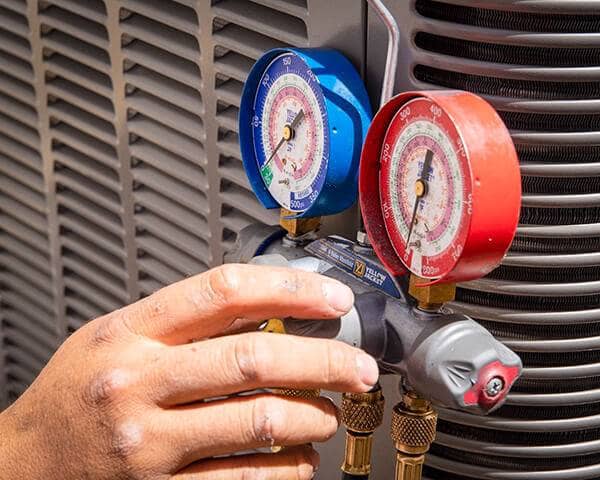
Short answer: A failing AC capacitor is the single most common repair call in Las Vegas — and for good reason. When ambient temperatures around your outdoor unit hit 130–140°F on a July afternoon, the small cylindrical component that starts your compressor and fan motors takes an absolute beating. Signs of failure include a humming outdoor unit that won't start, a slow-spinning fan, short cycling, and a visibly bulging or leaking capacitor can. Professional replacement — including diagnosis, correct part matching, safe installation, and warranty — typically runs $150–$400+. The Cooling Company stocks capacitors on every service truck for same-day repairs.
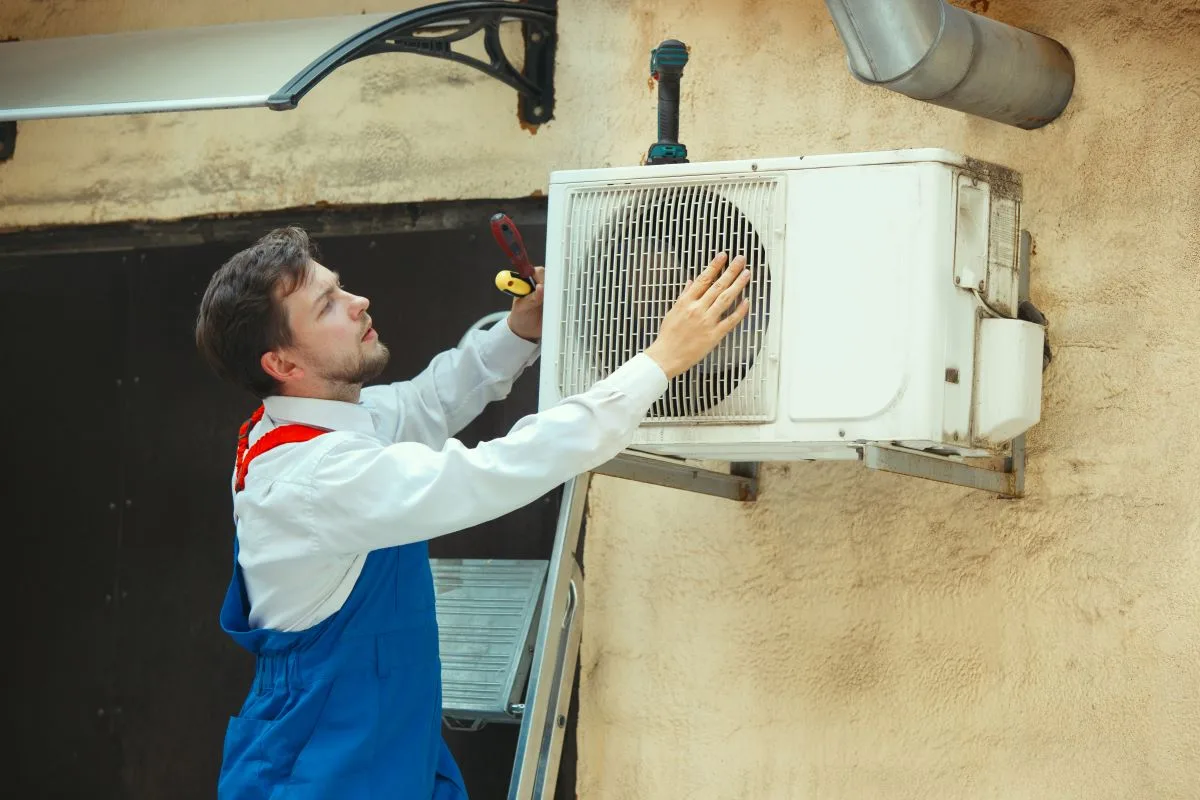
Key Takeaways
- Capacitors are the most-replaced AC component in Las Vegas — the extreme heat dramatically shortens their lifespan.
- A dual run capacitor handles both the compressor and condenser fan motor in most residential systems.
- Warning signs include humming without starting, slow fan spin-up, frequent shutdowns, and visible swelling on the capacitor can.
- Professional replacement runs $150–$400+ in Las Vegas — covering expert diagnosis, correct part sourcing, safe installation, and warranty.
- Capacitors hold a lethal charge even after the unit is powered off. Don't attempt DIY replacement.
- Annual AC maintenance includes capacitor testing — the best way to catch weakness before it fails on a 115°F day.
What does an AC capacitor actually do?
Think of a capacitor as a short-term battery for your AC's motors. When your thermostat calls for cooling, the system needs a sudden jolt of electrical energy to overcome inertia and get the compressor spinning. Your home's electrical supply is continuous alternating current — it's not capable of delivering that startup surge on its own without the motors struggling, overheating, or tripping a breaker.
That's where the capacitor steps in. It charges up while the system is running and then discharges that stored energy in a precise, controlled burst when a motor needs to start. Once the motor is running, the capacitor stays partially charged and continues to provide a phase-shifted voltage that keeps the motor running smoothly and efficiently. Without it, the motor draws far more amperage, runs hotter, and wears out much faster.
Capacitors are rated in two ways: microfarads (µF), which measures how much charge they can store, and voltage (VAC), which is the maximum electrical pressure they can handle. A typical residential compressor start capacitor might be rated at 35–70 µF, while the fan motor capacitor runs around 5–10 µF. The voltage rating is usually 370 VAC or 440 VAC for most residential systems. Using the wrong rating — especially a lower µF value — causes the motor to work harder and will shorten the life of both the new capacitor and the motor itself.
When a capacitor weakens, it can no longer deliver the startup surge or maintain proper running current. Your motor starts drawing excessive amperage trying to compensate, the condenser fan motor or compressor runs hot, and eventually something gives. Either the capacitor fails completely, or — worse — the compressor burns out. A capacitor replacement versus a $1,500–$3,000 compressor replacement is an easy call.
Start capacitors, run capacitors, and dual capacitors explained
Walk up to your outdoor unit and pull the access panel, and you'll find a cylindrical component — probably the size of a large can of soup — wired into the system. There are actually a few different types, and knowing which one you have matters for understanding what's failed.
Start capacitors
A start capacitor is only in the circuit during the startup sequence — usually less than a second. It provides a high-torque boost to get a hard-to-start motor moving, then a relay kicks it out of the circuit. Start capacitors are typically rated much higher, often 100–400 µF, because that startup surge is huge. They're common in older systems and in some heat pumps where the compressor has to start under load. Once the motor is spinning, the start capacitor disconnects and just sits there waiting for the next cycle.
Run capacitors
A run capacitor stays in the circuit the entire time the motor is operating. It's rated lower — typically 5–60 µF — because its job is to maintain a phase-shifted current that keeps the motor running efficiently, not to provide a startup jolt. Most modern single-speed residential systems use run capacitors for both the compressor and the fan motor.
Dual run capacitors
This is what most Las Vegas homeowners have. A dual run capacitor is one physical component that handles two jobs simultaneously — it has three terminals labeled HERM (hermetic compressor), FAN (condenser fan motor), and COM (common). The compressor side and the fan side have different µF ratings, combined into one can. So instead of two separate capacitors, you have one unit doing double duty. A typical dual cap for a residential system might be rated something like 45+5 µF at 440 VAC — 45 µF for the compressor, 5 µF for the fan.
The dual design saves space and cost, but it also means one failed component takes down both motors. If your outdoor fan is running but the compressor isn't — or vice versa — one side of the dual cap has likely failed while the other is still functional. Understanding how the condenser fan motor differs from the blower motor helps you describe the symptom accurately when you call for service. Your technician will test both sides independently with a capacitor meter to identify exactly what's happening.
Why Las Vegas heat destroys capacitors faster
Capacitors fail everywhere. But in Las Vegas, they fail at a rate that genuinely surprises technicians who move here from other markets. It's not just the air temperature — it's a combination of factors that stack up to create one of the harshest operating environments for HVAC equipment in the country.
The temperature problem is worse than you think
When Las Vegas hits 115°F in late July, that's the air temperature in the shade. Your outdoor unit is almost never in the shade. It's sitting in direct sunlight, often next to a block wall or stucco fence that's been absorbing solar radiation all day. That concrete block wall — common throughout the valley — can hit 160°F on a summer afternoon. The radiant heat bouncing off those surfaces means the condenser cabinet environment is regularly 20–30°F hotter than ambient air temperature.
So while you're reading 115°F on your weather app, the capacitor inside your outdoor unit is sitting in a 140°F environment, running continuously for 10–14 hours a day, sometimes for days without a meaningful break.
Capacitors have a rated operating temperature range, typically up to 85°C (185°F) for quality components. That sounds like plenty of headroom, but the dielectric material — the insulating layer inside the capacitor that makes the whole thing work — degrades with heat exposure over time. Every hour at high temperature is cumulative wear. A capacitor in Minneapolis might experience three months of hard summer operation per year. A capacitor in Las Vegas gets that and more every single summer, running longer days with higher ambient temperatures.
South-facing units take the worst beating
If your condenser unit is on the south or west side of the house, it's catching maximum afternoon sun right when the grid peaks and temperatures are highest. West-facing units in particular bake from about 1 PM until sunset with no relief. Homeowners in Summerlin with units mounted on west-facing block walls see capacitor failures at a noticeably higher rate than the same model units on the north side of a neighbor's house. The physics are unforgiving.
Dust storms and clogged condensers
Las Vegas gets haboobs — those massive dust storms that roll through the valley a few times each summer. After a haboob, the condenser coil fins can be packed with fine dust and debris, dramatically reducing airflow through the unit. When airflow drops, the system can't dissipate heat efficiently. The compressor and fan motors work harder and longer to maintain the same cooling output. That means more current draw, more heat generation inside the cabinet, and faster capacitor degradation.
Even without dust storms, Las Vegas has a lot of airborne particulate. Cottonwood season, construction dust, and general desert conditions mean regular AC maintenance — including condenser coil cleaning — matters more here than in most cities.
Extended runtime and duty cycles
In a moderate climate, your AC might run 30–40% of the time on a hot summer day. In Las Vegas in July, it's not unusual for a system to run 80–90% of the time — starting and stopping dozens of times per day. Each startup cycle puts stress on the capacitor. More starts per day equals faster wear, plain and simple.
All of this adds up to why we say July is capacitor season. During peak summer, a significant portion of our service calls are capacitors. Some days it feels like we're doing nothing but, and honestly — the numbers back it up.
7 warning signs your capacitor is failing
A failing capacitor rarely dies instantly. It usually degrades gradually, and there are real symptoms to watch for. Catching it early saves you from a compressor replacement or an emergency AC repair call at 10 PM on a Saturday in August.
1. The outdoor unit hums but doesn't start
This is the classic capacitor failure symptom. You hear the unit trying — there's a humming sound from the outdoor unit — but nothing actually spins up. Sometimes the compressor tries to start and immediately shuts down on thermal overload protection. The hum is the motor trying to draw enough current to overcome inertia without the capacitor's startup boost. After 20–30 seconds of humming, the motor protection kicks in and shuts it down to prevent damage.
If you hear humming but no actual operation, turn the system off at the thermostat immediately. Running a motor that can't start causes it to draw locked-rotor amperage — sometimes 5–6 times normal running current — which generates extreme heat and can burn out the motor windings in minutes.
2. The condenser fan starts slowly
On a healthy system, the outdoor fan spins up to full speed almost instantly when the unit starts. If you notice the fan blade spinning sluggishly for 5–10 seconds before reaching full speed, the run capacitor's fan side is weakening. The fan is getting there on its own, but it's struggling without the proper capacitor support. Left unchecked, this becomes a full stall.
Some homeowners try giving the fan blade a gentle push through the top grille to help it start — this sometimes works with a weak capacitor because the mechanical assist provides what the capacitor can't. But this is a bandage, not a fix, and poking around a running unit is dangerous. If you've seen this symptom, schedule a diagnostic call before it becomes an emergency.
3. Your AC short cycles
Short cycling means the system runs briefly — sometimes only a few minutes — then shuts off before your home reaches temperature, then restarts and repeats. There are several causes of short cycling, but a failing capacitor is one of them. When the capacitor can't properly support motor operation, the motors run inefficiently, overheat, and trigger thermal protection shutoffs. This looks a lot like a refrigerant issue or an oversized system, so proper diagnosis matters. See our guide on AC not cooling properly for the full range of possible causes.
4. Higher-than-normal energy bills
A capacitor running below its rated µF value makes your motors work harder. That means higher amperage draw, which shows up on your electric bill. If your bills have crept up but your usage patterns haven't changed, and especially if you notice any of the other symptoms here, a weakened capacitor could be part of the picture. A capacitor test costs almost nothing during a maintenance visit — it's one of the things we check during every preventive maintenance appointment.
5. The AC blows warm air even though it's running
If the fan is moving air but the compressor isn't running — because its capacitor has failed — you'll get air movement but no actual cooling. The blower motor inside the house keeps pushing air across the indoor coil, but without the compressor circulating refrigerant, there's no heat exchange happening. You get room-temperature air coming out of your vents instead of cool air. This is one of the more alarming symptoms because it seems like a bigger problem than it is — often it's just the capacitor. Check our full guide on why your AC isn't cooling to work through the possibilities.
6. The outdoor unit randomly shuts off in peak heat
If your system runs fine in the morning but shuts off on its own at 3 PM when it's 113°F outside, a thermally weakened capacitor is a prime suspect. As the capacitor heats up, its effective capacitance drops further. A capacitor that measures 42 µF at 75°F might only deliver 35 µF at 140°F — putting it below the acceptable tolerance for a 45 µF rated component. This thermal degradation means the system performs worse exactly when you need it most. See our resource on AC breakdown warning signs for the full picture of heat-related failures.
7. You're dealing with frequent, repeated failures
If you've had capacitors replaced multiple times in recent years, that's not normal — even in Las Vegas. A properly sized, quality-rated capacitor in a well-maintained system should last 5–8 years here. Frequent failures suggest an underlying issue: the unit might be undersized for the load (check our AC sizing guide), the condenser is running too hot due to poor airflow or dirty coils, or there's a voltage issue from your electrical supply. Chasing symptoms with repeated cheap replacements isn't a strategy — it's deferred maintenance catching up with you.
What a bad capacitor looks like
Some capacitor failures are visible without any tools. If you're comfortable around your outdoor unit and the system is powered off and has been off for at least 30 minutes, you can do a visual inspection — though you should never touch the capacitor itself due to stored charge.
Bulging top
A healthy capacitor has a flat or very slightly domed top. A failed or failing capacitor often has a clearly bulged, domed, or swollen top. This happens because the electrolyte inside has degraded and is producing gas. If you see a puffed-up top, that capacitor is done — it's just a matter of whether it's failed completely or is about to.
Leaking fluid
Advanced capacitor failure can result in oily or waxy residue around the base of the component or on the bottom of the unit cabinet. This is electrolyte leaking out. It's a definitive sign of failure and the capacitor needs immediate replacement.
Burn marks or corrosion
Scorch marks, blackening, or corrosion on the capacitor body or on the terminals indicate the component has experienced an electrical event — either a near-failure surge or direct arcing. This is also an immediate replacement.
No visible damage
Here's the thing: many failed or failing capacitors look completely normal. The capacitor can degrade internally — losing capacitance as the dielectric breaks down — with no external signs whatsoever. This is why visual inspection alone isn't enough. A proper diagnosis uses a capacitor meter to measure actual µF output and compare it to the rated value. Acceptable tolerance is typically ±6% of the rated value. A 45 µF capacitor reading 38 µF is outside tolerance even if it looks perfect.
AC capacitor replacement cost in Las Vegas
This is usually the first question after diagnosis, and it's a fair one. Here's what you can realistically expect to pay for a professional capacitor replacement in Las Vegas.
What a professional capacitor replacement actually costs
Total cost for an AC capacitor replacement in Las Vegas typically runs $150–$400+, with most residential calls landing in the $175–$300 range. The price varies based on the specific capacitor your system requires — capacitors aren't one-size-fits-all. They come in different microfarad ratings (µF), different voltage ratings (370 VAC vs. 440 VAC), and different physical configurations (single vs. dual). A 3-ton system in a tract home needs a different capacitor than a 5-ton system in a larger property, and higher-capacity units cost more.
What you're paying for (and why it matters)
We get it — you can find capacitors on Amazon. But here's what that $10 part listing doesn't include:
- Expert diagnosis, not just a parts swap. A professional technician tests the entire system — contactor, motor amperage, refrigerant pressures, electrical connections — to determine why the capacitor failed, not just that it failed. A cheap capacitor on an overloaded compressor fails again in months. Proper diagnosis catches the root cause.
- Correct specification matching. Installing a capacitor with the wrong µF rating — even a few microfarads off — makes the motor run hot and shortens both the capacitor and motor lifespan. A technician measures the original spec (not just reads a faded label) and matches it exactly.
- Safe handling of a component that stores lethal voltage. Capacitors hold a charge at 370–440 VAC even after the system is powered off. Improper discharge or installation creates a genuine electrocution risk. Professional techs have the training, tools, and insurance to handle this safely.
- Quality components, not the cheapest available. There's a meaningful difference between a $10 capacitor from an unknown overseas supplier and a quality component rated for 105°C continuous operation from a reputable manufacturer. The cheap one might last 18 months in Las Vegas heat. The right one lasts 5–8 years. We use components we trust — because a callback costs everyone more.
- Warranty and accountability. When a licensed HVAC company installs the part, you have a warranty on both parts and labor. If it fails prematurely, we come back and make it right. An Amazon purchase and a YouTube video give you none of that.
- Same-day resolution. When it's 115°F and your AC is dead, you need it fixed now — not in 2–3 business days when a package arrives.
For more context on what various AC repairs cost in the Las Vegas market, see our AC repair cost guide and full pricing guide.
Emergency and after-hours rates
A capacitor failure at 9 PM on a Friday in August is not a comfortable situation in Las Vegas — indoor temps can hit 90°F within a few hours in a typical valley home. Emergency 24/7 AC repair carries a premium, and the total for an after-hours capacitor replacement typically runs $250–$500. That's not fun, but it's a lot better than a night at 95°F or, worse, watching the compressor burn out because the motors kept trying to start without capacitor support. A burned-out compressor turns a $250 repair into a $1,500–$3,000 one. See our breakdown of emergency AC repair costs in Las Vegas for the full picture.
Red flags on pricing — both directions
Be cautious of companies quoting significantly above $400 for a single capacitor replacement with no other work involved — that's above market for the Las Vegas valley. But be equally skeptical of unusually cheap quotes, especially from companies that skip a full diagnostic. A tech who just swaps the part without checking motor amperage, contactor condition, and the reason for early failure is setting you up for a repeat visit. The right price reflects the right level of service — thorough diagnosis, quality parts, and professional installation with a warranty.
Why TCC stocks capacitors on every truck
We carry the most common capacitor ratings on every service vehicle — dual caps across the full residential range, in both 370 VAC and 440 VAC ratings. When we diagnose a failed capacitor, we can replace it the same visit, the same day, without waiting on parts. That matters when it's 115°F outside and you're trying to stay cool while waiting for repair (we wrote a guide on that too: how to stay cool while waiting for AC repair). For most residential systems, a same-day fix is the norm, not the exception.
Why DIY capacitor replacement is genuinely dangerous
This needs to be said plainly: capacitors store electrical charge. They do this by design. And they don't stop storing charge just because you turned off your system or even flipped the breaker.
A residential dual run capacitor charged to 440 VAC can deliver a shock that is potentially fatal. The discharge happens in milliseconds. There is no warning. You cannot react fast enough to let go. The Occupational Safety and Health Administration (OSHA) classifies electrical hazards at even lower voltages as serious and life-threatening.
Properly discharging a capacitor requires specific knowledge of the procedure and the right tools — a resistor with the correct resistance and wattage rating, not just a screwdriver across the terminals. Shorting the terminals directly with a screwdriver (a common internet-video technique) creates a spark, can damage the terminals, and can cause injury. The correct discharge procedure dissipates the charge safely through resistance.
Beyond the shock hazard, there are practical reasons to use a professional:
- Correct specs matter. Installing a capacitor with the wrong µF rating — even slightly off — will cause the motor to run hot and will shorten motor life. A tech uses a meter to verify the existing capacitor's rating and matches it exactly, accounting for the label rating vs. actual measured output.
- The capacitor might not be the only problem. A tech diagnosing the system will also check the contactor, check refrigerant pressures, measure motor amperage, and look for the root cause of early failure. A DIY swap that misses an underlying issue is just delaying the next failure.
- Warranty and liability. DIY electrical work on HVAC systems can void equipment warranties and may create homeowner's insurance complications if an electrical fire results.
The capacitor repair is one of the more affordable AC fixes. It's not the place to DIY.
How long do capacitors last in Las Vegas vs. other climates?
In moderate climates — think the Pacific Northwest or the upper Midwest — a quality run capacitor can easily last 10–15 years. The system runs seasonally, ambient temperatures are reasonable, and the duty cycle is manageable.
In Las Vegas, realistic lifespan for a residential run capacitor is 5–8 years under normal conditions. Systems that run harder — oversized homes, poor duct design, south-facing units, units that haven't been maintained — can see failures in 3–5 years. We see plenty of capacitors fail at the 3-year mark in homes where the condenser is poorly positioned or the coils have never been cleaned.
Capacitor manufacturers rate components with temperature and operational hour specs, and organizations like ASHRAE have established guidelines for equipment operating conditions that account for regional climate factors. Las Vegas consistently operates outside the "standard" assumptions built into those ratings for much of the summer — the equipment is essentially being run harder than the design baseline.
Quality matters, too. There's a significant difference between a budget capacitor from a wholesale supplier and a capacitor from a reputable manufacturer with a 105°C temperature rating. We use quality components, not the cheapest thing available, because a cheap capacitor that fails again in 18 months costs the homeowner more in the long run.
If your system is 8–10 years old and you're in your first capacitor replacement, you're right on schedule. If your system is 15+ years old and facing a capacitor failure plus other repairs, the repair vs. replace calculation starts to shift. We'll give you an honest assessment either way.
How to extend capacitor life
You can't make Las Vegas weather moderate, but you can reduce the stress on your capacitors with some straightforward practices.
Annual maintenance and testing
The single best thing you can do. An annual AC maintenance visit includes capacitor testing — we measure actual µF output and compare it to the rated spec. A capacitor reading 10–15% below spec is still technically "working" but is a candidate for proactive replacement before peak season. Catching a borderline capacitor during a spring maintenance visit is far cheaper than an emergency replacement in August. According to the U.S. Department of Energy, regular AC maintenance also improves efficiency and extends overall system lifespan — it's one of the highest-ROI things you can do as a homeowner.
Keep the condenser clean
A dirty condenser coil means the system works harder and runs longer to achieve the same cooling output. More runtime means more heat accumulation in the cabinet, which accelerates capacitor wear. Hosing off the condenser coil from the inside out a couple of times during the summer is something most homeowners can do safely with the system off. After any significant dust storm, a quick rinse is worth doing. For a thorough cleaning with coil cleaner, a professional maintenance visit is the right move.
Improve shade and airflow around the unit
If your unit is in direct afternoon sun, shading it can meaningfully reduce the ambient temperature inside the cabinet. A shade structure built to allow proper airflow on all four sides (don't enclose the unit tightly — it needs to breathe) can drop cabinet temperatures 10–15°F. Even a strategically planted tree or tall shrubs to the west and south can help. Just don't obstruct the airflow path — at least 2 feet of clearance on all sides, and 5 feet above the unit for the discharge air.
Surge protection
Voltage spikes — from lightning storms, grid switching events, or power restoration after an outage — can degrade capacitors rapidly. A whole-home surge protector or an HVAC-specific surge protector installed at the disconnect can extend the life of capacitors and other sensitive electronics in your system. Given that Las Vegas gets both summer monsoon lightning and occasional grid events during peak demand, it's a low-cost insurance policy.
Address the underlying cause of repeated failures
If you're on your second or third capacitor in a few years, something is wrong beyond normal wear. Have a tech check motor amperage draw — if the compressor or fan motor is pulling more amperage than its nameplate rating, the motor itself is degrading and stressing the capacitor. Dirty coils, low refrigerant, restricted airflow, and wrong capacitor sizing all contribute to early failure. Solving the underlying issue costs less than a pattern of repeated emergency repairs. Check our guide to why your AC isn't blowing hard for airflow-related causes, and our AC not cooling guide for the broader diagnostic picture.
Should you repair or replace the whole unit?
A capacitor replacement on a 4-year-old system is a no-brainer — fix it and move on. But what about a 12-year-old system with its second capacitor failure this summer, plus a refrigerant leak that needs attention?
The rule of thumb most technicians use is the 50% rule: if the repair cost exceeds 50% of the cost of a new system, replacement is worth serious consideration — especially if the system is more than 10 years old. A capacitor alone never triggers that threshold. But when you're adding up a capacitor, a refrigerant charge, a contactor, and looking at a compressor that's showing signs of wear, the math shifts.
Other factors that push toward replacement:
- Age over 12–15 years. Older systems lose HVAC efficiency significantly over time. A new system with a better SEER rating can cut cooling costs 20–40% compared to an aging, inefficient unit. See our full analysis in the repair or replace guide.
- R-22 refrigerant. Systems using the now-phased-out R-22 refrigerant face increasingly expensive refrigerant costs and parts availability issues. A leaking R-22 system is a strong candidate for replacement.
- Compressor at risk. If the capacitor failed because the compressor is struggling — pulling high amperage, running hot — replacing the capacitor without addressing the compressor is often short-term thinking. A compressor replacement on an aging system frequently costs more than a new system when you factor in labor and the rest of the aging components.
We'll always give you an honest read on where your system stands. Our goal isn't to sell you a replacement when a repair is the right call — but it's also not to patch an aging system with repeat repairs when replacement would save you money within 2–3 seasons. Our AC replacement page and installation page have more detail on what a new system involves if you're at that decision point.
If you're not sure whether to repair or replace, our AC breakdown warning signs guide has a more detailed framework for making that call.
Need HVAC service in Las Vegas?
The Cooling Company provides expert HVAC service throughout Las Vegas, Henderson, and North Las Vegas. Our licensed technicians deliver honest assessments, upfront pricing, and reliable results.
Call (702) 567-0707 or visit AC repair, maintenance, heating, or installation for details.
Need a repair right now? Our emergency AC repair team is available around the clock. For non-urgent service, our AC repair near me page has scheduling options.
Neighborhoods we serve for AC repair
- Summerlin, The Lakes, and Queensridge
- Henderson, Green Valley, and Anthem
- North Las Vegas, Aliante, and Centennial Hills
- Spring Valley, Paradise, and Winchester
- Downtown Las Vegas, Rancho, and Arts District