

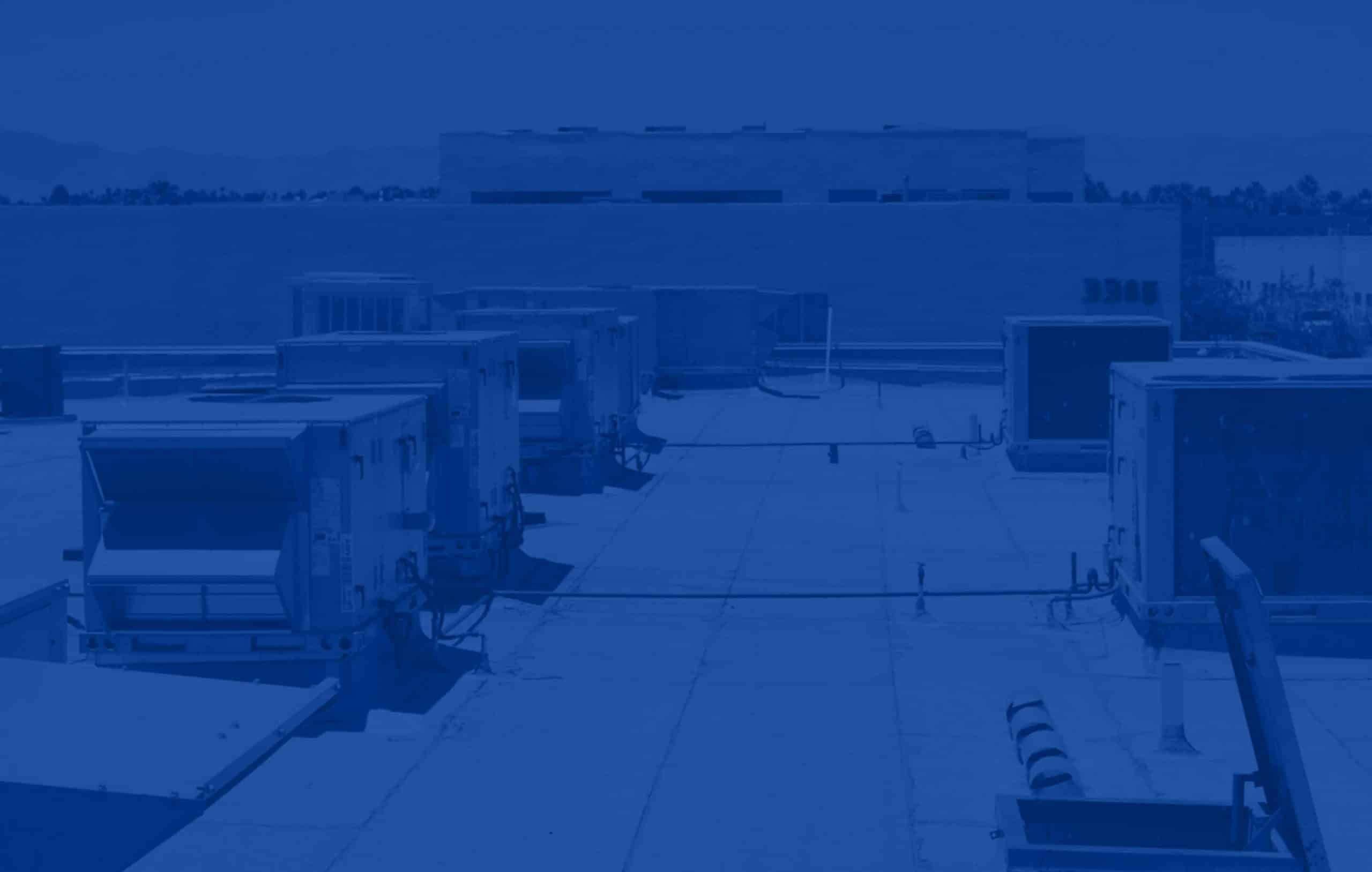
Short answer: Commercial packaged units (also called rooftop units or RTUs) are self-contained HVAC systems that house the compressor, condenser, evaporator, and air handler in a single cabinet installed on the building's roof. They are the dominant HVAC system type for Las Vegas commercial buildings under 25,000 square feet — strip malls, standalone restaurants, small offices, retail stores, and light industrial spaces. Units range from 3 to 25+ tons, with 3-20 ton units covering the vast majority of Las Vegas commercial applications. Installed costs range from $3,000-$6,000 per ton depending on efficiency level and accessories. In Las Vegas, properly maintained packaged units last 15-20 years, but units without regular maintenance often fail at 10-12 years due to extreme heat stress, desert dust fouling, and the 2,500-4,000+ runtime hours accumulated annually during cooling season.
Check our rooftop unit pricing guide for detailed cost breakdowns.
See our commercial packaged systems page for service details.
What Is a Commercial Packaged Unit?
A commercial packaged unit — commonly called an RTU (rooftop unit), a package unit, or simply a "rooftop" — is a factory-assembled HVAC system that contains all major components in a single weatherproof cabinet:
- Compressor(s): One or two scroll compressors that circulate refrigerant
- Condenser coil and fan: Rejects heat from the refrigerant to the outdoor air
- Evaporator coil: Absorbs heat from the building's return air
- Supply air blower: Moves conditioned air through the building's ductwork
- Gas heat section (on gas/electric units): A gas-fired heat exchanger for heating
- Controls: Factory-wired control board with thermostat connection
- Economizer (optional but standard on most units): Damper assembly that uses outdoor air for free cooling when conditions allow
- Filters: Built-in filter rack for standard commercial filters
Everything is contained in a single cabinet, typically 4-8 feet long, 3-5 feet wide, and 3-5 feet tall, depending on tonnage. The unit sits on a roof curb — a raised frame that seals the unit to the roof opening — and connects to the building's ductwork through the bottom of the cabinet.
Why Packaged Units Dominate Las Vegas Commercial HVAC
Several factors make packaged units the default choice for small to mid-size commercial buildings in Las Vegas:
Roof space is free. Las Vegas commercial buildings are predominantly single-story with flat roofs. The roof provides unlimited equipment space at no additional real estate cost. Ground-level placement would consume valuable parking or tenant space.
Single-point installation. A crane sets the unit on the roof curb in one lift. Ductwork connects from below. Electrical and gas connect on the roof. The entire installation can be completed in 1-2 days for a straightforward replacement. Compare this to a split system, which requires setting an outdoor condensing unit, mounting an indoor air handler, running refrigerant lines between them, and performing a field refrigerant charge — a process that takes 2-4 days.
Factory-assembled reliability. Packaged units are charged with refrigerant at the factory, tested before shipping, and arrive ready to install. Field-piped split systems require on-site brazing of refrigerant connections and field charging — two processes where installation quality directly affects system reliability. A poorly brazed joint can leak refrigerant for years before failing completely.
Simplified maintenance access. All components are in one location on the roof. A technician can inspect the compressor, condenser coil, evaporator coil, blower, and filters in a single visit without entering the building.
Packaged Unit vs. Split System: When to Choose Each
| Factor | Packaged Unit (RTU) | Split System |
|---|---|---|
| Installation location | Roof (requires structural capacity) | Outdoor unit at grade + indoor unit in mechanical room |
| Installation complexity | Low (single crane lift, factory-charged) | Moderate (field piping, field charge) |
| Maintenance access | Roof access required | Ground-level outdoor unit, indoor unit inside building |
| Space impact | None inside building | Indoor unit requires mechanical closet or ceiling space |
| Noise inside building | Lower (equipment is on the roof) | Can be higher (indoor unit blower noise inside building) |
| Efficiency range | 11.0-16.0 IEER (commercial rating) | Can achieve higher efficiency in larger sizes |
| Tonnage range | 3-25+ tons in a single unit | 1.5-20+ tons per system |
| Cost (installed) | Lower for 3-15 ton range | Competitive for 15+ ton applications |
| Best for | Strip malls, standalone retail, restaurants, small offices | Multi-story buildings, spaces without roof access, high-efficiency requirements |
Las Vegas recommendation: For single-story commercial buildings under 20,000 square feet with a flat roof — which describes the vast majority of Las Vegas commercial properties — a packaged unit is almost always the right choice. Split systems make sense for multi-story buildings, properties with weight-restricted roofs, or applications requiring efficiency levels that packaged units cannot achieve.
Tonnage Sizing for Las Vegas Commercial Spaces
Proper sizing for Las Vegas commercial buildings accounts for extreme outdoor temperatures, solar heat gain through the roof and windows, internal heat loads from equipment and occupants, and ventilation requirements.
Rules of Thumb (for Initial Budgeting Only)
| Building Type | Approximate Square Feet Per Ton |
|---|---|
| Standard office | 350-450 sq ft/ton |
| Retail (standard) | 300-400 sq ft/ton |
| Restaurant (dining area) | 200-300 sq ft/ton |
| Restaurant (kitchen) | 150-200 sq ft/ton |
| Medical/dental office | 250-350 sq ft/ton |
| Warehouse (conditioned) | 500-700 sq ft/ton |
| Beauty salon/barber shop | 200-300 sq ft/ton |
| Server room/IT closet | 100-200 sq ft/ton |
Critical caveat: These rules of thumb are for budgeting and preliminary planning only. Final sizing must be based on a commercial load calculation that accounts for the specific building's envelope, orientation, glazing, occupancy, equipment heat gain, and ventilation rates. Undersizing by one ton on a Las Vegas building means the system cannot maintain temperature on 115-degree days. Oversizing by two tons wastes $3,000-$5,000 in equipment cost and creates humidity issues during transitional months.
Common Tonnage Ranges by Building Type
| Building Type | Typical Building Size | Typical Tonnage |
|---|---|---|
| Small retail/office suite | 1,000-2,500 sq ft | 3-5 tons |
| Standard retail store | 2,500-5,000 sq ft | 5-10 tons |
| Restaurant | 2,000-4,000 sq ft | 7.5-15 tons |
| Multi-suite strip mall (per unit) | 1,000-3,000 sq ft | 3-7.5 tons |
| Small warehouse/shop | 3,000-8,000 sq ft | 5-12.5 tons |
| Large retail | 5,000-15,000 sq ft | 12.5-25 tons (often 2 units) |
| Medical office | 2,000-5,000 sq ft | 7.5-15 tons |
When to Use Multiple Units vs. One Large Unit
For buildings requiring more than 12.5-15 tons, consider installing two or more smaller units rather than a single large unit:
- Redundancy: If one unit fails during a July heat wave, the other unit maintains partial cooling. A single-unit failure means zero cooling.
- Zoning: Multiple units allow different building zones to operate independently — the restaurant runs its unit 14 hours a day while the adjacent office suite runs 10 hours.
- Staging: Two 10-ton units serving a building that only needs 10 tons of cooling most of the year can alternate operation, extending the life of both units.
- Replacement flexibility: Replacing a 10-ton unit costs $8,000-$15,000. Replacing a 20-ton unit costs $20,000-$35,000. Spreading the investment across two units allows staggered replacement as each unit ages.
Rooftop Installation Considerations for Las Vegas
Structural Requirements
Commercial packaged units weigh between 400 pounds (3-ton) and 3,500+ pounds (20-ton) — operating weight including refrigerant charge. The roof structure must support:
- The operating weight of the unit
- Snow load (minimal in Las Vegas, but code still requires calculation)
- Seismic load (Las Vegas is in Seismic Design Category B or C depending on soil conditions)
- Wind uplift load (Las Vegas design wind speed is 115 mph per ASCE 7)
- Service personnel weight (two technicians plus tools — typically 500 pounds added to the area around the unit)
For new construction: The structural engineer sizes the roof framing to accommodate the specified unit weight and location. No issues if specified during design.
For replacement on existing buildings: Verify that the existing roof structure can support the new unit. Modern high-efficiency units are often 10-20% heavier than the units they replace due to larger coils and additional components. A structural analysis is recommended when replacing units larger than 10 tons or when the building is more than 20 years old.
Roof Curb and Transition
The roof curb is the interface between the unit and the building. It must:
- Match the unit's footprint exactly (or use an adapter curb if replacing a different brand/model)
- Be properly sealed and flashed into the roofing system to prevent water intrusion
- Be tall enough to clear any roofing insulation buildup (minimum 14 inches is standard; Las Vegas buildings with multiple re-roofs may have accumulated insulation that reduces curb height)
- Include a duct transition from the curb to the building's ductwork below
Adapter curbs: When replacing a packaged unit with a different brand or model that has a different footprint, an adapter curb (also called a transition curb) bridges the difference. Adapter curbs cost $800-$2,000 and add half a day to the installation. Using the exact same brand and model footprint avoids this cost.
Crane Access
Every packaged unit installation or replacement requires a crane. The crane must have:
- Clear access to the building (no overhead power lines, trees, or adjacent buildings blocking the swing path)
- Sufficient reach to place the unit on the designated roof location
- Adequate capacity for the unit weight plus rigging (typically 150% of unit weight as a safety factor)
Crane cost for Las Vegas commercial HVAC: $1,500-$4,000 depending on the crane size required, travel distance, and duration of use. For multi-unit replacements on the same building, a single crane mobilization reduces cost per unit.
Electrical and Gas Connections
Packaged units require:
- Electrical service: 208V/3-phase or 460V/3-phase for commercial units. A 10-ton unit typically requires a 60-80 amp breaker on 208V/3-phase. The electrical panel must have capacity for the unit's maximum circuit amperage.
- Disconnect switch: A visible, lockable disconnect within sight of the unit (NEC requirement). Must be within 50 feet and visible from the unit location.
- Gas supply (for gas/electric units): Gas piping to the roof, sized for the unit's BTU input rating. A 10-ton gas/electric unit with a 150,000 BTU/hr heat section requires 1-inch gas piping for typical run lengths.
- Thermostat wiring: Low-voltage control wiring from the unit to the thermostat location inside the building. Standard 5-conductor (18/5) thermostat wire for conventional systems; additional conductors for communicating or smart thermostats.
Desert Climate Considerations for Las Vegas RTUs
Las Vegas imposes specific stresses on packaged units that do not exist in moderate climates. Understanding these factors drives both equipment selection and maintenance practices.
Extreme Heat and Compressor Stress
When the outdoor temperature reaches 115 degrees F — which happens multiple days per year in Las Vegas — the condenser must reject heat to air that is only 25-30 degrees cooler than the refrigerant condensing temperature. This narrow temperature differential forces the compressor to work harder, increasing head pressure, amp draw, and operating temperature.
Equipment selection implication: Specify units with high-ambient-temperature ratings. Most major manufacturers (Lennox, Carrier, Trane, York) offer units tested and rated for operation at 115-125 degrees F outdoor ambient. Units not rated for high-ambient operation may activate high-pressure safety lockouts during Las Vegas peak conditions, shutting down cooling when it is needed most.
Compressor protection: Dual-compressor units provide an advantage in Las Vegas — if one compressor locks out on high pressure, the other can still operate at reduced capacity. This partial cooling is far better than total system failure during a heat wave.
Desert Dust and Condenser Coil Fouling
Las Vegas desert dust is fine, pervasive, and relentless. Condenser coils on rooftop units accumulate dust continuously, with significant buildup occurring within 30-60 days during spring and summer. Monsoon storms (July-September) deposit large quantities of fine particulate in a single event.
Impact of fouled condenser coils:
- Head pressure increases by 5-15 PSI per degree of coil temperature rise caused by dust
- Compressor amp draw increases 5-15% with moderately fouled coils
- Cooling capacity decreases 10-20% as the coil cannot reject heat effectively
- Energy consumption increases 15-30% as the compressor works harder to overcome restricted airflow
- Compressor life shortens — every 10 degrees F of elevated head pressure reduces compressor life by approximately 10%
Maintenance implication: Condenser coil cleaning in Las Vegas must be performed quarterly at minimum, with additional cleanings after dust storms and monsoon events. Use a coil cleaning solution rated for aluminum fins and rinse with low-pressure water (garden hose pressure, not a pressure washer). High-pressure washing bends condenser fins and creates more problems than it solves.
Hard Water and Condensate Issues
Las Vegas municipal water has a hardness of 275-300 PPM (very hard). When condensate evaporates from drain pans — and in Las Vegas's dry air, condensate evaporates quickly on exposed surfaces — it leaves mineral deposits that accumulate rapidly.
Condensate-related problems:
- Primary drain lines clog with mineral scale within 6-12 months without preventive flushing
- Drain pans develop mineral buildup that creates standing water pools, promoting bacterial growth and odors
- Secondary (overflow) drains clog if not maintained, allowing condensate to overflow into the building ceiling below
Maintenance implication: Flush condensate drain lines quarterly with a vinegar solution or commercial drain treatment. Clear drain pans of mineral deposits during each maintenance visit. Las Vegas hard water makes condensate maintenance more frequent than in soft-water areas.
UV Degradation
Las Vegas receives approximately 294 sunny days per year, with UV index values frequently reaching "extreme" (11+) during summer. Rooftop equipment is fully exposed.
Components affected by UV:
- Wire insulation: PVC wire jackets become brittle and crack after 3-5 years of direct sun exposure, creating short-circuit risks
- Rubber vibration isolators: Degrade and crumble within 2-4 years
- Flexible duct connections: UV-damaged flex connections at the curb can split and leak conditioned air
- Labels and nameplates: Become illegible, making future service identification difficult
Maintenance implication: Inspect wiring for UV damage during every service visit. Replace cracked or brittle wiring before it shorts. Photograph data plates during initial installation for future reference.
Efficiency Ratings and Energy Costs
Commercial packaged units use different efficiency metrics than residential equipment.
Key Efficiency Metrics
IEER (Integrated Energy Efficiency Ratio): The primary efficiency rating for commercial packaged units. IEER measures cooling efficiency at multiple part-load conditions, reflecting real-world operation more accurately than full-load ratings. Higher IEER = more efficient.
| Efficiency Level | Typical IEER Range | Annual Energy Cost Savings vs. Minimum |
|---|---|---|
| Code minimum | 11.0-12.0 IEER | Baseline |
| Standard efficiency | 12.0-13.5 IEER | 8-15% |
| High efficiency | 13.5-16.0 IEER | 15-25% |
| Premium efficiency | 16.0+ IEER | 25-35% |
For a 10-ton packaged unit in Las Vegas running 2,500-3,000 hours per year during cooling season at $0.12/kWh:
| IEER | Approximate Annual Cooling Energy Cost |
|---|---|
| 11.0 (code minimum) | $3,600-$4,300 |
| 13.0 (standard efficiency) | $3,000-$3,600 |
| 15.0 (high efficiency) | $2,600-$3,100 |
The difference between a code-minimum and high-efficiency unit is approximately $800-$1,200 per year in energy costs for a 10-ton unit. Over a 15-year equipment life, that is $12,000-$18,000 in cumulative savings — often exceeding the efficiency upgrade cost.
NV Energy Commercial Rebates
NV Energy offers rebates for high-efficiency commercial HVAC equipment. Rebate amounts change annually, but typically:
- $25-$75 per ton for packaged units exceeding minimum efficiency thresholds
- Additional rebates for advanced controls (smart thermostats, demand-controlled ventilation)
- Pre-approval required before equipment purchase
Check with NV Energy or your HVAC contractor for current rebate availability and requirements.
Maintenance Schedule for Las Vegas Commercial RTUs
A commercial packaged unit in Las Vegas requires more frequent maintenance than the same unit in a moderate climate. The following schedule represents best practice for Las Vegas conditions.
Quarterly Maintenance Visits (4x Per Year)
Every quarterly visit should include:
- Filter replacement (monthly during peak cooling season)
- Condenser coil inspection and cleaning
- Evaporator coil inspection
- Condensate drain pan and line inspection/flushing
- Belt inspection and tension adjustment (belt-drive units)
- Electrical inspection: contactor, capacitor, wiring
- Compressor amp draw measurement and comparison to nameplate
- Thermostat calibration verification
- Economizer operation test (damper movement, sensor accuracy)
- Safety controls test (high-pressure, low-pressure, freeze protection)
- Overall unit condition: curb seal, roof penetration, panel condition
Pre-Season Annual Service (April)
In addition to the quarterly maintenance, the spring service should include:
- Full refrigerant charge verification (subcooling and superheat)
- Chemical condenser coil cleaning (not just rinse)
- Blower wheel inspection and cleaning
- Motor bearing lubrication (if applicable — many modern motors are sealed)
- Full electrical tightening of all connections
- Economizer calibration for summer operation
- Controls sequence verification (staging, fan delays, lockouts)
- Document all operating parameters for trending
Post-Monsoon Service (October)
After the July-September monsoon season:
- Complete condenser coil cleaning (monsoon dust is particularly fine and adhesive)
- Condensate system flush
- Heating system activation test (gas ignition, flame sensor, heat exchanger)
- Economizer changeover adjustment for fall/winter free cooling
- Full inspection for storm damage (bent panels, water intrusion, debris)
Equipment Lifespan and Replacement Planning
Expected Lifespan in Las Vegas
| Maintenance Level | Expected Lifespan |
|---|---|
| Premium maintenance (quarterly + post-storm) | 18-22 years |
| Standard maintenance (quarterly) | 15-18 years |
| Minimal maintenance (annual only) | 10-13 years |
| No maintenance | 7-10 years |
End-of-Life Indicators
Plan for replacement when:
- The unit is 15+ years old and requiring more than $1,500/year in repairs (the 50% rule — if repair cost exceeds 50% of replacement cost, replace)
- Compressor replacement is needed on a unit over 12 years old
- The unit uses R-22 refrigerant (phased out — replacement R-22 costs $75-$150 per pound vs. $10-$20 per pound for R-410A)
- Energy consumption has increased 20%+ compared to earlier years despite maintenance
- The unit cannot maintain building temperature during peak Las Vegas conditions (115+ degrees F)
Replacement Cost Ranges
| Unit Size | Installed Cost Range (Standard Efficiency) | Installed Cost Range (High Efficiency) |
|---|---|---|
| 3 ton | $5,000-$8,000 | $7,000-$11,000 |
| 5 ton | $7,000-$12,000 | $10,000-$16,000 |
| 7.5 ton | $10,000-$16,000 | $14,000-$22,000 |
| 10 ton | $14,000-$22,000 | $19,000-$30,000 |
| 12.5 ton | $17,000-$26,000 | $24,000-$36,000 |
| 15 ton | $22,000-$32,000 | $30,000-$44,000 |
| 20 ton | $28,000-$42,000 | $38,000-$58,000 |
Costs include equipment, crane, curb adapter (if needed), electrical reconnection, gas reconnection, startup, and commissioning. Costs vary based on roof access, unit location, and any required ductwork modifications.
The Cooling Company: Commercial Packaged Unit Specialists in Las Vegas
The Cooling Company installs, maintains, and replaces commercial packaged units across the Las Vegas Valley. We work with Lennox, Carrier, Trane, and other major manufacturers to match the right equipment to your building's specific requirements — tonnage, efficiency level, budget, and Las Vegas climate demands.
Our commercial maintenance programs are built for Las Vegas conditions, with quarterly service visits that include condenser coil cleaning, economizer calibration, and the comprehensive inspection that packaged units need to survive 15+ years in our desert climate.
Call (702) 567-0707 for a commercial packaged unit consultation, maintenance agreement, or replacement estimate.
Frequently Asked Questions
How long does it take to replace a commercial packaged unit in Las Vegas?
A straightforward packaged unit replacement — same brand and footprint, existing curb in good condition, no ductwork modifications — takes 1-2 days from crane lift to system startup. If an adapter curb is needed for a different unit footprint, add half a day. If electrical service needs upgrading or ductwork modifications are required, the project can extend to 3-5 days. Equipment lead time is the bigger factor — standard units may be available in 1-2 weeks, while high-efficiency or specific configurations can take 6-12 weeks to arrive.
What size packaged unit do I need for my Las Vegas commercial space?
As a rough guideline, Las Vegas commercial spaces need approximately 1 ton per 300-450 square feet depending on building type — offices at the higher end, restaurants at the lower end. A 3,000-square-foot retail store typically needs a 7.5-10 ton unit. However, accurate sizing requires a commercial load calculation that accounts for your specific building's insulation, windows, orientation, occupancy, and internal heat sources. Undersizing means the system cannot keep up on 115-degree days. Oversizing wastes capital and creates comfort problems. A load calculation costs $500-$1,500 and prevents either mistake.
Should I repair or replace my commercial packaged unit?
Use the 50% rule as a starting point: if the repair cost exceeds 50% of the replacement cost, replace the unit. Additionally, replace rather than repair when the unit is over 15 years old and needs a major component (compressor, coil, or heat exchanger), when the unit uses R-22 refrigerant (phased out, extremely expensive to recharge), when annual repair costs have exceeded $1,500 for two consecutive years, or when the unit can no longer maintain building temperature during Las Vegas peak conditions despite being properly maintained.
What is an economizer and why does it matter in Las Vegas?
An economizer is a damper assembly on a packaged unit that brings in outdoor air for free cooling when the outdoor temperature is lower than the return air temperature — typically below 65-70 degrees F. In Las Vegas, this condition exists from roughly October through April, providing 5-6 months of reduced compressor runtime. A properly functioning economizer can cut cooling energy costs by 20-30% annually. However, economizers are the most commonly neglected component on Las Vegas packaged units. Stuck dampers, failed sensors, and miscalibrated controls prevent the economizer from operating, forcing the compressor to run year-round. Annual economizer calibration is one of the highest-return maintenance investments available.
How often should condenser coils be cleaned on Las Vegas rooftop units?
Quarterly at minimum, with additional cleanings after dust storms and monsoon events. Las Vegas desert dust fouls condenser coils significantly faster than moderate climates. A moderately fouled condenser coil increases compressor amp draw by 5-15%, reduces cooling capacity by 10-20%, and increases energy consumption by 15-30%. During peak summer months when the condenser is working hardest against 115-degree outdoor air, even light dust buildup reduces the unit's ability to reject heat and can trigger high-pressure safety lockouts. Chemical cleaning with a coil-rated solution and low-pressure rinse is the correct procedure — never use a pressure washer.
Is a high-efficiency packaged unit worth the extra cost in Las Vegas?
In Las Vegas, yes — more so than in most markets. Because packaged units in Las Vegas run 2,500-4,000+ hours per year during cooling season, the energy savings from higher efficiency accumulate faster. A 10-ton unit upgraded from 11.0 IEER (code minimum) to 15.0 IEER (high efficiency) saves approximately $800-$1,200 per year in energy costs. Over a 15-year equipment life, that is $12,000-$18,000 in cumulative savings. The efficiency upgrade typically costs $4,000-$8,000 more than the standard unit, making the payback period 4-7 years. NV Energy rebates can shorten that payback by an additional 1-2 years.
Neighborhoods We Serve for Commercial Packaged Units
We install and maintain commercial packaged units across Downtown Las Vegas, Summerlin, Spring Valley, Enterprise, Paradise, Henderson, North Las Vegas, Centennial Hills, Silverado Ranch, Green Valley, and the Las Vegas Strip corridor.
Why Building Owners Trust The Cooling Company
- Serving Las Vegas since 2011
- 55+ years combined experience
- Licensed, EPA-certified technicians
- 100% satisfaction guarantee
- BBB A+ rated
- Lennox Premier Dealer
Service Area Map
Share This Page
Related reading: See our complete commercial HVAC guide for a broader look at commercial systems. For detailed pricing data, read our rooftop unit cost breakdown. For maintenance specifics, see our property manager maintenance checklist.
Need a Commercial Packaged Unit in Las Vegas?
The Cooling Company provides expert commercial packaged unit installation, maintenance, and replacement throughout Las Vegas, Henderson, and North Las Vegas. Our licensed technicians size, specify, and install rooftop units built to perform in our extreme desert climate.
Call (702) 567-0707 or visit commercial packaged systems, commercial HVAC services, or commercial repair for details.