

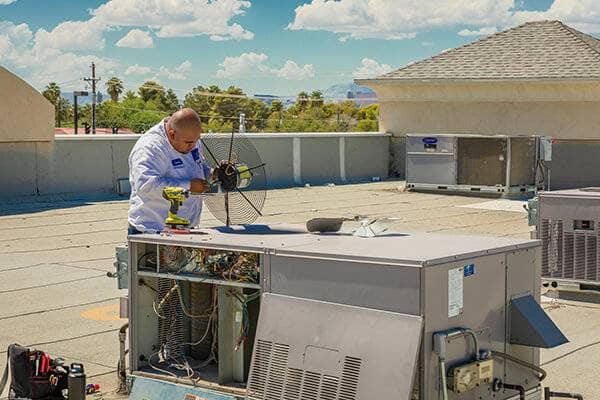
Short answer: Restaurant HVAC in Las Vegas is fundamentally more demanding than any other commercial application. You are balancing 30,000 to 150,000+ BTU per hour of kitchen heat load against a dining room that must stay comfortable at 72 degrees F while outdoor temperatures push 115 degrees F. Add Southern Nevada Health District makeup air requirements, exhaust hood balancing, and grease infiltration that degrades equipment in months instead of years, and you have a system design problem that demands commercial HVAC specialists with food service experience. Restaurant HVAC systems cost $15,000 to $80,000 or more depending on size and configuration. When a restaurant closes because the AC failed, every hour without service costs real revenue. Call The Cooling Company at (702) 567-0707 for commercial restaurant HVAC service, design, and maintenance throughout Las Vegas.
Key Takeaways
- Kitchen heat loads are massive. Commercial cooking equipment generates 30,000 to 150,000+ BTU per hour of additional heat that must be removed before your HVAC system even begins cooling the space. Standard residential or light commercial sizing methods fail catastrophically in restaurant environments.
- Makeup air is a legal requirement. The Southern Nevada Health District and Nevada mechanical codes require that exhaust air removed by kitchen hoods be replaced with conditioned makeup air. Failing to comply creates negative pressure, carbon monoxide risks, and health code violations.
- Restaurants need tighter tonnage ratios. While residential construction uses 500-700 square feet per ton, restaurant dining areas require 400-600 square feet per ton and kitchen areas may need supplemental cooling independent of the main system.
- Grease destroys HVAC equipment. Grease-laden vapor from cooking infiltrates condenser coils, air filters, and ductwork at rates that demand monthly maintenance instead of the quarterly schedule typical for office buildings.
- Emergency response time defines your vendor relationship. A restaurant with a failed HVAC system on a Friday night in July loses $5,000 to $20,000 in revenue per day depending on size and concept. Your HVAC contractor must offer guaranteed emergency response, not standard business hours.
- Planned maintenance contracts pay for themselves. Restaurants on preventive maintenance agreements average 40-60% fewer emergency service calls than those on reactive-only programs. The savings in emergency rates and avoided closures typically cover the contract cost two to three times over.
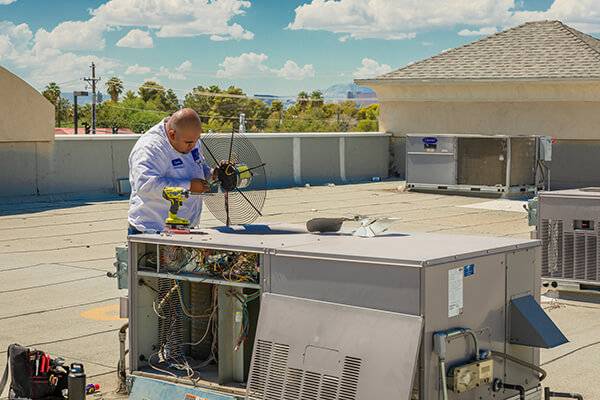
Why Restaurant HVAC Is a Different Problem Than Any Other Building
Most commercial HVAC guides treat restaurants as a variation of office buildings. They are not. A restaurant is among the most thermally demanding environments in commercial construction, combining three simultaneous heat generation sources that office buildings never face: cooking equipment, occupancy density, and outdoor kitchen heat transfer.
A 3,000-square-foot full-service restaurant might have 80 guests at peak seating, a kitchen running six burners, two convection ovens, a fryer, and a commercial broiler, all while outdoor temperatures sit at 112 degrees F. Each person generates roughly 400 BTU per hour of sensible heat. The cooking equipment contributes another 60,000 to 90,000 BTU per hour. The kitchen walls and ceiling absorb and radiate heat continuously. Your HVAC system must remove all of it while maintaining 72-74 degrees F in the dining room.
This is before we account for Las Vegas-specific factors. The desert climate compresses the cooling season to nearly year-round, reduces nighttime recovery temperatures, and means your rooftop units are working in ambient conditions that would stress any commercial equipment. When those units also sit above a kitchen exhaust hood and pull in grease-laden air from nearby intakes, the degradation timeline accelerates significantly.
Getting restaurant HVAC right requires understanding heat load calculations, exhaust and makeup air systems, hood balancing, front-of-house versus back-of-house zoning, equipment selection, and the maintenance discipline that keeps it all functioning. The sections below cover each component in the depth that restaurant operators and facilities managers need.
Kitchen Heat Load Calculations: The Foundation of Restaurant HVAC Design
Every restaurant HVAC design begins with a heat load calculation that accounts for the cooking equipment. This calculation is performed differently from a standard heat pump or residential load calculation and requires ASHRAE 2019 Handbook data for food service equipment sensible and latent heat contributions.
Heat Output by Equipment Type
The following table shows sensible heat output ranges for common commercial kitchen equipment based on ASHRAE standard data. These figures assume equipment is operating under a properly functioning exhaust hood, which captures a portion of the heat before it enters the room. Without an effective hood, the room heat gain is significantly higher.
| Equipment Type | Energy Input | Sensible Heat to Room (Hooded) | Sensible Heat to Room (Unhooded) |
|---|---|---|---|
| 6-Burner Range | 60,000 BTU/hr | 8,000-12,000 BTU/hr | 36,000-45,000 BTU/hr |
| Commercial Fryer (single) | 90,000 BTU/hr | 12,000-18,000 BTU/hr | 54,000-72,000 BTU/hr |
| Convection Oven (full size) | 44,000 BTU/hr | 6,000-9,000 BTU/hr | 26,000-35,000 BTU/hr |
| Charbroiler (36-inch) | 90,000 BTU/hr | 18,000-30,000 BTU/hr | 60,000-80,000 BTU/hr |
| Commercial Steamer | 22,000 BTU/hr | 4,000-7,000 BTU/hr | 18,000-22,000 BTU/hr |
| Warming Drawers (4-unit) | 8,000 BTU/hr | 5,000-8,000 BTU/hr | 8,000 BTU/hr |
| Dishwasher (high temp) | 30,000 BTU/hr | 10,000-15,000 BTU/hr | 25,000-30,000 BTU/hr |
A typical fast-casual kitchen running a range, two fryers, and two convection ovens generates 50,000 to 80,000 BTU per hour of room-side heat load even with properly functioning exhaust hoods. A full-service restaurant kitchen running a full battery of equipment can push 100,000 to 150,000 BTU per hour. These figures dwarf the heat load from occupancy, lighting, and solar gain that would otherwise drive the HVAC calculation in an office or retail environment.
Tonnage Requirements by Restaurant Type
The rule of thumb used in residential construction — one ton of cooling capacity per 500-700 square feet — is not appropriate for food service. Restaurant HVAC sizing must account for the cooking heat load as a separate calculation from the building envelope calculation, then combine both to determine total system capacity.
| Restaurant Type | Typical Size | Dining Area Ratio | Kitchen Supplement | Total System Capacity |
|---|---|---|---|---|
| Fast-Casual (limited kitchen) | 1,500-3,000 sq ft | 450 sq ft/ton | 2-4 tons additional | 7-12 tons typical |
| Full-Service Dining | 3,000-6,000 sq ft | 400 sq ft/ton | 4-8 tons additional | 15-28 tons typical |
| High-Volume/Large Venue | 6,000+ sq ft | 350-400 sq ft/ton | 8-15 tons additional | 30-60+ tons typical |
These figures use Las Vegas outdoor design conditions of 115 degrees F dry bulb and incorporate the additional heat load from cooking equipment. They are starting points for a proper ASHRAE load calculation, not substitutes for one.
Makeup Air: The Southern Nevada Health District Requirement Most Restaurants Ignore
Exhaust hoods above commercial cooking equipment remove heat, smoke, grease vapor, and combustion byproducts. A Type I hood over a charbroiler might exhaust 3,000 to 5,000 cubic feet per minute of air continuously during service. A full restaurant kitchen might exhaust 8,000 to 15,000 CFM total.
That air has to come from somewhere. If a makeup air system does not supply it, the building goes negative relative to outdoors. Negative pressure in a restaurant causes:
- Backdrafting on gas appliances, which can pull combustion exhaust back into the kitchen — a carbon monoxide risk
- Doors that are difficult to open against the negative pressure gradient
- Accelerated infiltration of hot outdoor air through every gap in the building envelope
- Reduced exhaust hood capture velocity, meaning cooking byproducts spill into the kitchen rather than being captured
- Health code violations if inspectors identify inadequate ventilation
The Southern Nevada Health District (SNHD) requires food establishment permit holders to maintain adequate ventilation per Nevada Mechanical Code Chapter 5 and SNHD food establishment regulations. This explicitly includes makeup air requirements for kitchens with commercial cooking equipment. Inspectors check ventilation system documentation and can require corrections as a condition of permit renewal.
Makeup air systems for restaurants are not simply supply air grilles. Proper commercial kitchen makeup air requires:
- Tempered makeup air — Outdoor air at 115 degrees F cannot be introduced directly without conditioning. Makeup air units (MAUs) heat or cool incoming air to a discharge temperature that avoids disrupting hood capture velocity, typically 65-75 degrees F for summer supply.
- Correct discharge positioning — Makeup air is typically introduced at the face of the hood or short-circuit directly into the hood plenum (short circuit makeup), or distributed through ceiling diffusers positioned to avoid creating cross-drafts at the hood face.
- Exhaust-to-makeup air balance — Code requires that makeup air quantity be within 10-15% of exhaust volume. Under-supply creates negative pressure; over-supply creates positive pressure that pressurizes the kitchen and pushes grease-laden air into the dining area.
Many Las Vegas restaurants operate with undersized or incorrectly designed makeup air systems because the original installation was not designed by a mechanical engineer familiar with food service requirements. If your kitchen staff complains of excessive heat, your dining room gets hazy during service, or your health inspector has cited ventilation issues, your makeup air system is likely the root cause.
Exhaust Hood Balancing and Grease Management
Commercial kitchen exhaust hoods are graded in two categories under NFPA 96 (Standard for Ventilation Control and Fire Protection of Commercial Cooking Operations):
- Type I hoods — Required over equipment that produces grease-laden vapors: fryers, ranges, broilers, griddles, and woks. Type I hoods include grease filters and must be connected to grease ducts that discharge directly to outdoor air.
- Type II hoods — Used over equipment producing heat and moisture but not grease: ovens, steamers, dishwashers. Type II hoods can use standard ductwork.
Hood balancing refers to achieving the correct capture velocity across the face of the hood to capture all cooking byproducts without excessive airflow that wastes conditioned air. Under-balanced hoods allow smoke and grease vapor to escape into the kitchen and HVAC system. Over-balanced hoods remove more conditioned air than necessary, increasing energy costs and placing additional load on the makeup air system.
Grease accumulation in the exhaust duct is a fire hazard and a maintenance reality. NFPA 96 requires grease duct cleaning at intervals based on cooking volume:
- High-volume cooking (solid fuels, char broiling): Monthly
- Moderate-volume cooking (woks, griddles): Quarterly
- Low-volume cooking (churches, day care): Semi-annually to annually
For most Las Vegas restaurants, monthly or quarterly cleaning is the appropriate interval. Grease that accumulates in ducts eventually migrates into the HVAC equipment itself, coating evaporator coils, clogging air filters, and reducing airflow through the system. A restaurant that skips grease management will spend two to three times as much on HVAC repairs as one that maintains it properly.
Front-of-House vs Back-of-House Zoning
One of the most common HVAC mistakes in restaurant design is treating the dining room and kitchen as a single zone controlled by a single thermostat. They are fundamentally incompatible environments:
| Factor | Dining Room (Front of House) | Kitchen (Back of House) |
|---|---|---|
| Target Temperature | 70-74 degrees F | 80-85 degrees F (industry standard) |
| Heat Load Character | Occupancy, solar gain, lighting | Equipment, exhaust hood draft, outdoor air |
| Humidity Target | 45-55% RH (guest comfort) | Higher RH acceptable (cooking generates moisture) |
| Air Pressure Relationship | Slight positive vs kitchen | Slight negative vs dining room |
| Airflow Pattern | Even distribution, no drafts at tables | Directional toward hoods |
| Filter Requirements | MERV 8-11 standard | Pre-filters for grease protection |
A proper restaurant HVAC design maintains the dining room at positive pressure relative to the kitchen so that kitchen odors and grease vapor do not migrate into the guest area. This requires separate zone controls, separate supply and return air systems in most cases, and a mechanical design that coordinates the two environments.
Zoning systems for restaurants typically use either VAV (variable air volume) boxes that modulate airflow to each zone independently, or dedicated HVAC units for each area. The dining room system handles occupancy comfort. A dedicated kitchen makeup air unit handles the kitchen heat load and exhaust balance. Bar areas and restrooms may require their own small zones to handle concentrated heat loads and odor control.
Equipment Selection: RTU vs Split Systems for Restaurants
Las Vegas restaurants most commonly use rooftop units (RTUs) for their primary cooling, and for good reason. RTUs consolidate all mechanical equipment on the roof, away from the dining room and kitchen where noise and space are at a premium. They are easily accessible for maintenance and replacement, and the commercial RTU market offers units sized specifically for high-heat commercial applications.
Rooftop Units (RTUs)
Commercial RTUs for restaurants typically range from 5 to 25 tons per unit, with multiple units installed to meet total load requirements. Key specifications for Las Vegas restaurant applications include:
- High-ambient rating — Standard commercial RTUs are rated to 105-110 degrees F outdoor ambient. Las Vegas summer temperatures regularly exceed this. Specify units with high-ambient ratings to 115-125 degrees F or install condenser coil protection systems.
- Economizer function — RTUs with air-side economizers can use outdoor air for free cooling during mild conditions (Las Vegas spring and fall evenings), reducing compressor runtime and energy cost.
- Demand-controlled ventilation — RTUs with CO2-based demand-controlled ventilation reduce outdoor air intake (and associated cooling load) during off-peak hours, cutting energy costs without sacrificing air quality.
- Variable-speed supply fan — A variable-speed motor on the supply fan allows airflow modulation to match actual load rather than running at full speed constantly, improving comfort and efficiency.
VRF/VRV Systems for Restaurants
Variable refrigerant flow (VRF) systems have gained traction in restaurant applications, particularly for smaller spaces and restaurants in multi-tenant buildings where rooftop access is limited. VRF systems offer several advantages:
- Individual zone temperature control without VAV boxes or complex ductwork
- Heat recovery capability — waste heat from the kitchen can be redirected to warm office or storage areas during winter
- Compact indoor units that do not require ceiling plenum space
- High efficiency at partial load, which matches restaurant operating patterns (lunch service, dinner service, off-hours)
VRF systems have limitations in restaurant applications: they are not well-suited for spaces requiring large amounts of outdoor air (which most commercial kitchens do), and the refrigerant piping must be routed away from cooking areas due to refrigerant release risks in enclosed spaces per ASHRAE 15. A hybrid approach — VRF for dining room and bar zones, dedicated makeup air and exhaust systems for the kitchen — is increasingly common in Las Vegas restaurant projects we handle at The Cooling Company.
Split Systems
Traditional split systems (separate indoor air handler and outdoor condenser) are appropriate for smaller restaurants and fast-casual concepts where a single unit in the 5-10 ton range covers the entire space. Their limitations include noise from the air handler, space requirements for the indoor unit, and the need for separate makeup air equipment rather than the integrated approach available with commercial RTUs.
Restaurant HVAC Costs: What to Budget in Las Vegas
Restaurant HVAC costs in Las Vegas are higher than the national average due to the extreme climate, high-ambient equipment requirements, and local labor costs. The following ranges reflect installed costs including equipment, labor, startup, and commissioning.
New Installation Costs by Restaurant Size
| Restaurant Type | Size | HVAC System Capacity | Installed Cost Range | Makeup Air Unit | Total Mechanical Budget |
|---|---|---|---|---|---|
| Fast-Casual (limited kitchen) | 1,500-3,000 sq ft | 7-12 tons RTU | $15,000-$35,000 | $6,000-$12,000 | $21,000-$47,000 |
| Full-Service Dining | 3,000-6,000 sq ft | 15-28 tons (multiple units) | $35,000-$70,000 | $10,000-$20,000 | $45,000-$90,000 |
| Large Venue / Steakhouse | 6,000+ sq ft | 30-60+ tons (multiple units) | $65,000-$150,000+ | $15,000-$35,000 | $80,000-$185,000+ |
These ranges assume standard construction. Tenant improvement projects in existing shells may cost 15-25% more due to existing infrastructure conflicts. Restaurants in historic buildings or with unusual roof configurations add further complexity.
Replacement and Retrofit Costs
For existing restaurants replacing aging HVAC equipment:
- Single RTU replacement (10-15 ton) — $12,000-$22,000 installed, including crane service if required
- Full system replacement (multiple RTUs) — $35,000-$80,000+ depending on scope
- Makeup air unit replacement — $8,000-$18,000 installed
- Ductwork rehabilitation or replacement — $8,000-$25,000 depending on condition and access
- Zoning system addition — $5,000-$15,000 for VAV conversion or zone damper installation
Maintenance Contract Costs
Commercial restaurant maintenance agreements from The Cooling Company typically run $2,400-$6,000 per year depending on system size and visit frequency. This covers:
- Monthly filter changes and coil inspections (during peak season)
- Quarterly full system inspections
- Semi-annual coil cleaning
- Priority emergency response with guaranteed 2-4 hour response time
- Discounted parts and labor on covered repairs
The maintenance contract is not optional for a restaurant. It is risk management. Our commercial clients on maintenance agreements average fewer than one unplanned service call per year. Restaurants without contracts average three to five emergency calls per year at emergency rates of $150-$250 per hour, often during weekend dinner service.
Maintenance Frequency for Commercial Kitchen Environments
Standard commercial HVAC maintenance intervals — quarterly inspections, semi-annual coil cleanings, annual system tune-ups — are designed for office buildings and retail environments. Restaurants require significantly more frequent attention due to grease infiltration, high runtime hours, and the revenue consequences of unexpected failure.
Recommended Maintenance Schedule for Las Vegas Restaurants
| Task | Frequency | Notes |
|---|---|---|
| Air filter replacement (HVAC units) | Monthly | Desert dust and grease vapor clog filters 3-4x faster than office environments |
| Grease filter cleaning (hood) | Weekly to bi-weekly | Per NFPA 96 and SNHD requirements |
| Condenser coil inspection and cleaning | Monthly (summer), quarterly (winter) | Grease-contaminated coils lose 20-30% capacity; desert dust compounds the problem |
| Evaporator coil inspection | Monthly | Check for grease infiltration past filters |
| Exhaust duct cleaning | Monthly to quarterly per NFPA 96 | Based on cooking volume and fuel type |
| Refrigerant charge verification | Semi-annually | High ambient temps mask refrigerant loss symptoms |
| Makeup air unit inspection | Quarterly | Check filter, dampers, heating and cooling function |
| Thermostat and control calibration | Semi-annually | Control accuracy drifts in high-heat environments |
| Belt and bearing inspection | Quarterly | High runtime hours accelerate wear |
| Full system commissioning check | Annually (pre-summer) | Verify all system parameters before peak season |
Grease and Smoke Impact on HVAC Equipment
Grease-laden air is the defining challenge of restaurant HVAC maintenance. Grease vapor follows the path of airflow throughout the building. When exhaust hoods are undersized, improperly balanced, or temporarily overloaded, grease-laden air enters the general building space and is drawn through the HVAC return system.
The consequences accumulate over time:
- Evaporator coils — Grease coats the coil surface and fins, reducing heat transfer efficiency and restricting airflow. A moderately grease-fouled evaporator coil can lose 15-25% of its rated capacity. Severely fouled coils require professional chemical cleaning.
- Air filters — Grease-saturated filters become fire hazards in addition to airflow restrictions. Monthly replacement is mandatory, not optional.
- Ductwork — Ductwork running through kitchen areas accumulates grease on interior surfaces. This is both a fire hazard and a contamination risk if the same ductwork serves dining areas.
- Outdoor condenser units — Grease vapor can migrate to the rooftop and deposit on condenser coils even in exhaust-directed systems, particularly if roof drainage patterns bring grease-laden water toward equipment.
- Compressors — Reduced airflow from dirty coils causes high head pressure, which stresses compressors and accelerates failure. In Las Vegas where ambient temperatures already push compressors hard, grease-induced airflow restriction is a leading cause of premature compressor failure in restaurant applications.
Restaurants that maintain proper hood balance and regular coil cleaning see HVAC equipment lasting 10-15 years. Restaurants that neglect these practices often replace compressors and coils every 5-7 years at costs of $3,000-$8,000 per incident.
Energy Management Strategies for Restaurant HVAC
Restaurant HVAC is the single largest energy consumer in most food service operations, accounting for 30-40% of total utility spend. Las Vegas electricity costs averaging $0.09-$0.12 per kWh for commercial accounts, combined with demand charges, make energy management a meaningful financial priority.
Demand-Controlled Ventilation (DCV)
DCV systems use CO2 sensors to modulate outdoor air intake based on actual occupancy rather than running at designed maximum airflow continuously. A restaurant with CO2-based DCV can reduce outdoor air-related cooling load by 20-40% during off-peak hours (breakfast service, early lunch, late dinner). DCV adds $2,000-$5,000 to a new installation and typically pays back within 2-3 years in Las Vegas's climate.
Smart Scheduling and Pre-Cooling
Restaurant HVAC should be scheduled to pre-cool the building before opening rather than running at maximum capacity once guests arrive. A restaurant that pre-cools from 10 AM to 11 AM before a 11:30 opening uses off-peak electricity to store cooling in the building mass, reducing the peak demand spike that drives commercial electricity demand charges. This strategy alone can reduce monthly demand charges by $200-$500 for a mid-size restaurant.
Night Setback and Unoccupied Modes
Restaurant HVAC controls should include unoccupied setback modes that allow temperatures to rise to 85-90 degrees F when the building is closed overnight, while maintaining any walk-in refrigeration exhaust heat as needed. Proper unoccupied setbacks save 15-25% on annual HVAC energy costs with zero capital investment beyond thermostat programming.
RTU Economizer Use
Las Vegas has more economizer-eligible hours than most desert cities because of cool fall, winter, and spring nights. RTUs with air-side economizers can use outdoor air for free cooling when outdoor temperatures drop below approximately 55 degrees F. In a restaurant operating year-round, economizer hours may represent 1,500-2,000 hours annually — enough to justify the $1,500-$3,000 economizer option on RTU replacement projects.
Health Code Compliance and HVAC Documentation
The Southern Nevada Health District conducts food establishment inspections that include ventilation system review. Inspectors look for:
- Adequate exhaust ventilation in kitchen areas (Type I hoods over cooking equipment)
- Evidence of functioning makeup air (no negative pressure symptoms)
- Grease filter maintenance documentation
- Exhaust duct cleaning records per NFPA 96
- Adequate ventilation in restrooms (minimum air changes per hour)
- Temperature maintenance in dining areas (Nevada food code specifies guest comfort requirements)
SNHD can issue corrective action orders requiring HVAC improvements as a condition of continued operation. Serious violations can result in temporary closure. Maintaining documentation of HVAC inspections, filter changes, and hood cleaning provides evidence of due diligence that typically satisfies inspector concerns.
For detailed requirements, the SNHD Food Safety Program publishes inspection guidelines and food establishment requirements online.
Emergency Repair Priority for Restaurants
A restaurant with a failed cooling system in Las Vegas in July faces an immediate decision tree: find a solution within hours or close for the day. A lunch and dinner closure at a 100-seat full-service restaurant represents $8,000-$20,000 in lost revenue. Weekend closures during tourist season can exceed these figures significantly for strip-adjacent and Henderson dining concepts.
Emergency response for restaurant HVAC requires:
- 24-hour availability — HVAC failures don't schedule themselves around business hours. Your contractor must answer calls at 2 AM before a Saturday breakfast service.
- Commercial equipment expertise — A technician familiar only with residential splits cannot effectively diagnose a 20-ton commercial RTU with VFD controls and economizer dampers.
- Parts inventory — Common commercial failure components — capacitors, contactors, fan motors, TXVs — should be in the truck. Every additional trip to a supply house adds hours to your closure.
- Prioritized dispatch for contract customers — Maintenance agreement customers receive priority dispatch over non-contract customers. This matters when demand for emergency service spikes during heatwaves.
The Cooling Company maintains a commercial emergency response program for Las Vegas restaurant clients. Call (702) 567-0707 for 24-hour commercial service.
Planned Maintenance Contracts for Restaurant HVAC
The financial case for preventive maintenance contracts in restaurant HVAC is strong enough that we treat it as essential advice rather than an optional upsell. Consider the numbers for a mid-size 4,000-square-foot full-service restaurant with 20 tons of HVAC capacity:
| Scenario | Annual HVAC Cost | Emergency Calls | Equipment Life |
|---|---|---|---|
| Reactive only (no contract) | $6,000-$12,000 | 3-5 per year average | 7-10 years |
| Preventive maintenance contract | $3,500-$5,500 (contract + minor repairs) | 0-1 per year average | 12-15 years |
| Lifetime difference (15 years) | $37,500-$97,500 savings | 30-75 fewer calls | 1 additional replacement cycle |
These figures do not include avoided revenue losses from closures, which can double or triple the economic advantage of preventive maintenance. Our commercial restaurant clients on maintenance agreements report higher staff satisfaction (kitchens that are properly cooled retain cooks), fewer health code concerns related to ventilation, and significantly reduced facility management stress.
Indoor Air Quality in Restaurant Environments
Restaurant indoor air quality is a separate concern from comfort cooling. Cooking processes generate combustion byproducts (from gas ranges), particulate matter from frying and grilling, CO2 from high occupancy, and odors that guest experience demands be managed. Beyond exhaust hoods, restaurant IAQ benefits from:
- Enhanced filtration — MERV 11-13 filters in the dining room supply system capture smoke particles and particulate matter that escape kitchen hoods. See our Las Vegas Indoor Air Quality Guide for filter selection guidance.
- UV-C germicidal lights in the air handler — UV-C systems installed in AHU plenums reduce bacterial and mold growth on coil surfaces, which is particularly relevant in grease-prone kitchen environments. More on this in our IAQ guide.
- Proper exhaust for restrooms — Nevada mechanical code requires continuous or occupancy-controlled exhaust in restrooms. Inadequate restroom exhaust is a common health code finding in restaurant inspections.
- Bar area ventilation — Bars with significant occupancy and alcohol vapor require proper exhaust and supply to maintain comfort and meet code requirements.
Learn more about Las Vegas-specific air quality challenges at our Indoor Air Quality: Dust, Allergies, and What Actually Works guide, and our dedicated indoor air quality and air filtration service pages.
Selecting and Working With a Commercial Restaurant HVAC Contractor
Not every HVAC contractor in Las Vegas has the expertise to properly design, install, or maintain restaurant mechanical systems. Residential-focused contractors can replace a residential split system competently but may lack the engineering background to size a makeup air unit, balance a Type I hood, or commission a demand-controlled ventilation system across multiple rooftop units. Selecting the right contractor avoids expensive misdesigns that require correction later.
What to Look for in a Restaurant HVAC Contractor
- Commercial mechanical license — Nevada requires a C-21 (air conditioning and refrigeration) contractor's license for commercial HVAC work. Verify the license number at the Nevada State Contractors Board. Unlicensed work on commercial mechanical systems is a code violation and creates liability for the restaurant operator.
- Food service experience — Ask specifically about completed restaurant projects. Request references from similar restaurant types (fast-casual, full-service, high-volume). A contractor with 20 residential replacements per month may have limited experience with commercial kitchen makeup air systems.
- Mechanical engineering capability — Proper restaurant HVAC design requires ASHRAE load calculations, not rule-of-thumb sizing. Contractors that provide a formal load calculation — not just square footage estimates — are more likely to design a system that performs correctly at peak summer demand.
- Commercial RTU manufacturer relationships — The commercial RTU market (Trane, Carrier, Lennox Commercial, York, Daikin Applied) operates through separate commercial distributor channels from residential equipment. A contractor with established commercial distributor relationships has better access to the right equipment, lead times, and warranty support.
- 24/7 emergency response capability — Verify this before you need it. Ask how emergency calls are dispatched, what the guaranteed response time is, and whether the on-call technicians have commercial RTU experience. A contractor whose emergency response is a residential technician with basic training is not adequate for a restaurant client.
- NATE certification — North American Technician Excellence (NATE) certification, particularly the commercial refrigeration and commercial HVAC specialty tracks, indicates technicians have demonstrated competency beyond basic licensing requirements.
The New Restaurant Buildout HVAC Process
For new restaurant construction or major tenant improvement buildouts, the HVAC process involves multiple phases that should be coordinated with the general contractor and the local building department:
- Design phase — Mechanical engineer or contractor performs ASHRAE load calculations based on building envelope, occupancy, and cooking equipment list. Equipment schedule is established and submitted with permit drawings. In Clark County, commercial HVAC installations require permitted drawings reviewed by Clark County Building Department.
- Permit application — Commercial mechanical permits are required for new HVAC installation and major modifications. The permit drawings must include equipment specifications, duct layout, makeup air design, and exhaust system configuration. SNHD may require separate review of the ventilation system as part of the food establishment permit process.
- Equipment procurement — Commercial RTU lead times have been 8-16 weeks for major brands in 2024-2026 due to supply chain conditions. Start the equipment order at design completion, not after permit issuance, to avoid construction delays.
- Rough-in installation — Ductwork, electrical, refrigerant line sets, and structural roof supports are installed during the rough-in phase before ceiling and roof finishes are in place. Coordination with the general contractor's schedule is essential — missed coordination often results in expensive rework when ductwork conflicts with structural members or plumbing.
- Equipment startup — Once equipment is set and connected, factory startup procedures must be followed for warranty validation. For Lennox Commercial, Trane, and Carrier equipment, startup documentation is required within 30 days of installation to activate the full manufacturer warranty.
- Test and balance (TAB) — A third-party TAB contractor verifies that supply and return airflows match design specifications, hood exhaust and makeup air are balanced, and building pressure relationships are correct. TAB is required by Nevada mechanical code for commercial projects and is essential for verifying that the SNHD ventilation requirements are met.
- SNHD inspection — The Southern Nevada Health District conducts pre-opening inspections of food establishments that include ventilation system review. Having your TAB report available at the SNHD inspection demonstrates compliance documentation that inspectors typically require.
Seasonal HVAC Considerations for Las Vegas Restaurants
Las Vegas restaurant HVAC operates under dramatically different demands across the year. Understanding the seasonal pattern allows operators to plan maintenance, pre-season preparation, and capacity management strategically.
Summer (May through September)
Peak demand season. Outdoor temperatures regularly exceed 110 degrees F through most of July, August, and early September, with peak days reaching 115-120 degrees F. This is when your HVAC system is at maximum load for the longest consecutive period of the year. Key considerations:
- Dining room comfort is the most challenging to maintain — every heat load source (cooking, occupancy, solar gain) peaks simultaneously
- Compressor failures are most common during July-August due to sustained high ambient temperature stress
- Monsoon humidity (July-September) adds latent cooling load not present in dry summer conditions — systems sized for desert-dry conditions may struggle to dehumidify during monsoon events
- Monthly coil cleaning is essential — summer operating conditions accumulate grease and desert dust on condenser coils rapidly
- Filter changes should be at least monthly; some high-volume kitchens require bi-monthly changes during peak summer
Fall and Spring (October-November and March-April)
Moderate demand seasons ideal for planned maintenance and replacement. Outdoor temperatures in the 65-90 degree F range allow economizer use during early morning hours. Contractor availability is higher than summer and lead times for parts are shorter. This is the optimal window for:
- Pre-season maintenance tune-ups (pre-summer in March-April)
- Major equipment replacement projects (better weather for rooftop work, better contractor availability)
- Ductwork rehabilitation or inspection (easier access in moderate temperatures)
- Test and balance commissioning for new installations
Winter (December through February)
Las Vegas winters are mild — typical lows of 35-45 degrees F with occasional freezes. Restaurant HVAC transitions to heating mode during early morning and overnight hours. Key winter considerations:
- Gas-fired makeup air units need heating coil inspection before cold weather arrives — a failed heating coil in a makeup air unit means either closing the kitchen or operating with cold unconditioned air entering the space
- Economizer function is most valuable in winter — outdoor temperatures frequently allow full free cooling during evening and early morning hours, reducing compressor runtime and energy cost
- Kitchen heat loads remain high year-round — kitchen HVAC still removes significant heat even in winter, and the temperature differential between kitchen cooking area and outdoor conditions is reduced, sometimes making winter the easiest season for kitchen cooling
- Condensate drain lines are less likely to experience biological growth (algae) in winter, but freeze risk in extreme cold events (rare in Las Vegas, but possible) should be considered for exposed drain lines
Monitoring and Building Automation for Restaurant HVAC
Modern commercial HVAC equipment and building automation systems (BAS) offer restaurant operators visibility into their mechanical systems that was not available a decade ago. For restaurants with multiple rooftop units and complex zone control, a BAS investment pays for itself through energy savings, reduced emergency calls, and operational awareness.
What Building Automation Provides for Restaurants
- Real-time fault detection — Modern RTUs with BAS integration send fault codes and alarm conditions to a central monitoring dashboard and optionally to your phone. A compressor lockout at 6 PM Friday triggers an immediate alert that allows emergency dispatch before the dinner rush is impacted.
- Runtime and efficiency monitoring — BAS data logs show how hard each unit is working and whether efficiency is degrading over time. A unit that historically cooled the dining room with 8 hours of runtime that now requires 11 hours at the same setpoint has a developing problem — visible through BAS data before it becomes a failure.
- Demand management — BAS systems can shed HVAC load during demand charge peaks by temporarily raising setpoints by 2-3 degrees F, saving on commercial electricity demand charges without significantly impacting guest comfort for brief periods.
- Centralized scheduling — Pre-cool and unoccupied setback schedules managed centrally rather than programmed at each thermostat individually — eliminates the risk of staff changing thermostat settings and leaving them in wrong modes.
- Energy benchmarking — Track HVAC energy use per square foot per degree-day, which allows meaningful comparison between locations in a multi-unit restaurant group and identification of underperforming sites.
Entry-level BAS integration for a 3-unit restaurant (three RTUs plus makeup air) typically costs $5,000-$12,000 installed and produces energy savings of 8-15% on HVAC energy, typically paying back within 3-5 years in a Las Vegas climate with its high cooling energy intensity. Enterprise-grade systems for larger venues or restaurant groups cost more but scale proportionally.
Commercial HVAC for Las Vegas Restaurant Types: Specific Considerations
Fast-Casual Restaurants (1,500-3,000 sq ft)
The fast-casual segment — counter service with limited table dining, typical kitchen footprint of 400-600 square feet — dominates Las Vegas's non-casino food service growth. HVAC design for fast-casual restaurants has some distinct characteristics:
- Kitchen equipment lists are typically smaller (fewer burners, possibly no char broiler) than full-service restaurants, but fryers and flat-tops still generate significant heat
- High customer turnover means the dining room experiences more door opening events per hour, increasing infiltration load — specify commercial-grade entrance air curtains if possible
- Smaller footprints often use a single large RTU rather than multiple units, simplifying control but eliminating redundancy — if the single unit fails, the restaurant closes
- Outdoor dining areas common in Las Vegas shopping center fast-casual locations require consideration for adjacent HVAC exhaust and makeup air locations to avoid directing conditioned air into the outdoor space (wasted energy) or hot exhaust toward the outdoor dining area
- Energy management is proportionally more impactful for smaller concepts where HVAC represents a higher percentage of total operating cost
Full-Service Dining Restaurants (3,000-6,000 sq ft)
Full-service restaurants introduce the bar zone as a third distinct area with its own HVAC considerations. Bar areas require:
- Slightly cooler temperatures than the dining room — bar patrons are typically stationary but consuming alcohol, which affects perceived comfort
- Higher air change rates to dilute alcohol vapor and breath exhaled by higher-density seating
- Sound attenuation considerations — ductwork routing near bar areas should avoid creating noise paths from kitchen or mechanical equipment to the bar zone
- Separate zone control from the dining room to maintain independent temperature management
Full-service restaurants also typically have private dining rooms or event spaces that require independently controlled zones — a private dining room hosting a rehearsal dinner at full occupancy has dramatically different loads than the same room empty between reservations. Zoning systems with occupancy-based control are appropriate investments for multi-zone full-service restaurants. Our zoning systems service page covers the technology options for restaurant applications.
High-Volume and Large Venue Restaurants (6,000+ sq ft)
Large-format venues — steakhouses, seafood houses, entertainment dining concepts — have the most complex HVAC requirements and the highest stakes when systems fail. Specific considerations for large format include:
- Redundancy planning — A 60-ton system serving a 6,000-square-foot steakhouse should be configured as 3x20-ton units rather than 1x60-ton unit. If the single 60-ton unit fails, the restaurant closes. If one 20-ton unit fails, the remaining 40 tons can maintain partial operation while the third is repaired.
- Multiple kitchen zones — Large venue restaurants often have separate hot stations, cold prep, pastry, and dish areas, each with independent ventilation requirements. The mechanical design must coordinate all these zones.
- Grease duct routing complexity — Multiple exhaust hoods serving a large kitchen may have long duct runs that traverse much of the building before exiting to the roof. Longer runs require more frequent cleaning and careful design to maintain the required upward pitch for grease drainage.
- Event capacity fluctuations — A venue that operates at 120 capacity for normal dinner service but holds buyout events at 200+ capacity needs HVAC capacity adequate for the peak event load, not just the typical service load. This is often overlooked in initial design and becomes a complaint generator during large events.
Frequently Asked Questions: Restaurant HVAC Las Vegas
How often should a restaurant's HVAC system be serviced in Las Vegas?
Monthly service visits are the minimum appropriate interval for most Las Vegas restaurants. Grease infiltration, desert dust, and year-round high runtime hours create maintenance demands that quarterly schedules cannot address. At a minimum, plan for monthly filter changes and condenser coil inspections, quarterly full system inspections, and semi-annual coil cleaning. High-volume operations with heavy cooking equipment should have monthly coil inspections and quarterly coil cleaning.
What is makeup air and is it legally required for my restaurant?
Makeup air is conditioned outdoor air supplied to replace the air exhausted by your kitchen hood system. It is required by Nevada Mechanical Code and Southern Nevada Health District regulations for any restaurant with commercial cooking equipment under a Type I exhaust hood. The quantity of makeup air must be within 10-15% of the exhaust volume. Operating without adequate makeup air creates negative building pressure, carbon monoxide backdraft risk, and health code violations. If your restaurant has no dedicated makeup air unit, it is likely out of compliance.
Should my restaurant use a rooftop unit or a split system?
For most Las Vegas restaurants larger than 2,000 square feet, commercial rooftop units are the preferred choice. They consolidate mechanical equipment away from the dining room, are available in sizes appropriate for restaurant loads, can integrate makeup air and economizer functions, and are easier to service without disrupting restaurant operations. Split systems are appropriate for very small fast-casual concepts or kiosk-style operations where a single 3-5 ton unit covers the entire space. VRF systems are increasingly viable for dining room zones but are not well-suited for the high outdoor air requirements of commercial kitchens.
How much does restaurant HVAC cost compared to office building HVAC?
Restaurant HVAC costs 25-50% more per square foot than comparable office building HVAC because of the higher system capacity requirements, the addition of makeup air equipment, the need for grease-rated components, and the additional complexity of hood balancing and zone separation. A 3,000-square-foot office building might cost $40,000-$60,000 to fully HVAC. A 3,000-square-foot restaurant with a proper kitchen and makeup air system would cost $55,000-$90,000. The higher initial cost is offset by the revenue consequences of failure: a restaurant with inadequate HVAC can close entirely, while an office building with inadequate HVAC creates discomfort but not necessarily a business stoppage.
What causes HVAC to fail faster in restaurant kitchens than in other buildings?
Four factors accelerate HVAC degradation in restaurant environments: (1) Grease-laden air coats coil surfaces, filters, and ductwork, reducing heat transfer efficiency and causing compressor overload from restricted airflow. (2) High runtime hours — a restaurant HVAC system may run 14-18 hours per day, compared to 8-10 hours for an office building, doubling wear rates on moving components. (3) Las Vegas extreme heat compounds compressor stress during the already-demanding summer cooling season. (4) Cooking heat spikes during service periods create thermal stress cycles that affect refrigerant pressure balance and control system calibration. Regular maintenance is the primary mitigation strategy for all four factors.
Can I use residential HVAC equipment in my restaurant?
No. Residential HVAC equipment is not designed, warranted, or code-compliant for commercial food service applications. Residential units are sized for 95 degrees F outdoor ambient, not 115 degrees F. They do not have the airflow capacity, operating pressure ratings, or grease-resistant construction required for commercial kitchen environments. Using residential equipment in a restaurant will result in frequent failures, voided warranties, and potential health code violations if inspectors identify non-commercial equipment in a food establishment. Commercial RTUs, commercial split systems, or VRF systems designed for commercial applications are required.
When should a Las Vegas restaurant replace vs repair its HVAC system?
The repair-versus-replace threshold for restaurant HVAC differs from residential guidance because of the revenue implications of reliability. In a residential home, waiting for a system to fail before replacing it is a reasonable financial strategy. In a restaurant, a failed system at dinner service is a revenue emergency. Our guidance for restaurant operators: when any single repair exceeds 25-30% of replacement cost, and the system is more than 8-10 years old, replacement is generally the better business decision. Reliability, not just repair cost, drives the calculus for commercial food service. For detailed general guidance, our Complete Guide to Replacing Your Air Conditioner covers the decision framework in depth, which applies with the restaurant-specific considerations noted above.
Need Restaurant HVAC Service in Las Vegas?
The Cooling Company is a family-owned Lennox Premier Dealer serving Las Vegas since 2011. With 780+ Google reviews and a 4.8/5 rating, our technicians provide transparent, upfront pricing with written quotes and back every installation with a workmanship warranty. Licensed, bonded, and insured (NV #0082413).
Call (702) 567-0707 or visit HVAC services, HVAC maintenance, heating, or AC repair for details.
For commercial food service accounts, visit our dedicated restaurant HVAC service page for information on maintenance agreements, emergency service programs, and new restaurant buildout consultations.